

DEHú notifications in Spain: notices foreigners and companies must monitor
This is why dehu notificaciones should be treated as part of Spanish compliance, not as a casual inbox. For clients with Spanish tax exposure, business activity, residency procedures, vehicles, or active files with the Administration, the question is not only whether a notice exists. It is who is responsible for seeing it, proving when it was accessed, and deciding whether the response is tax, legal, immigration, accounting, or procedural.
If the notice concerns Spanish tax filings, penalties, or a request from the Agencia Tributaria, it should sit inside a broader filing and response strategy. Our Spanish income tax filing service helps clients align the tax position before the notice becomes a sanction problem. Where the notice affects a company, renewal, appeal, or substantial matter, a paid review through our consultation options is often the safer first step.
- DEHú is an official access point for electronic notifications and communications from Spanish public bodies that use the system.
- Under Spanish administrative law, electronic notification is normally effective when the content is accessed; if electronic notification is mandatory or chosen, it can be deemed rejected after 10 calendar days without access.
- Email or SMS alerts are warnings, not the legal act of notification. A missing alert does not normally invalidate a valid notice.
- Companies, entities without legal personality, certain professionals, and representatives of electronically obliged parties must relate electronically with the Administration.
- AEAT, Seguridad Social, DEHú, and, for traffic matters, DEV can all matter. Do not assume one portal covers every risk.
- The deadline to respond depends on the specific notice. The 10-day DEHú access period is not the same as the deadline for appeal, payment, evidence, or correction.
What dehú actually does
DEHú is not a private email inbox and it is not simply an AEAT tool. It is the Dirección Electrónica Habilitada única, the electronic notification service operated by the General Secretariat for Digital Administration and accessible through the State’s General Electronic Access Point (PAGe). The official General Access Point guidance on notifications describes it as a place where citizens and companies can access notifications and communications issued by integrated public administrations.
In practice, DEHú matters because it can be the place where the Administration makes a notice legally available. Spanish Law 39/2015 allows electronic notifications to be made through the relevant electronic office, through DEHú, or through both systems, depending on the administration involved. Royal Decree 203/2021 goes further for state-level issuers: notices from bodies within its state scope must be made available through DEHú, although they may also appear in the issuing body’s own electronic office.
The legal risk is not the mailbox. The legal risk is the timestamp. DEHú and the issuing body’s electronic office can record when a notice was made available, when it was opened, and when it was treated as rejected. Those records can decide whether an appeal or response is on time.
There is also a distinction between a notificación and a comunicación. A notification is usually tied to an administrative act that can start legal effects: a request for documents, a tax assessment, a sanction proposal, a resolution, or an appeal deadline. A communication may be informative and may not by itself open the same kind of procedural period. In practice, clients should still keep both, because communications often explain context, file status, or next steps.
Who must monitor dehú
Spanish administrative law gives individuals more flexibility than companies, but that distinction is easy to misunderstand.
As a general rule, natural persons can choose whether they communicate with the Administration electronically, unless they fall into a category that is legally required to use electronic means. By contrast, legal persons, entities without legal personality, certain regulated professionals acting in that capacity, representatives of parties who are electronically obliged, and public employees for their official dealings must use electronic channels for administrative procedures.
Foreign residents and non-residents
A foreign individual is not automatically a company simply because they have a NIE, own property, or receive Spanish-source income. Many individuals are not generally forced into electronic-only communication for every procedure. But risk often appears in three situations.
- You chose electronic notification in a filing, tax process, residency process, or administrative procedure.
- You act through a representative who is electronically obliged or who has filed electronically on your behalf.
- The procedure has its own electronic-notification rule or practice, especially where the file was initiated online or the administration uses DEHú for that type of file.
Foreigners also face a practical problem: access credentials. DEHú can be accessed with Cl@ve, a digital certificate, DNIe, and, according to AEAT’s DEHú access guidance, certain foreign identification systems through eIDAS. But many foreign clients discover the notice before their credential setup is stable. That is not just an IT problem; it can become a timing problem.
Companies, founders, and Spanish entities
For Spanish companies, the position is stricter. A sociedad limitada, sociedad anonima, branch, association, foundation, or other legal person should assume electronic monitoring is part of its compliance infrastructure. The company may need a valid representative certificate, access for an appointed director or authorised person, and a clear internal rule for who checks and escalates notices.
This is especially important for founders and foreign controlled companies where the legal representative travels, changes email address, leaves the company, or delegates everything to an accountant without defining who handles legal notices. Accounting support can be essential, but a requerimiento, sanction proposal, or appeal deadline is not merely bookkeeping. It may require legal analysis before any response is filed.
For companies operating in Spain, DEHú monitoring should sit alongside ordinary tax and accounting controls. Our monthly accounting support is designed for that wider compliance context, but electronic notices still need a named owner and an escalation protocol.
The 10-calendar-day rule
The most dangerous misunderstanding is to treat DEHú as a courtesy inbox. Law 39/2015 states that electronic notifications are considered made when the interested party or authorised representative accesses the content. If electronic notification is mandatory or was expressly chosen, the notice is treated as rejected when 10 calendar days have passed —counted from the day after the notice was made available— without access.
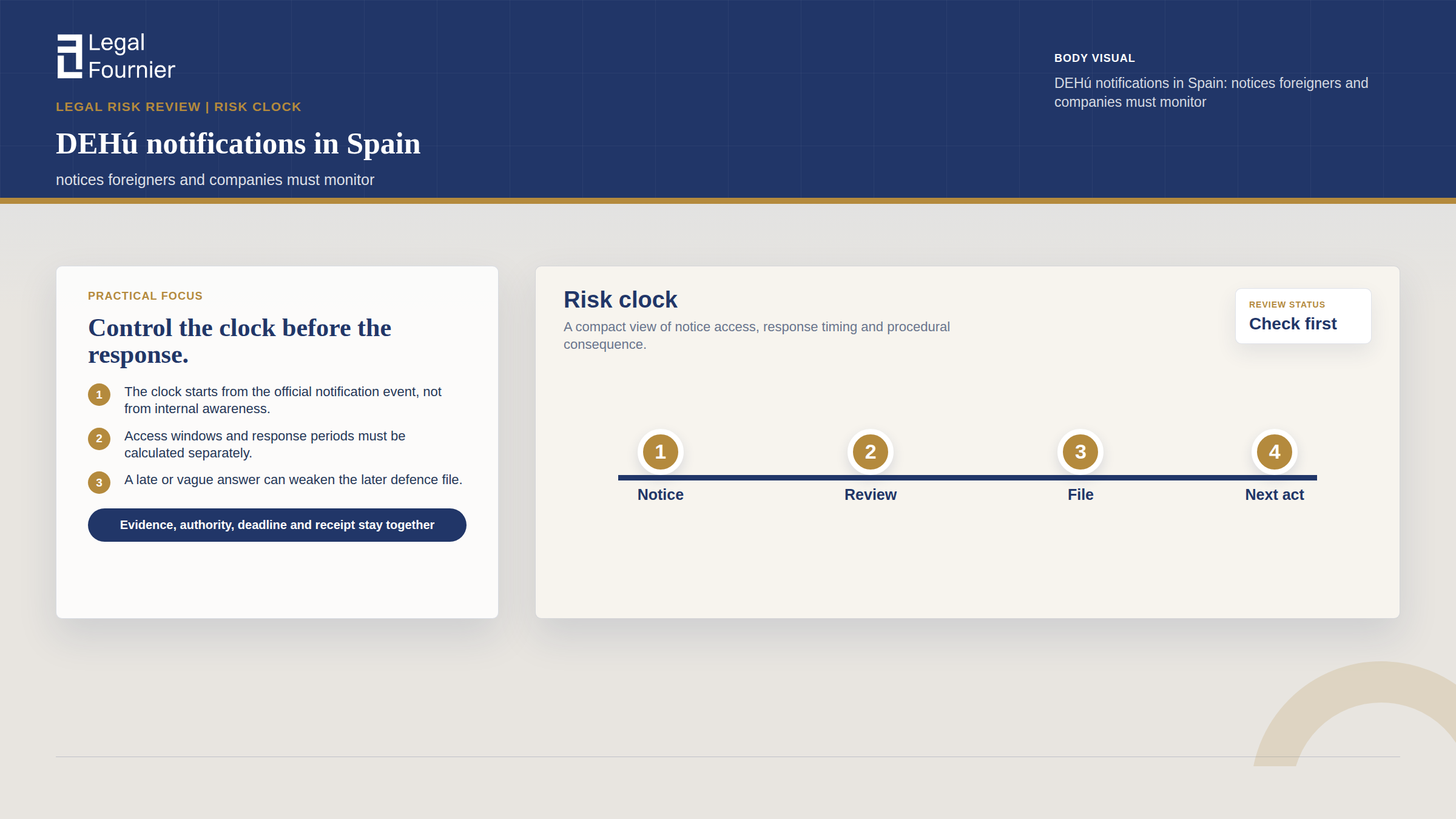
This is a legal presumption with real consequences. The procedure can continue. A tax assessment can move forward. A sanction file can advance. A request for documents can be treated as unanswered. The notice may also remain downloadable later, but later download does not necessarily rewind the legal clock.
Two details matter in practice.
- Calendar days means calendar days. The access period is not limited to business days. In Spanish law, días naturales include Saturdays, Sundays and bank holidays, so a notice made available on a Friday before a long weekend keeps counting.
- The response deadline is a separate question. The document itself may give a period for allegations, payment, appeal, correction, or document production. That period usually needs to be calculated from the legally effective notification date, but the exact rule depends on the procedure and the notice.
Where the same notice is available through the issuing body and DEHú, Royal Decree 203/2021 and AEAT guidance both point to the first valid access or rejection as the date that counts. A client who opens the document in AEAT first should not assume DEHú gives a second chance, and the opposite is also true.
Email alerts are not enough
DEHú and other official systems may send warnings to an email address or mobile number. AEAT explains that DEHú can send informative alerts to the email addresses configured in the user’s contact details, and that several email addresses can be added. This is useful. It is not a compliance system by itself.
Article 41.6 of Law 39/2015 is explicit that the courtesy alert is merely informative, and that the lack of that alert does not prevent the notification from being fully valid. Spam filters, changed domains, a departed employee, an inactive phone number, or a foreign mailbox that blocks Spanish government messages can therefore create a false sense of safety.
Do not build the process around the email. Build it around scheduled portal checks, saved evidence, and clear responsibility for escalation.
Which portals should be checked?
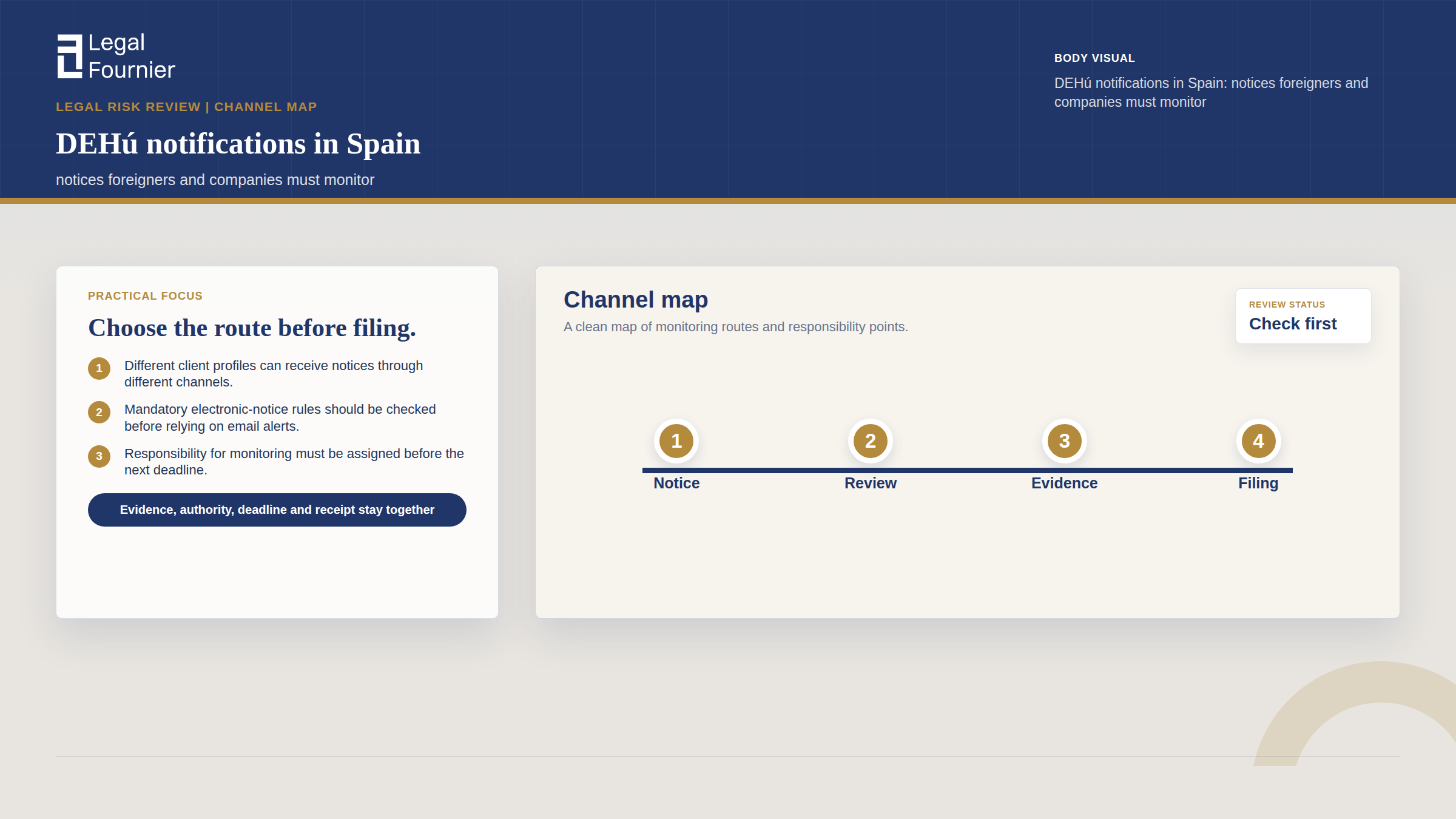
DEHú is important, but it is not the only place a foreigner or company may need to monitor. The right monitoring map depends on your profile.
| Area | Where notices may appear | Why it matters |
|---|---|---|
| Tax and AEAT | DEHú and AEAT electronic office | Requests, assessments, penalties, audits, VAT, non-resident tax, IRPF, and company tax matters. |
| Social Security | DEHú, Mi Carpeta Ciudadana, Seguridad Social channels, and sometimes authorised RED access | Company registrations, affiliation, contributions, collection, sanctions, INSS resolutions, and related claims. |
| Traffic sanctions | DEV, the Dirección Electrónica Vial | Company vehicles and long-term leased vehicles can generate electronic-only traffic notices. |
| Residency, nationality, and administrative files | DEHú, ministry electronic offices, Mi Carpeta Ciudadana, or the platform used for the filing | Requests for missing documents, resolutions, and appeal periods can affect immigration or nationality strategy. |
| Regional and local matters | DEHú if integrated, plus regional, municipal, cadastral, or local tax offices | Property tax, municipal penalties, local licensing, grants, and regional tax matters may have their own channels. |
For AEAT specifically, the Tax Agency explains in its general electronic-notification guidance that DEHú gives access to AEAT notifications and communications as well as those of other integrated administrations. AEAT also states in its notification FAQs that its electronic notification systems record the date and time when a notice is made available, accessed, or considered rejected. For tax matters, that audit trail is often as important as the PDF itself.
If the issue is only a tax notice from the Agencia Tributaria, our separate guide to Notificacion AEAT goes deeper into AEAT document types, first-response risks, and appeal strategy. This article is broader: it maps the DEHú monitoring problem across tax, Social Security, traffic, residency, and company administration.
For Social Security, official telematic-notification guidance says notifications cover acts from the Tesorería General de la Seguridad Social, resolutions from the Instituto Nacional de la Seguridad Social, and acts or resolutions from the Instituto Social de la Marina. It also notes that certain TGSS matters may be accessed by the authorised RED representative or proxy. That means a company should not assume the gestor alone sees every legally sensitive item, or that the company itself has no duty to supervise.
For traffic, do not confuse DEHú with DEV. The DGT guidance on Dirección Electrónica Vial states that DEV is voluntary for individuals but mandatory for legal persons in the relevant vehicle context. Since November 1, 2022, DGT has stopped sending paper traffic notices to legal persons that fall within that system and notifies electronically through DEV. If a company should be registered and is not, DGT says it can assign a DEV address of its own motion; notices may still be available even if no alert can be sent because no contact details were provided.
For corporate vehicle owners, the economic exposure is rarely the original fine. Under Article 11.1.a) of the Traffic Law, the registered owner must identify the driver responsible for the infringement, in principle within 20 calendar days from the notification. Failure to comply is itself a separate very serious offence, with a fine set at twice the original penalty if the underlying offence was minor, and three times the original penalty if it was serious or very serious. An unread DEV notice can therefore convert a routine penalty into a multiplied sanction without the company ever having been involved in the underlying traffic incident.
A monitoring protocol that actually works
For individuals with no active procedures, monitoring can be lighter. For companies, founders, high-income foreign residents, property owners with tax exposure, and anyone with an open file, it should be formal.
1. define the owner
Every profile should have one named person responsible for checking DEHú and related portals. For companies, this should be written into the compliance routine, not left to whoever happens to hold the digital certificate. If a gestor, accountant, or lawyer checks a portal, define what they check, how often, and when they must notify the client.
2. keep credentials alive
A digital certificate that expires during August, a Cl@ve account that cannot be used from abroad, or a representative certificate tied to a former director can turn a routine notice into an urgent matter. Foreigners should test access before travel, not after receiving a warning email. Companies should maintain director and representative-certificate continuity through corporate changes.
3. check often enough to protect the 10-day window
As an operational rule, many clients should check at least twice weekly, and more often during active tax audits, immigration filings, sanctions, appeals, company changes, or collection procedures. This is not because Spanish law says “twice weekly”; it is because a 10-calendar-day access period leaves little room for holidays, travel, illness, IT failures, or internal forwarding delays.
4. save the right evidence
When a notice is found, download the notice, the acknowledgment or receipt, and any metadata showing availability, access, rejection, or expiry. Save the issuing body, file number, NIF/NIE/CIF, date of availability, date of access, and any response deadline stated in the document. A screenshot alone is often not enough.
5. triage before responding
Some notices are administrative housekeeping. Others require legal strategy. A tax requerimiento, sanction proposal, residency document request, company Social Security collection act, or traffic fine involving a company vehicle should not be answered reflexively. The first filing can narrow later arguments, admit facts, or miss a procedural defence.
When foreigners should escalate quickly
A foreign resident, non-resident owner, investor, or founder should seek advice promptly where the notice touches any of the following:
- A tax inspection, data request, sanction, surcharge, payment demand, garnishment, or appealable AEAT act.
- A residency renewal, immigration resolution, missing-document request, inadmissibility issue, or nationality communication.
- A company where the director, shareholder, or administrator has changed and access credentials may not reflect the current governance.
- A notice that has already passed the 10-calendar-day period, or that appears as expressly rejected, rejected by lapse of time, or made available without the client having read it.
- Any matter where a deadline is unclear, the notice refers to prior unanswered communications, or the amount at stake is material.
For residency matters, electronic notice management should be coordinated with the immigration strategy. If your file concerns renewal or continuity of residence, see our residency renewal support. If the issue is tax-led, start with the tax file and the exact notice received, not with a generic DEHú explanation.
Frequently asked questions
Is dehú the same as AEAT electronic notifications?
No. DEHú is a general electronic notification access point. AEAT also has its own electronic office. In many tax cases, the same or related AEAT notice may be accessible through AEAT channels and DEHú. The first valid access or rejection can be the legally relevant date.
I did not receive the email alert. Is the notice invalid?
Usually, no. Spanish law treats the alert as informative. If the notice was properly made available through the legally applicable channel, a missing or unread email warning does not normally invalidate the notification.
Does every foreigner in Spain have to use dehú?
Not in every situation. Many individuals can choose paper or electronic notification unless they are legally obliged to communicate electronically or have chosen electronic notification in the relevant procedure. However, foreign clients with tax exposure, active administrative files, or representatives should still check their DEHú risk carefully.
Can my accountant or gestor monitor dehú for me?
They may be able to monitor certain matters if they have the correct authorisation, certificate, RED access, or registered power. But the scope matters. Tax, Social Security, immigration, traffic, and legal appeals do not always sit under the same authorisation. The client should know exactly who monitors which portal.
What if the 10 days have already passed?
Act quickly. The notice may already be legally effective or treated as rejected, but there may still be a payment, appeal, correction, or evidence deadline running from that date. A lawyer should review the notice, the timestamp record, the issuing body, and any possible notification defect before deciding the next step.
What is the difference between dehú and DEV?
DEHú is the general enabled electronic address for administrative notifications and communications. DEV is the Dirección Electrónica Vial, used for traffic and road-safety notices. Legal persons with relevant vehicle ownership or long-term leasing exposure should treat DEV as a separate monitoring channel.