Foreign shareholder of a Spanish SL: documents banks and notaries request
A foreign company may own a Spanish SL. The arrangement often suits an international group, a founder with an existing holding company or a business that has outgrown an employer of record Spain arrangement. The harder part is documenting the foreign shareholder, its representative, beneficial owners and source of funds for the Spanish notary, bank, tax office and Commercial Registry.
With a Spanish-resident individual founder, the ownership and banking file may be straightforward. An international corporate shareholder adds another legal entity, often with directors, powers of attorney, apostilles, translations, tax numbers and upstream owners in several jurisdictions. One missing, expired or inconsistent document can stall the incorporation after the commercial decision has already been made.
These files need a coordinated company, banking, tax and notarial review. If you are planning a Spanish company owned by a foreign parent, start with the company formation service. If banking is already a concern, also review the guidance on opening a Spanish bank account.
Published: 7 July 2026
- A foreign company can be a founding shareholder of a Spanish SL, but the notarial deed must identify the shareholders, contributions and representation correctly.
- Banks and notaries are anti-money-laundering obliged entities, so they usually review the foreign company, its representative, its beneficial owners and the origin of funds.
- The foreign shareholder will often need a Spanish NIF before the notarial and tax steps can be completed.
- Foreign public documents usually need apostille or diplomatic legalisation, plus sworn translation into Spanish when they are not in Spanish.
- Foreign investment declarations may apply after the transaction, and prior declarations can arise in higher-risk jurisdiction cases.
- The safest workflow is to clear the document pack before money is moved, directors travel, or a notary appointment is booked.
Why this file is different
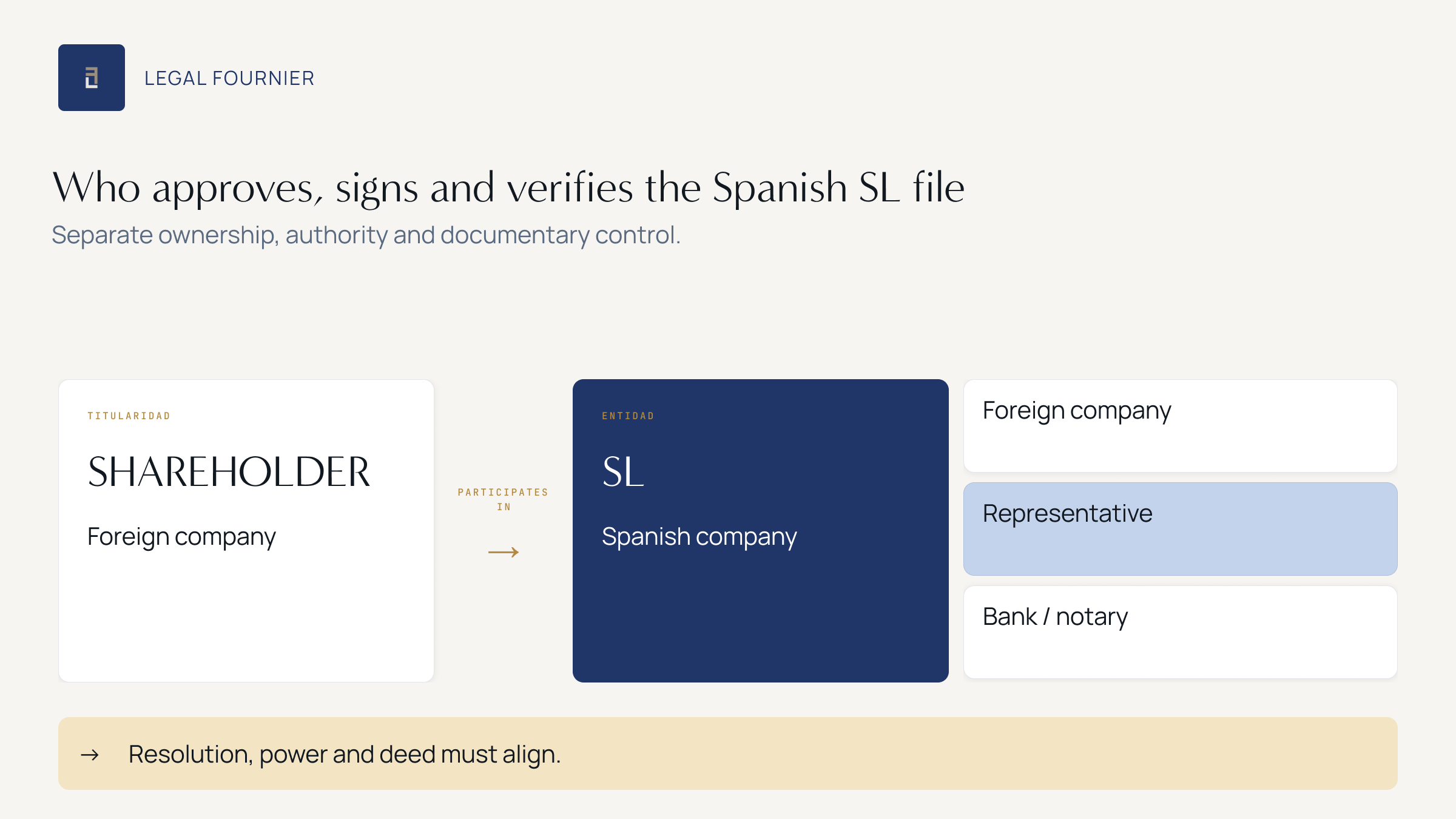
Spanish company law does not require every founder of an SL to be an individual. The consolidated Spanish Companies Act provides that a capital company is incorporated by public deed and registration in the Commercial Registry, and that the incorporation deed is granted by all founding shareholders, whether individuals or legal persons, directly or through a representative. The deed must include, among other items, the identity of the shareholders and the contributions made by each one.
That is the legal starting point. A foreign corporate shareholder also raises practical questions: who can bind it, who ultimately controls it and whether its funding matches the Spanish company’s stated plan. The notary must assess capacity, representation and anti-money-laundering information rather than simply copy a name from the cap table. The bank applies its own risk policy when deciding whether to onboard the Spanish company or its foreign parent.
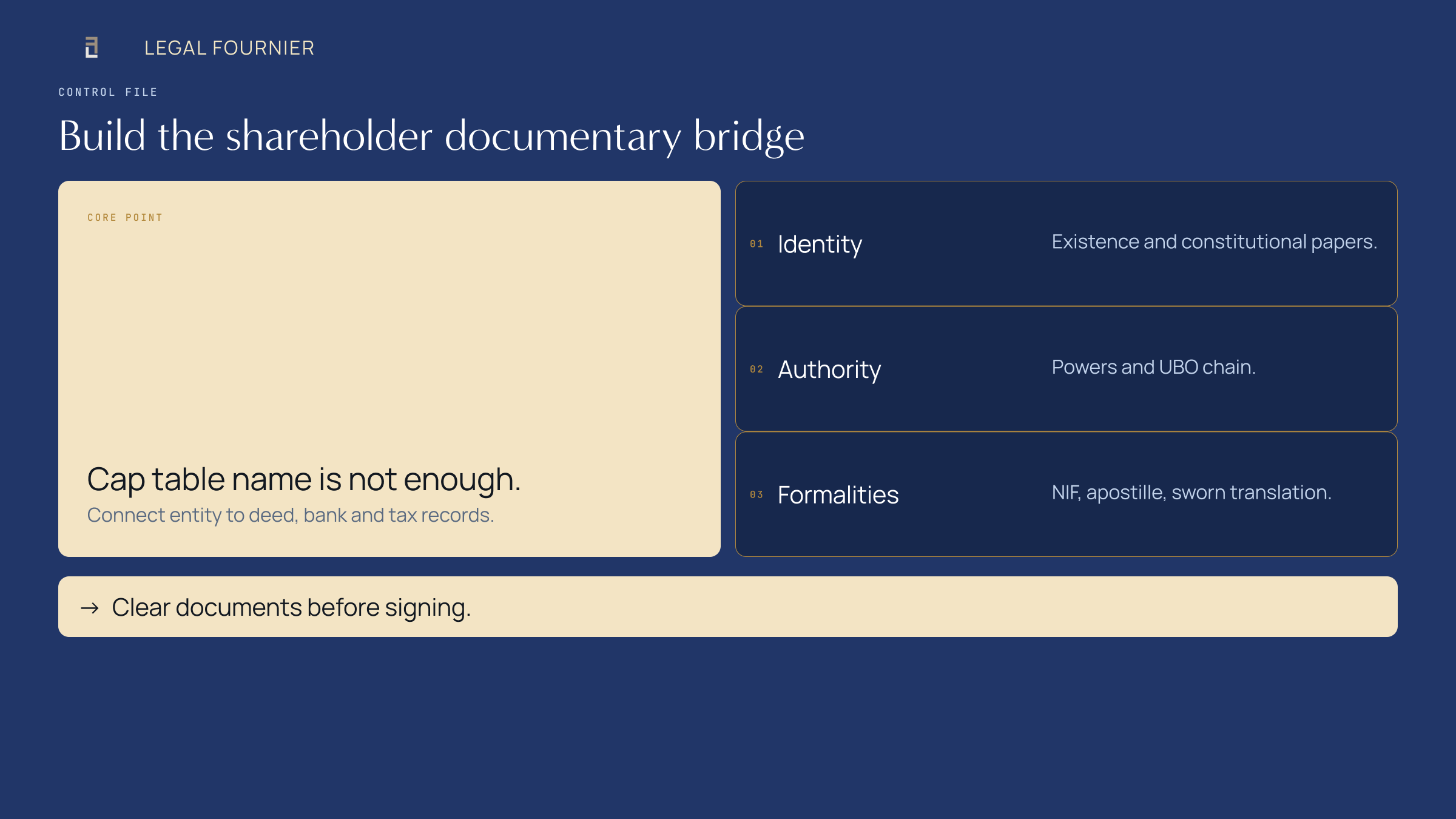
The key legal point: the foreign company can usually be the shareholder, but Spain still needs a clean documentary bridge from the foreign legal system to the Spanish notarial deed, bank file, tax registration and beneficial-owner record.
The notary document pack
Every notary and registry file depends on the jurisdiction of the shareholder, the governance documents of the foreign company, the amount invested, the business activity, the bank used, and whether the person attending the notary is a director, officer or attorney. Still, most foreign corporate shareholder files need the same families of documents.
| Document area | Why it matters |
|---|---|
| Foreign company existence | Proves the shareholder exists, is registered and remains active. |
| Constitutional documents | Shows the company type, powers, internal approval rules and shareholding authority. |
| Representative authority | Confirms who can sign for the foreign shareholder before the Spanish notary. |
| Beneficial ownership | Lets notary and bank identify the natural persons who ultimately own or control the chain. |
| Tax identification | Allows Spanish tax and notarial systems to identify the foreign legal person. |
| Apostille or legalisation | Gives foreign public documents international evidentiary force in Spain. |
| Sworn translation | Makes non-Spanish documents usable in the Spanish notarial, registry and tax process. |
1. Certificate of incorporation or registry extract
The notary will usually ask for a recent certificate, good standing certificate, commercial registry extract or equivalent document from the shareholder’s home jurisdiction. The name varies by country, but the function is the same: prove that the foreign company exists, identify its registered details, and connect it to the person signing. For non-EU companies, apostilled or legalised certificates and clear translations are often especially important.
2. Articles, bylaws or operating agreement
The constitutional documents show whether the foreign company has capacity to subscribe shares or participations in a Spanish SL and who can approve the investment. A Delaware LLC operating agreement, UK articles, Swiss articles, Latin American bylaws or fund governance document may each answer this differently. A registry certificate may identify the company but not prove whether one director can invest abroad alone, whether two signatures are required, or whether member consent is needed.
3. Board or shareholder resolution approving the Spanish SL
A resolution is often used to show that the foreign company approves the incorporation or acquisition of the Spanish SL participation, appoints a person to sign, approves the capital contribution, and authorises ancillary steps such as bank account opening, tax registrations and foreign investment filings. The resolution should match the Spanish deed: company name, shareholder name, capital amount, percentage, appointed representative and signature powers.
4. Power of attorney for the person signing in Spain
If a director of the foreign shareholder travels to Spain and has registry-visible authority, a separate power may not be necessary. If a lawyer, employee, local director or third party signs before the notary, a power of attorney will usually be required. Under the Regulation of Law 10/2010, in representation cases the identity of the representative and the represented entity is checked documentarily, and the public document evidencing the powers granted is part of that review.
For foreign powers, form matters. The notary will look at who granted the power, whether that person had authority under the foreign company’s documents, whether the power is public or notarised where required, whether it is apostilled or legalised, and whether the Spanish translation is complete.
What the Spanish bank usually reviews
The bank file is not a formality. A Spanish SL often needs an account to receive the share capital contribution, operate payroll, pay suppliers, receive client payments and register certain tax operations. In some cases, the bank is asked to issue a certificate of deposit for the initial share capital. Even where the SL can be incorporated with a very low capital amount, the bank may still ask commercial questions about the business, expected flows and ownership structure.
The Banco de España customer portal explains that banks ask for identification and may request proof of the origin of funds because of money-laundering prevention rules. In a separate criterion on restrictive measures, the Banco de España notes that banks may request documentation and information on identity, economic activity and transactions, and periodic updates. In practice, a foreign corporate shareholder file therefore usually needs more than the future Spanish company’s draft deed.
The bank will often ask for documents such as:
- Draft or final corporate documents for the Spanish SL.
- Foreign shareholder registry extract and constitutional documents.
- Passport or national ID of the person signing bank forms.
- Power of attorney or corporate authority for that person.
- Ownership chart showing each entity in the chain up to the natural-person beneficial owners.
- Passports or official IDs for ultimate beneficial owners, especially where they hold or control more than 25 percent or otherwise exercise control.
- Evidence of source of funds: bank statements, audited accounts, sale documentation, intragroup loan agreements, dividend minutes or other support depending on the case.
- Business plan, expected annual turnover, countries of operation, main clients or suppliers, and explanation of expected incoming and outgoing payments.
The requests may feel intrusive, but they form part of the bank’s customer due diligence. Law 10/2010 requires obliged entities to understand the purpose and intended nature of the relationship and the customer’s professional or business activity, then monitor it over time. If the bank cannot apply those measures, the law prevents it from establishing the relationship or executing the transaction.
Practical consequence: a bank can delay, refuse or later restrict an account if the foreign shareholder cannot document the ownership chain, business purpose or origin of funds to the bank’s satisfaction.
Beneficial ownership is the main friction point
Spanish anti-money-laundering rules focus on the titular real, usually the natural person or persons who ultimately own or control a legal entity. The Ministry of Justice page on the Registro Central de Titularidades Reales describes Spain’s central beneficial ownership register and explains that beneficial ownership generally refers to the natural person or persons who ultimately possess or control, directly or indirectly, more than 25 percent of the capital or voting rights of a legal person, or who otherwise exercise control.
For a foreign company as shareholder of a Spanish SL, the relevant question is not only who owns the Spanish SL. It is who owns or controls the foreign shareholder. If the foreign shareholder is owned by another company, the review climbs the chain. If the chain includes a trust, foundation, nominee arrangement, partnership, fund or family holding vehicle, the file becomes more sensitive. A simple organisation chart may not be enough unless it is supported by registry records, shareholder registers, certificates, trust extracts or equivalent documents.
The Regulation of Law 10/2010 states that obliged entities identify the beneficial owner and adopt appropriate measures, according to risk, to verify that identity before establishing business relations or certain transactions. It also provides for access to beneficial ownership information in the Spanish register, without excluding additional checks. A notary or bank can therefore ask for additional reliable documentation where the file presents higher-than-average risk.
Foreign groups often underestimate this because their home jurisdiction treats beneficial ownership as a private matter or because their corporate registry does not show shareholders. Spain does not need to copy the home jurisdiction’s public disclosure model. The Spanish bank and notary still need enough information to understand who controls the Spanish investment.
Apostille, legalisation and sworn translation
Foreign documents must be made usable in Spain. If the document is a public document from a country that is part of the Hague Apostille Convention, an apostille will often replace diplomatic legalisation. The Spanish Ministry of Justice apostille guidance explains that the apostille certifies the authenticity of the signature on public documents issued in a member country so they can be recognised in another member country without further authentication.
If the issuing country is not covered by a relevant apostille or exemption route, diplomatic legalisation may be required. The Spanish Ministry of Foreign Affairs legalisation guidance explains the diplomatic legalisation concept and the usual steps for foreign public documents that must take effect in Spain. This can involve the foreign ministry of the issuing country and the Spanish consular authority, depending on the document and jurisdiction.
Translation is a separate issue. A document can be apostilled and still not usable if the notary, bank or tax office needs it in Spanish. The Ministry of Foreign Affairs guidance on sworn translation explains that sworn translators and interpreters appointed by the Ministry produce official translations that can be submitted to judicial and administrative bodies.
Order the documents at the right time. A board resolution using a draft company name may need to be translated and apostilled again if the name changes. A power completed before the notary confirms the required wording may be too vague. A bank may also reject an old shareholder certificate and ask for a recent one. Confirming the pack first avoids repeat costs and disrupted travel.
Tax numbers and foreign investment declarations
A foreign company that will become a shareholder of a Spanish SL often needs a Spanish tax identification number, or NIF. The Spanish Tax Agency states that non-resident or non-established entities must have a NIF when they are going to carry out operations with tax implications. The Tax Agency’s Modelo 036 procedure page identifies Form 036 as the census declaration used for registration, modification and deregistration, and notes presentation channels including AEAT offices and, for non-resident NIF requests, Spanish consular offices abroad.
In a foreign corporate shareholder file, the NIF process should not be left until the day before the notary appointment. The tax office may ask for the foreign company’s constitutional documents, proof of representation, identity documents, translations, apostilles or legalisations, and a clear reason for the Spanish tax number. If the person signing Form 036 is not visibly authorised, the file can be stopped at the tax-ID stage.
Foreign investment reporting should also be checked. The Ministry of Economy, Commerce and Business explains that Royal Decree 571/2023, in force from September 1, 2023, changed the declaration regime and lists models including D-1A for foreign investment in Spanish companies. Official guidance indicates that investment in Spanish non-listed companies is generally declared when the non-resident investor reaches or holds at least 10 percent, with special rules for later transactions and certain non-cooperative jurisdiction cases.
This is not always a notary condition, and it is not the same as tax registration. For a foreign parent company acquiring a material Spanish SL participation, however, it is part of basic transaction hygiene. Larger structures may also need to assess annual reporting such as D-4 where the applicable thresholds are met. Check which filings actually apply before closing rather than overloading the incorporation with unnecessary filings.
A workable sequence for a foreign-parent SL
Treat the Spanish SL as a structured transaction rather than a template incorporation. A typical sequence is:
- Confirm the structure. Decide whether the foreign company should be the direct shareholder, whether a Spanish holding company is needed, who will be the administrator, and whether the structure is meant for operations, property, staff, group services or market entry.
- Map the authority chain. Identify who controls the foreign company, who can approve the investment, and who can sign for the shareholder in Spain.
- Clear the document list. Agree the notary and bank document pack before ordering apostilles or sworn translations.
- Obtain the foreign shareholder NIF where needed. Prepare Form 036 and supporting documents with the same representative logic used for the notary file.
- Pre-clear bank onboarding. Send the ownership chart, source of funds evidence and business purpose before relying on a capital deposit date.
- Prepare the Spanish deed and bylaws. Align the deed with the foreign resolution, the bank certificate, the shareholder NIF and the selected administrator structure.
- Sign before the notary and register. The incorporation deed is granted and then filed with the Commercial Registry for registration.
- Complete post-signing registrations. Final NIF, tax census, accounting setup, foreign investment declarations and business licences should be handled as applicable.
This sequence also protects confidentiality and timing. Families, business owners, relocating founders and corporate groups usually need controlled disclosure rather than repeated institutional requests after sensitive documents have begun to circulate.
Special cases that need extra care
EU corporate shareholder
An EU company is often easier to document because registry information may be more familiar, but the file still needs evidence of representation, beneficial ownership, activity and source of funds.
UK, US or Latin American parent company
These files are common, but each jurisdiction has its own documentary logic. A UK company extract, Delaware good standing certificate and Latin American public deed do not answer identical Spanish questions, so the checklist should be adapted to the home jurisdiction.
Holding company, trust or fund structure
Where the shareholder is a holding vehicle, trust-related company, fund vehicle or family office entity, the beneficial ownership analysis should be done before banking begins and should explain control without unnecessary disclosure.
Employer of record versus Spanish SL
Some groups start with an employer of record in Spain to employ one person while testing the market. That can be useful for a limited employment need, but it does not replace an owned Spanish company when the group needs Spanish contracts, invoicing, banking independence or a local subsidiary for broader expansion.
When counsel changes the outcome
Sending more documents without a plan rarely helps. The file needs the documents that prove capacity, control, funding and business purpose, in the form required by the receiving institution. Counsel can identify that set before the bank or notary starts returning incomplete submissions.
Legal Fournier typically focuses on four points: first, whether the Spanish SL is the correct vehicle; second, which foreign documents are actually needed; third, how the bank and notary should receive the ownership and funds explanation; and fourth, which tax, accounting and foreign investment steps follow after incorporation. This keeps the client from treating company formation, bank onboarding, NIF, beneficial ownership and post-closing declarations as separate isolated tasks.
If the company will have employees, monthly accounting, VAT, intercompany service agreements, directors abroad, group financing or Spanish clients, the formation file should also connect to ongoing compliance. The monthly accounting service and Talk to a Spanish lawyer are usually the next steps for clients who need a structured review before moving funds or signing powers.
FAQ
Can a foreign company be the only shareholder of a Spanish SL?
Yes, if capacity, representation and registration requirements are satisfied. If there is only one shareholder, the sole-shareholder status must also be reflected properly.
Does the foreign shareholder need a Spanish NIF?
Often yes. Non-resident legal entities need a Spanish NIF when they carry out operations with tax implications in Spain, and becoming shareholder of a Spanish SL usually requires that assessment early.
Will the bank accept documents in English?
Some banks may review English documents informally, but Spanish notarial, tax and registry use often requires Spanish documentation or sworn translation.
Is apostille always enough?
No. Apostille authenticates certain public documents, but it does not solve translation, representative authority, freshness, or whether the document proves the required legal point.
Can the Spanish SL be incorporated before the bank account is fully open?
It depends on the capital route, notarial approach and banking plan. For foreign corporate shareholders, pre-clearing bank onboarding is usually safer than incorporating a company that cannot move funds efficiently.
Is an employer of record enough instead of a Spanish SL?
An employer of record can be useful for a limited employment need, but it does not give the foreign group an owned Spanish subsidiary, local balance sheet, Spanish contracting platform or corporate presence. If the strategic need is market entry, client contracting or a controlled local subsidiary, an SL may be more appropriate.