

Put two quotations beside each other and a mismatch may appear before the legal analysis begins. A low monthly amount might exclude insurance and maintenance. A more expensive offer might include both, yet impose a usage limit and a costly early return. Before deciding between leasing and renting, rewrite the quotations against the same intended use and exit date.
Take a fictional Spanish company that needs three refrigerated vans for 36 months. It expects each van to cover 25,000 kilometres a year and plans to return or replace the vehicles at month 36. The figures below are illustrative, exclude VAT and do not reproduce any provider’s offer.
Normalise the offers before choosing a label
| Item | Offer A: leasing | Offer B: renting |
|---|---|---|
| Cash at signing | €10,000 non-refundable initial payment | €3,000 refundable deposit, subject to the return inspection |
| Periodic payments for the three-van package | 36 monthly payments of €1,180: €42,480 | 36 monthly payments of €1,460: €52,560 |
| Services stated in the offer | Maintenance and insurance excluded | Scheduled maintenance and insurance included, but the excess and exclusions are not supplied |
| Use and return | No kilometre limit quoted; condition on return not supplied | 30,000 kilometres per van per year; excess-kilometre rate and wear standard not supplied |
| Exit at month 36 | Purchase option of €12,000 if exercised; return mechanics need confirmation | Vehicles returned; €3,000 deposit remains at risk until inspection |
| Early exit | Offer refers to a settlement formula that has not been attached | Offer refers to an early-return schedule that has not been attached |
| Comparable committed cash | €52,480 before insurance, maintenance, VAT and any return amount; €64,480 if the stated option is exercised | €52,560 before VAT, excesses and return charges, assuming the deposit is repaid in full |
The apparent difference is €80 if the company returns the assets after 36 months and the renting deposit comes back in full. That number is not a conclusion. Offer A still lacks the cost of insurance and maintenance. Both offers hide their early-exit calculation, and neither gives enough information to estimate the final return charge. VAT appears separately because an invoice amount and a recoverable VAT amount are not the same thing.
No tax saving appears in the worksheet because the facts needed to calculate one are not there. The blank fields identify the documents and figures still needed to compare the economic commitment. For machinery or IT equipment, the same sheet can use hours, cycles or output in place of kilometres.
What the words leasing and renting tell you
The Banco de España description of leasing is a useful orientation: the provider acquires an asset selected for the customer’s specifications and grants its use in exchange for periodic payments that include financing interest and expenses. Fees may also apply. The description is not evidence that Offer A has a particular tax result.
A statutory financial lease has more specific features. Under additional provision 3 of Law 10/2014, the operation concerns movable or immovable assets acquired for the future user’s specifications, the asset must be used only for the listed business or professional activities, and the contract must contain an end-of-term purchase option. Those requirements need the proposed contract and the intended use, not merely the heading on a quotation.
Banco de España describes renting as the rental of movable assets for fixed periodic payments. The contract governs the coverage, duration and compensation for early termination. In the arrangement Banco de España describes, there is no purchase option, and renting is not a specially supervised financial product. It does not say that every renting package includes tyres, insurance, maintenance or a replacement vehicle. Offer B must say what is included and on what conditions.
One quotation, five separate reviews
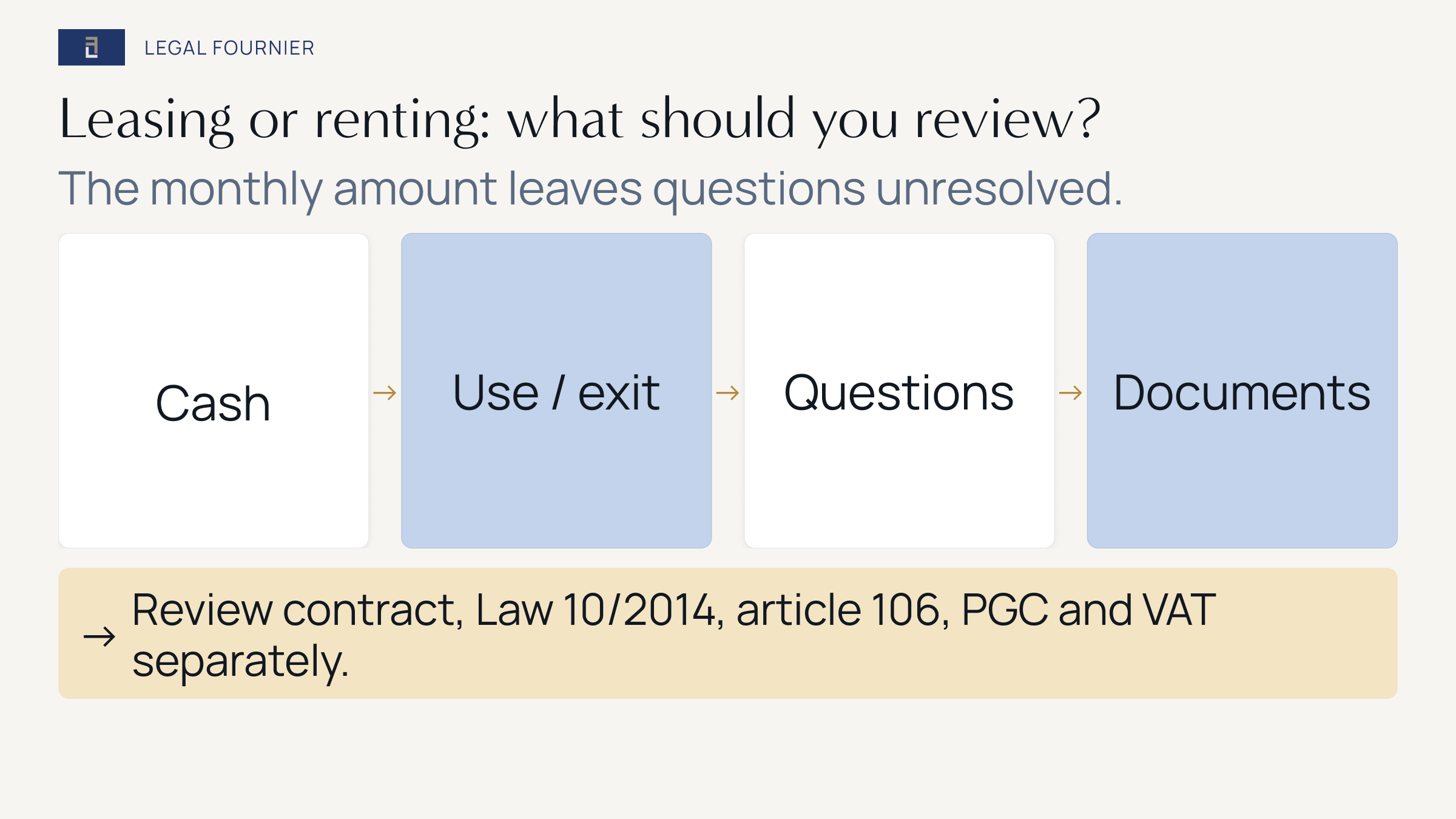
The signed terms establish the company’s obligations. Law 10/2014 sets the features of a statutory financial lease. Corporate Tax Law article 106 has its own conditions, while the accounting framework and VAT evidence require separate analyses. The table applies each check to the same fictional facts. An unresolved entry points to a document or instruction that is still missing.
| Contract obligations | Law 10/2014 | Corporate Tax Law article 106 | Accounting under PGC NRV 8 | VAT use and evidence |
|---|---|---|---|---|
| Fact: maintenance stays with the company; option is €12,000. Rule: the signed terms control payment, use and exit. Open question: missing settlement and return clauses. | Fact: the label says leasing and an option appears. Rule: the statutory operation must satisfy all features in additional provision 3. Open question: provider, acquisition and exclusive business-use facts. | Fact: the quotation does not identify the lessor’s regulatory status or split the instalment. Rule: the special regime has lessor, term, payment-breakdown and cost-recovery conditions. Open question: does the contract meet each condition? | Fact: management has not decided whether it expects to exercise the option. Rule: economic substance and transfer of substantially all risks and rewards govern classification. Open question: which PGC framework applies and is exercise reasonably certain? | Fact: business mileage is forecast, but use records do not yet exist. Rule: deduction depends on business use and the statutory conditions. Open question: what evidence supports the degree of use? |
| Contract obligations | Law 10/2014 | Corporate Tax Law article 106 | Accounting under PGC NRV 8 | VAT use and evidence |
|---|---|---|---|---|
| Fact: some services are named, but limits, excesses and return standards are absent. Rule: the agreed contract defines the package and early-exit amount. Open question: what do the missing schedules add? | Fact: there is no purchase option in the quotation. Rule: the renting label does not itself establish a financial lease. Open question: do the full rights and obligations alter that first reading? | Fact: no special tax treatment is quoted. Rule: article 106 applies only to operations satisfying its conditions. Open question: none should be assumed from the monthly invoice. | Fact: the provider retains title, but the allocation of risks is incomplete. Rule: the applicable PGC analysis follows economic substance. Open question: who bears the material residual, damage and availability risks? | Fact: the same vans and intended mileage apply. Rule: product type does not decide the deductible proportion. Open question: what actual business use and supporting records will the company have? |
The special leasing tax regime has conditions
Article 106 of the Corporate Tax Law applies only when the lessor is a credit institution or financial credit establishment. It sets a minimum term of two years for movable assets and ten years for immovable assets or industrial establishments. The contract must separate recovery of the asset’s cost, excluding the purchase-option value, from the finance charge, and the annual cost-recovery portion must remain equal or increase.
The article allows deduction of the finance charge within that regime. Its treatment of the cost-recovery portion has exclusions for land, plots and other non-depreciable assets and a statutory annual cap; excess amounts carry forward subject to the cap. The usual cap is twice the official straight-line depreciation coefficient, with an adjustment for qualifying small entities. This is why “the leasing instalment is immediately deductible” is not a safe summary.
Where regulatory status matters, check the provider’s legal entity rather than its brand. Banco de España maintains entity registers. Its authorisation guidance also explains that professionally carrying on real-estate leasing or factoring does not, by itself, require bank or financial credit establishment status. The article 106 condition must therefore be checked, not inferred.
Accounting follows substance; VAT follows use and proof
The General Accounting Plan, NRV 8 asks whether the arrangement transfers substantially all risks and rewards attached to ownership. A purchase option creates a presumption only if there is no reasonable doubt it will be exercised. Finance-lease and operating-lease accounting differ, and a company using PGC-PYMES must apply the framework that actually governs its accounts. The accountant therefore needs the contract rather than its marketing label.
VAT needs another evidence file. Under article 95 of the VAT Law, deductibility depends on business use, the kind of asset and the remaining statutory requirements. Passenger cars have a rebuttable 50% business-use presumption, subject to listed exceptions and possible regularisation. That is neither a universal 50% entitlement nor a route to a universal 100% deduction. Accounting for the vehicle or putting it in a register does not, on its own, prove the degree of business use.
Documents to place beside the quotations
For Offer A, request the full payment table, the purchase-option clause, the identity of the contractual lessor and its status, the asset specification, the supplier and acceptance terms, and the missing settlement formula. Ask who pursues a supplier defect while instalments remain due. For Offer B, obtain every service schedule, exclusions, insurance excess, maintenance authorisation route, replacement arrangements, use limits and the return-inspection standard.
For both offers, write down the intended exit date and test a plausible earlier date. Identify amounts that are refundable, those that are lost on signature and those that remain exposed after return. Keep VAT separate. Then give the accountant the same documents, the applicable accounting framework, delivery date, useful life, intended use and evidence plan. A tax or accounting answer produced from the quotation’s product name alone is incomplete.
Other finance structures may fit the asset or the company’s cash position better. The overview of business funding for foreign-owned companies in Spain is a route to those alternatives, not authority for the leasing analysis.
This article provides general information about Spanish law. It is not legal, tax, accounting or financial advice for a particular transaction.