


Let's be direct: getting Spanish citizenship is a marathon, not a sprint. The process is governed by a detailed Spanish nationality law, and it demands patience and a clear strategy. Think of it less like a race and more like a long-distance hike with a map—you need to know the trail before you start.
The main paths boil down to how long you've lived here, who your family is (ius sanguinis, or "right of blood"), or, in specific cases, where you were born (ius soli, or "right of soil").
Mapping Your Journey to Spanish Citizenship
We've seen countless people through this process, and one thing is certain: you need a clear roadmap. This isn't something you can just wing. This guide is your plan, breaking down the complexities and showing you that the finish line is very much within reach with the right approach.
Your first real step is figuring out which legal path actually applies to you, because each route has its own rules, evidence requirements, and timelines.
Which Path Is Right for You?
So, how do you figure out your route? It comes down to those three big questions: How long have you lived in Spain? Do you have Spanish family? Were you born here? This decision tree helps you visualize which route might be yours.
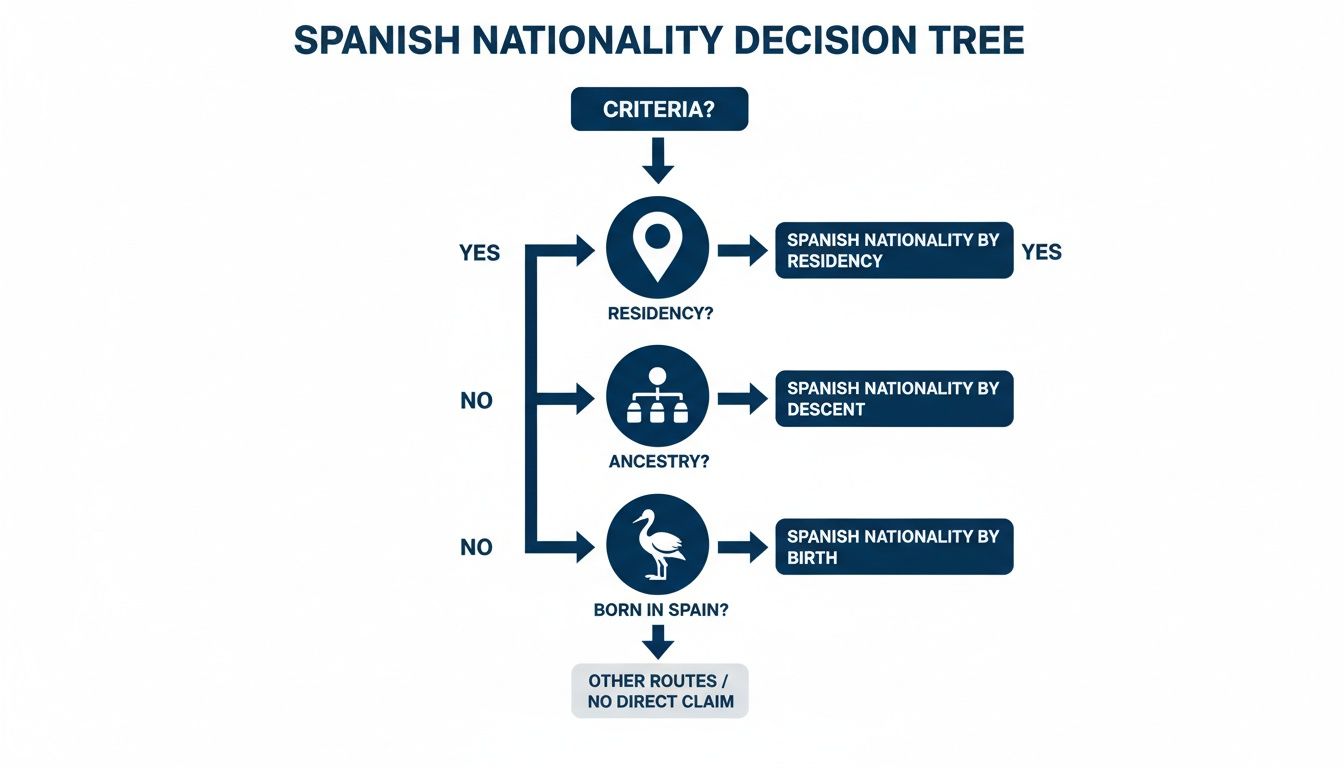
This chart simplifies things, pointing you toward the right legal framework for your specific situation. We’ll dig into each of these options in detail, so don't worry if it's not crystal clear just yet.
In Spain, ius soli (right of soil) is quite limited. It's your connection through long-term residency or family heritage—ius sanguinis (right of blood)—that forms the backbone of most successful nationality claims.
Getting your head around these core principles is the first hurdle. Next, we'll break down the most common route by far: nationality by residence. We’ll lay out exactly what you need to know to navigate the system, setting realistic expectations from the very beginning.
Main Routes to Spanish Nationality at a Glance
To give you a quick overview, this table summarises the main pathways and the typical residency time required for each. It’s a good starting point for seeing where you might fit in.
| Path to Nationality | Minimum Legal Residency Required | Common Applicant Profile |
|---|---|---|
| Standard Residency | 10 years | Expats and entrepreneurs without Spanish or Ibero-American ties. |
| Refugee Status | 5 years | Individuals granted official refugee status in Spain. |
| Ibero-American Nationals | 2 years | Citizens of Latin American countries, Andorra, Philippines, Equatorial Guinea, or Portugal. |
| Marriage to a Spanish Citizen | 1 year | Individuals legally married to and living with a Spanish national. |
| Spanish Grandparent | 1 year | Individuals whose parent was born outside Spain but had a Spanish-born grandparent. |
This table doesn't cover every nuance—Spanish law is full of them—but it gives you a solid framework for understanding the timelines you might be looking at. Each of these paths has its own specific documentation and process.
Nationality by Residence: The Most Common Path
Need help with your case in Spain?
If this article applies to your situation, contact our team for tailored legal guidance and clear next steps.
This is the route most foreigners take to get Spanish citizenship. It's also the one we handle most often at our firm. The standard rule is straightforward: you need 10 years of continuous and legal residency in Spain before you can apply. Think of it as putting in the time, showing Spain you're here for the long haul.
But that 10-year rule isn't set in stone. Spain offers massive time reductions for people from certain countries or in specific situations. This is where having a good strategy pays off, because you might qualify for a much shorter path than you think.
How Long Do You Really Need to Live in Spain?
While 10 years is the general rule, a huge number of our clients qualify for a reduced timeline. The law acknowledges the deep historical and cultural ties Spain has with certain nations, making the journey to citizenship significantly faster for their citizens.
Here’s how the main residency reductions break down:
- Five Years: This applies to anyone who has been granted official refugee status in Spain.
- Two Years: This is the big one. It's a major advantage for citizens of Ibero-American countries (that's most of Latin America), Andorra, the Philippines, Equatorial Guinea, and Portugal. If you hold a passport from one of these places, your residency requirement plummets from ten years to just two.
- One Year: The fastest track is reserved for very specific personal circumstances. You only need a single year of legal residency if you:
- Were born on Spanish soil.
- Have been married to a Spanish citizen for at least one year and are not legally or de facto separated.
- Are the widow or widower of a Spanish citizen, as long as you weren't separated when they passed away.
- Are the child or grandchild of someone who was originally Spanish by birth.
Spanish nationality files remain numerous every year, which is one reason applicants need to expect a procedure that can take time even when the legal route itself is clear.
What Does "Continuous" Residency Actually Mean?
The law says your residency must be "continuous," and the administration scrutinizes this. It doesn't mean you can never leave the country for a holiday. But it does mean you can't have long or frequent absences, especially in the final year before you apply.
The safest approach is to keep absences modest and well documented. Long or poorly explained periods outside Spain can create problems with the continuity requirement, and the impact should be assessed against your specific route before you apply.
We always tell clients to keep their travel to a minimum in the 12 months leading up to their application. It's just not worth risking a denial over a technicality.
Passing the Citizenship Exams: DELE A2 and CCSE
Beyond just living here, you need to show you've integrated into Spanish society. This is done by passing two exams managed by the Instituto Cervantes.
- DELE A2 (Diploma of Spanish as a Foreign Language): This is your Spanish language test. The A2 level is basic—it's about handling everyday conversations and understanding common expressions.
- CCSE (Constitutional and Sociocultural Knowledge of Spain): This test checks your knowledge of Spanish government, culture, and society. It’s a 25-question multiple-choice exam covering topics from Spanish geography to how the government is organized.
Not everyone has to take these. Applicants from countries where Spanish is the official language are exempt from the DELE A2 language exam. Minors and individuals with certified learning difficulties can also be excused. For most people, though, these tests are a mandatory step. We give our clients resources and preparation tips because knowing what's coming makes the whole thing a lot less stressful. Our guide on nationality through residence digs deeper into these requirements.
Not sure which path fits your situation? Book a consultation, and we'll map out the best strategy for you.
Nationality Through Heritage: Option vs. Origin
So far, we've talked about earning citizenship by living in Spain long enough. But what if your connection to the country is in your bloodline?
Spanish law has two powerful routes tied directly to your family tree: nationality by option and nationality for those of Spanish origin. These paths don't care how long you've lived here. They care about your heritage.
For many, this is a much faster track to a Spanish passport. We've seen countless clients live in Spain for years on various visas, only to discover their family history offered a shortcut to citizenship all along. It’s an avenue you should definitely explore.
Nationality by Option: Making the Choice
Think of "nationality by option" (nacionalidad por opción) as a right Spain gives you because of your close family ties. It’s not automatic; it’s a choice you have to actively make if you qualify.
So, who gets this choice? The most common situations we see are:
- You have a parent who was originally Spanish and born in Spain. If your mother or father fits this description, the law gives you the right to opt-in.
- Your legal parentage (filiation) or your birth in Spain is officially determined after you turn 18. Imagine discovering late in life that your biological father was Spanish. From the moment that’s legally recognised, a two-year clock starts for you to claim your nationality.
- You were adopted by a Spanish citizen after your 18th birthday. Same rule applies: you get a two-year window from the date of the adoption to make your claim.
The key thing to remember about "option" is that it requires action. The right is there, but you must formally declare your desire to become Spanish by submitting a proper application and proving your case.
Spanish by Origin: It Was Always Yours
This route is different. It’s not a choice you make, but a recognition of a status you may have had from the day you were born. Spanish law considers you a "Spaniard of origin" (español de origen) based almost entirely on the principle of ius sanguinis—the right of blood.
You're likely Spanish by origin if:
- You were born to a Spanish father or mother. This is the classic rule. It doesn’t matter where on the planet you were born. If one of your parents was a Spanish citizen when you arrived, you are considered Spanish from birth.
- You were born in Spain to foreign parents, but at least one of them was also born in Spain. This is a special rule that solidifies the status of families with deep roots in the country, even if they aren't citizens yet.
- You were born in Spain to foreign parents whose home country won’t give you citizenship. This is Spain's way of preventing statelessness. A perfect example is a child born in Spain to Argentinian parents. Because Argentina's laws don't automatically grant citizenship by birth abroad, Spain steps in and grants the child Spanish nationality by origin.
We’ve seen a huge surge in people digging into their family history lately, mostly because of new legislation. If your grandparents were Spanish, recent legal changes have opened up new possibilities. We break down how this works in our guide covering nationality under the Democratic Memory Law.
Figuring out the difference between these two paths can get complicated fast. It often comes down to a deep dive into your family tree and the specific laws that were active when your ancestors were born. Contact us for personalized advice and we can map out the best route for your specific situation.
Getting Your Application Across the Finish Line
Alright, you’ve confirmed you're eligible. Now comes the part that demands precision and patience: the application itself. Think of this as your roadmap from document chaos to a Spanish passport.
First things first: gathering your papers. This is the foundation of your entire application. In our experience, getting this right from the very beginning saves you from massive headaches down the road. Every document from outside Spain needs to be properly apostilled and then translated into Spanish by a government-approved sworn translator (traductor jurado). No exceptions.
Your Essential Document Checklist
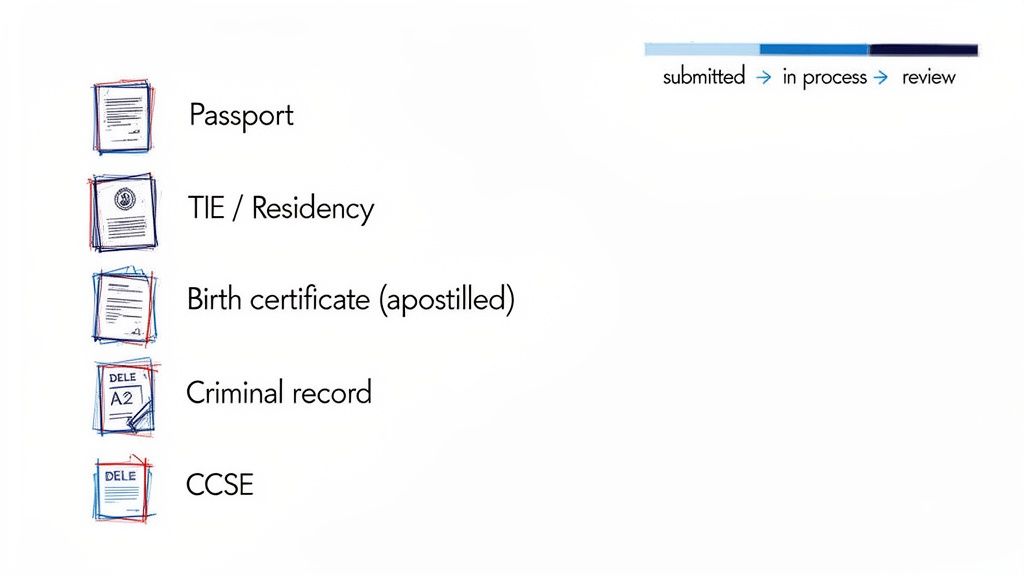
Let's get practical. While your specific situation might call for extra paperwork, this is the standard list that applies to nearly everyone applying through residency.
- Complete Passport: Not just the main page. A full, valid copy of every single page, blank ones included.
- Spanish Residency Card (TIE): A clear copy of the front and back of your current Tarjeta de Identidad de Extranjero.
- Birth Certificate: This needs to be a recent copy, apostilled in your home country, and then translated by a sworn translator here in Spain.
- Criminal Record Certificates: You'll need two of these. One from your home country (plus any other country you lived in for over six months in the last five years) and one from Spain. The Spanish one is issued by the Ministry of Justice. We can help you get your criminal record certificate without the usual runaround.
- Proof of Exam Passes: The certificates showing you passed the DELE A2 language exam and the CCSE cultural knowledge test.
- Proof of Fee Payment: The receipt from paying the administrative fee via form Modelo 790, código 026.
- Empadronamiento Certificate: A current certificate from your local town hall (ayuntamiento) to prove you're officially registered as a resident.
It is also worth remembering that your underlying residence history has to remain valid and compliant while you build up time toward nationality.
Submitting Your Application
Once your document pile is complete, it's time to submit. You can technically do this in person at a Civil Registry, but we strongly advise against it. The best, most efficient way is to file online through the Ministry of Justice's electronic portal.
Why? Two reasons. First, it’s much faster. An online submission is in the system instantly. A paper application can take months just to be scanned and logged. Second, the online platform lets you (and us, if we're helping) track your file's status directly.
The Waiting Game: What to Expect
Once you file, processing can still be slow. The Ministry of Justice has reported a very high volume of nationality applications and resolutions in recent years, so applicants should plan for a process that may extend well beyond the minimum legal timeline.
The practical message is to file cleanly, keep your address and contact details current, and expect the case to take time even if you qualify clearly.
Dual Nationality in Spain: The Official Rules vs. Reality
Spanish law treats dual nationality differently depending on the country involved. Citizens of Ibero-American countries, Andorra, the Philippines, Equatorial Guinea, Portugal, and France have a clearer legal route to keep both nationalities when they acquire Spanish citizenship.
The official exceptions
If you fall within one of those categories, the nationality process is usually more straightforward on this point. For everyone else, the oath stage generally includes a declaration of renunciation for Spanish legal purposes.
What happens in practice for other countries?
That Spanish declaration does not automatically determine what your original country will do. The effect on your previous nationality depends on the law of that country, so this point should be checked case by case before the oath rather than assumed from general summaries online.
The safest approach is to analyse the Spanish rules and your home-country rules together before you reach the final stage of the file.
After Approval: The Final Steps to Your Passport
That official approval letter, the concesión de nacionalidad, feels like the finish line. We see it all the time—clients think the hard part is over. But there are a few final, time-sensitive hurdles to clear before that Spanish passport is actually in your hands.
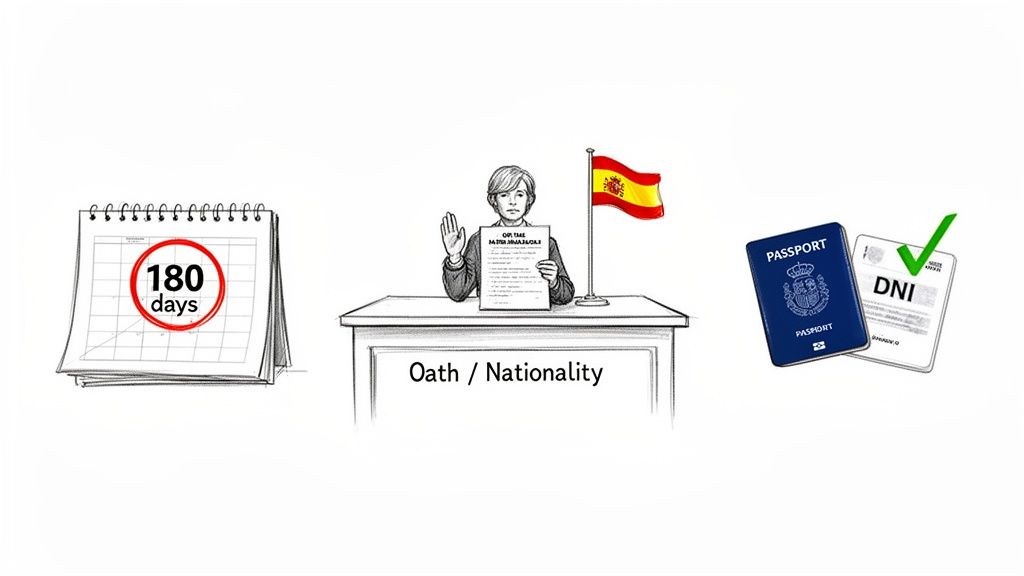
The moment that approval lands, a 180-day clock starts ticking. You have exactly that long to complete the oath ceremony, known as the jura de nacionalidad. This isn't a suggestion; it's a hard deadline, so you need to move quickly.
Scheduling and Completing the Oath Ceremony
You have two choices for the jura: your local Civil Registry (Registro Civil) or a public notary. We almost always recommend using a notary. Yes, it comes with a fee, but you can typically get an appointment in days or weeks, versus the months you might wait for an opening at the swamped Civil Registry.
The ceremony itself is the formal moment you legally become a Spanish citizen. During the appointment, you'll:
- Swear Allegiance: You'll pledge your loyalty to the Spanish King, the Constitution, and the laws of the land.
- Declare Your Nationality: This is where you formally state your position on your previous citizenship. As we've covered, for Spain this is mostly a formality.
- Register Your Name: Officials will confirm exactly how your first name and surnames will appear in the Spanish system.
Once the jura is done, the notary or registrar gets to work generating your official Spanish birth certificate (partida de nacimiento literal). This single document is the key to everything that comes next.
Here’s the most critical piece of advice we give every single client: The second you confirm your jura appointment date, get online and book your appointment for the DNI and passport. Police station slots can be booked up for weeks, and waiting until you have the birth certificate in hand is a recipe for frustrating delays.
Getting Your DNI and Spanish Passport
With your new Spanish birth certificate, you're on the home stretch. You’ll head to your pre-booked appointment at a National Police station (Comisaría de Policía Nacional) that issues identity documents.
Bring your birth certificate, your TIE card, a recent passport-sized photo, and your appointment confirmation. In that one visit, they will issue your DNI (Documento Nacional de Identidad) right on the spot. With your new DNI card in hand, you can then immediately request your Spanish passport at the same counter.
That’s it. Your journey through Spanish nationality law is officially complete. You are now a full citizen of Spain and the European Union.
Frequently Asked Questions About Spanish Nationality
Here are the answers to the questions we get asked every single day by clients navigating the path to Spanish citizenship.
How Long Can I Be Outside Spain and Still Qualify?
The law says your residency must be "continuous," but what does that actually mean? Generally, you can't be out of Spain for more than six months in a single stretch.
But here’s the unwritten rule we’ve learned from experience: frequent, shorter trips can also raise red flags. An officer reviewing your file might see a pattern of constant travel and decide your life isn't truly centred in Spain. Our advice is simple: keep your absences to a minimum.
Do My DELE and CCSE Exam Results Expire?
This is a critical detail that trips people up. Your DELE A2 language certificate is good forever. Once you pass it, you're done.
The CCSE cultural exam, however, is a different story. That certificate is only valid for four years. With government backlogs, it's entirely possible for your citizenship application to take longer than that to process. If it does, you'll have to sit for the CCSE exam all over again.
Can I Work in Other EU Countries with Spanish Citizenship?
Yes, absolutely. This is one of the biggest benefits. The moment your Spanish citizenship is granted, you are officially a citizen of the European Union.
That means you have the unconditional right to live, work, and study in any other EU member state—from Portugal to Poland, Ireland to Italy—without needing any special visas or work permits. The whole continent opens up.
Get It Right the First Time
Spanish nationality law isn't just complicated; it's unforgiving. The path to a Spanish passport is littered with strict deadlines, obscure document requirements, and bureaucratic traps that can set you back years.
We see it all the time. An applicant thinks they have continuous residency, only to find out a trip home broke the chain. Another submits a document that hasn't been properly legalized, forcing them to start the process from scratch after waiting a year for a decision. These aren't edge cases; they're common, costly mistakes.
Don't leave your future to chance. If you're not 100% certain which route to citizenship is right for you, or how to build an application that sails through the system, contact us for personalized advice. We'll map out a clear strategy based on your specific situation and make sure every detail is handled correctly.
Ready to take the next step? Contact us for clear, expert guidance on your specific case.
