


So, you're thinking about studying in Spain? It's a fantastic choice, but before you start packing, let's get one common mix-up out of the way. The Spanish student visa isn't a long-term residency permit. It’s what Spanish law calls an estancia por estudios—a temporary stay authorisation.
This legal status lets you live in Spain for the entire time you're studying, as long as your course is more than three months long. It's your official green light to immerse yourself in the culture while you learn.
Spain remains one of Europe's main destinations for international students, but the key point for your application is not the headline numbers. What matters is fitting your case into the study-stay rules and presenting a clean file from the start.
This visa is purpose-built for one thing: full-time education. It doesn't matter if you're enrolling in a university master's programme, signing up for an intensive language course, or taking part in an unpaid internship—this is the legal path you need to take.
Core Eligibility Requirements
To get your student visa application approved, you have to nail three fundamental pillars. Think of these as non-negotiable foundations. In our experience, getting these right from the very start is what separates a successful application from a rejected one.
Full-Time Studies: Your course has to be a serious commitment. Spanish authorities define "full-time" as a minimum of 20 hours of classes per week. You'll need an official acceptance letter from an accredited school in Spain to prove it.
Financial Proof: You must show you can support yourself without needing to rely on work in Spain. The benchmark is generally set by reference to 100% of the monthly IPREM, but the exact euro amount should always be checked against the official figure being applied when you file.
Complete Health Insurance: You’re required to have private health insurance from a company authorised to operate in Spain. This can't be just any policy; it must provide full coverage with no co-payments or deductibles for your entire stay.
In practice, many refusals come from basic documentary problems: incomplete financial evidence, insurance that does not meet the required standard, or enrolment documents that do not clearly support the length and nature of the studies.
Once you have a firm grip on these core requirements, you can start gathering your documents with real confidence. Our team helps students every day to make sure their school, finances, and insurance tick all the right boxes. If you want to start your application on solid ground, get in touch for some personalised advice.
Navigating the Visa Application Process
So, you’re ready to get your Spanish student visa. Great. The first thing you need to know is there are two main ways to do it. You can apply from your home country before you even pack your bags, or you can apply from right here in Spain after arriving as a tourist.
Both paths get you to the same place, but they move at different speeds and follow different rules. Picking the right one for you is important. We’ve seen countless students run into trouble by choosing a path that didn’t fit their timeline, so let’s break down how each one works.
Applying from Your Home Country
This is the traditional route, the one most people take. Your journey will start at the Spanish consulate or embassy in your country of residence. Simple enough, right?
The first hurdle, honestly, is often just getting the appointment. Consulates in busy countries can be booked out for months, so you need to be on top of this. Once you have a slot, you'll show up with your completed National Visa application form and your stack of supporting documents.
How long does it take? Plan on waiting anywhere from one to three months for a decision. You have to find that sweet spot: apply early enough to get the visa before your flight, but not so early that your documents, like your criminal record check, expire.
Applying from Within Spain
The other option gives you a bit more flexibility. You can enter Spain as a tourist and then apply for your student stay authorisation (estancia por estudios) while you're already here. This is a fantastic option, but it comes with one very, very firm deadline.
You have to submit your application to the local Foreigner's Office (Oficina de Extranjería) within the first 60 days of your legal entry into the Schengen zone. The clock starts the second your passport gets stamped at the airport. You have to move fast.
We see this mistake all the time: students wait until day 58 to get started. The 60-day window isn't a suggestion. If you file on day 61, your application is dead on arrival. You’ll be in an irregular situation and forced to leave Spain.
Whether you apply from home or in Spain, your application needs to stand on three solid pillars. If any of these are weak, the whole thing can collapse.
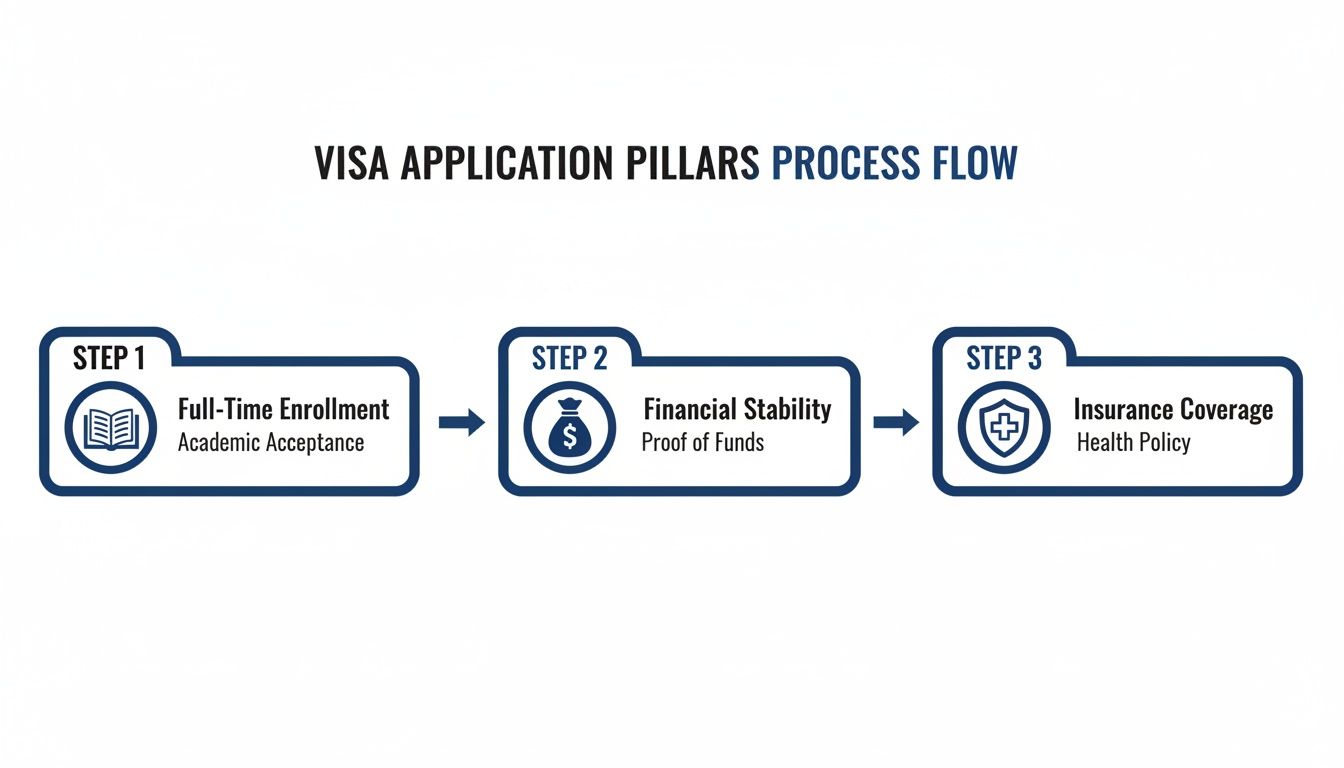
This just reinforces the non-negotiables: you absolutely must have a full-time study plan, prove you can support yourself financially, and have comprehensive health insurance. No exceptions.
A Step-by-Step Roadmap
To make it crystal clear, here’s how the process typically unfolds for each path.
If You Apply from Your Home Country:
- Document Hunt: Start gathering everything—the acceptance letter from your school, bank statements, health insurance policy, medical certificate, and your criminal record check.
- Legalise & Translate: Key documents like your criminal record and medical certificate will need an Apostille of The Hague. After that, they must be translated into Spanish by an official sworn translator (traductor jurado).
- Book the Appointment: Get online and book that consular appointment. Seriously, do this as soon as you can. It can take weeks, if not months.
- Submission Day: Head to your appointment. You’ll hand over your application form and all your carefully prepared documents.
- The Waiting Game: The consulate will review your file. Expect it to take one to three months.
- Visa in Hand: Once it's approved, you'll go back to the consulate, and they'll place the visa sticker in your passport.
- ¡Vamos a España! You're cleared for travel. You can now legally enter Spain and start your studies.
If You Apply from Within Spain:
- Arrive in Spain: Enter the country as a legal tourist. Double-check that you get an entry stamp in your passport. This is your proof of entry date.
- Assemble Your File, Fast: You've got no time to waste. Get all your documents in order, making sure they meet the specific requirements here in Spain.
- File Online: The application must be submitted electronically to the Foreigner's Office. This has to be done within your first 60 days. We handle these digital submissions for clients across Spain.
- Wait for the Resolution: The government has up to three months to respond, but it’s often much quicker for applications filed within Spain.
- Next Steps: As soon as you're approved, you can move on to the post-arrival tasks, like getting your TIE residency card.
Understanding which of these two processes is right for you is the first real step to a successful application. Learn more about how our expert team can manage your student visa in Spain from start to finish.
Not sure which path fits? Book a consultation and we'll map out the best option.
Your Essential Student Visa Document Checklist
Need help with your case in Spain?
If this article applies to your situation, contact our team for tailored legal guidance and clear next steps.
Let's be direct. Getting your documents in order isn't just a step in the process; it’s the entire foundation of your application. In our experience, well over 90% of student visa rejections boil down to simple document mistakes—missing information, incorrect formats, or a botched translation.
We're going to break down exactly what you need, with practical tips to make sure every single paper is perfect.
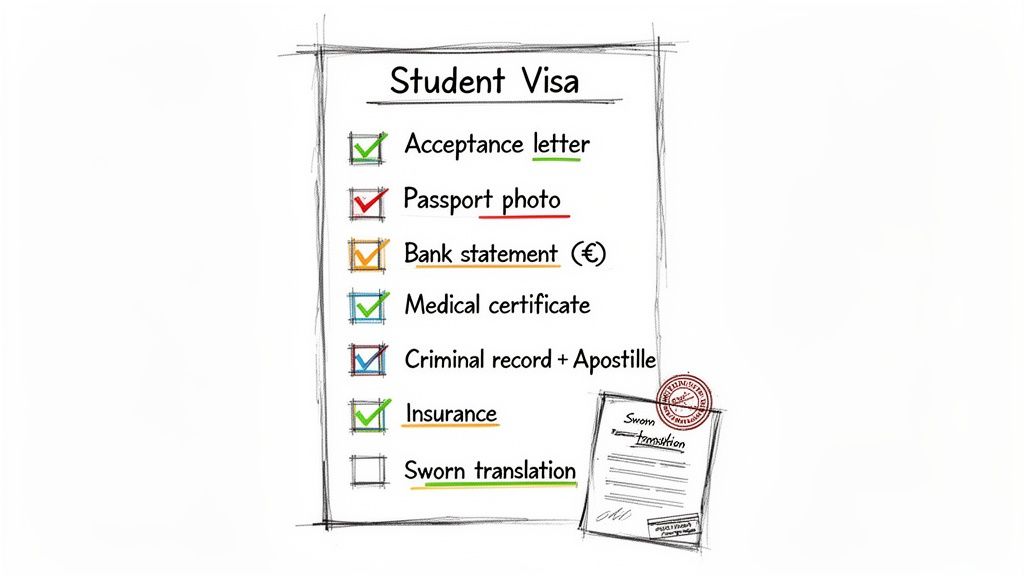
Core Application Forms and Personal ID
First, the absolute basics. These are the non-negotiable items that officially start your file with the Spanish consulate.
- National Visa Application Form: This is your formal request. Fill it out completely and sign it. Double-check every single field, because even a tiny mistake can stall the whole process.
- Valid Passport: Your passport must be valid for the entire duration of your planned stay in Spain. You'll need to submit the original along with a photocopy of the main pages.
- Passport-Sized Photographs: You'll need two recent, high-quality colour photos taken against a plain white background. Don't try to use an old picture; consulates have strict rules about how recent they must be.
Academic and Financial Proof
Next, you have to prove two things: why you're going to Spain and that you can afford to be there. This is where many applicants stumble.
Your official acceptance letter (carta de aceptación) from an accredited Spanish institution is the centrepiece. It has to confirm your full-time enrolment (a minimum of 20 hours per week), state the course dates, and show that you've paid the tuition.
For proof of financial means, you can't just show a random bank statement. You must prove you have access to 100% of Spain's monthly IPREM (currently €600) for every month you'll be in Spain. For a one-year course, that's a minimum of €7,200. The money has to be in an account in your name, and you'll typically need to provide statements covering the last three to six months.
Medical and Legal Documentation
This is where things get more complicated because of legalisation and translation rules. Seriously, don't underestimate how much time these steps take. We constantly see clients scrambling at the last minute because they didn't factor in this bureaucracy.
- Medical Certificate: A recent letter from your doctor is required. It must state that you are free from any diseases that could pose a serious public health risk, as defined by the International Health Regulations of 2005.
- Criminal Record Check: You must provide a police clearance certificate from every country where you've lived for the past five years. And it has to be clean.
Both the medical certificate and the criminal record check need two extra steps before Spain will accept them:
- Apostille of The Hague: This is an international certification that authenticates your document. Without it, your document is worthless in Spain.
- Official Sworn Translation (Traducción Jurada): After the apostille is attached, the entire document—apostille included—must be translated into Spanish by a government-approved sworn translator.
A classic mistake we see is a DIY translation or using a standard service. It absolutely must be a traducción jurada. Anything else will be rejected on the spot. We manage the apostille and sworn translation process for our clients to guarantee it's done right the first time.
For health coverage, the practical point is simple: the policy should come from an insurer authorised to operate in Spain and it should match the level of cover required by the consulate or immigration office handling your case. Fee schedules and local consular procedures can vary, so it is worth checking the exact filing instructions before booking your appointment.
Getting every single document right is the key. Contact us for personalized advice, and we'll make sure your application file is flawless from the start.
What to Do When You Arrive in Spain
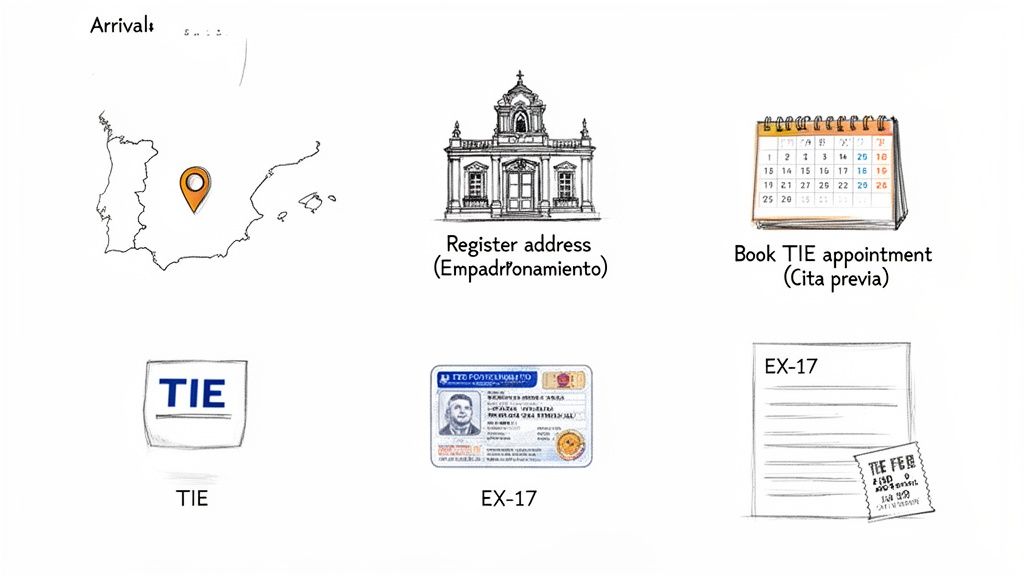
Your visa is stamped, your bags are unpacked, and you've officially landed in Spain. Congratulations! The biggest hurdle is behind you, but a few administrative tasks are waiting. These aren't optional—they're required to formalise your legal stay. The most important of all is getting your Foreigner Identity Card, known as the TIE (Tarjeta de Identidad de Extranjero).
Think of the TIE as your official physical ID card in Spain. It confirms your legal status as a student and will be your go-to document for everything from opening a bank account to signing a flat contract. You must apply for it within 30 days of your arrival.
Step 1: Registering Your Address or Empadronamiento
Before you can even think about the TIE, you need an official address. This is done through a process called empadronamiento, which is basically registering with your local town hall (Ayuntamiento). You'll need your passport and proof of where you live, like a rental contract or a letter from your landlord.
Once that's done, you'll get your Certificado de Empadronamiento. Hold onto this document; it's essential for your TIE application and pops up constantly in Spanish bureaucratic life.
Step 2: Securing Your TIE Appointment
With your empadronamiento certificate in hand, it's time to book your TIE appointment. This is done online through the government's notoriously tricky cita previa system. We've seen it all across Spain—these appointments can be incredibly difficult to get, especially in big cities like Madrid or Barcelona.
You have to be persistent. Check the system frequently, often first thing in the morning when new slots are sometimes released.
A common mistake we see is students waiting too long to book this appointment. The 30-day arrival window is for starting the process. If you can't find an appointment within that time, having proof that you've been actively trying can be helpful. Don't delay.
Getting your TIE card is a common headache, but we can help you navigate the appointment system and get your documents in perfect order. Find out more about our services for obtaining your TIE card in Spain.
Step 3: Preparing for Your Appointment
Once you finally have a date, it’s time to gather your paperwork for the appointment at the designated police station (Comisaría de Policía). Here’s what you absolutely must bring:
- Application Form EX-17: The official TIE application form. Fill it out completely and bring two printed copies.
- Proof of Fee Payment: You have to pay the administrative fee using form Tasa 790-012 (currently €16.08) at a bank before your appointment. The stamped receipt is your proof.
- Passport: Bring your original passport, plus a photocopy of the main photo page and the page with your visa stamp.
- Recent Passport-Sized Photo: One recent colour photo with a plain white background.
- Certificado de Empadronamiento: Your proof of address, issued within the last three months.
- Visa Resolution Letter: This is the letter that confirmed your student stay was approved in the first place.
At the appointment, an official will check everything and take your fingerprints. You won't get the card on the spot. They’ll give you a receipt (resguardo) and tell you to come back in about 30-45 days to pick up your shiny new TIE card.
The table below breaks down the two main post-arrival tasks to help you keep things straight.
Post-Arrival Checklist: TIE and Empadronamiento
| Procedure | Key Steps | Required Documents |
|---|---|---|
| Empadronamiento | 1. Book an appointment at your local town hall (Ayuntamiento). 2. Attend the appointment and register your address. |
– Passport (original and copy) – Proof of address (rental contract, utility bill) – Completed application form |
| TIE Card | 1. Get your empadronamiento certificate first. 2. Book a cita previa online for "Toma de Huellas". 3. Pay the fee (Tasa 790-012). 4. Attend the police station appointment. 5. Return 30-45 days later to collect the card. |
– Form EX-17 – Paid Tasa 790-012 receipt – Passport & visa (original and copies) – Passport photo – Empadronamiento certificate |
Getting these steps right sets you up for a smooth year. It's a bit of a bureaucratic marathon, but crossing the finish line feels great.
Of course, to truly make the most of your time here, you'll want to dive into the culture. A huge part of that is the language. Finding the best way to learn Spanish will completely transform your experience, opening doors both socially and professionally.
These post-arrival steps are a rite of passage for every international student in Spain. If the bureaucracy feels like too much, just know you're not alone. Contact us for personalized advice to get it all sorted.
Working and Staying in Spain After Your Studies
One of the first questions we get from students is always, "What happens next?" Many want to work during their studies or, better yet, find a way to stay in Spain after they graduate. The good news is, the system is built for this. There are clear paths for both.
Current rules are quite friendly. You can now work up to 30 hours per week, so long as the job doesn't interfere with your classes. This is a huge improvement over the old rules and makes it much easier to get professional experience and earn some money while you're here.
Just remember, you can't start working automatically. Your employer needs to get a separate work authorisation for you from the immigration office. It's a formal step, so don't just assume your student visa includes the right to work.
Renewing Your Student Stay
What if you want to keep studying? If your first course ends and you enrol in another, you don't have to start the whole visa process over from scratch. Instead, you can simply apply for a renewal, known in Spanish as a prórroga de estancia por estudios.
To get the renewal, you'll need to prove a few key things:
- You're still a student: An acceptance letter for your new, full-time course is essential.
- You passed your last course: You have to show you successfully completed your previous studies. Official grades or a certificate will do the trick.
- You can still support yourself: Just like your first application, you must prove you have the funds. The requirement is still 100% of the IPREM, which is €600 per month.
You should apply for the renewal within the 60 days before your current TIE card expires or up to 90 days after it expires. Honestly, it's always better to apply before it expires to avoid any gaps in your legal status. To get a better handle on the renewal process, you can learn more about residency renewal process in Spain on our services page.
Transitioning to a Work Permit After Graduation
For most people, studying in Spain is the first step toward building a life here. The system has several clear pathways for graduates to switch from a student stay to a proper residency and work permit. This is a critical move because your student stay (estancia por estudios) doesn't count towards long-term residency or Spanish citizenship on its own.
These are the most common routes we help students take:
- Job Search Residence Permit (Búsqueda de Empleo): This gives you a one-year permit to stay in Spain legally after you finish your degree to look for a job or start a business. It's the perfect bridge from student life to your professional career.
- Highly Qualified or specialist work route: In some cases, graduates move into a faster work-permit route for roles that meet the salary and profile rules in force at the time. Those thresholds should be checked when the job offer is on the table rather than assumed in advance.
- Standard Work Permit (Cuenta Ajena): Got a job offer that doesn't fit the "highly-qualified" box? You can still apply for a standard work permit. The process is a bit more involved because it considers the national employment situation, but it's a perfectly viable option.
A critical detail that trips many students up: you must apply to change your status while your student TIE is still valid. If your card expires before you submit your application to switch to a work permit, you lose the opportunity and will have to leave Spain.
Moving from student to professional is a major legal shift. Each of these options has its own specific requirements, deadlines, and paperwork.
Not sure which path fits? Book a consultation and we'll map out the best option.
Common Visa Rejection Reasons and How to Avoid Them
We’ve seen it happen more times than we can count. A student has everything lined up—acceptance letter, flights, a place to live—only to have their visa application rejected. A rejection isn't just a setback; it can throw your entire academic year off course.
From our experience handling applications across every Spanish consulate, the same few mistakes trip people up again and again. Understanding what goes wrong is the best way to make sure your application goes right.
The number one reason for rejection? Insufficient proof of financial means. It’s not enough to just show the minimum amount required. A last-minute, lump-sum deposit into your account is a huge red flag for consular officials. They need to see a stable, consistent financial history with funds that are clearly yours and accessible.
Incomplete or Incorrect Paperwork
The next biggest killer of visa applications is flawed paperwork. This is where small details have massive consequences. We regularly see denials for simple, totally avoidable errors.
- Missing a Sworn Translation: Any official document not in Spanish must be translated by an official traductor jurado. A regular translation won't cut it and leads to an automatic rejection. Your medical certificate and criminal record check are the usual suspects here.
- Forgetting the Apostille: Before you even think about translation, key documents from your home country (like that criminal record check) need an Apostille of The Hague to be legally recognised in Spain. Skipping this step makes your document invalid.
- Wrong Type of Medical Insurance: Your health insurance must be with a company authorised to operate in Spain. The policy must explicitly state it has no co-payments (sin copagos). Most standard travel insurance plans fail to meet this strict requirement.
Honestly, about half the rejections we're asked to fix come down to one of these three documentation errors. It's frustrating because a thorough check would have caught it instantly.
Finally, timing is everything. Applying too late leaves no buffer for delays. But apply too early, and some of your documents, like the police clearance certificate, could expire before the consulate even makes a decision.
This is exactly where we come in. We don't just fill out forms; we manage the whole process, checking every document and making sure every legal box is ticked perfectly. If you want to build an application designed for approval from day one, get in touch with us for personalised advice.
Your Student Visa Questions Answered
We get these questions all the time. Here are the straight-up answers to the most common queries we see from students planning their move to Spain.
Can I Bring My Family with Me?
Yes, you absolutely can. Spain allows student visa holders to bring their spouse, civil partner, and dependent children.
The main thing you'll need to show is that you can support them financially. The rule is an additional 75% of the IPREM for your first family member, and 50% for each person after that. This is on top of the 100% you need for yourself. Of course, you'll also have to prove your relationship with official documents like marriage and birth certificates.
How Much Money Do I Actually Need in the Bank?
You have to prove you have enough funds to support yourself for your entire stay. The magic number is 100% of Spain's monthly IPREM, which is currently €600 per month.
So, if you're coming for a one-year master's program, you'll need to show a bank account in your name with at least €7,200 (€600 x 12 months). The key is that the money must be yours and readily accessible.
What’s the Deal with Health Insurance?
This is a big one. You need a private Spanish health insurance policy that offers complete coverage in Spain, basically mirroring what the public system provides.
This is, without a doubt, one of the top reasons we see applications get rejected. Your policy must have no co-payments (sin copagos) and no deductibles. It also needs to cover things like hospitalisation and repatriation of remains. Your standard travel insurance from back home? It almost never cuts it.
How Long Is This Whole Process Going to Take?
Patience is key. The timeline really depends on where you apply. If you're submitting your application at a Spanish consulate in your home country, you should budget for anywhere between one and three months for a decision.
Applying from within Spain is often a bit quicker. While the government officially has three months to respond, in our experience, it's usually faster than that.
Getting the student visa right involves a lot of moving parts, and a small mistake can lead to big delays. We handle the entire process for students all over Spain, making sure every document is perfect and every deadline is met.
