
AEAT tax residency certificate in Spain: when foreigners need it
An AEAT tax residency certificate for Spain is evidence of a tax position. It does not create that position. Before requesting one, identify who has asked for it, the tax year involved, the other country and the wording or form the recipient expects.
The answer determines which document to request. A foreign bank may want a current Spanish certificate for its records, while a foreign tax authority or payer may require proof of residence under a particular double-tax treaty. Those are different documents.
Do not use immigration documents as a shortcut
A NIE, TIE, visa or padrón may be relevant evidence, but none decides Spanish tax residence for a tax year on its own. The domestic rules, the facts for that year and, where another state also claims residence, the applicable treaty must be examined.
Choose the certificate that matches the request
AEAT describes two relevant versions. Where the destination country has a tax treaty with Spain, the certificate states residence in the sense of that treaty. For a country without a treaty, it states Spanish residence. AEAT says both are issued in Spanish and English on its tax-residence certificate page.
Order EHA/3316/2010 approves Annex IV for general proof of residence in Spain and Annex V for proof of residence under a Spanish double-tax treaty. It identifies foreign tax administrations, foreign payers and other foreign economic operators as intended recipients. The choice should follow the recipient’s written request, not a convenient label.
A treaty certificate cannot be selected safely without knowing the country and relevant period. If Spain and another state both treat the person as resident, the actual treaty’s residence article and any competent-authority provision must be checked, including amendments in force for that year. Generic OECD wording is not a substitute for the applicable treaty published in the BOE.
Reconcile one tax year before applying
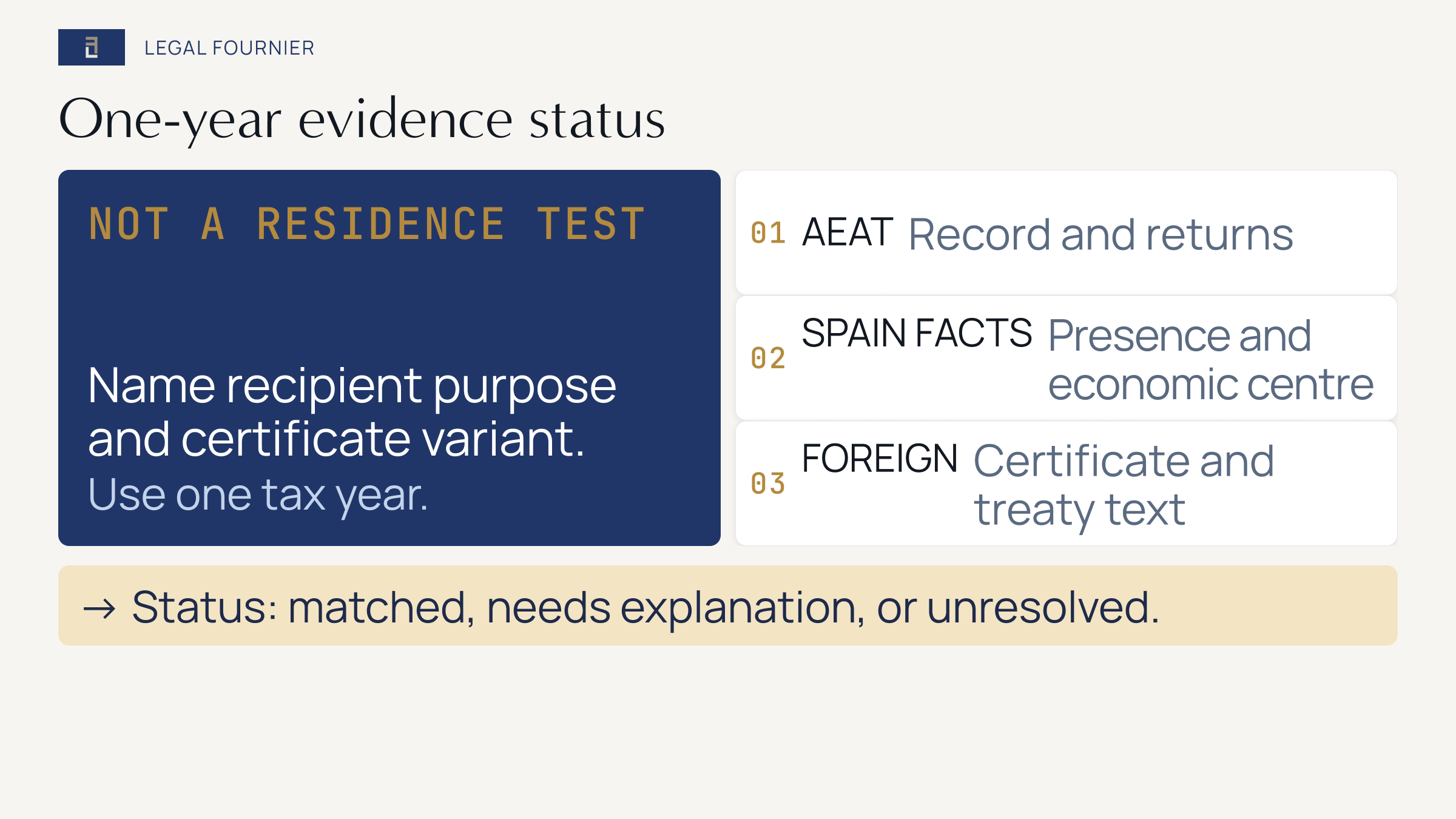
A ledger makes contradictions visible without pretending to calculate residence. Complete it for one identified year and use “unclear” or “unresolved” where the evidence does not support a conclusion.
| Ledger row | Evidence or fact field | Legal or source field | Permitted status |
|---|---|---|---|
| Recipient request | Recipient, purpose, country, wording or form, freshness requirement | Recipient document and applicable official rule | identified / unclear |
| Certificate variant | General or treaty; requested period | AEAT certificate page and Order annex IV or V | matched / needs correction |
| AEAT records | Fiscal address or status and relevant returns | Current AEAT record or filing evidence | consistent / needs explanation |
| Presence | Travel-day record and any sporadic-absence issue | IRPF article 9.1(a) | consistent / legal conflict |
| Economic centre | Activities and economic-interest facts | IRPF article 9.1(b) | consistent / legal conflict |
| Family presumption | Only the family facts article 9 makes relevant | IRPF article 9.1 final paragraph | consistent / needs explanation |
| Foreign position | Foreign certificate, return or authority request | Official foreign document kept private | consistent / dual claim |
| Treaty | Treaty and protocol in force for the year | BOE treaty text for the named country | matched / unresolved |
| Submission route | Identity or representation method and supporting documents | AEAT G305 and current request guidance | ready / not ready |
Read the ledger as a reconciliation aid rather than a points test. A mixed status or a missing record does not decide residence automatically. The ledger shows whether the requested certificate, AEAT’s records and the person’s factual and foreign tax positions tell a coherent story.
The domestic residence test is wider than day count
For an individual, article 9 of the current Spanish IRPF law sets alternative statutory circumstances. One concerns presence in Spain for more than 183 days during the calendar year, with detailed wording on sporadic absences. Another concerns whether the principal centre or base of the person’s activities or economic interests lies in Spain, directly or indirectly. The article also contains a rebuttable presumption linked to specified family facts.
“I spent fewer than 183 days in Spain” is therefore an incomplete residence opinion. Article 9 does not operate as a score or require every listed circumstance to be satisfied. A TIE, a home, a municipal registration, a Spanish bank account or a filed return can form part of the evidence, but no single item replaces the legal analysis.
AEAT issues the certificate using information available to it. A request does not repair inconsistent census data, returns, day-count evidence or a foreign residence position. Where the ledger reveals a real domestic-law or treaty dispute, deal with that analysis before treating the certificate application as an administrative formality.
How the request is made
The AEAT G305 procedure sheet allows an electronic request or an office route. It lists Modelo 01 for the office application. The taxpayer may request the certificate, as may an authorised requester under the stated conditions; representation has to be evidenced rather than assumed.
AEAT’s current online request guidance describes access with an electronic certificate, DNIe or Cl@ve Móvil. It also explains representation, status checks, immediate generation where possible and later retrieval where a certificate cannot be generated at once. “Immediate where possible” describes the channel; it is not a promise that a positive certificate will appear immediately.
The specific G305 procedure and Order EHA/3316/2010 state a maximum period of ten working days. That is the relevant sourced period for this certificate, rather than the general 20-day certificate rule. The period is not a guaranteed delivery date, and silence does not create a positive certificate. The AEAT delivery guidance also distinguishes electronic availability, including DEHú, from postal delivery rules for people who are not required to interact electronically.
If the certificate is wrong or the recipient has its own form
After issue, a taxpayer who disagrees with data in the certificate may submit a written disagreement within ten days from the day after receipt, with supporting evidence. If AEAT agrees, it issues a new certificate within ten days; if it does not, it must give reasons. Under the certificate rules in RD 1065/2007, the certificate itself is not subject to an administrative appeal or economic-administrative claim. The disagreement route should not be labelled an “appeal”. A separate later administrative act may have its own challenge route.
An electronic certificate has the same effects as a paper certificate and includes a secure verification code. AEAT also publishes a route for certain foreign-authority residence forms. Check the receiving body’s requirements first; the standard Spanish certificate is not guaranteed to satisfy every foreign form or additional statement.
Article 75 of RD 1065/2007 contains a general validity rule of 12 months for periodic obligations and three months for non-periodic obligations, unless a specific rule provides otherwise and while the determining circumstances remain unchanged. That rule does not guarantee acceptance for every use. The certificate type, covered period and the recipient’s own freshness requirement still matter.
When a review should come before the request
Pause where Spain and another country both appear to claim residence, where Spanish filings conflict with a foreign certificate, or where the presence and economic-centre evidence point in different directions. The same applies when the recipient’s request does not say whether it needs general Spanish proof or treaty-specific proof.
For a focused review through Legal Fournier’s English contact page, provide the tax year, the recipient’s written request, the country, the proposed certificate variant and the residence evidence relevant to that period. The review can establish whether the application is ready or whether the domestic or treaty position needs attention first. It cannot guarantee AEAT issuance, timing, retroactive effect or acceptance by the foreign recipient.