


Everything about your Spanish tax obligations starts with one question: are you a tax resident?
This isn't just a technicality; it's the fork in the road that determines your entire financial relationship with Spain. Get this right, and everything else falls into place. Get it wrong, and you're heading for confusion and potential trouble with the Agencia Tributaria (the Spanish Tax Agency).
Your First Question: What Taxes Will You Pay In Spain?
Let's cut straight to it. Your tax situation as an expat boils down entirely to whether Spain considers you a resident for tax purposes. If you are, you'll pay tax on your worldwide income. If you're not, you'll only pay tax on income generated inside Spain.
We see this often—expats getting tangled up because they assume their visa type or nationality dictates their tax status. It doesn’t. Spanish law looks at objective facts: how many days you spend here and where the center of your life truly is.
The Fundamental Difference
At its heart, the distinction is simple. A tax resident is fully plugged into the Spanish system. They file the comprehensive annual income tax return (IRPF) and must declare everything they earn, no matter where in the world it comes from.
A non-resident, on the other hand, has a much more limited connection. Their tax obligations are strictly confined to their economic footprint in Spain, like rental income from a Spanish property or salary from a Spanish employer.
In our experience, the most common mistake is people thinking, "I already pay tax in my home country, so I'm covered." That's a dangerous assumption. Your Spanish tax residency creates a legal duty to file here, period. Double taxation treaties will prevent you from being taxed twice on the same euro, but they don't erase your obligation to report to Spain in the first place.
To make this crystal clear, we've broken down the two statuses side-by-side.
Tax Resident vs Non-Resident At A Glance
This table gives you a high-level summary of the critical differences between being a tax resident and a non-resident in Spain. It's a quick way to see which category you might fall into.
| Factor | Tax Resident | Non-Resident |
|---|---|---|
| Primary Tax | Personal Income Tax (IRPF) | Non-Resident Income Tax (IRNR) |
| Tax Base | Worldwide Income | Spanish-Sourced Income Only |
| Tax Rates | Progressive (19% to 47%+) | Flat Rate (typically 24%) |
| Main Filing Form | Modelo 100 | Modelo 210 |
| Foreign Asset Reporting | Required (Modelo 720) | Not Required |
Figuring out which column you belong in is your first and most vital step. The consequences of each are completely different, affecting everything from your tax rates to your reporting requirements.
Now, let's look into exactly how the Spanish authorities determine this status.
Determining Your Spanish Tax Residency Status
So, how does Spain decide if you're a tax resident? Many expats think it's all about the famous 183-day rule, but that's just the starting point. The Spanish Tax Agency (Agencia Tributaria) uses a series of tests, and meeting just one is enough to classify you as a tax resident.
Once that happens, you're obligated to pay Spanish tax on your worldwide income. It’s a critical distinction that trips up many newcomers.
The 183-Day Rule Explained
This is the most straightforward test. If you spend more than 183 days in Spain during a single calendar year (1 January to 31 December), you are automatically a tax resident. It's a simple tally.
But be careful how you count. The authorities count any part of a day you are physically in Spain as a full day. This includes your arrival and departure days. That quick Monday-to-Friday trip? That's five days in their book, not three. Sporadic absences, like holidays, don't reset the clock unless you can prove tax residency somewhere else.
Beyond Physical Presence: Center of Interests
Even if you spend less than 183 days here, you’re not automatically off the hook. This is where it gets more nuanced. The tax authorities look at your “center of interests” to figure out where your life is primarily based. These tests often catch expats by surprise.
First up is the center of economic interests. This test looks at where the core of your professional or business activities is located.
- Do you work for a Spanish company?
- Are your main clients in Spain, even if you’re a remote worker for a foreign business?
- Are your most significant investments or income-generating assets located here?
If the answer to questions like these points to Spain, you could be considered a tax resident, no matter how many days you've been in the country. We can help you navigate these gray areas, but you can also dig deeper with our detailed guide on how Spain defines tax residency.
This flowchart breaks down the key questions the Spanish Tax Agency asks. It shows how they decide if you pay taxes like a resident on worldwide income or like a non-resident on just your Spanish income.
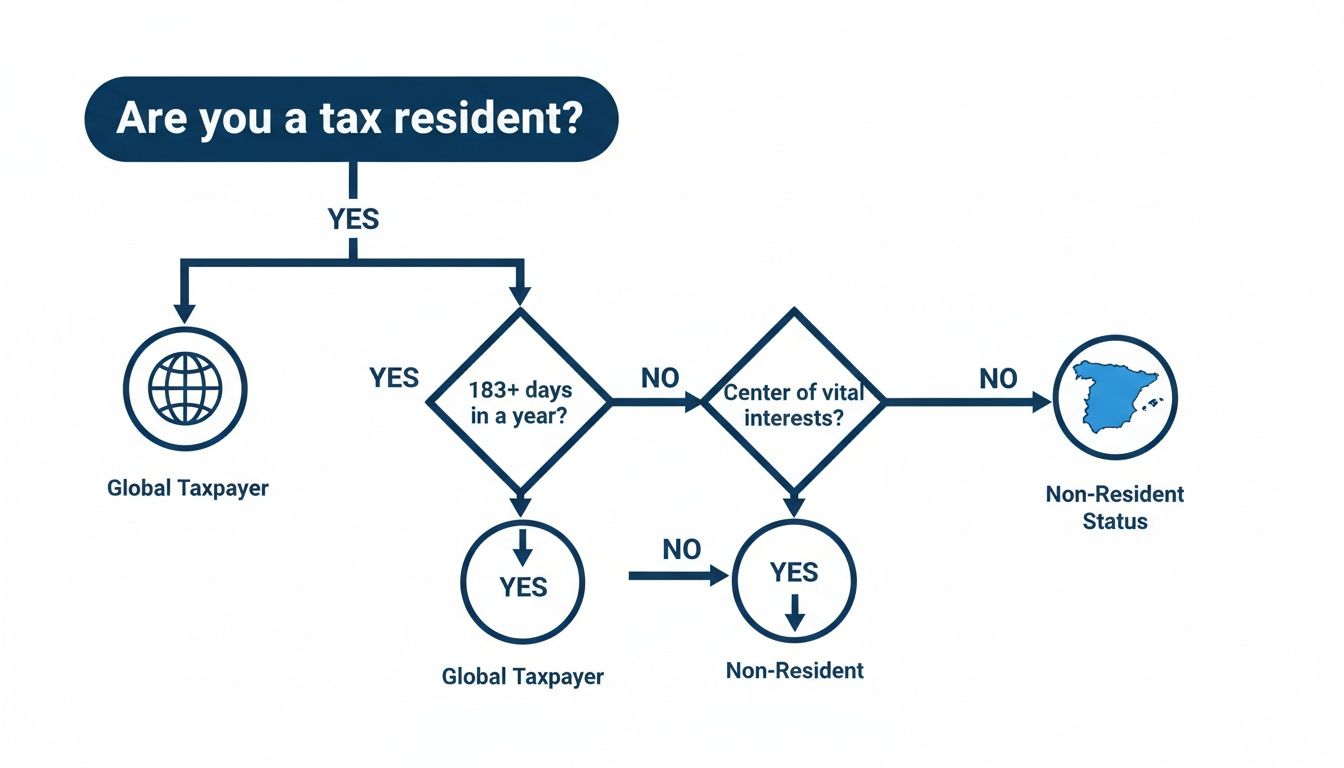
The key takeaway is that the 183-day rule is just the first checkpoint. Your economic and family ties can be just as decisive.
The Deciding Factor: Family Ties
The final test is the center of vital interests. This is a powerful legal presumption that is very difficult to argue against. If your spouse (and you aren't legally separated) and your dependent minor children live in Spain, the law presumes you are also a tax resident.
Practical Example: An IT consultant lives in Portugal for nine months of the year, but their spouse and children live full-time in Barcelona. Even though the consultant spends well under 183 days in Spain, the Agencia Tributaria will presume they are a tax resident because their family nucleus—their center of vital interests—is in Spain.
To overcome this, you would need to produce an official tax residency certificate from another country. Proving your life is genuinely centered elsewhere is a high bar to clear when your immediate family lives here.
Understanding these three tests—physical presence, economic interests, and vital interests—is non-negotiable. Getting it wrong can lead to incorrect filings, back taxes, and significant penalties. If you're unsure where you stand, contact us for personalized advice.
How Residents Are Taxed On Worldwide Income
Once you become a Spanish tax resident, the game changes completely. Your financial world is no longer just about what you earn in Spain; it’s about everything you earn, everywhere. You're now under the national Personal Income Tax, known as Impuesto sobre la Renta de las Personas Físicas, or IRPF.
Think of it as Spain’s core tax on individuals. It applies to your total global income, meaning your salary from a Spanish employer, rent from a flat in the UK, dividends from US stocks, and freelance income from clients in Germany all get bundled together. The system is progressive, which means the more you make, the higher the tax rate you pay on each new slice of income.
Understanding Spain's Progressive Tax Brackets
The IRPF system doesn't hit your entire income with one single rate. This is where most new expats get tripped up. Instead, it slices your income into different brackets, taxing each piece at an increasing rate. You pay a certain percentage on the first chunk, a higher percentage on the next, and so on.
The system is also a hybrid. Part of the tax rate is set by the national government, which is the same for everyone. The other part is decided by the autonomous community where you live. This regional twist means your final tax bill will look different in Andalusia than it does in Catalonia or Madrid.
For now, let’s stick to the national tax brackets, as they form the foundation of any calculation.
Spending over 183 days a year in Spain makes you a tax resident, and that triggers the progressive IRPF on your worldwide income. Rates start at 19% for earnings up to €12,450, jumping to 24% up to €20,200, then 30% up to €35,200, 37% up to €60,000, 45% up to €300,000, and finally 47% on anything above that. And remember, regional rates get added on top. For another perspective on this, check out the HSBC Expat Explorer guide.
A Practical Example of How IRPF Works
Let's make this real. Imagine a single professional living and working in Spain with a gross annual salary of €150,000. Here’s a simplified look at how their IRPF would be calculated:
- Find the Taxable Base: First, we make a few deductions. Let's subtract social security contributions (say, €4,200) and a standard general deduction (e.g., €2,000). This leaves a taxable base of €143,800.
- Apply the Brackets: Now we apply the tax rates to each slice of that income. The first €12,450 is taxed at 19%, the next portion up to €20,200 gets hit with 24%, and so on, until we've accounted for the full €143,800.
- Calculate the Gross Tax: After adding up the tax from each bracket, we get a gross tax liability of roughly €55,611.
- Subtract Personal Allowances: From this figure, we can deduct the standard personal allowance, which is €5,550 for a single person under 65.
- Final Tax Bill: This brings the final tax due to around €50,061. This is just an approximation, of course. The exact amount depends on the rates in their autonomous community and any other deductions they might qualify for.
This example really shows how quickly the tax bill climbs for higher earners under a progressive system.
A Separate System For Savings and Investment Income
One of the most important features of the IRPF is that not all income is treated the same. Your salary, freelance gigs, and rental income fall into the "general" bucket. But there’s a whole separate, much friendlier tax treatment for savings and investment income.
This category covers things like:
- Interest from your bank accounts
- Dividends from shares
- Capital gains from selling assets like property or stocks
- Income from life insurance policies
This type of income gets its own set of lower, progressive rates. For 2024, they look like this:
- 19% on the first €6,000
- 21% on income from €6,001 to €50,000
- 23% on income from €50,001 to €200,000
- 27% on income from €200,001 to €300,000
- 28% on anything above €300,000
Your final tax bill is a combination of the tax on your general income and the tax on your savings income. Knowing which income stream falls into which category is critical for proper tax planning. The Spanish system has a lot of moving parts, and getting it right from the beginning saves a world of headaches later. If you need help calculating what your IRPF liability might look like, contact us for personalized advice.
How Your Location In Spain Changes Your Tax Bill
Where you decide to live in Spain isn't just a lifestyle choice; it’s a major financial decision. In our experience helping expats settle across Spain, one of the biggest surprises is learning just how much their final tax bill can change based purely on their address.
Spain’s tax system isn't one single, uniform structure. It’s a partnership between the national government and the country’s 17 autonomous communities. The central government sets a base income tax rate, but each region gets to add its own layer right on top. This isn't a minor tweak—we’re talking about a difference that can easily run into thousands of euros per year on the exact same salary.
A Tale Of Two Cities: Madrid vs Barcelona
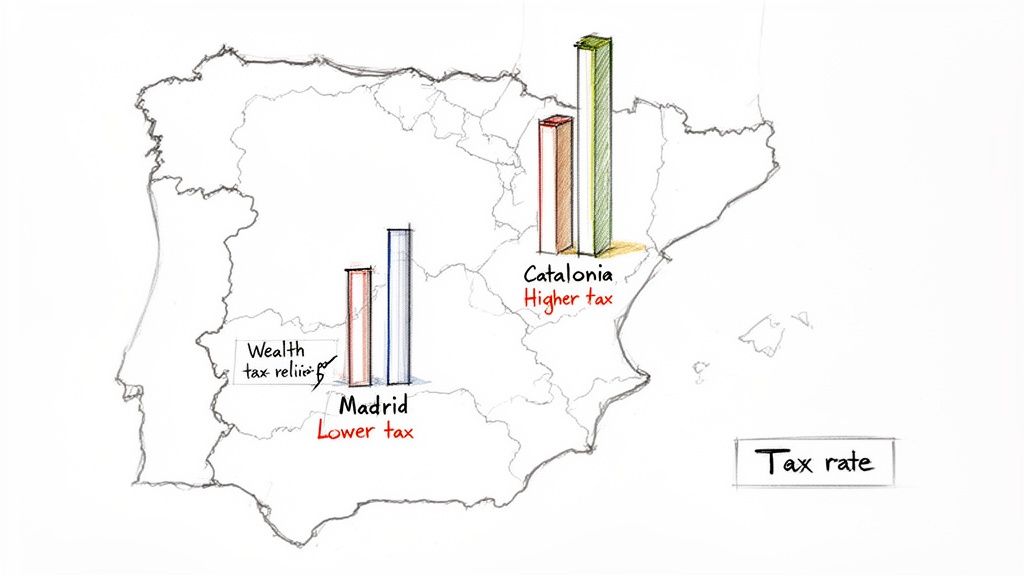
To make this real, let’s compare two of Spain’s most popular spots for expats: Madrid and Catalonia (home to Barcelona). These two regions sit at opposite ends of the tax spectrum.
Madrid has deliberately positioned itself as a low-tax haven within Spain. It consistently offers lower regional income tax rates, a strategy that especially benefits middle and high earners. For someone with a significant salary, simply choosing to be a tax resident in Madrid instead of a high-tax region can translate into substantial annual savings.
On the other hand, regions like Catalonia and Valencia are known for having some of the highest regional tax burdens in the country. They offer incredible lifestyles, no doubt, but you’ll pay a premium in taxes for the privilege of living there.
In Spain, your tax bill could vary dramatically depending on where you plant your flag. For instance, the baseline progressive rates for tax residents start at 19% but regions pile on their share, pushing top marginal rates from 42.72% to as high as 54%. For more details on these regional differences, you can find a good breakdown on Greenback Tax Services.
The Real-World Impact on Your Salary
Let’s put some numbers to this. Imagine two expats, each earning a gross salary of €150,000. One lives in Madrid, the other in Catalonia.
- In Catalonia: The minimum regional income tax rate is 20%, climbing to 50% at the top end. On a €150,000 salary, the expat could face a tax bill of around €35,600.
- In Madrid: With more favorable tax brackets, the same person would see a significantly lower bill. The difference often comes down to just a few percentage points at each income level, but that adds up fast.
This regional patchwork repeats itself across the country. An entrepreneur in the Basque Country might pay €37,500 on that same €150,000 income, while someone in Navarre would pay even more. This is exactly why strategic location planning has to be a core part of managing your finances as an expat in Spain.
It's Not Just About Income Tax
The regional differences don't stop with your paycheck. Other major taxes are also managed at the autonomous community level, with Wealth Tax (Impuesto sobre el Patrimonio) being a huge one.
Wealth Tax is levied on your net assets once you cross a certain threshold. While the national government sets the basic rules, the regions have the power to change them—and they do, dramatically.
- Madrid offers 100% relief on Wealth Tax. This is a game-changer. It means that no matter how significant your worldwide assets are, you won't pay a cent in Wealth Tax if you are a tax resident there.
- Andalusia has followed Madrid's lead, now offering a 100% bonus on this tax as well.
- In stark contrast, regions like Catalonia or the Valencian Community apply the tax without such generous relief. An expat with substantial assets could face a large annual wealth tax bill in these regions that they would completely avoid in Madrid.
For high-net-worth individuals, this single factor can be the most important part of the decision-making process. The difference isn’t minor; it could be the deciding factor between two otherwise similar locations.
Choosing your home base in Spain requires a careful look at the local tax laws. What might seem like a small detail can have a huge effect on your financial well-being. If you're weighing your options, contact us for personalized advice on how your choice of location will impact your specific tax situation.
Understanding The Beckham Law For Expats
For many high-earning professionals moving to Spain, the Beckham Law is a true game-changer. Officially, it's the "Special Regime for Workers Posted to Spanish Territory," but what it really means is a dramatically lower tax bill for your first six years here. In our experience, it's one of the most powerful tax tools available for expats.
Think of it this way: the Beckham Law lets you live in Spain as a full tax resident but get taxed more like a non-resident. This creates a huge financial advantage, especially if you have income or assets outside of Spain. It was designed to attract top foreign talent by making the tax situation simple and predictable.
Core Benefits Of The Beckham Law
The advantages are direct and substantial. Instead of facing Spain’s progressive income tax rates, which can climb to 47% or higher, you pay a much lower, fixed rate on your Spanish earnings.
Here’s what that looks like in practice:
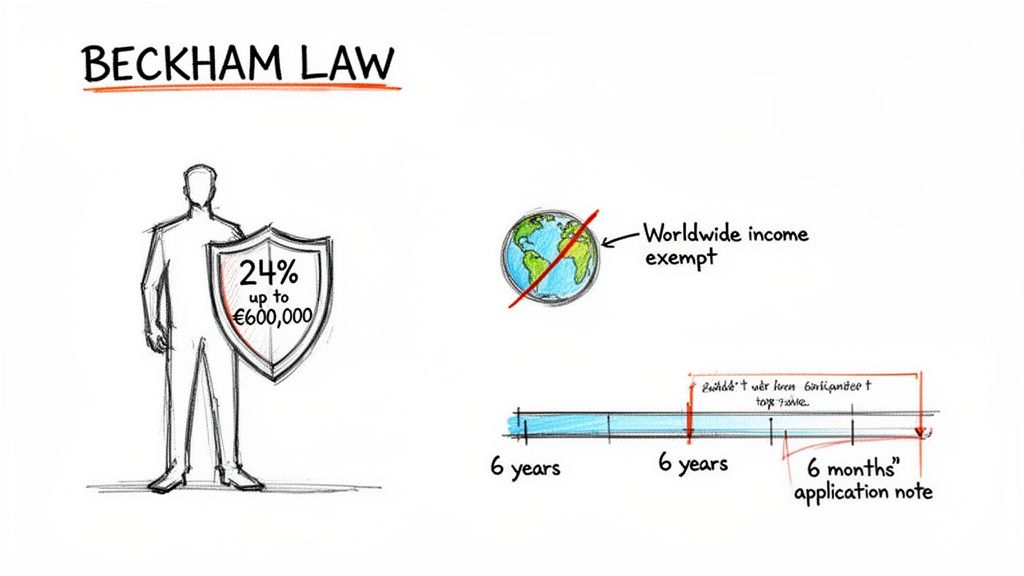
- Flat Tax Rate: You pay a flat 24% tax on your Spanish employment income up to €600,000. Anything above that threshold is taxed at 47%.
- Worldwide Income Exemption: This is the biggest draw. Your income from outside Spain—like dividends, interest, or capital gains—is simply not taxed in Spain at all.
- Simplified Wealth Tax: You are only liable for Spanish Wealth Tax on your assets located within Spain, not on your worldwide assets.
These benefits effectively create a protective tax bubble for your first six years. It allows you to manage your global finances far more efficiently than under the standard resident tax system. To see if you're a good fit, check our detailed article on who actually qualifies for the Beckham Law.
Who Is Eligible For This Special Regime
The Beckham Law isn't for everyone. The Spanish tax authorities have strict criteria to ensure it’s used by its intended audience: relocated professionals, entrepreneurs, and highly-qualified workers. You have to tick every box.
The main requirements are:
- Previous Residency: You must not have been a tax resident in Spain for the five years before your move. This was recently lowered from ten years, opening the door for more people.
- Reason for Moving: Your relocation has to be for a specific purpose, like an employment contract with a Spanish company, an appointment as a company director, or to carry out an approved entrepreneurial activity.
- Income Source: The bulk of your employment income must be generated in Spain.
- No Business Ownership Exception: You generally cannot own more than 25% of a Spanish company, though some exceptions exist under new startup provisions.
In our experience, the most common mistake people make is missing the application deadline. You must apply for the Beckham Law within six months of registering with Spanish Social Security. This is a hard, non-negotiable deadline. If you miss it, the opportunity is gone for good.
The Application Process
Getting approved for the Beckham Law hinges on timely and accurate paperwork. The clock starts ticking as soon as you have your employment contract and are registered with the Spanish social security system.
The key document is Modelo 149. This is your official application to the Agencia Tributaria (the Spanish Tax Agency). You'll submit it along with your work contract, your NIE (foreigner's identity number), and proof of social security registration.
Once approved, the regime applies for the year you arrive and the next five years, giving you a total of six years of major tax advantages. Given the financial stakes, getting your application right the first time is critical. Contact us for personalized advice to navigate the process and secure your status under this powerful law.
Spanish Tax Deadlines and Paperwork
Knowing the rules is one thing, but actually filing on time is a whole different ball game. The Spanish tax system waits for no one, and as an expat, it's completely on you to hit every deadline with the right form. A missed date isn't just a mistake; it's an automatic penalty.
The main event is the annual income tax declaration, what everyone here calls la declaración de la renta. The tax year is simple enough—it runs with the calendar year, from 1 January to 31 December. You then have a window in the following year to file your return for that period.
The Annual Tax Filing Season
That filing window typically opens in early April and closes on 30 June. This is when you report all your income from the previous year. So, for everything you earned in 2023, you’ll be sorting out the paperwork between April and June of 2024.
If you're a tax resident, you'll get to know Modelo 100 quite well. This is the standard form for your personal income tax (IRPF). It's where you pull together all your worldwide earnings to get right with the tax office.
The Critical Foreign Asset Declaration: Modelo 720
Beyond your income, there's another declaration that trips up a lot of expats: Modelo 720. This isn't a form to pay tax. It’s a purely informational return where you tell the government about the assets you hold outside of Spain.
You have to file this if you're a Spanish tax resident and your assets abroad are worth more than €50,000 in any of three buckets: bank accounts, investments, or real estate. The deadline for Modelo 720 is 31 March, so it comes up fast. To get into the nitty-gritty, you can learn more about what Modelo 720 is in our guide.
The penalties for messing up the Modelo 720—filing late, incorrectly, or not at all—are famously harsh. While the EU courts have forced Spain to tone them down a bit, the Agencia Tributaria still takes this form incredibly seriously. In our experience, this is the single most important piece of reporting for a new expat resident to get right from day one.
For expats in Spain, keeping your records straight is non-negotiable for staying compliant. It's worth looking into the mejores aplicaciones para escanear recibos to keep your financial life organized.
Consequences of Late Filing
The Agencia Tributaria is strict. Filing your tax return late, even by one day, triggers a penalty. If you realize your mistake and file voluntarily before they chase you, the surcharge starts at 1% and climbs for each month of delay.
But if they have to come looking for you? The penalties can skyrocket, potentially hitting 50% of the tax you owe.
The Spanish tax system has a lot of moving parts. To make sure your filings are accurate and on time, it’s best to get professional help. Contact us for personalized advice and we’ll make sure you're covered.
Common Questions About Expat Taxes In Spain
Navigating the Spanish tax system for the first time brings up a lot of questions. We see the same ones pop up again and again with new clients. Here are some straightforward answers to the most common concerns we hear from expats on the ground.
Will I Be Taxed Twice On The Same Income?
The short answer is no, you shouldn't be. Spain has signed double taxation treaties with dozens of countries—including the US, the UK, and nearly all of Europe—specifically to prevent this from happening.
These agreements work by letting you claim a foreign tax credit on your Spanish tax return for any tax you've already paid on that same income in another country. Getting this right is absolutely critical. In our experience, it's where expats often overpay if the treaty rules aren't applied with careful attention to detail.
How Do Social Security Contributions Work For Freelancers?
If you're registered as self-employed (autónomo) in Spain, you're on the hook for monthly social security payments. Since 2023, the system has changed: your contributions are now based on your real earnings, which makes things a lot fairer, especially for those just starting their business.
Think of it less as a tax and more as an investment. These payments are what grant you full access to Spain's excellent public healthcare system and start building up your entitlement to a Spanish state pension. One of the biggest upsides we point out to our clients is that your social security contributions are a fully deductible expense on your annual IRPF tax return, which directly lowers your final tax bill.
Are There Special Tax Rules For Foreign Pensions?
Yes, and the details matter quite a bit. As a Spanish tax resident, your foreign pension is generally treated as regular income, subject to the same progressive IRPF rates as a salary. However, the specific double taxation treaty between Spain and the country your pension comes from can change everything.
For example, certain government service pensions are often only taxable in the country that pays them, meaning Spain can't touch them. You absolutely must check the specific treaty that applies to you, because the rules can vary dramatically from one country to the next.
As an expat managing sensitive financial and tax-related information online, ensuring your digital security is important. For guidance on staying connected and secure while living abroad, you might want to look into resources like The Best VPN for Expats.
The Spanish tax system is complex, and your specific circumstances will determine the right approach. For clear, personalized advice on your situation, contact us.
