


So you’re planning a move from the UAE to Spain. It’s a fantastic choice, trading desert skylines for Mediterranean life. But before you get lost in daydreams of tapas and flamenco, there’s a serious first step: picking the right visa.
This isn’t just paperwork. In our experience, your visa choice dictates everything that follows—from the documents you’ll need to gather in Dubai or Abu Dhabi to your path to long-term residency. Get this wrong, and you’re in for months of delays.
The Spanish government has a few key pathways for UAE residents. Your professional situation is what really matters here.
Finding Your Visa Path
The three most common routes for expats from the Emirates are:
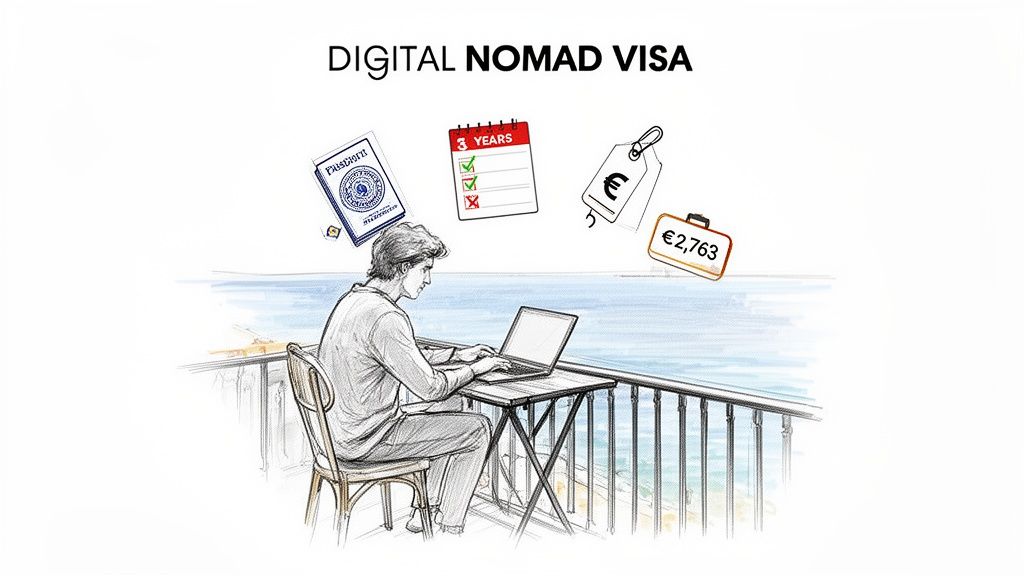
- The Digital Nomad Visa: This is your best bet if you work remotely for a company outside of Spain. The main hurdle is proving a stable monthly income, which is currently €2,763.
- The Non-Lucrative Visa (NLV): Perfect for retirees or anyone with enough savings or passive income to live on without working. You’ll need to show you have access to at least €28,800 for the year.
- Work and Entrepreneur Visas: These are for anyone who has either landed a job with a Spanish company or is ready to launch their own business in Spain.
This flowchart breaks down the decision based on how you plan to support yourself.
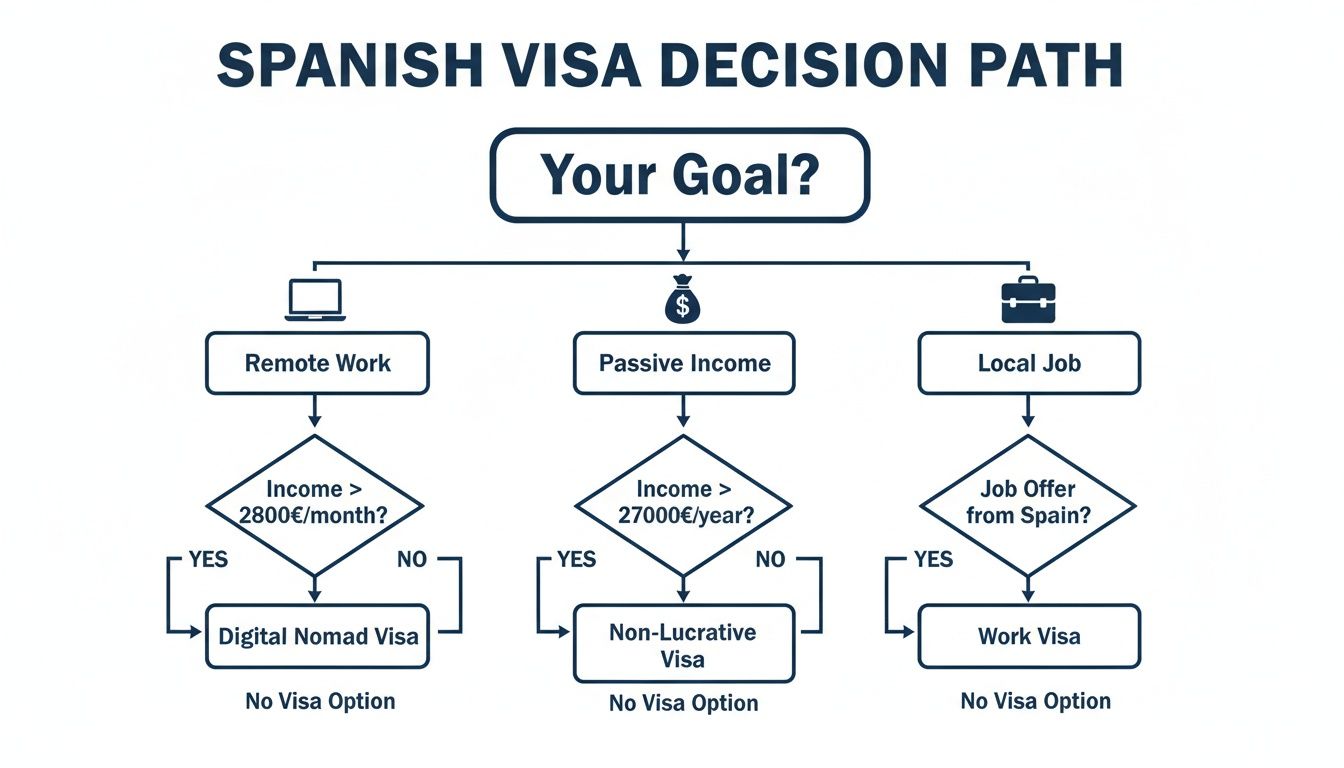
As you can see, what you do for a living—remote work, living off investments, or finding a local job—points you directly to the right application.
To give you a clearer picture, here’s a quick comparison of the most popular options.
Spanish Visa Options at a Glance for UAE Residents
| Visa Type | Ideal Candidate | Minimum Financial Requirement | Right to Work |
|---|---|---|---|
| Digital Nomad | Remote workers for foreign companies | €2,763 per month | Yes, for foreign employers |
| Non-Lucrative (NLV) | Retirees or those with passive income | €28,800 per year | No |
| Entrepreneur | Founders with an approved business plan | Varies based on business plan | Yes, for your own business |
| Highly Qualified Professional | Employees with a job offer in Spain | Dependent on job contract | Yes, for the sponsoring company |
This table should help you narrow down which path makes the most sense before you dive into the specific requirements for each.
Not sure which path fits? Contact us and we’ll map out the best option.
The most common mistake we see is people gathering a pile of generic documents before they’ve even chosen a visa. Don’t do it. Pinpoint your visa route first, because the evidence you need—from bank statements to criminal records—is completely different for each one.
Speaking of documents, you’ll need to start the process in the UAE. For instance, obtaining a Police Clearance Certificate from Dubai is a non-negotiable step for nearly every Spanish residency visa. This document must then be properly legalised with an Apostille to be valid. Getting these things sorted early saves a world of headaches later.
This guide will break down what you need for each visa, covering the financial proofs, document checklists, and timelines. For more detail specifically for applicants from the Emirates, our guide on residency in Spain for UAE citizens is a great resource.
The move from the UAE to Spain is a journey with a lot of administrative hurdles, but it’s completely manageable with the right plan. The next sections will dive into each option, giving you the clarity to move forward.
The Digital Nomad Visa for Remote Work in Spain
If you’re a remote professional in the UAE, Spain’s Digital Nomad Visa is likely your most straightforward route to residency. It’s specifically for non-EU citizens who are employed by, or freelancing for, companies located entirely outside of Spain.
It’s no surprise this visa is so popular. Spain actually topped a recent Digital Nomad Visa Index with a perfect score, confirming its status as the top choice for remote workers leaving hubs like the UAE.
The index highlights Spain’s fast internet, attractive tax options like the Beckham Law, and a very clear income requirement. With consulate applications often processed in just 15-30 days, it’s one of the fastest ways to get here.
Who Qualifies and How Much You Need
To qualify, you need to prove a stable, ongoing remote work relationship. This can be as a full-time employee for a non-Spanish company or as a freelancer with a roster of international clients. The key point is that your income originates from outside Spain.
The main financial threshold is tied to Spain’s national minimum wage, the Salario Mínimo Interprofesional (SMI). You have to show an income of at least 200% of the SMI.
- Main Applicant: This works out to roughly €2,763 per month or €33,156 per year.
- Spouse/Partner: You’ll need an additional 75% of the SMI (about €1,036 per month).
- Each Child: Add another 25% of the SMI (around €311 per month).
These figures are updated annually, so it’s important to check the current amounts before you apply. We always work with our clients to calculate their specific needs based on the latest official numbers.
Essential Documents for Your Application
Getting the paperwork right is where most applications get stuck. One missing or incorrectly prepared document can derail the whole process.
Here’s a breakdown of what you’ll need:
- Proof of Remote Work: This is your core evidence. It might be your employment contract or service agreements with your freelance clients. The working relationship must be at least three months old when you apply.
- Proof of Income: Bank statements from the last three to six months are needed to show you consistently receive funds meeting the income threshold.
- Clean Criminal Record: You’ll need a police clearance certificate from the UAE and any other country you’ve lived in for the past two years. This document must be legalised with an Apostille and then officially translated into Spanish.
- Private Health Insurance: A comprehensive policy from an insurer authorised in Spain is mandatory. It must provide full coverage without co-payments for your entire stay.
- University Degree or Professional Experience: You have to provide a relevant university degree or demonstrate at least three years of professional experience in your field.
A quick tip from our experience: Spanish authorities want to see stability. A single, short-term freelance project won’t cut it. Your application needs to paint a picture of a consistent and reliable professional career that can support you long-term.
Application Routes from the UAE
You have two main ways to apply. The best choice depends on how quickly you want to move.
1. Apply from the UAE: You submit your application at the Spanish Consulate in Abu Dhabi. If approved, you get a one-year visa. Once you arrive in Spain, you complete the process by applying for your three-year residency card (TIE).
2. Apply from Spain: This is often the faster route. You can enter Spain as a tourist and apply for the three-year residency permit directly from within the country during your first 90 days. This skips the initial consulate step, and it’s the path we manage for many of our clients.
One of the biggest draws of the Digital Nomad Visa is that it grants a three-year residency permit right away, unlike most other visas that start with a one-year card.
Not sure if you meet the core requirements? You can run a quick check on your personal situation with our free Digital Nomad Visa eligibility tool.
Work Permits and Entrepreneur Visas
For many professionals leaving the UAE, the goal isn’t remote work, but integrating directly into Spain’s economy. This means either landing a job with a local company or launching your own business.
These paths are distinct from the Digital Nomad Visa. You’re not working for a foreign employer; you’re becoming part of the Spanish workforce or business community.
The timing is good. Spain is actively recruiting international talent and is a top destination for skilled workers. The country welcomed a record 368,000 permanent immigrants in a recent year, making it the fifth-largest recipient among OECD nations. You can dig into the numbers in the latest OECD migration outlook for Spain.
Securing a Job Offer for a Work Permit
If a Spanish company has hired you, they take the lead. Your employer handles the initial work permit application, which is a major difference from visas where you’re on your own.
The most common route for skilled professionals is the Highly Qualified Professional (HQP) visa. It’s designed for managers and specialists.
To qualify for the HQP visa, you’ll typically need:
- A university degree or a minimum of three years of relevant professional experience.
- A job contract with a gross annual salary above €40,000. This figure can be more flexible for younger applicants or those in strategic industries.
Your employer starts the process by applying to Spain’s Unit for Large Companies and Strategic Collectives (UGE-CE). They must prove the role requires a highly qualified profile and that you’re the right person for it. We often advise the Spanish company directly to ensure their application is solid, which dramatically reduces processing times.
Once your permit is approved in Spain, you visit the Spanish consulate in Abu Dhabi to get the visa stamped in your passport. After you arrive, the final step is getting your residency card (TIE).
The Entrepreneur Visa and Self-Employment
If you’re building a business from the ground up, the Entrepreneur Visa is your pathway. This isn’t about finding a job; it’s about creating them. We’ve seen many clients from the UAE’s fast-paced business scene thrive with this visa, but it demands serious preparation.
The entire application hinges on your business plan. It can’t just be an idea on a napkin. It must be a comprehensive document that earns the approval of ENISA, the official Spanish agency that certifies innovative business projects.
Your business plan has to show real innovation and economic benefit to Spain. Just opening another coffee shop or retail store won’t cut it. The successful applications we see are in tech, green energy, or unique service-based industries.
A strong business plan must include:
- A complete market analysis.
- Detailed financial projections for at least five years.
- A clear breakdown of your product or service.
- An explanation of how your business will create jobs in Spain.
With ENISA’s approval, you can apply for the Entrepreneur Visa. This visa grants an initial three-year residency permit, giving you a solid runway to get your company off the ground.
Registering as a Freelancer or Autónomo
There’s another route for the self-employed: registering as an autónomo. This is the right choice for freelancers who plan to serve Spanish clients—a key difference from the Digital Nomad Visa, which is for foreign clients only.
The process involves proving you have the right qualifications for your field and a viable business projection. You’ll need to register with the Spanish tax agency (Agencia Tributaria) and the social security system (Tesorería General de la Seguridad Social).
As an autónomo, you’ll be responsible for your own monthly social security contributions, which thankfully start at a reduced flat rate for the first year.
Choosing between a work permit, an entrepreneur visa, or becoming an autónomo comes down to your career goals. Each path has its own rules and responsibilities.
Not sure which path fits? Contact us and we’ll map out the best option for your move from the UAE to Spain.
Using Passive Income with the Non-Lucrative Visa
The Non-Lucrative Visa (NLV) is a classic route for UAE residents who can support themselves in Spain without working. It’s perfect if you have substantial savings, investments, or a steady flow of passive income like property rentals or dividends. We often see it used by early retirees or financially independent individuals who want to enjoy Spain without the need for a local job.
At its core, the NLV is about proving one thing: you won’t cost the Spanish state a single euro. This visa strictly forbids any employment or professional activity in Spain, at least for your first year of residency.
Meeting the Financial Requirements
The main challenge of the NLV is proving you have enough money. The minimum amount is based on Spain’s IPREM (Public Multiple Effects Income Indicator), which sits around €600 per month. For the visa, you must prove you have 400% of this figure for the year.
- Main Applicant: You need to show access to at least €28,800 for the first year.
- Each Dependant: For every family member you bring, you must add another 100% of the IPREM, which is roughly €7,200 per person.
A couple moving from the UAE would need to show €36,000 (€28,800 + €7,200). For a family of three, that number rises to €43,200. You can prove this with savings in the bank or by documenting a consistent passive income.
Assembling Your Document Checklist
A successful NLV application from the UAE comes down to perfect paperwork. You must apply from the Spanish consulate in Abu Dhabi. You cannot apply for this visa while you’re in Spain as a tourist.
Here’s a look at what you’ll need:
- Proof of Financial Means: This is the make-or-break document. You’ll need six to twelve months of bank statements showing the required balance. If you’re using passive income, provide official documents like property rental agreements or investment dividend statements. All of it needs an official Spanish translation.
- Private Health Insurance: You must have a full-coverage private health insurance policy from a company authorised to operate in Spain. The policy must last a full year with no co-payments or deductibles and offer coverage equivalent to the Spanish public health system.
- Criminal Record Certificate: A police clearance certificate from the UAE is mandatory. You’ll also need one from any other country where you’ve lived for over six months in the last two years. It has to be legalised with an Apostille and then officially translated into Spanish.
- Medical Certificate: A doctor needs to issue a certificate confirming you don’t have any diseases that pose a public health risk, as defined by the International Health Regulations of 2005.
A common mistake we see is people submitting a vague motivation letter. Your letter needs to be direct. Clearly state why you want to live in Spain, confirm you understand you cannot work, and explain exactly how you plan to support yourself.
Well-prepared NLV applications are a priority for Spanish consulates. For a deeper dive into the specifics, our comprehensive guide covers every step of the Spanish Non-Lucrative Visa process.
The Path to Permanent Residency
The NLV provides a very clear route to making Spain your permanent home. The residency timeline is straightforward:
- Year 1: Your initial residency card is valid for one year.
- Years 2-3: You renew your residency for a two-year period.
- Years 4-5: You file a second two-year renewal.
After five continuous years of living in Spain, you become eligible to apply for permanent residency. This grants you the right to live and, importantly, work in Spain indefinitely.
Your First Steps After Arriving in Spain
You’ve landed in Spain with your visa approved. That was the first major hurdle. Now comes the paperwork on the ground to make your residency official.
This is where many people get bogged down in bureaucratic loops and appointment delays. But if you know the sequence, you can get through it without the headache. Your first month is all about converting that visa sticker in your passport into a physical ID card and getting yourself registered in the Spanish system.
Securing Your TIE Residency Card
Within 30 days of arrival, you need to apply for your Tarjeta de Identidad de Extranjero (TIE). This is the physical, biometric ID card that proves you’re a legal resident. It’s the single most important document you’ll carry in Spain.
People often mix up the NIE and the TIE. They aren’t the same thing.
- NIE (Número de Identidad de Extranjero): This is just your foreigner identification number. It’s for tax and administrative tracking. Your visa probably has this number printed on it already.
- TIE (Tarjeta de Identidad de Extranjero): This is the physical card with your photo and fingerprint. You apply for the TIE after you arrive in Spain.
Getting the TIE involves booking an appointment (cita previa) online at a National Police station. You’ll bring Form EX-17, proof of paying the fee (Form 790-012, which costs about €16), and a passport photo. These appointments are notoriously hard to find, so start looking the moment you arrive.
Registering Your Address with Empadronamiento
Before you can even attend your TIE appointment, you must register your address at the local town hall (Ayuntamiento). This process is called empadronamiento, and the certificate it produces is your padrón.
You absolutely cannot get your TIE without a padrón. It’s the official proof of where you live, and you’ll need it for everything from opening a bank account to signing up for healthcare. To get it, you’ll need your passport and a rental contract or utility bill in your name.
We see this all the time: a client finally snags a rare TIE appointment but has to forfeit it because they couldn’t get their padrón in time. They didn’t have a signed rental agreement ready. Make sorting out your long-term lease your absolute first priority.
Unlocking Tax Savings with the Beckham Law
For high-earning professionals moving from a low-tax country like the UAE, Spain’s Beckham Law is a game-changer. This special tax regime lets you pay a flat tax rate of 24% on Spanish income up to €600,000, instead of the progressive rates that can climb past 47%.
Even better, almost all your foreign-sourced income—like capital gains or investment returns from outside Spain—is completely exempt from Spanish tax. For the right person, the savings are massive.
You have to apply within six months of starting your employment in Spain. The main conditions are:
- You haven’t been a tax resident in Spain for the past five years.
- You’re moving to Spain for a new job or as a company director.
- Your work is primarily performed in Spain.
The application is done by filing Form 149 with the Spanish Tax Agency (Agencia Tributaria). We manage this for our clients to guarantee it’s filed correctly and on time, locking in those tax benefits for their first six years.
Next Steps: Bank Accounts and Social Security
Once you have your padrón certificate and a TIE appointment confirmation, opening a Spanish bank account is straightforward.
If you’re working for an employer, as a digital nomad, or are self-employed, your final key step is registering with the Social Security system. This gets you an affiliation number and access to public services. An employer usually handles this, but if you’re on your own, it’s one more task for your list.
These post-arrival steps are a chain reaction; one unlocks the next. Get them done right, and you’ll be set for a smooth start to your life in Spain.
Common Questions About Moving to Spain from the UAE
Can I Apply for a Visa While on a Tourist Trip to Spain?
For some visas, yes, you absolutely can. This is one of the most powerful strategies we use for our clients.
The Digital Nomad Visa is the best example. You can enter Spain as a tourist and then submit your application from within the country during your first 90 days. This in-country route is often significantly faster than applying from abroad.
However, this shortcut doesn’t work for every visa. Other popular routes, like the Non-Lucrative Visa, have a strict rule: you must apply from the Spanish Consulate in your country of residence. For anyone in the UAE, that means a mandatory application in Abu Dhabi.
Picking the right application route from the start is important. Contact us for personalized advice on the most efficient strategy for your specific visa and timeline.
What Is an Apostille and Why Do I Need It?
Think of an Apostille as a global seal of approval for official documents. It’s an international certificate, established by the Hague Convention, that verifies a public document for use in another country.
When you’re applying from the UAE, key documents like your criminal record check or birth and marriage certificates won’t be accepted by Spanish authorities without it. A missing Apostille is an automatic rejection of the document.
The process of getting documents apostilled can be confusing. We handle the entire legalisation and sworn translation process, ensuring every piece of your paperwork is compliant so you don’t have to navigate this bureaucracy alone.
How Does the Beckham Law Save Me Money?
The Beckham Law is a special tax regime that makes a massive difference for high-earning professionals moving to Spain. Instead of paying Spain’s progressive income tax rates, which can climb as high as 47%, you pay a simple flat rate of 24% on your Spanish employment income up to €600,000.
For high earners coming from a zero-tax environment like the UAE, this is the most important part: under Beckham Law, most of your foreign-sourced income—like capital gains or dividends from outside Spain—is not taxed in Spain at all. For the right person, this benefit alone can save tens of thousands of euros every year for up to six years.
We can assess your eligibility for this powerful tax-saving tool and manage the entire application with the Spanish Tax Agency on your behalf.
How Much Money Do I Need to Show for a Family?
The financial proof required varies wildly depending on the visa path you choose. The thresholds are all pegged to Spanish economic indicators like the IPREM (currently €600/month) or the SMI (minimum wage), which change annually.
Here’s how it breaks down for two of the most common visas:
- Non-Lucrative Visa: You’ll need to prove you have €28,800 in savings or passive income for the main applicant for the first year. You must add €7,200 for each additional family member.
- Digital Nomad Visa: This visa focuses on monthly income. The main applicant needs to show a recurring income of roughly €2,763 per month. You’ll need to add an extra €1,036 for a spouse and €311 for each child.
These are today’s numbers. The government updates them, so working with the latest figures is non-negotiable for a successful application. We always provide our clients with the precise, up-to-date financial requirements for their specific family situation.
So, you’ve seen what it takes to move from the UAE to Spain. It’s a fantastic leap, but the path is littered with administrative hurdles—from picking the right visa to getting your documents apostilled and navigating the Spanish tax system.
Getting it wrong is costly, not just in money, but in time and stress. We’ve seen hundreds of professionals and families make this exact move. We know the difference between a smooth landing and a relocation nightmare often comes down to getting the details right from the very beginning.
Honestly, the biggest mistake we see is people underestimating the bureaucracy. They assume it’s straightforward, then get stuck in a loop between the consulate, the UGE-CE, and the tax office. Our job is to manage that entire process for you, so you can actually focus on starting your new life in Spain.
Immigration and relocation cases can vary depending on each person’s circumstances. You may schedule a 45-minute legal consultation with Legal Fournier to review your case and discuss the available options.
Schedule a Consultation
