

Permanent establishment in Spain: risk checklist for foreign companies
A foreign company can create a permanent establishment in Spain before it has incorporated a Spanish subsidiary, signed a lease, or opened a formal branch. The risk usually appears earlier: a senior employee working from Spain, a local sales agent who effectively closes deals, a warehouse used for Spanish orders, a construction or installation project that runs longer than expected, or management decisions being taken from Spanish territory.
For an international group, this is not a technical label. If the Agencia Tributaria treats the Spanish activity as an establecimiento permanente, the company may need Spanish tax registration, separate accounting, Corporation Tax-style filings, instalment payments, transfer-pricing support, and a review of VAT treatment. If the commercial plan has already moved beyond occasional Spanish sales, the review should sit beside the decision whether to form a Spanish company, register a branch, or keep the activity outside Spain with documented controls.
This guide is written for foreign founders, finance directors, family groups, and non-Spanish companies entering Spain carefully. It is not a generic overview of Spanish company formation. It is a risk checklist for deciding when Spanish activity has become tax-visible.
For a quick first screen, the Spain permanent establishment risk checker can help identify facts that deserve a full legal review.
Last updated: 23 May 2026 · Based on current AEAT guidance, the Non-Resident Income Tax Law, Spanish double-tax treaty guidance, and EU VAT fixed-establishment rules.
Key takeaways at a glance
- The Spanish domestic test is broad. A permanent establishment can arise through continuous or habitual premises, workplaces, a dependent contracting agent, or construction, installation or assembly work lasting more than six months.
- The treaty needs to be checked. Spain’s tax treaties often use a narrower OECD-style definition, but the relevant treaty article has to be reviewed country by country.
- A PE has no separate legal personality. It is not a Spanish subsidiary, but it is a taxable Spanish presence of the foreign company.
- VAT is a separate analysis. An EU VAT fixed establishment depends on permanence and human and technical resources; a VAT number alone is not enough.
- The practical risk is timing. The review should happen before hiring, signing authority, project mobilisation, inventory storage, or Spanish customer onboarding becomes habitual.
Why permanent establishment risk appears before incorporation
Foreign companies often assume the Spanish tax question starts only when they incorporate a Sociedad Limitada or register a branch. That assumption is dangerous. The Spanish Non-Resident Income Tax framework looks at the activity actually carried out in Spain, not only at the legal form chosen by the group.
Under Article 13.1.a of the consolidated Non-Resident Income Tax Law, and the AEAT’s published guidance, a non-resident company operates through a permanent establishment when it has, by any title, facilities or workplaces in Spain on a continuous or habitual basis where all or part of the activity is carried out, or when it acts in Spain through an agent authorised to contract in the name and on behalf of the non-resident and that agent habitually exercises those powers.
That is why the analysis must be factual. A business can be legally incorporated abroad and still have Spanish tax exposure. Conversely, a Spanish subsidiary does not automatically become a permanent establishment of its foreign parent merely because it belongs to the same group. The work is to examine the Spanish footprint: people, premises, authority, contracts, stock, project duration, management, and customer-facing conduct.
The first question is not “Have we opened a Spanish company?” It is “What part of the foreign company’s business is now being carried out from Spain, and by whom?”
The Spanish tax test: three main gateways
The domestic Spanish definition has several examples, but in practice most foreign-company cases fall into three gateways: a fixed place, a dependent agent, or a project that crosses the construction or installation threshold.
1. fixed place or habitual workplace in Spain
The AEAT lists management headquarters, branches, offices, factories, workshops, warehouses, shops, mines, oil or gas wells, quarries, agricultural and livestock operations, and other places used for natural-resource exploration or extraction as examples of permanent establishments. The list is not limited to formal offices. The phrase instalaciones o lugares de trabajo de cualquier índole is wider than many foreign boards expect.
The risk is not just whether the company has a lease. It is whether the foreign company has the use of a Spanish place with enough continuity and enough connection to its business activity. A coworking office used occasionally by travelling executives is a different file from a Spanish workspace used every week by a country manager who coordinates sales, staff and delivery.
2. dependent agent with contracting authority
A Spanish permanent establishment can also arise where the company acts in Spain through an agent authorised to contract in the name and on behalf of the non-resident, and the agent habitually exercises that authority. The signing authority does not always need to look theatrical. In a modern sales process, the risk can sit in who negotiates final terms, who binds the group commercially, and whether head office approval is a genuine review or a formal rubber stamp.
Foreign companies should be especially careful with based in Spain business development, country manager and senior sales roles. The employment contract may say “no authority to bind the company”; the actual email trail, CRM record and customer expectation may say something else.
3. construction, installation or assembly projects lasting more than six months
Spanish domestic law expressly includes construction, installation and assembly work whose duration exceeds six months. The calendar matters because a project that starts as a limited deployment can become a tax presence through extensions, change orders, phased installations, support teams and subcontractor management.
This is particularly relevant for engineering, energy, industrial equipment, infrastructure, hospitality fit-outs, logistics, telecoms and real-estate-adjacent projects. The review should start before mobilisation, not after the sixth month is already visible in the project file.
Treaty protection: useful, but not a substitute for review
Spain’s domestic definition is the starting point. It is not always the end point. Where the foreign company is resident in a country with a double taxation agreement with Spain, the relevant treaty can narrow the permanent establishment analysis. The AEAT expressly notes that the applicable treaty article should be consulted, and that Spain’s treaties are generally based on the OECD model, although the precise wording changes by country.
The practical mistake is treating “we have a treaty” as a conclusion. It is only an instruction to read the treaty. Some treaties modify the construction-site period. Some include specific agency language. Some are affected by later protocols or anti-abuse instruments. For groups with US, UK, LATAM, Gulf, Swiss or EU structures, the treaty review has to be tied to the actual Spanish operating model, not to the country name alone.
Treaty protection is not a shield you cite at the end. It is a legal filter applied to the facts before the Spanish activity is designed.
Risk checklist by Spanish operating model
The following checklist is not a scoring tool. It is a way to identify where a foreign company should stop and take advice before the Spanish footprint becomes difficult to unwind.
| Spanish footprint | Main PE question | What to review before acting |
|---|---|---|
| based in Spain employee | Is the employee carrying out core revenue activity or exercising authority from Spain? | Role description, signing authority, CRM conduct, employment structure, home-office permanence. |
| Local sales agent | Does the agent habitually bind the foreign company or finalise essential terms? | Agency agreement, actual negotiations, approval process, customer-facing representations. |
| Coworking or office access | Is the place used continuously or habitually for the foreign company’s business? | Access terms, frequency, signage, staff use, client meetings, address on contracts. |
| Spanish warehouse or stock | Is the warehouse a fixed place through which Spanish sales are fulfilled? | Inventory ownership, fulfilment control, staff, third-party logistics contracts, VAT flows. |
| Installation or construction project | Will the work exceed six months under Spanish domestic law or a treaty threshold? | Project timeline, extensions, subcontractors, phases, site control, treaty article. |
| Spanish real estate rental | Is it passive leasing, or an organised business with hospitality-style services or staff? | Services offered, management contracts, employees, cleaning/laundry scope, tourist-use model. |
| Management in Spain | Are key decisions or effective management functions being performed from Spain? | Board minutes, executive travel, director residence, delegation matrix, decision records. |
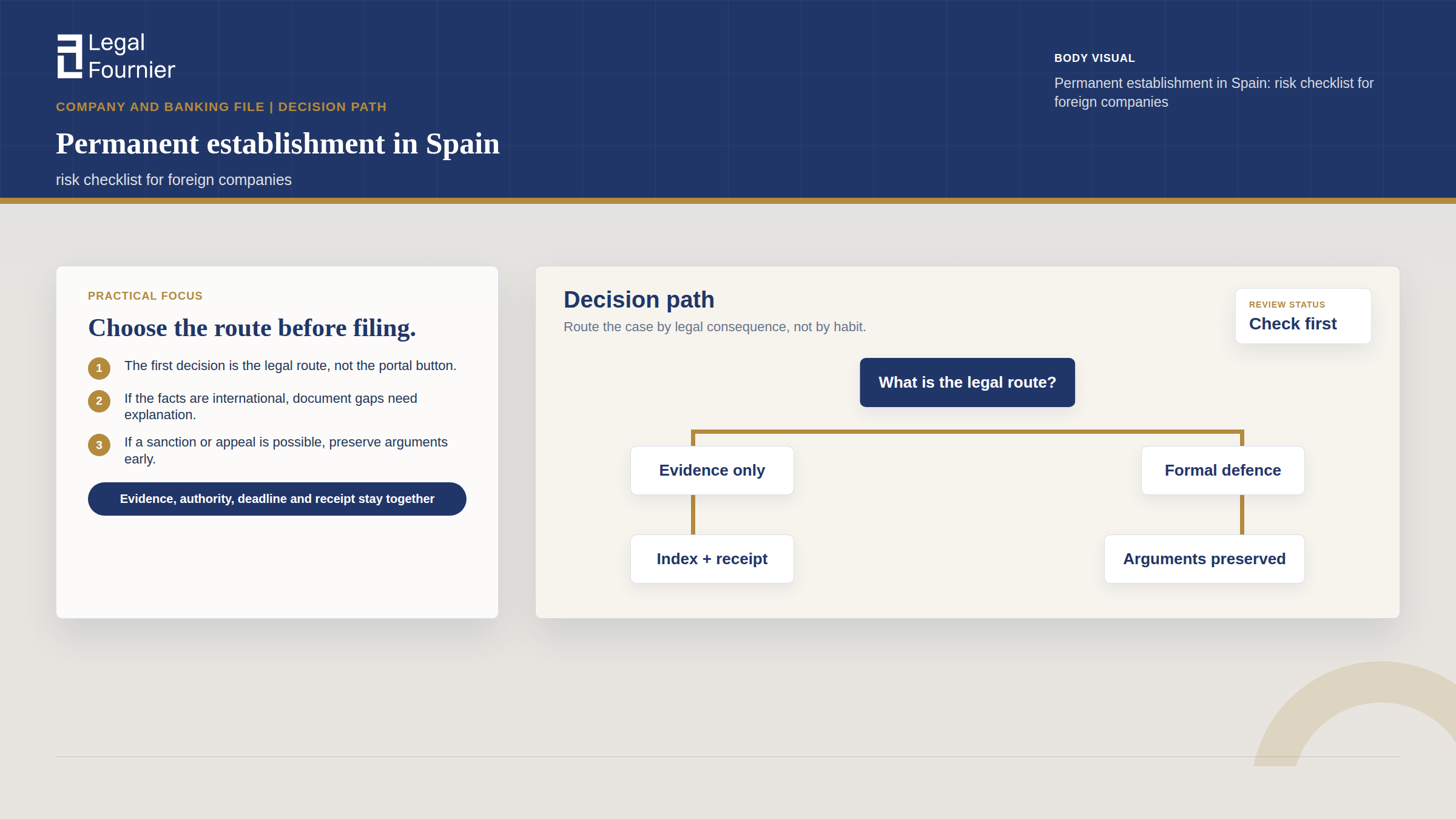
Remote workers, directors and home offices
Remote work is the area where companies most often under-document the risk. A foreign employee working from Spain does not automatically create a permanent establishment. The risk depends on the employee’s function, authority, permanence, resources and integration into the Spanish market.
A back-office employee temporarily working from Spain while serving non-Spanish operations is a different case from a senior country manager permanently based in Madrid, using a home office as a stable business base, negotiating Spanish customer contracts, and coordinating local delivery. The second file starts to look much closer to a Spanish business presence.
Directors require separate attention. A foreign company whose real strategic decisions are increasingly made from Spain may have broader tax residence and management concerns in addition to PE risk. For wealthy families, holding companies, founder-led groups and LATAM businesses relocating principals to Spain, the director’s personal residence, the place of board meetings, and the company’s effective decision trail should be reviewed together.
Controls that usually matter
- Authority matrix. Who can sign, approve pricing, accept amendments, bind delivery obligations, and issue side letters?
- Client evidence. What does the Spanish customer believe the based in Spain person is authorised to do?
- Workplace facts. Is the home office occasional, or a stable place used to carry out the company’s business?
- Management record. Are important commercial and financial decisions actually taken abroad, or merely documented there after the event?
Branch, subsidiary or permanent establishment: do not confuse the labels
A permanent establishment is not a Spanish company. The AEAT expressly notes that a PE has no legal personality distinct from the head office. It is a Spanish tax presence of the non-resident entity itself. That is why liability, accounting and internal dealings with head office have to be treated carefully.
A branch is a formal registered presence. A subsidiary is a separate company, usually a Spanish SL or SA. A factual permanent establishment can arise without either of those being properly registered. That is the uncomfortable scenario: the foreign company is trading in Spain with no clean Spanish vehicle, but the facts already show Spanish taxable presence.
There are cases where a Spanish subsidiary is the better structure precisely because it gives a clearer operating perimeter, Spanish contracts, local accounting, payroll, governance and tax registration. That does not eliminate transfer-pricing and group-control issues, but it can be more defensible than pretending a mature Spanish operation is still occasional foreign activity. For groups at that stage, the decision should be coordinated with monthly accounting and tax compliance in Spain from the beginning, not after the first Spanish assessment letter arrives.
The wrong structure is not always the one that pays more tax. Often it is the one that leaves the facts, contracts and accounting telling three different stories.
Tax consequences if a permanent establishment exists
Once a Spanish permanent establishment exists, the company is no longer treated as a foreign taxpayer earning isolated Spanish-source income. The PE is taxed on the income attributable to it, and the taxable base is generally determined under the Corporation Tax system, with special rules for dealings with head office and other related entities.
The AEAT summarises the main consequences clearly: Spanish permanent establishments are taxed on all income attributable to the establishment, irrespective of where the income is obtained; they must keep separate accounting; they must meet the filing and formal accounting obligations applicable to Corporation Tax taxpayers; and related-party rules apply to transactions with head office, other permanent establishments and related persons.
| Area | Practical consequence |
|---|---|
| Tax base | Determined broadly under Corporation Tax principles, with special rules for head-office payments and general administration costs. |
| Transfer pricing | Transactions with head office, other PEs and related parties must be priced under related-party rules. |
| Forms | The PE generally files using Form 200, with Form 206 as the payment or refund document, and may have Form 202 instalment-payment obligations. |
| Tax rate | For tax periods beginning on or after 1 January 2015, the applicable Corporate Tax rate applies; the general rate is 25%. |
| Representative | Non-EU and certain non-EEA taxpayers with Spanish PE income may need a tax representative before the Spanish Tax Administration. |
| Complementary tax | Transfers of PE income abroad can trigger supplementary taxation, subject to EU and treaty exceptions. |
The accounting point is often underestimated. A PE file is difficult to defend if the Spanish activity was never tracked separately. Head-office management fees, technical assistance, interest, commissions and shared costs need a defensible allocation method. Article 18 of the Non-Resident Income Tax Law restricts certain payments to head office and requires rational, continuous criteria for deductible management and general administrative expenses.
In other words, PE work is not only a registration question. It is also a finance function. If the Spanish presence is real enough to be taxed, it must be real enough to be measured.
VAT fixed establishment Is a different test
Direct tax permanent establishment and VAT fixed establishment are related in business language, but they are not the same legal test. EU Implementing Regulation 282/2011 defines a VAT fixed establishment, for Article 44 place-of-supply purposes, by reference to a sufficient degree of permanence and a suitable structure in terms of human and technical resources enabling the establishment to receive and use services for its own needs. The same Regulation states that having a VAT identification number is not, by itself, sufficient to create a fixed establishment.
This distinction matters when a foreign company registers for Spanish VAT, stores goods in Spain, receives Spanish B2B services, uses local infrastructure, or has group companies supporting Spanish activities. The invoice treatment, reverse-charge analysis and place-of-supply conclusion can be wrong even where the direct tax PE conclusion is right.
For complex groups, the VAT review should answer three questions separately:
- Resources. Does the company have human and technical resources in Spain, directly or through arrangements that give it practical access?
- Use of services. Are services received and used by a Spanish establishment for its own needs, or by the head office abroad?
- Invoicing evidence. Do contracts, order forms, VAT numbers, addresses and payment flows point to Spain or to the foreign head office?
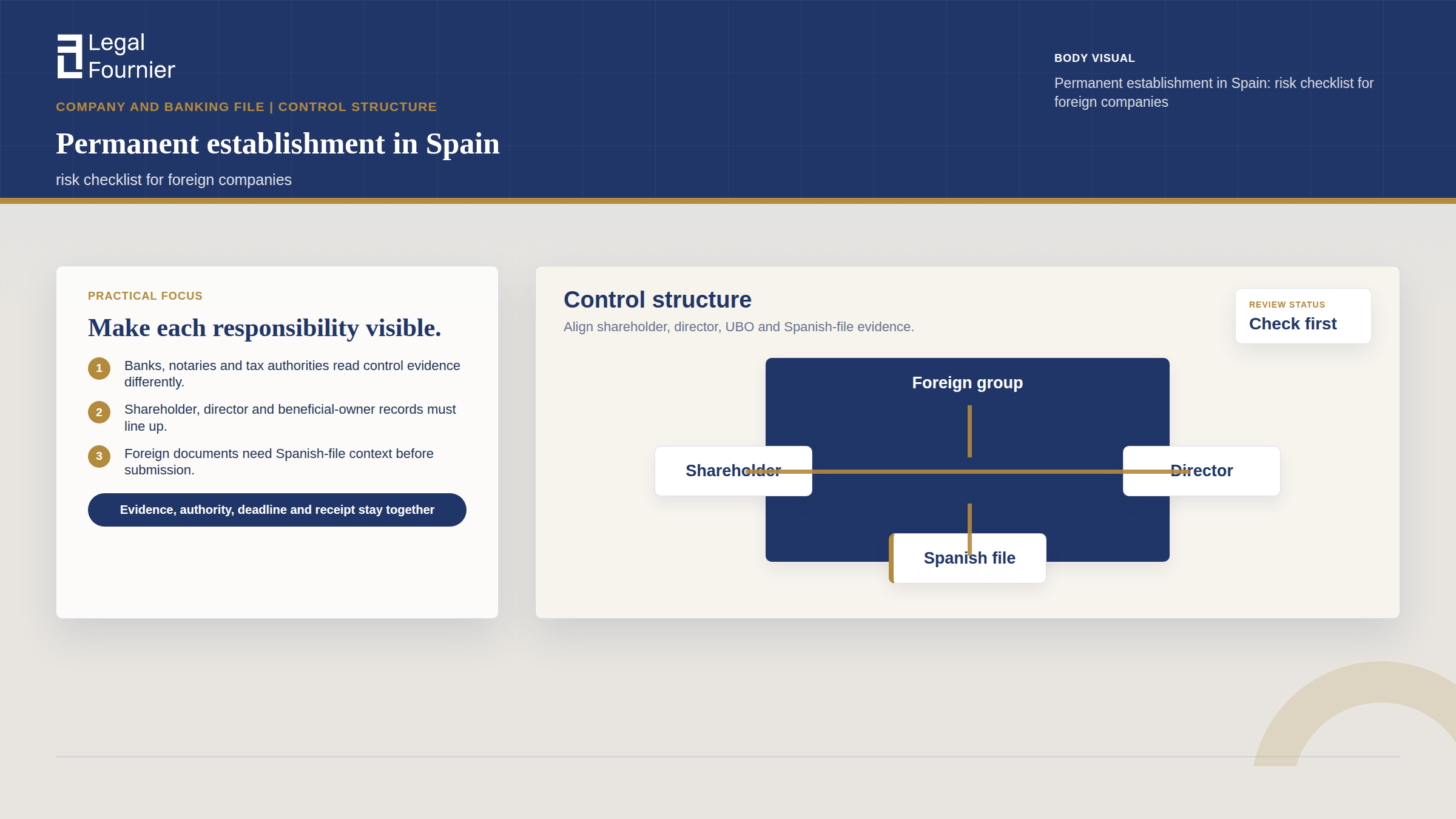
Spanish real estate and rental activity
Real estate creates its own traps. The AEAT states that, in general, a non-resident person leasing real estate in Spain is not considered to operate through a permanent establishment merely because of the lease. That is an important starting point for investors.
But the answer changes where the rental activity becomes an organised economic activity through hospitality-style services or staff. The AEAT identifies PE risk where the owner directly rents the property and provides additional or complementary services typical of the hotel industry, such as restaurant, cleaning, laundry or similar services, including where those services are subcontracted. It also identifies PE risk where at least one full-time employee is used in Spain to manage the activity.
This distinction is relevant for family offices, foreign property companies, serviced-apartment models, luxury rentals, and real-estate groups that are not merely holding assets passively. If Spanish property is part of a broader relocation or investment plan, it should be reviewed with both tax and corporate structuring in mind, not only conveyancing.
A practical pre-entry review
Before a foreign company expands into Spain, the PE review should be built around evidence. The best time to do this is before the first based in Spain employee starts, before the local agent begins negotiating, before the warehouse contract is signed, and before the project team is mobilised.
Documents to place on the table
- Corporate structure chart. Parent, subsidiaries, branches, shareholders, directors and management lines.
- Spanish operating map. People, places, suppliers, warehouses, contractors, client sites and assets in Spain.
- Authority matrix. Who negotiates, who approves, who signs, and who can vary commercial terms.
- Project calendar. Start dates, expected end dates, extensions, phases, and subcontractor involvement.
- Tax registrations and invoices. VAT numbers, customer contracts, supplier invoices, payment routes and account codes.
- Treaty position. Residence country, applicable double taxation agreement, and any protocol or anti-abuse overlay.
Possible conclusions
A proper review does not always end with “register a PE”. Sometimes the conclusion is that the company can trade into Spain with stricter controls: no Spanish signing authority, no fixed workplace, no Spanish inventory, and clear foreign management. Sometimes the conclusion is that a PE exists and should be regularised. Sometimes the cleaner answer is a Spanish subsidiary or formal branch because the Spanish activity has become operationally permanent.
The point is to choose consciously. The worst file is the one where a foreign company has already built a Spanish business but has left the legal and tax position implied rather than documented.
Frequently asked questions
What is a permanent establishment in Spain?
For Spanish Non-Resident Income Tax purposes, a permanent establishment generally exists where a non-resident company has facilities or workplaces in Spain on a continuous or habitual basis where all or part of its activity is carried out, or where it acts in Spain through an agent authorised to contract in the name and on behalf of the non-resident and the agent habitually exercises those powers. Spanish law also lists examples such as management headquarters, branches, offices, factories, workshops, warehouses, shops and construction, installation or assembly work lasting more than six months.
Does hiring one employee in Spain automatically create a permanent establishment?
Not automatically. The analysis depends on the employee’s function, authority, permanence and the way the company uses Spanish resources. A temporary support employee is not the same as a senior based in Spain person who negotiates, closes or materially drives Spanish customer contracts. The employment contract, actual conduct and customer evidence all matter.
Is a Spanish subsidiary automatically a permanent establishment of the foreign parent?
No. A Spanish subsidiary normally has its own legal personality and is not automatically a permanent establishment of its foreign parent. Direct-tax PE risk is more likely to arise if the facts show that the subsidiary or local personnel habitually conclude contracts for the parent, act as a dependent agent, or make Spanish premises or functions available so that the parent is effectively carrying on business in Spain. VAT fixed-establishment analysis is separate and should be reviewed under EU VAT rules where human and technical resources are relevant.
Is VAT fixed establishment the same as direct tax permanent establishment?
No. VAT fixed establishment is an EU VAT concept focused on sufficient permanence and human and technical resources for receiving or supplying services. Direct tax permanent establishment is assessed under Spanish Non-Resident Income Tax law and the applicable treaty. A Spanish VAT number alone is not enough to create a VAT fixed establishment, but VAT registration should still trigger a careful review of the company’s Spanish resources and invoice flows.
What happens if AEAT considers that a foreign company has a Spanish PE?
The company may need to register, file as a Non-Resident Income Tax taxpayer with a permanent establishment, keep separate accounting, attribute income and expenses to the Spanish PE, apply related-party rules to head-office dealings, make instalment payments, appoint a representative where required, and correct VAT or withholding positions. There may also be interest and penalty exposure depending on the facts and timing.
Conclusion: design the Spanish footprint before it designs itself
Permanent establishment risk in Spain is not solved by avoiding the word “branch” or delaying incorporation. Spanish tax law looks at the business carried out in Spain, the authority exercised in Spain, the places and resources used in Spain, and the income attributable to that activity.
For a foreign company, the right outcome may be a documented non-PE model, a formal Spanish permanent establishment, a branch, or a Spanish subsidiary. The answer depends on the facts, the treaty, the VAT position, and the commercial need for credibility in Spain. A careful review before expansion is usually cheaper than regularising a Spanish presence after the tax authority has reconstructed it from contracts, emails, invoices and bank flows.