
Tax penalty in Spain: allegations, appeal deadlines and payment strategy
A Spanish sancion tributaria is rarely just a fine to be paid or appealed in isolation. For a foreign founder, HNW family, private office or non-resident shareholder, the notice can sit on top of a wider tax file: IRPF residency, wealth-tax exposure, a Spanish company, a property transaction, late filings, deductions challenged by AEAT, or international income that was declared in another country but not presented correctly in Spain.
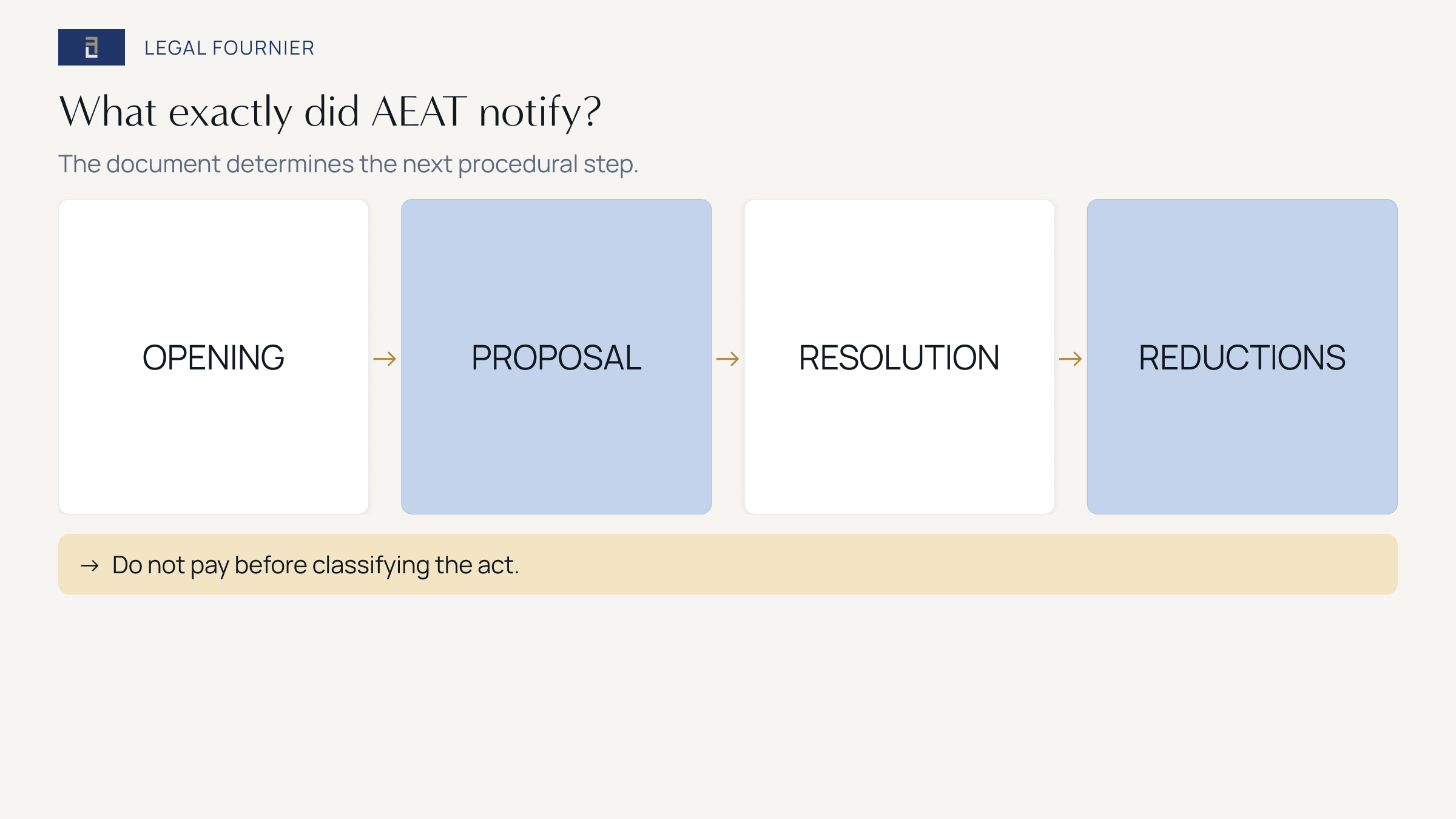
The first decision is therefore not emotional. It is procedural. You need to know whether you are looking at the opening of a sanction file, a proposed sanction, a final resolution, a payment letter, a tax debt, or a combined notification. Each document has a different clock. Missing the allegations window can weaken the defence; appealing without checking reductions can change the economics; paying too quickly can close off arguments that should have been preserved.
Legal Fournier handles tax disputes and compliance matters for international clients who need the Spanish file reviewed together with their relocation, company and family-office position. If the sanction relates to Spanish personal tax, start with our income tax filing support in Spain. If the matter has already become a dispute, the route may also require appeal strategy before any payment decision is made.
Last updated: 25 June 2026 · Based on Ley 58/2003 General Tributaria, Real Decreto 2063/2004 and AEAT procedure guidance.
Key points before responding to AEAT
- Identify the document first. An initiation notice, proposed resolution and final sanction resolution do not carry the same action.
- The usual allegations window in the sanction proposal is 15 days. The exact deadline should be calculated from the actual notification date and channel.
- Administrative appeals are usually one month. Reposicion and economic-administrative claims have their own sequencing rules.
- Penalty reductions are strategic. Conformity and prompt-payment reductions can be valuable, but some reductions can be lost if the wrong act is challenged.
- A sanction is not automatically enforceable while properly appealed in administrative route. Article 212 LGT provides automatic suspension for timely administrative challenges to tax sanctions, without guarantee, until finality in administrative route.
What a sancion tributaria actually Is
A sancion tributaria is the penalty side of a Spanish tax problem. It is different from the underlying tax debt, interest, surcharge or corrected assessment, even when all of them arrive in the same commercial crisis. The legal basis sits mainly in Title IV of Ley 58/2003, General Tributaria, which regulates the principles, types of infringement, reductions, procedure and appeal effects for tax penalties.
That distinction matters because the sanction requires more than arithmetic. Article 179 LGT states that individuals, companies and certain entities can be sanctioned when they are responsible for facts constituting a tax infringement. It also recognises circumstances in which liability should not arise, including force majeure and cases where the taxpayer used the necessary diligence, acted under a reasonable interpretation of the rule, or followed certain published administrative criteria.
For international clients, this is often the real battlefield. A corrected Spanish tax amount may be difficult to contest if the numbers are objectively wrong. The sanction, however, may still be defensible if AEAT has not properly explained culpability, if the issue came from a reasonable interpretation, if international documents were available but misunderstood, or if the client relied on professional advice or official criteria in a way that should be brought into the file.
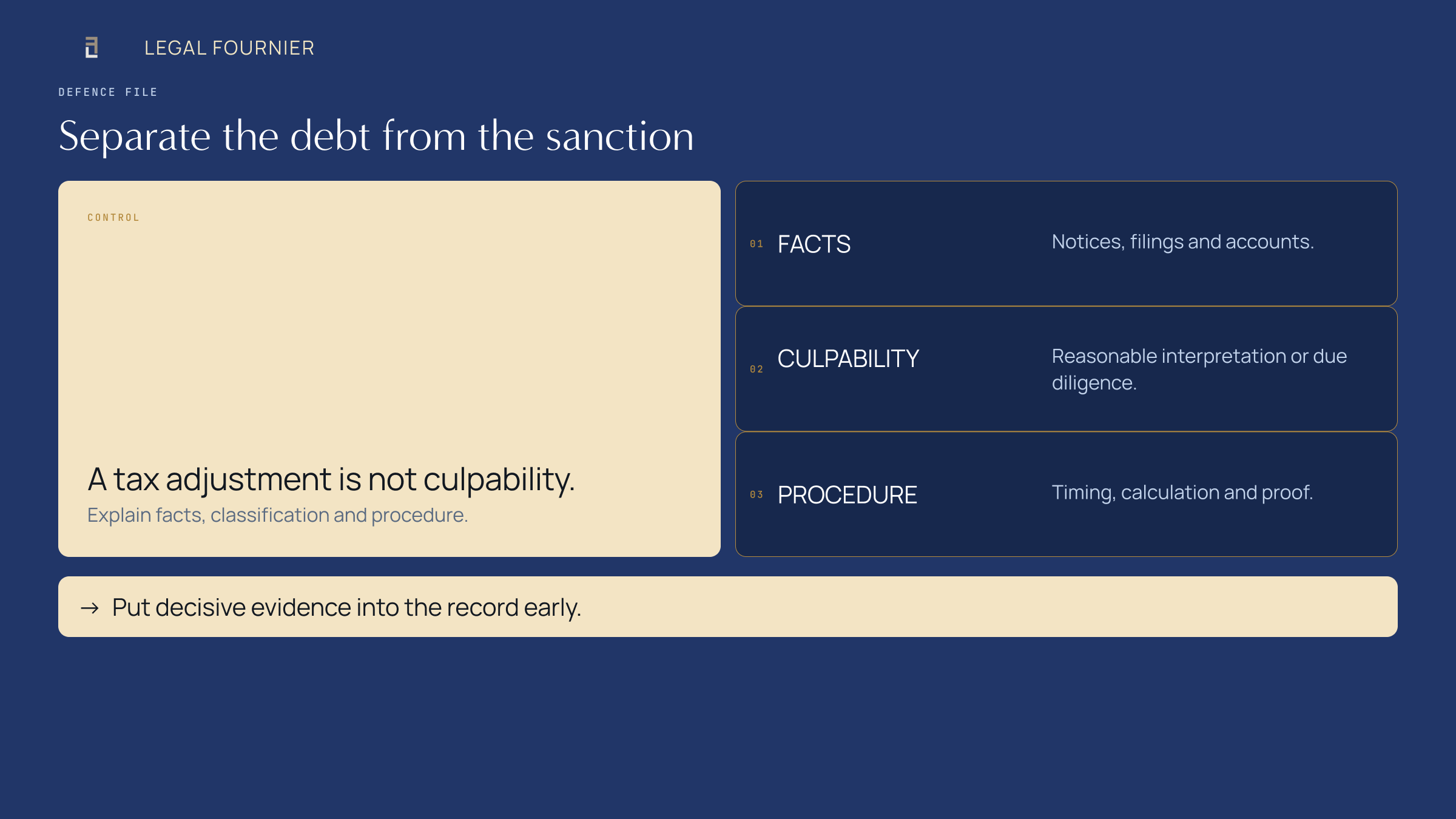
The tax debt answers the question “what does AEAT say is due?”. The sanction answers a different question: “why should this conduct be punished?”. A serious response separates those two issues from the beginning.
The first review: which notice did you receive?
Most bad decisions happen in the first 48 hours after the notification. A client forwards a PDF, sees a payment amount and assumes the only options are to pay or appeal. In practice, the document may be one of several procedural stages.
| Document | What it usually means | Strategic response |
|---|---|---|
| Inicio del expediente sancionador | AEAT has opened the sanction procedure. | Check whether the proposal is already included and calculate the allegations period. |
| Propuesta de resolucion | AEAT states the facts, legal classification and proposed sanction. | File targeted allegations with evidence. This is often the best moment to challenge culpability. |
| Resolucion sancionadora | The sanction has been imposed. | Choose between reposicion, economic-administrative claim, payment, or a combined strategy. |
| Carta de pago | A payment document may reflect voluntary-period payment after assessment or sanction. | Do not pay blindly. Check reductions, appeal effect and whether payment implies acceptance in the specific context. |
| Liquidacion and sanction together | AEAT may be resolving the tax adjustment and proposing or imposing a related sanction. | Separate the tax merits, penalty defence, reductions and suspension effects before acting. |
The AEAT page for the inspection sanction procedure describes the procedure as one that analyses whether a tax infringement has been committed and, where appropriate, imposes the corresponding sanction. It confirms that the sanction procedure starts ex officio, by notification of the competent body, and that the file may include a proposed sanction at the start where the office already has the necessary elements.
For companies and family holding structures, the notification channel is part of the legal analysis. Under Article 14 of Law 39/2015, legal persons and entities without legal personality are among the subjects required to interact electronically with public administrations. That means a Spanish SL, partnership-like entity or representative of an electronically obliged taxpayer cannot treat missed electronic access as a minor administrative inconvenience.
The allegations stage: where the defence Is built
The strongest sanction defence is usually not a long narrative about fairness. It is a disciplined response to the exact elements AEAT must prove: facts, legal classification, infringement type, culpability, graduation criteria, calculation and procedural timing.
Article 210 LGT requires the proposed resolution to set out the facts, legal classification, possible infringement, proposed sanction and graduation criteria with adequate reasoning. It also provides that the proposal must be notified to the interested party, with access to the file and a 15-day period to submit allegations, documents, supporting evidence and proof considered appropriate. Where all elements are already available when the sanction file is opened, the proposal can be incorporated into the initiation agreement, again with a 15-day allegations period.
AEAT’s own technical help page on presenting allegations in a sanction file also distinguishes between allegations against an initiation or hearing-stage notice and a formal appeal against a final resolution. That is more than a website detail. It reflects the procedural difference between trying to prevent or reduce the sanction before resolution and challenging a sanction already imposed.
What strong allegations usually address
In substantial tax files, allegations should normally be built from the administrative file rather than from the client’s memory alone. The starting bundle often includes the tax assessment, previous AEAT communications, electronic notification evidence, filings, accounting records, invoices, bank statements, international certificates, advice memoranda, board or shareholder records, and proof of how the tax position was formed.
The allegations should then focus on the points that can legally change the outcome. Was the alleged conduct actually typified as an infringement? Has AEAT explained why the taxpayer was culpable, not merely wrong? Is there a reasonable interpretation of the tax rule? Did the taxpayer follow administrative criteria, a binding consultation, professional advice, or a consistent compliance policy? Has AEAT applied the correct sanction percentage and graduation criteria? Has the file respected the required procedure and timing?
For a family office or founder moving to Spain, the evidence can be highly personal: tax-residency calendars, foreign payroll documents, investment-vehicle reporting, company minutes, property closing files, wealth-tax valuation support, or advice received before becoming Spanish tax resident. The objective is not to overwhelm AEAT with material. It is to put the decisive facts into the record before the file becomes an appeal about a sanction already imposed.
Appeal routes and deadlines
Once AEAT issues a final sanction resolution, the question changes. You are no longer only making allegations inside the sanction procedure. You are choosing a remedy.
Article 212 LGT confirms that the sanction resolution can be challenged independently. If the taxpayer also challenges the underlying tax debt, the appeals or claims are accumulated, and the competent body is the one dealing with the challenge against the debt. This is important when the client wants to accept the tax adjustment but challenge the penalty, or when the penalty defence depends on the same facts as the underlying assessment.
The usual administrative routes are:
- Recurso de reposicion. Article 223 LGT gives a one-month period from the day after notification of the appealable act, or from the relevant silence date. It is optional, but if used it must come before an economic-administrative claim.
- Reclamacion economico-administrativa. Article 235 LGT gives a one-month period from the day after notification of the contested act. AEAT’s economic-administrative claim pages also state the one-month deadline and explain that the claim is filed with the body that issued the act.
- Contentious-administrative court route. This is not the first tactical step for every sanction. It usually comes after administrative route, and AEAT guidance for inspection economic-administrative claims refers to a two-month contentious-administrative period under Law 29/1998.
These periods need exact calculation. Weekends, holidays, electronic notification access, representative notifications and whether a prior reposicion was filed can all affect the calendar. For corporate taxpayers, the electronic channel is often decisive; for foreign individuals, the question may be whether a representative, postal address or electronic access point triggered the deadline before the client actually read the PDF.
Do not choose between reposicion, economic-administrative claim and payment by habit. Choose by file strength, reduction economics, evidence needs and the client’s broader Spanish tax position.
Payment strategy and penalty reductions
Payment strategy is not the same as surrender. In some cases, paying preserves commercial stability and avoids collection escalation. In others, paying too early or without reserving the right issues can make the file more expensive than it appears.
Article 188 LGT is central. For monetary sanctions under Articles 191 to 197 LGT, it provides a 65% reduction for actas con acuerdo and a 30% reduction in cases of conformity. It also provides a 40% reduction of the amount to be paid for any infringement, after any conformity reduction where applicable, if the remaining sanction is paid within the Article 62.2 voluntary-payment period, or within certain guaranteed deferral or instalment terms requested before that period ends, and no appeal or claim is filed against the tax assessment or the sanction.
Those words create the practical tension. A client may save a substantial percentage by accepting and paying, but Article 188 also states when reductions are recovered if the taxpayer later challenges the regularisation, sanction or both. The correct answer is not always “appeal everything” or “pay for the discount”. It depends on whether the proposed sanction is legally weak, whether the tax assessment is itself wrong, whether the evidence is strong enough, and whether the sanction affects future dealings with banks, buyers, investors or a Spanish company.
Article 62.2 LGT sets the voluntary-payment calendar for debts resulting from administrative liquidations. If the notification is received between the 1st and 15th of a month, payment runs until the 20th of the following month, or next business day. If notified between the 16th and the last day of the month, payment runs until the 5th of the second following month, or next business day. In a sanctions file, that payment calendar needs to be read together with Article 188 reduction conditions and the appeal strategy.
When paying may be rational
Payment may be rational when the facts are clear, the sanction is correctly calculated, the client needs closure, the reduction is economically material and the wider Spanish tax position is not harmed by accepting the outcome. This can happen in low-risk late-filing or documentation mistakes where the procedural file is clean and the cost of contesting exceeds the realistic upside.
When appealing may be rational
Appeal may be rational when AEAT has not justified culpability, the taxpayer has a reasonable interpretation defence, the sanction calculation is wrong, the facts are incomplete, the notification or timing is defective, or the sanction creates reputational or future compliance consequences that matter beyond the amount due. For a HNW family, founder or investment structure, a penalty file can also influence how future AEAT reviews understand the taxpayer’s conduct.
Why suspension matters
Article 212 LGT gives a valuable protection: filing an administrative appeal or claim against a sanction in time and form automatically suspends its execution in voluntary period without the need to provide guarantees until it becomes final in administrative route. The same article states that no late-payment interest is charged for the time until the end of the voluntary-payment period opened by the notification of the resolution that ends the administrative route. This protection concerns the sanction; it should not be confused with suspension of the underlying tax debt, which has its own rules.
Issues that matter for foreign clients
Foreign clients often receive Spanish tax sanctions in files where the international context was never properly presented. The sanction may relate to a Spanish tax return, but the evidence may be in another country, another language and another advisor’s files.
- Tax residency years. A client may have become Spanish tax resident earlier or later than expected. Calendar evidence, travel data, family location and centre-of-interests analysis can affect both the tax debt and sanction culpability.
- Foreign income and assets. Dividends, carried interest, trusts, foundations, foreign property, offshore portfolios and family companies need careful translation into Spanish tax categories.
- Spanish companies. A newly incorporated SL, holding company or operating business may receive notices electronically. Management should know who controls AEAT access, certificates, powers and representative notifications.
- Property transactions. Purchase values, rental treatment, non-resident returns and deductible expenses can lead to assessments where the paper trail at acquisition becomes central.
- Advisor handover. Many files become sanction files because no one had the full picture: immigration lawyer, accountant, foreign tax advisor, bank and family office each held only part of the evidence.
This is why premium tax defence is not only a procedural service. It is a reconstruction exercise. The Spanish response should make AEAT understand what happened, why the client’s position was reasonable where it was reasonable, which parts are accepted, which parts are disputed, and what evidence proves each point.
A practical decision framework
Before deciding whether to allege, appeal or pay, we would normally ask seven questions:
- What exact act was notified? Initiation, proposal, final resolution, tax assessment, payment letter or enforcement step.
- When was it legally notified? The operative date may be electronic, representative-based or postal.
- What deadline is open today? Allegations, reposicion, economic-administrative claim, payment, or a later court route.
- What does AEAT say the taxpayer did wrong? The facts, tax rule, infringement article and sanction percentage must be identified.
- Where is the culpability analysis? A penalty should not be a mechanical consequence of a tax adjustment.
- What reductions are available and what would be lost? Article 188 must be modelled before appeal or payment.
- What is the wider consequence? The sanction may affect a sale, finance round, bank review, company governance, immigration planning, or future AEAT scrutiny.
If the answers are unclear, the file is not ready for a payment decision. It needs a structured review, calendar calculation and evidence map.
FAQ
How long do I have to make allegations against a Spanish tax sanction proposal?
Article 210 LGT gives a 15-day period after notification of the proposed resolution, with access to the file, to submit allegations, documents, justifications and evidence. Calculate the deadline from the actual notification and the specific document received.
Can I appeal only the sanction and not the tax debt?
Often yes. Article 212 LGT states that a sanction resolution can be challenged independently. It also states that the conformity reduction can be preserved when only the sanction is appealed and the regularisation is not challenged, but the exact file should be reviewed before relying on that route.
Will AEAT collect the sanction while I appeal?
A timely administrative appeal or claim against a tax sanction automatically suspends execution of the sanction in voluntary period, without guarantees, until it is final in administrative route. This does not automatically suspend the underlying tax debt.
Should I pay to keep the 40% reduction?
Sometimes, but not automatically. The 40% reduction depends on payment within the relevant voluntary-payment or qualifying deferral terms and no appeal or claim against the tax assessment or sanction. If the sanction is legally weak or strategically harmful, the reduction must be weighed against the appeal value.
Can a Spanish company miss a sanction notice because it was electronic?
Yes, operationally. Legally, companies and certain entities are required to interact electronically with public administrations, so poor certificate control or missed electronic access can create real deadline problems. Spanish companies should have a notification-control process, especially when shareholders or directors live abroad.