

Canary Islands Film Tax Incentives: What Foreign Productions Need Before Shooting
The Canary Islands can be fiscally attractive for foreign productions, but the incentive is not a location discount that applies automatically. Before a studio, agency or service producer commits dates, local spend or a production service company, the structure should be reviewed against Article 36.2, the Canary Islands tax regime, ICAA requirements, tax residence tests for personnel, eligible expenditure and the practical evidence needed to defend the deduction.
The short answer for foreign producers
For a foreign production, the Canary Islands incentive is usually approached through a Spanish production service company or producer that executes the Spanish part of the work. The Spanish rules are not written as a direct cash coupon for the foreign commissioner. They grant the Spanish taxpayer a deduction for qualifying production expenditure, subject to conditions. In the Canary Islands, the rates and caps can be higher than in the common Spanish territory, but the same basic discipline remains: the local company, the invoices, the personnel residence position, the production budget, the certificate file and the final credit obligations all have to be aligned before the spend is locked in.
The official Spanish Tax Agency guidance on Article 36.2 identifies the registered producer responsible for executing the foreign production as the taxpayer entitled to the deduction. For Canary Islands work, the Tax Agency also keeps a specific line for foreign film production deductions in the Canary Islands. The practical consequence is simple: the incentive should be reviewed as part of the legal and tax structure, not after a location decision has already been made.
Why the Canary Islands attract production finance teams
The Canary Islands’ economic and tax regime can produce higher deduction percentages and caps than the common Spanish regime. Those headline figures apply only when the production and expenditure meet the statutory conditions. Read the Canary Islands Film incentives page and its public tax guide alongside the Spanish Tax Agency guidance.
A line producer may be focused on crew, studios, transport and permits. Finance and legal teams also need to map qualifying spend, check the service producer’s tax profile, direct invoices to the correct entity and schedule the certificate work. The schedule and budget should therefore be backed by an audit-ready file.
The Spain Film Commission tax incentives overview is useful as an orientation tool, and local film commissions can be very helpful for coordination. They are not a substitute for a legal opinion on the transaction documents, tax residence position, corporate tax capacity or recoverability mechanics.
Mainland Spain compared with the Canary Islands
At a high level, the common Spanish regime for foreign productions under Article 36.2 applies 30 percent to the first EUR 1 million of the deduction base and 25 percent on the excess, with general caps of EUR 20 million per production and EUR 10 million per episode for audiovisual series. The same official guidance also states minimum Spanish spend thresholds and an 80 percent maximum deduction base by reference to total production cost.
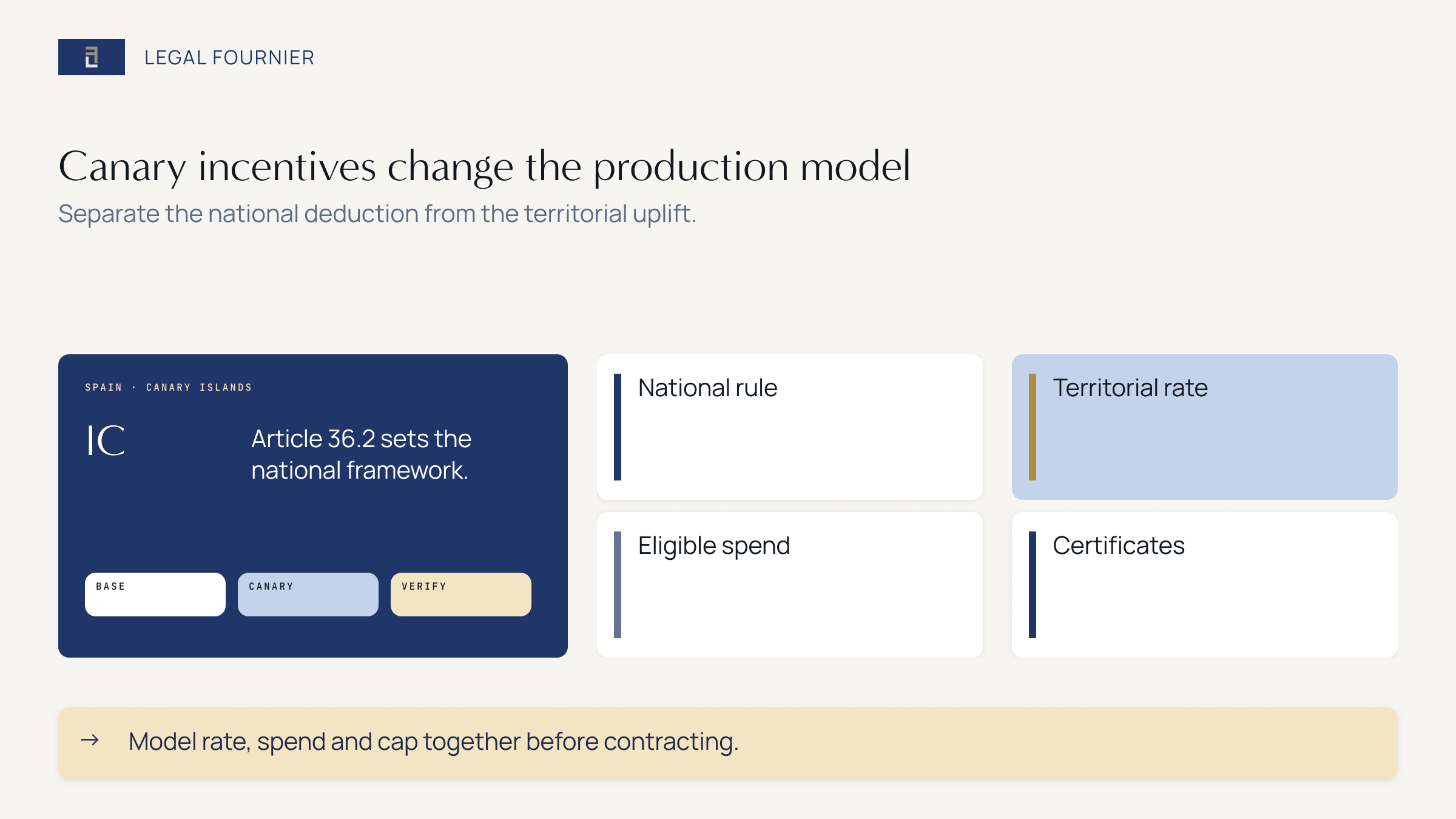
The Canary Islands regime increases the potential tax result for qualifying Canary Islands expenditure. The official Spanish Tax Agency material for the Canary Islands refers to the application of Article 36.2 together with the Canary Islands rules, including the additional provision of Law 19/1994. Public materials from the Canary Islands and local film commissions describe rates of up to 54 percent for the first EUR 1 million of qualifying expenditure and 45 percent on the excess, with a cap that can reach EUR 36 million for a feature film and EUR 18 million per episode for series. These figures must be reviewed against the tax period, aid-intensity rules and the exact production profile before being built into a financing model.
The higher headline rate does not decide the location. The production must be able to generate enough qualifying Canary Islands expenditure through an eligible local structure for the incentive to work in the final budget. Our Spain film tax rebate guide explains the common Article 36.2 rules used as the starting point for this comparison.
The local producer or production service company is not a formality
For foreign productions, the beneficiary is typically the Spanish producer or production service company responsible for execution. In the Canary Islands context, the public guidance from local film commissions refers to production companies or service production companies with tax residence in the Canary Islands, registered with the ICAA, that have executed the foreign production. That is not an administrative detail to be solved at the end. It affects contract allocation, invoice flow, corporate tax use, documentation, indemnities and negotiation of the economic benefit between the foreign commissioner and the local service company.
Before selecting a local production service company, check its tax residence and registration, its capacity to incur and evidence eligible spend, and its proposed route for using or recovering the deduction. The service agreement should allocate tax, certificate and audit risk. Any net-budget quotation should also identify the assumptions that have not yet been documented.
It is common for commercial proposals to present a net cost after incentive. That can be useful, but it should not be treated as legal advice. The production service agreement should explain what happens if the deduction is reduced, delayed, challenged or not generated because a condition was not met.
Eligible expenditure: which local costs count
Article 36.2 does not treat every euro spent near a shoot as eligible. The Tax Agency states that the deduction base consists of expenses incurred in Spanish territory directly related to production, including creative personnel expenses where the personnel have tax residence in Spain or in a European Economic Area member state, and expenses arising from technical industries and other suppliers. Canary Islands materials apply that logic to expenditure in the islands for the higher regional regime.
This makes invoice mapping essential. The production should distinguish creative personnel, technical suppliers, production services, post-production, travel, accommodation, rentals, studio costs, location services and overhead. Some items may be commercially necessary but still require review before being counted in the deduction base. In addition, where costs are shared across episodes or territories, the allocation method must be reasonable and documented. A series that spends across several jurisdictions cannot simply load common costs into the Canary Islands file without a defensible basis.
Tax residence is another practical pressure point. The rules around creative personnel expenses are not the same as a general crew-cost rule. A non-EU actor or department head may be essential to the production, but that does not mean the cost automatically qualifies in the same way as a Spanish or EEA tax-resident creative. The review should be done before contracts and payroll arrangements are finalized, especially where crew will move between the Canary Islands, mainland Spain and other countries during the same production window.
Minimum spend, total budget and caps need to be modeled together
A headline percentage is only one part of the calculation. The foreign production rules include minimum spend thresholds, total production cost requirements, maximum deduction-base rules and maximum deduction amounts. Public Canary Islands guidance refers to a minimum EUR 1 million of eligible expenditure for foreign productions, a lower EUR 200,000 threshold for animation in certain cases, and a minimum total production cost of EUR 2 million. The Tax Agency guidance also refers to an 80 percent maximum deduction base by reference to total production cost.
Those conditions should be tested in the first incentive model. If the Canary Islands spend is close to the threshold, the project should not rely on a comfortable incentive result until the budget is sufficiently granular. If the project is episodic, the cap and allocation questions have to be considered per episode. If animation, VFX or post-production services are involved, the legal team should identify which specific rule is being relied on and whether the facts are closer to the general foreign production route or a special VFX scenario.
The model should include a legal-risk column that separates confirmed, likely, uncertain and non-qualifying expenditure. This makes an optimistic assumption visible before it is built into the service contract’s gross-to-net calculation.
ICAA and certificate work should be scheduled, not improvised
The incentive file is not complete just because the production was filmed in the islands. The Article 36.2 regime includes requirements connected with the cultural certificate, final credits and authorization for use of title and press materials for promotional activities. The official Tax Agency guidance refers to a certificate issued by the ICAA or the competent autonomous-community body. Canary Islands materials also refer to Canary-specific certificate considerations for certain productions.
Put certificate work on the production calendar. Assign the application, declarations, underlying-rights evidence, final credits and promotional-material authorizations before wrap. Otherwise the local service producer may need documents after the international commissioner has moved on to delivery.
Foreign producers should also ensure that final-credit obligations and film commission references are agreed contractually. If a streamer, agency client or brand has tight credit rules, that should be reconciled with the Spanish incentive obligations before delivery materials are locked.

Tenerife and Gran Canaria film commissions: useful, but not the tax adviser
Local film commissions are useful for production intelligence. Public pages from the Tenerife Film Commission and the Gran Canaria Film Commission summarize the foreign production incentive and can point producers toward local procedures and professional contacts. They matter at the planning stage because island-level logistics, supplier availability and local coordination can affect whether the proposed spend is realistic.
A film commission summary is not a binding tax ruling or a review of the production service contract. The foreign producer still has to address Spanish corporate tax, local tax residence, eligible-expenditure evidence, ICAA registration, certificates, insurance, worker classification, immigration for non-EU crew and the contractual allocation of incentive risk.
Use film commissions for local coordination and market information. Private contract terms and tax filing positions require separate advice.
Contract points to settle before committing spend
The production service agreement should not merely state a gross budget and a net cost after incentive. It should define the incentive assumption, the eligible spend categories, the documentation standard, the timing of the economic benefit, and what happens if the deduction is denied, reduced or delayed. It should also cover whether the foreign producer has audit rights over the local spend file and whether the local producer can make unilateral tax positions that affect the foreign producer’s economics.
The main schedules should include a chart of accounts for qualifying expenditure, a certificate responsibility matrix, final-credit language, promotional-material authorizations, VAT or IGIC treatment, insurance requirements, data protection language for crew and supplier documents, and a dispute mechanism for tax adjustments. If payroll or loan-out structures are used, the agreement should identify who is responsible for social security, withholding and immigration compliance.
The foreign producer should be cautious with clauses that promise an incentive result without explaining the conditions. A credible clause will usually say what must be true for the assumption to hold. A risky clause simply subtracts a percentage from the budget and leaves the parties to argue later.
When the Canary Islands structure may not be the right answer
The Canary Islands regime is not automatically the best answer for every foreign production in Spain. It may be less suitable if the creative and technical work will mostly occur in mainland Spain, if the production cannot reach the qualifying local spend threshold, if the preferred service company does not have the required tax profile, if the certificate timetable is too tight, or if the commissioner needs contractual certainty before the local producer can properly validate the incentive.
It may also be inappropriate to force a Canary Islands structure onto a production whose real operational center is elsewhere. Tax incentives work best when the legal structure follows the commercial reality. If the production is artificially routed through the islands while principal suppliers, crew and work are located outside the qualifying territory, the legal risk increases and the commercial benefit may disappear.
The review may support a Canary Islands service producer, the common Spanish regime or separate island and mainland units. Make that choice before the production incurs spend that cannot be reassigned. The broader filming in Spain checklist covers permits, crew and immigration issues outside this Canary Islands tax analysis.
Practical pre-shoot checklist
- Identify the Spanish or Canary Islands taxpayer that will execute the foreign production and claim the deduction.
- Confirm ICAA registration, tax residence and the corporate tax position of the proposed service producer.
- Map the budget into qualifying, likely qualifying, uncertain and non-qualifying cost categories.
- Test the EUR 1 million local spend threshold, animation threshold where relevant, EUR 2 million total production cost and 80 percent deduction-base limit.
- Review creative personnel tax residence before relying on those costs in the deduction base.
- Schedule ICAA or competent-body certificate work, final-credit language and promotional-material authorizations.
- Align the production service agreement with the incentive model, including audit rights and risk allocation.
- Check whether non-EU crew need immigration planning before travel, even where the tax incentive is the main driver of the discussion.
Paid legal and tax review before you choose the service producer
Legal Fournier advises foreign producers, production service companies and audiovisual clients on Spanish legal, tax and immigration planning. For a Canary Islands shoot, review the structure before selecting the service producer, signing the agreement, confirming crew or committing the spend expected to support the incentive.
A paid consultation can review the proposed structure, service-producer role, Article 36.2 assumptions, Canary Islands uplift, ICAA and certificate points, tax residence of relevant personnel, eligible expenditure map, crew authorization needs and contract risk allocation. The objective is not to promise a tax outcome. It is to identify the conditions that must be met, the documents that must exist, and the points that should be negotiated before the budget is treated as reliable.