

First occupancy licence in Spain: mortgage, rental and resale risks
A finished Spanish property may still have a weak licencia primera ocupacion file. The problem often appears only after the buyer has paid a reservation fee, when the bank, valuer or buyer’s lawyer checks whether the municipal and registry records support legal occupation and the property’s intended use.
The issue is common in off-plan and newly completed homes, converted premises, heavily renovated houses, rural villas and rental investments. Depending on the municipality and autonomous community, a first occupancy licence, first-use authorisation, prior communication or responsible declaration may show that the finished building matches the authorised project and can be used for the purpose promised to the buyer.
Our Spain property buyer cost and risk calculator covers the purchase economics. If a reservation contract or arras deposit is already involved, review the licence and the contract together before completion. The first occupancy file can affect mortgage finance, rental plans and resale value.
If the issue appears before signing, connect the licence review with the arras contract and the broader property purchase risks, instead of treating it as a document to chase after completion.
Published: 9 July 2026
- The first occupancy file is usually a municipal or local-authority control point confirming that the completed work can be used for its authorised purpose.
- Spanish national land law links completed new-build registration to documents proving the legal requirements for delivery and the administrative authorisations, communications or responsible declarations required for the building’s intended use.
- Mortgage valuers and banks may raise questions where the physical, registry, cadastral or urban-planning status of the property is not coherent.
- For rental, the issue is practical as well as legal: a landlord must be able to offer a habitable dwelling and the local/regional rules may require additional housing, activity or tourist-rental permissions.
- For resale, the missing licence can become the next buyer’s discount, the next bank’s condition, or the notary/registry problem that should have been negotiated before completion.
What the first occupancy licence actually tests
The expression buyers search for is usually licencia primera ocupacion. In practice, the local label can vary: licencia de primera ocupacion, licencia de ocupacion, licencia de primera utilizacion y ocupacion, comunicacion previa or declaracion responsable. The name matters less than the legal function. The authority is checking, or requiring the promoter to declare under responsibility, that the completed building is consistent with the licence, project and applicable urban-planning conditions.
The national framework is in the Spanish land and rehabilitation legislation. Article 28 of the consolidated Land and Urban Rehabilitation Law requires, for completed new-build declarations, documents proving the legal requirements for delivery to users and the administrative authorisations needed to show that the building has the conditions required for its intended planning use. Where the regional or local rules replace authorisation with prior communication or responsible declaration, the registration file must instead evidence that the communication was made and the relevant legal conditions were met.
Do not leave this document until after signing. For new-build and recently converted property, the first occupancy file connects the completed works with municipal planning control, the notarial deed, Land Registry, utilities and mortgage valuation. Gaps in that file can make the property harder to finance, rent or sell.
The key legal point: a first occupancy document is not a private promise by the seller. It is part of the public-law evidence that the completed building can be used for the purpose the buyer is paying for.
Why foreign buyers miss the problem
Developers may say the licence is “in process”, agents may point out that other buyers are completing, and the bank may have issued preliminary approval. None of this resolves the legal question. A preliminary mortgage offer does not approve the final property file, temporary utilities do not prove a clean licence, and a booked notarial appointment is not a due-diligence conclusion.
The terminology also changes by location. A buyer may ask for the cedula de habitabilidad used in one autonomous community when another municipality requires a first-occupation licence or declaration. In Madrid, the current municipal ordinance distinguishes between licence and responsible-declaration routes according to the act, use and activity. In Barcelona, the official procedure refers to a communication of first occupation and use for major-works files and requires technical completion documents. The review must follow the local route rather than a generic national checklist.
Timing matters just as much. The contract should state what must exist before completion, what evidence is acceptable and who bears the risk of delay. It should also explain what happens if the authority objects and whether the buyer may withhold funds, postpone or terminate. A promise that the seller will “process” the licence after completion may leave the buyer carrying an unpriced administrative risk.
Mortgage risk: the bank cares about more than your income
Foreign buyers usually focus on personal affordability: salary, dividends, tax returns, debt ratios and non-resident lending percentages. Those matter, but they are only one side of the mortgage decision. The bank also needs a reliable asset as security. If the property’s legal and planning position is unclear, the loan can slow down or become conditional even where the borrower is financially strong.
Spain’s official information for property purchases explains that off-plan due diligence is more complex and includes checking that the land is registered, that the development is authorised by the town hall, and, if the dwelling is registered, that the registration can evidence completion, technical conformity with the licence, building insurance, the Building Book, works licences and first occupancy licences. This is the logic a careful bank and valuer will also care about: not merely whether the apartment exists physically, but whether the legal file supports the mortgage security.
Mortgage valuation rules point in the same direction. Order ECO/805/2003 requires valuation work to consider, among other things, physical identification, occupation and use, public-protection status, architectural heritage protection and the property’s conformity with current planning. For mortgage-related valuations, it also requires registry and cadastral documentation and a transparent report with conditions or warnings where relevant. A missing first occupancy document does not automatically make every mortgage impossible, but it can generate a warning, a condition, a lower practical value, or a bank-level refusal depending on the file.
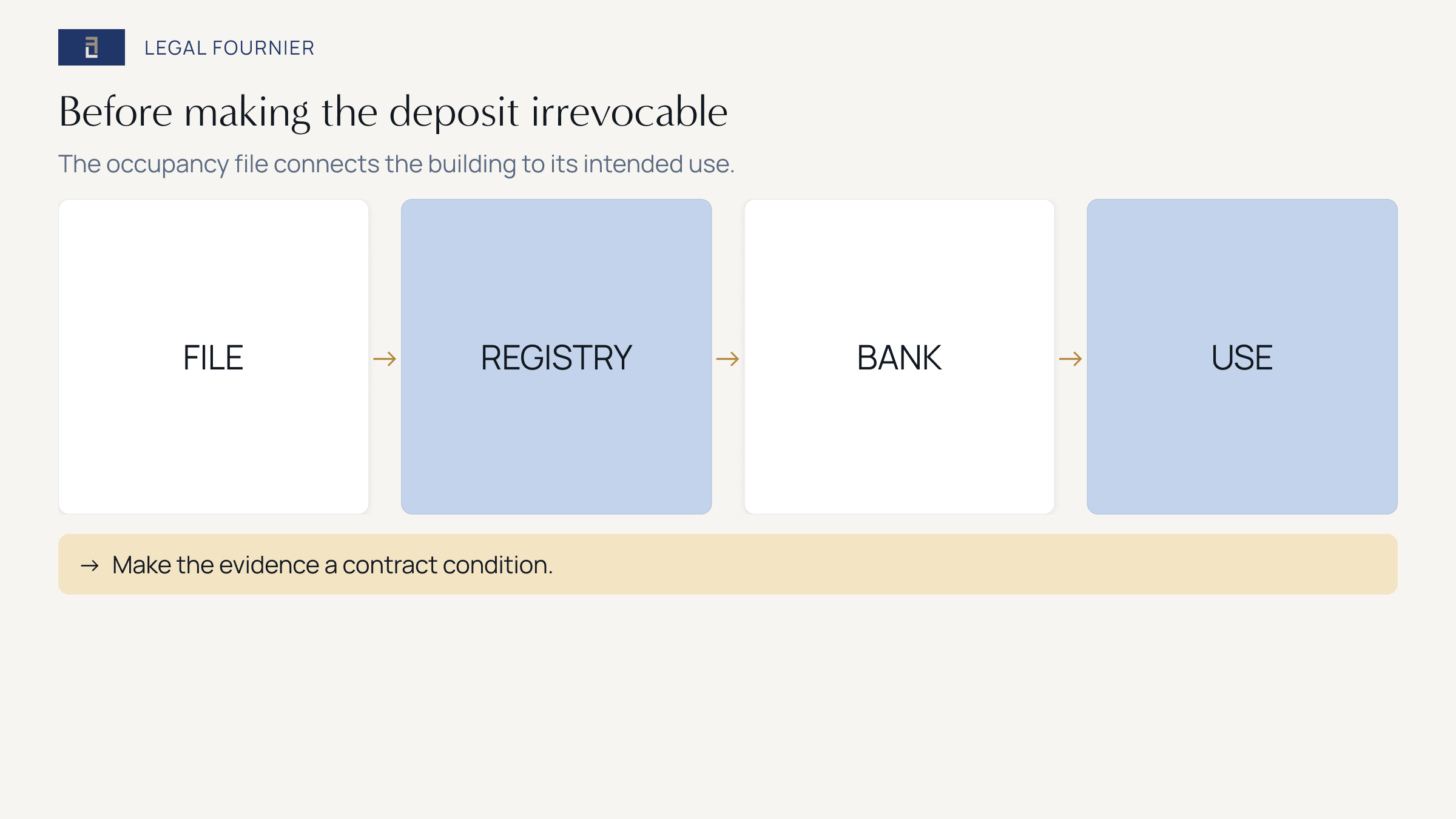
Typical bank questions
The bank or valuer may ask whether the property is registered as a completed dwelling, whether the registry description matches the physical unit, whether the building has the required energy certificate and technical documentation, whether the unit is legally residential rather than a commercial premises, and whether the town hall has any open planning or discipline file. For a new development, the lender may also ask whether the developer’s mortgage is cancelled or subrogated cleanly and whether the buyer’s unit can be mortgaged independently.
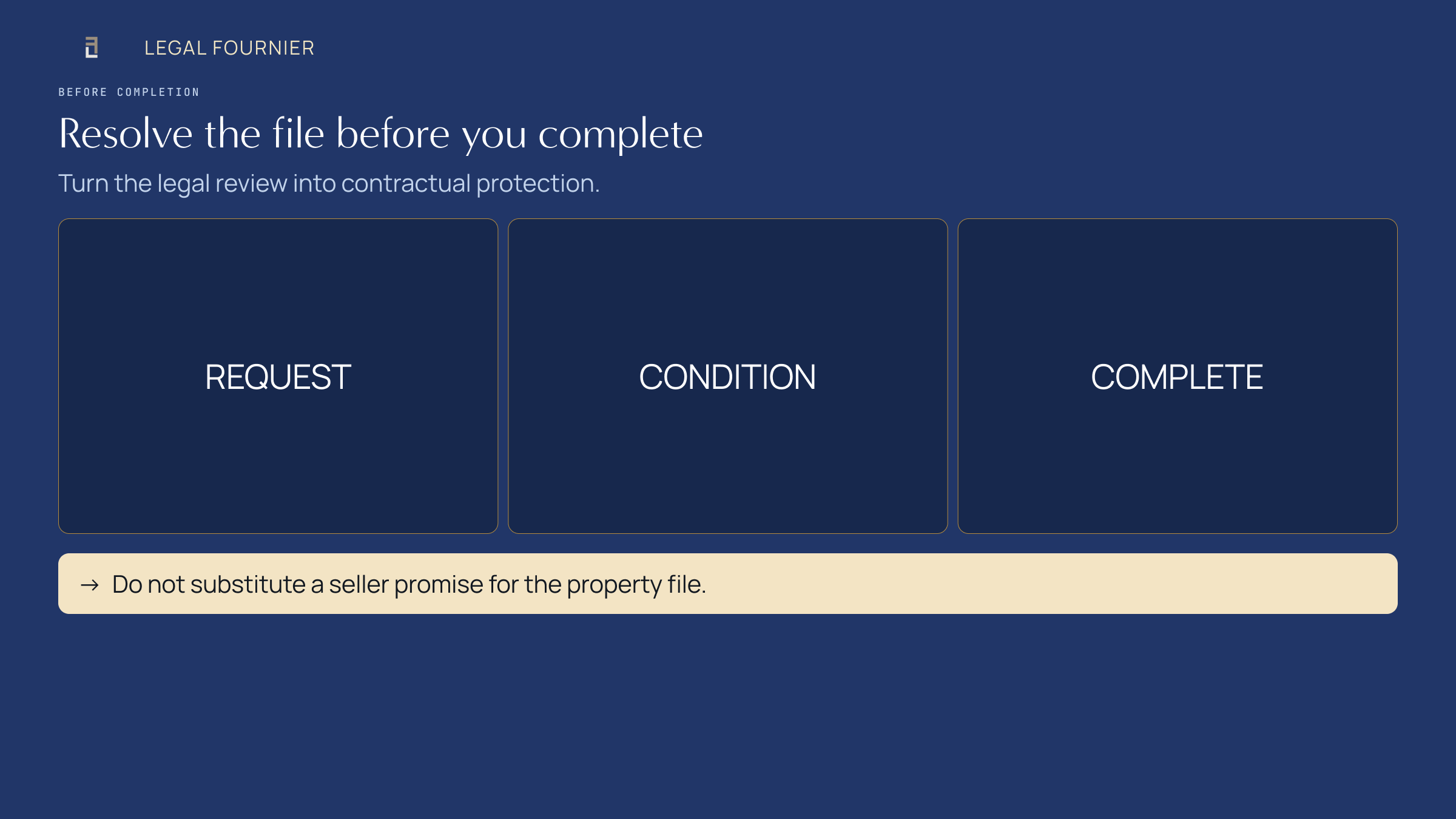
The high-risk case is a buyer who signs an arras contract with a hard completion deadline but makes the deposit non-refundable before the first occupancy issue has been tested. If the bank later conditions drawdown on documentation that the seller cannot yet provide, the buyer may be trapped between losing the deposit and completing without finance. The solution is contractual: define the first occupancy evidence as a completion condition or expressly price the risk if the buyer agrees to complete before it is resolved.
Rental risk: habitability, use and local permission
A buyer planning to rent the property needs a separate risk analysis, beginning with whether the dwelling can legally and practically be used as a home. The revised Spanish Urban Leases Act covers habitable dwellings and rooms for habitual housing and qualifying temporary housing needs. It also obliges the landlord to carry out the repairs necessary to keep the dwelling in habitable condition for the agreed use, except where deterioration is attributable to the tenant. Unresolved occupation or use documentation can therefore create a landlord-side risk as well as a purchase-side risk.
The rental type also matters. Since 8 October 2026, qualifying temporary and room rentals fall within the revised LAU rules; classification requires checking the temporary cause, contract date, transitional provisions and regional law. A first occupancy licence may support residential use, but it does not automatically authorise tourist exploitation, hotel-style activity or any use prohibited by local planning, regional tourism rules or community statutes. In Madrid, for example, the municipal ordinance treats first occupation and functioning for activities separately from responsible declarations for first occupation and functioning of building/use acts. The exact route depends on the property and the activity.
Do not rely on a rental-yield projection until the legal use is confirmed. If the price assumes short-term rental income but the file supports only ordinary residential use, the spreadsheet describes a different asset. Compare the municipal occupation or use file, the registry and cadastral description, and the proposed rental model under local and regional rules.
Rental-investment risk: if the purchase price depends on rental yield, first occupation, habitability and permitted-use checks should be completed before the purchase.
Resale risk: the missing paper becomes the next buyer’s discount
Even if the buyer is willing to accept the risk, the next buyer may not be. Resale risk is where first occupancy problems become expensive. A future buyer’s lawyer may ask for the licence, declaration, communication, completion certificate, Building Book, energy certificate, technical project, utility evidence, town-hall certificate or planning report. Spain’s Building Regulation Law supports the importance of executed-work documentation and the Building Book for users and later owners. A future bank may ask the same question through the valuation process. If the seller cannot answer cleanly, the property may still sell, but with delay, price pressure or more restrictive buyer financing.
Spanish land law also makes transmission risk important. Article 27 of the Land and Urban Rehabilitation Law provides that transmission of property does not change the owner’s position regarding the duties of ownership under land and planning law, and the new owner is subrogated into rights and duties of the previous owner where relevant. That does not mean every missing licence creates the same consequence. It means buyers should not assume that a planning or completion problem disappears because the deed is signed.
The official property-purchase guidance also reminds buyers that the seller can remain liable for hidden defects and that developer, builder and technical agents may have building-liability periods for certain defects. But those private or construction-law remedies are not a substitute for negotiating the first occupancy issue before completion. Litigation after completion is slower and less valuable than a correctly drafted condition before the buyer pays the balance.
High-risk purchase scenarios
| Scenario | Why the first occupancy file matters | Buyer protection point |
|---|---|---|
| Off-plan or new-build completion | The buyer is relying on the developer’s final municipal and registry file. | Make acceptable first occupancy evidence a completion condition. |
| Commercial premises converted into housing | The legal use may not match the physical layout or marketing description. | Check licence, change-of-use file, registry/cadastral update and community rules. |
| Rural villa or older extension | Parts of the building may be outside the licence, out of planning order, or only historically tolerated. | Obtain urban-planning report and technical comparison before signing hard deposits. |
| Investment property for rental | Yield depends on permitted use, habitability and local rental/tourism rules. | Test the rental model legally, not only the gross yield. |
What to ask before signing arras
The safest moment to control this risk is before the contrato de arras becomes binding. The buyer should ask for the occupation or first-use document, the building licence, the final works certificate, the deed of declaration of new construction or completion, the registry extract, cadastral data, energy certificate, Building Book where applicable and any town-hall communication or responsible declaration receipt. In a conversion or renovation file, the buyer should also ask for the change-of-use evidence and final documentation proving the works match the authorised project.
The contract should then translate the legal review into commercial protection. If the first occupancy licence or equivalent is still pending, the contract should say whether completion is postponed until it is granted, whether the buyer may terminate if the authority raises objections, whether a retention is held back, whether the seller bears regularisation costs, and whether the buyer’s mortgage approval is conditional on the property documentation. Generic promises are not enough for a serious international purchase.
Buyers should be especially cautious with phrases such as “the licence is automatic”, “everyone signs before it arrives”, “the town hall never refuses these”, or “the bank already knows”. Sometimes a declaration-responsibility route does allow occupation after a filing, subject to legal conditions and later control. But the legal question is not whether the phrase sounds plausible. It is whether the specific property, in that municipality, under that regional law, with that project history, has a file that a buyer, bank and future purchaser can rely on.
When the licence is missing: three options
1. Delay completion until the file is complete
This is usually the strongest buyer position in new-build purchases where the seller is responsible for delivery. The buyer does not refuse to complete indefinitely; the buyer defines the documents required and sets a controlled path to completion once they exist. This approach is most appropriate when the buyer needs mortgage finance, intends to rent quickly, or wants a low-friction resale file.
2. Complete with a retention and specific seller obligations
Sometimes the commercial deal justifies completion before the final document is issued. That is not a DIY decision. The deed or private agreement should specify the withheld amount, release conditions, deadline, seller obligations, evidence required, costs, tax handling and what happens if the authority refuses or imposes works. A symbolic retention is rarely enough where the defect could affect finance, rental legality or resale value.
3. Reprice or walk away
If the issue is not administrative delay but a real mismatch between the property and the authorised use, the buyer should consider repricing or terminating. A unit marketed as a luxury apartment but registered or licensed as another use is not just missing paperwork. A villa with unlicensed extensions may carry demolition, regularisation or valuation risk. A rental property whose intended activity cannot be authorised may be worth materially less than the seller’s projection.
FAQ
Is the first occupancy licence the same everywhere in Spain?
No. The concept is common, but the legal route varies by autonomous community and municipality. Some files use a licence; others use prior communication or responsible declaration. The buyer should check the local rule and the specific property history.
Can I buy without a licencia primera ocupacion?
Sometimes a purchase can still complete, but that does not make it commercially safe. The question is whether the missing document affects registry completion, mortgage valuation, lawful occupation, utilities, rental use, regularisation cost or resale. The answer depends on the file.
Will the bank always refuse the mortgage if the licence is missing?
No. Bank practice varies, and some issues can be resolved through alternative evidence or conditions. But a missing or inconsistent first occupancy file can create valuation warnings, drawdown conditions or refusal, especially in new-build, conversion and non-standard properties.
Does first occupancy authorise tourist rental?
No. First occupancy or first use may support the building’s lawful residential use, but it does not authorise tourist rental by itself. A new activity may require prior express approval from the community of owners as well as regional and municipal permissions. The May 2026 Supreme Court judgments partially annulled the national unique-registration procedure; they did not remove community, planning or tourism-law checks. Treat the occupancy document, community approval and public licences as separate due-diligence items.
What should be written into the arras contract?
The contract should identify the required document, who must obtain it, when completion can occur, whether mortgage approval is conditional on it, whether the buyer can terminate, and whether a retention applies if the buyer agrees to complete before the file is fully resolved.