Occupied property in Spain: tenant, eviction and deposit risks
An advertised discount can make comprar vivienda ocupada look attractive. But the buyer also takes on the uncertainty surrounding whoever is inside. That person may be a protected residential tenant, a tenant in arrears, a former owner after foreclosure, a family member claiming a right of use, a person in precario or an unlawful occupant with no contract. Each situation has a different legal route, cost and timetable.
For a foreign buyer, eventual recovery is only one concern. Occupation may affect the completion date, mortgage, insurance, renovation, rental or resale, and the buyer may not even obtain reliable access after signing. A low price offers little comfort if the arras deposit is at risk while possession, tenant rights and court timing remain unresolved.
Use our Spain property buyer cost and risk calculator to compare the purchase economics. If you are negotiating a reservation or deposit, also review our article on contrato de arras modelos. Here, the focus is the occupied-property file: tenant, eviction and rental-deposit risk before the buyer commits funds.
Published: 14 July 2026
- An occupied property is not one legal category. A valid tenant, expired tenant, non-paying tenant, precario occupant and illegal occupant require different analysis.
- Under the Spanish Urban Leases Act, a buyer of a rented dwelling can be subrogated into the landlord’s rights and obligations, so the lease may survive the sale.
- The tenant may have statutory tanteo and retracto rights unless a valid waiver or exception applies, so notices and declarations need to be checked before completion.
- Eviction routes exist, but timing is court-dependent and can be affected by notification, vulnerability checks, opposition and the exact procedural route.
- The rental deposit, unpaid rent, utilities, community charges, insurance and physical condition should be priced in the arras contract, not discovered after the deed.
Start with the occupation profile, not the discount
The first question is simple: who is inside, and why? A property “with tenant” is very different from a property “occupied” without title. A tenant with a current residential lease has rights that may bind the purchaser. A tenant whose lease has expired may still require a formal legal route for recovery. A non-paying tenant raises rent-arrears and eviction questions. A former owner still in possession after an enforcement process creates another profile. An unknown occupant can require possession proceedings and careful service of process.
Classify the occupation before signing a binding arras contract. Sales descriptions such as “occupied”, “with rental income”, “tenant leaving soon”, “currently unavailable for visits”, “bank-owned” or “auction opportunity” are not legal conclusions. Ask for the lease, rent-payment records, deposit documentation, communications with the occupant, litigation history, community debt certificates, utility status, insurance position and current inspection evidence.
The official Spanish property-purchase guidance explains that buyers can use the Land Registry nota simple to obtain information on ownership and charges, and that purchases are usually formalised in a public deed before inscription at the Land Registry. The government guidance on buying real estate in Spain is useful, but an occupied-property file requires more than a registry extract. Possession, leases and private agreements may not be fully visible from the registry alone.
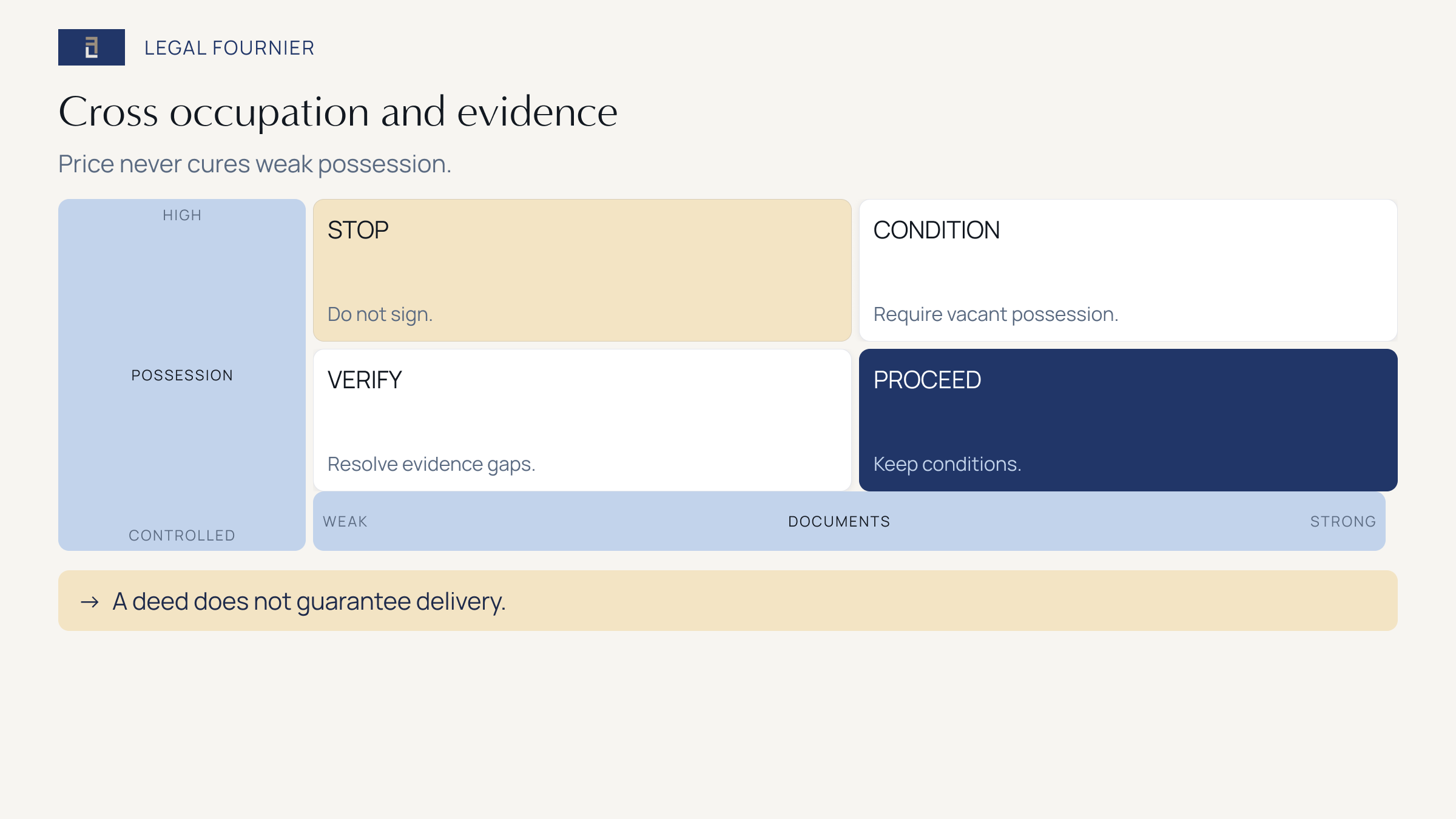
The key commercial point: do not price an occupied property as if it were vacant unless the contract gives you a realistic, enforceable and funded route to vacant possession.
If there is a tenant, the lease may survive the sale
The most common mistake is assuming that a sale automatically removes the tenant. It usually does not. Article 14 of the Spanish Urban Leases Act provides that the purchaser of a rented dwelling is subrogated into the landlord’s rights and obligations during the first five years of the contract, or seven years where the previous landlord was a legal person. Longer agreed terms need separate analysis, especially if registry-protection questions arise.
For a buyer, that means the economic question is not “can I buy it?” but “what exactly am I buying?” If the lease continues, the buyer is acquiring a rented asset, not a vacant home. The rent level, duration, renewal rights, repair obligations, deposit return, permitted use, tenant solvency and rent-control exposure can materially change value. A luxury apartment at a discount may still be poor value if the current rent is low, the tenant is protected, and the buyer’s business plan assumes immediate vacant possession or short-term rental.
This is especially important for non-resident investors, families buying for future relocation, and founders moving to Spain who need a home on a fixed timeline. A lease that is commercially acceptable for a local investor may be unacceptable for a buyer who needs to occupy the property for school admissions, immigration planning, a company relocation or a mortgage condition.
Check the contract date and landlord type
Residential lease rules in Spain have changed several times. The date of the lease, the landlord’s status as an individual or legal person, the agreed duration, any extensions, the tenant’s notices and any post-contract amendments all matter. Old leases and transitional regimes can be disproportionately valuable to tenants and disproportionately expensive for buyers. Do not rely on a one-page agency summary.
The diligence should also confirm whether the lease is for permanent housing, seasonal use, tourist use, rooms, commercial premises, office use, or another category. Since 8 October 2026, qualifying temporary and room rentals fall within the revised LAU rules; classification requires checking the temporary cause, contract date, transitional provisions and regional law. If the buyer’s plan depends on changing the use, ending the lease, or raising the rent, that plan should be tested before the deposit is exposed.
Tenant pre-emption rights can block a clean completion
A rented dwelling can also trigger tenant pre-emption rights. Article 25 of the Urban Leases Act gives the tenant a preferential acquisition right in a sale of the rented dwelling, through tanteo before the sale and retracto after the sale, unless a valid waiver or exception applies. The law also links registration of sales of rented dwellings to evidence that the relevant notices have been made, or to the seller’s declaration that the property is not rented.
This is a practical closing issue, not an academic point. If the tenant has not waived the right, or if the seller’s notice is defective, the buyer may face a challenge after completion. If the deed declares the property is not rented when the facts are different, the file becomes more serious. If the tenant waived pre-emption rights in the lease, the waiver and the seller’s advance communication still need to be reviewed in context.
For a foreign buyer, the correct approach is to require the lease, all annexes, evidence of tenant notices, any waiver wording, and a notarial strategy before signing arras. If the seller cannot provide this documentation, the buyer should not simply accept “the notary will handle it”. By the time the notary appointment is booked, the buyer may already have a deposit at risk.
Eviction risk: there is a route, but not a guaranteed date
Spain has civil routes for recovering possession, but a buyer should not underwrite the deal on a fixed online timeline. The Spanish Civil Procedure Law routes certain rent-arrears, expiry, precario and possession claims through juicio verbal. It also contains specific provisions for claims seeking recovery of a dwelling or part of it where the claimant has been deprived of possession without consent, subject to the claimant profile and procedural requirements.
Recovery is not automatic. The court must identify and notify the occupants, who may produce a title or oppose the claim. Housing cases may involve social-services communications, and hearing dates depend on local court capacity. The final possession date can move. A large portfolio investor, company, bank-related purchaser or foreign vehicle may also face additional procedural and reputational questions. For occupied properties, also check the October reform’s vulnerability and possession procedures before relying on a promised handover date.
There is also a strategic difference between evicting a tenant and recovering from an unknown occupant. A tenant case starts with the lease, the rent ledger, default notices, expiry date and contract clauses. An unlawful occupation case starts with title, proof of possession, proof that possession was taken without consent, identification issues and the correct claimant. A former owner after enforcement may require yet another route. The purchase file should identify the expected action, evidence, cost range and risk of opposition before price is agreed.
| Occupation profile | Core legal risk | Buyer protection point |
|---|---|---|
| Current residential tenant | Lease may bind the purchaser; tenant may have pre-emption rights. | Review lease, waiver, notices, rent, deposit and renewal exposure before arras. |
| Non-paying tenant | Court action, unpaid rent, utilities, damage and possible opposition. | Price arrears and eviction cost; decide who files and who bears delay. |
| Expired or tolerated occupant | Precario or possession claim may be needed; facts are evidence-sensitive. | Require written history, prior notices and a litigation strategy. |
| Unknown or unlawful occupant | Identification, notification and social-risk steps can affect timing. | Do not complete without a discount, retention or seller obligation that reflects possession risk. |
Deposit risk: the fianza is a liability, not just cash
The rental deposit is often handled casually in negotiations, but it matters. Article 36 of the Urban Leases Act requires a cash deposit equivalent to one month’s rent for residential leases and two months for leases for another use. The same article regulates return of the balance at the end of the lease and allows additional guarantees, with limits for certain housing leases.
The Act also allows autonomous communities to require the landlord to deposit the statutory fianza with the designated regional body. That is why the buyer should request proof that the deposit was actually lodged, the amount, the regional filing reference, and the process for changing the holder after completion. In Madrid, for example, the official regional deposit page notes that in a sale of the property the deposit should be changed into the buyer’s name. In Catalonia, INCASOL guidance explains that landlords must deposit rental deposits for urban leases under its procedure.
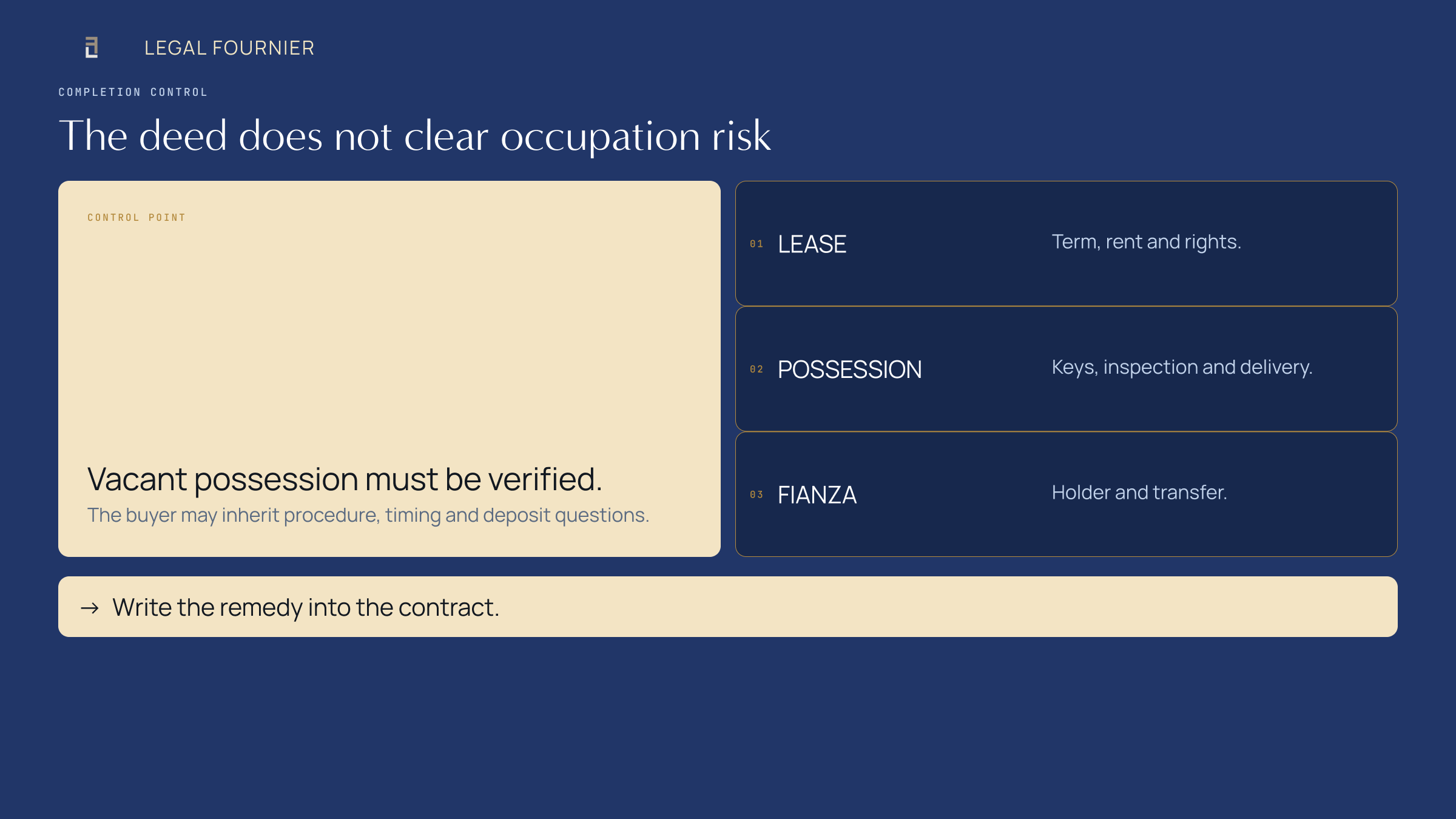
If the lease continues after the sale, the buyer may inherit landlord obligations but may not physically receive the deposit unless the sale contract deals with it. A clean completion statement should allocate the deposit, prepaid rent, unpaid rent, utilities, community expenses, IBI if contractually passed through, repairs, damage claims and any pending insurance event. The notarial deed or private completion settlement should make the economics explicit.
Buyer risk: title may transfer quickly, but unresolved tenant money can follow the buyer for years. Include the deposit, arrears and end-of-lease condition report in the price negotiation.
Arras strategy: make vacant possession a condition or price it properly
The safest position is to resolve possession before the buyer signs a binding deposit contract. If that is not commercially possible, the arras contract must define the risk with precision. It should state whether the property is sold vacant or occupied, identify the occupant status, attach the lease or litigation file, define the completion condition, and say what happens if the property is not vacant by the scheduled deed date.
If vacant possession is essential, the contract should make it a condition precedent. The seller should deliver keys, physical access, utility-control evidence, confirmation of no occupants, and ideally a final inspection before completion. If the buyer is willing to buy occupied, the price should reflect the lease or litigation risk, and the contract should include a retention, seller indemnity, arrears assignment, cooperation duties and evidence package.
The Spanish Civil Code is relevant because the seller is generally obliged to deliver and warrant the object of the sale. Articles 1461 and 1462 of the Civil Code frame delivery of the sold thing and the effect of a public deed, but in occupied-property cases the contract should remove ambiguity. The deed may transfer title, but the buyer’s commercial objective may be physical control. Those are not the same risk.
Clauses to negotiate before the deposit is paid
For a vacant-possession purchase, negotiate a clear representation that the property will be delivered free of occupants, leases, use rights and informal possession arrangements unless listed in an annex. Add a completion condition tied to inspection and key delivery. State whether failure gives the buyer the right to postpone, terminate with deposit refund, recover double deposit where applicable, or enforce a specific indemnity. If the seller says the occupant will leave voluntarily, require the signed agreement and proof of performance, not a verbal assurance.
For an occupied investment purchase, negotiate a different structure. The buyer may accept the tenant, but only after verifying the lease. The contract should transfer the deposit economics, rent from completion date, rent arrears if assigned, pending claims, tenant communications, regional deposit records, repair history and any court file. If a rent increase, termination or refurbishment is central to the investment thesis, counsel should test whether the law permits it before the buyer prices the asset.
Due diligence checklist for an occupied property
A serious occupied-property review is multidisciplinary. It combines conveyancing, tenancy law, civil procedure, tax, insurance, finance and sometimes family or insolvency history. The minimum file should include the nota simple, cadastre, title deed, community certificate, IBI and utility status, lease and annexes, deposit proof, rent ledger, tenant identity, notices, photos, inspection report, litigation documents and seller declarations. In a bank-owned or auction-related purchase, the file should also include enforcement or adjudication documents and any information on occupants with possible rights of permanence.
For financing, tell the bank early that the property is occupied. Some lenders will value a rented asset differently from a vacant home. Some may require vacant possession, access for valuation, evidence of lease income, or confirmation that the buyer can insure the asset. If the buyer is relying on rental income, the lender may ask whether the income is documented and sustainable. If the buyer is relying on eventual occupation, the lender may care about recovery timing.
For tax and wealth planning, occupied property can also alter cash flow assumptions. Non-resident owners must manage Spanish tax compliance, reporting and deductible expenses correctly. HNW families should consider whether the property is a personal residence, long-term rental asset, company-held asset or future relocation home. The legal answer to possession can change the tax and family-office answer to the acquisition structure.
Tourist-rental income: even after vacant possession, confirm community approval where required, regional and municipal licensing, and the national and platform rules that remain after the May 2026 judgments.
When to walk away
Not every occupied property should be avoided. Some are good investments: a solvent tenant, a market rent, a clean lease, deposit properly lodged, no arrears, no pre-emption issue, and a price reflecting the income stream. The problem is not occupation itself. The problem is buying an unknown legal position with a hard deposit and optimistic timeline.
Consider walking away, or materially repricing, where the seller refuses to disclose the lease, cannot prove the deposit, will not allow inspection, uses vague language about the occupant leaving, asks for a non-refundable deposit before producing documents, or relies on an eviction timeline with no procedural review. Also be cautious where the property is marketed as an immediate home for the buyer’s family but is still occupied at signing. A relocation deadline is not a legal remedy.
Before relying on the discount, calculate the legal work, time, cash reserve and enforcement risk the purchase transfers to you. If those figures remain unclear, the price comparison is incomplete.
Does an occupancy or tenancy claim require MASC?
It depends on the action. Ordinary declaratory civil claims generally require a documented negotiation attempt. Organic Law 1/2025 excludes a narrow category of summary protection for a person dispossessed or disturbed in possession. That exception does not mean that every eviction, tenancy or unlawful-occupancy case bypasses MASC.
Rent claims, lease termination, recovery of possession, precario claims and urgent possessory actions can follow different rules. Identify the occupant’s alleged right and the exact action before sending a notice. A notice written for the wrong procedure may waste time or fail the later admissibility test.
FAQ
Can I buy a property in Spain with a tenant inside?
Yes, but the lease may continue after the sale and the buyer may become the new landlord. The contract date, duration, rent, tenant rights, deposit and pre-emption notices need review before the buyer signs arras.
Does buying the property let me evict the tenant immediately?
Usually no. If the tenant has a valid lease, the purchaser is normally bound by the lease for the legally protected period. Eviction depends on the legal ground, such as non-payment or expiry, and on the court process.
What is the difference between a tenant and an okupa?
A tenant has or claims a lease or contractual right to occupy. An unlawful occupant may have no title. The evidence, procedure, timing and negotiation strategy are different, so the buyer should not treat both cases as the same risk.
Who receives the rental deposit after completion?
The sale contract should deal with this expressly. If the lease continues, the buyer should verify the amount, where it is deposited, whether the regional record must be changed, and whether the seller is transferring the economic benefit or liability at completion.
Should vacant possession be written into the arras contract?
Yes, if vacant possession is essential. The contract should make vacancy, inspection, key delivery and documentary proof conditions of completion, and should state the remedy if the property is still occupied on the scheduled signing date.