

Late Modelo 200 filing: corporate tax penalties for a Spanish SL
A late Modelo 200 can expose weak corporate governance, poor accounting control and wider Spanish tax risk. For a foreign-controlled company, the amount of the fine is only one part of the review. Check whether the company filed voluntarily, whether tax was due, whether AEAT had already contacted the company and whether the delay reveals another problem.
Founders, family groups and non-resident shareholders need to address the issue because Modelo 200 is the annual corporate tax self-assessment for the company. A dormant SL, a newly formed SL, a company with losses, and a profitable operating company can all be in very different economic positions, but the filing obligation still needs to be tested carefully. If the company was created as part of a relocation or commercial launch, the late return may also sit beside VAT, payroll, accounting, bank KYC or Spanish permanent establishment issues.
This is a corporate tax risk file, not a generic penalty calculation. If your SL is still being structured, start with our company formation in Spain service. If the company is already operating and needs ongoing tax control, our monthly accounting service is the more relevant starting point. This guide addresses the late filing of Modelo 200 by a Spanish limited company, often searched in Spanish as modelo 200 presentado tarde sanción sociedad limitada. It explains what may happen after a late filing and what to check before the company files or responds.
Published: 30 July 2026
- Modelo 200 is the general annual Corporate Income Tax return for Spanish companies, and AEAT states that these returns must be filed electronically.
- For calendar-year 2025 corporate tax returns, AEAT currently lists the filing period as July 1 to July 27, 2026, because the ordinary July 25 deadline falls on a Saturday.
- If the company files late voluntarily and there is tax to pay, the usual issue is the Article 27 LGT surcharge, not an ordinary penalty: 1 percent plus 1 percent for each full month of delay before 12 months have elapsed; once 12 months have elapsed, 15 percent, with late-payment interest from the day after the 12-month period until filing.
- If AEAT has already issued a prior requirement, the company is no longer in the same voluntary late-filing position; penalties can become materially more serious.
- If there is no tax to pay or no economic damage to the Treasury, Article 198 LGT fixed penalties may be relevant, often lower where the filing is made late without prior requirement.
- Corporate tax penalties, administrative fines and late-filing surcharges are not normally deductible expenses for Corporate Income Tax purposes.
What a late Modelo 200 means
Modelo 200 is not a simple annual information form. AEAT describes it as the self-assessment for Corporate Income Tax and, for certain cases, Non-Resident Income Tax involving permanent establishments and foreign pass-through entities with a presence in Spain. The AEAT Modelo 200 procedure page identifies it as the return and payment or refund document for these taxes. AEAT also explains in its Corporate Income Tax model guidance that, as a general rule, Modelo 200 is the single model for Corporate Income Tax declarations and must be filed electronically.
For a Spanish SL, the return connects accounting, tax base, deductions, payments on account, withholding, refunds, balance sheet information and company status. A late filing raises three issues: whether the statutory deadline was missed, whether the return produced tax payable or another result, and whether the company filed before or after AEAT contacted it.
That chronology changes the legal treatment. A company that voluntarily files a positive return two months late is not in the same position as a company that ignores an AEAT requirement and only files after the administration has started a compliance action. A company with a zero result is not in the same position as a company that failed to pay EUR 80,000 of Corporate Income Tax. A dormant SL is not automatically exempt merely because it had no invoices.
Classify the file: before estimating the sanction, identify whether filing was voluntary or after a requirement, whether tax is payable, which tax period applies and whether this is an isolated mistake or a repeated pattern.
The deadline: why July 25 is not always the final day
The statutory rule is in Article 124 of the Corporate Income Tax Law. The consolidated BOE text of Law 27/2014 on Corporate Income Tax says the return must be filed within the 25 calendar days following the six months after the end of the tax period. Article 125 adds that taxpayers must determine the debt and pay it when presenting the declaration.
For most Spanish SLs whose accounting year matches the calendar year, this usually means the first 25 calendar days of July of the following year. But the actual calendar can move when the last day is a Saturday or holiday. AEAT’s 2026 Corporate Income Tax filing deadline guidance currently states that, for 2025 returns where the financial year coincides with the calendar year, the deadline runs until July 27, 2026. The same AEAT page states that direct debit for online filing is available from July 1 to July 22, 2026 for that 2025 return.
That distinction is important because a company may think July 25 is always the last day. In 2026, for a calendar-year 2025 return, AEAT’s own calendar points to July 27. In another year, or for a company with a different financial year, the answer may change. AEAT also explains that the tax period generally follows the company’s financial year, can be shorter in special cases such as extinction, change of residence or certain transformations, and can never exceed 12 months.

First fork: did AEAT contact the company first?
The most important factual question is whether there has been a requerimiento previo, a prior requirement or formal administrative action by AEAT. Article 27 of the General Tax Law, Law 58/2003, treats late self-assessments filed without prior requirement differently from cases where the administration has already acted. The law defines prior requirement broadly as an administrative action formally known to the taxpayer and aimed at recognition, regularisation, verification, inspection, securing or liquidation of the tax debt.
Filing before AEAT starts asking is usually more favourable. Once AEAT has issued a formal notice, the file can move into the sanction regime. This is why a late Modelo 200 should usually be filed proactively once the accounting and tax position are ready, instead of waiting to see whether AEAT notices.
For foreign directors, the risk is often practical: notifications may arrive through the electronic mailbox, at the tax address, or through an adviser who no longer manages the company. A director who says “we never received anything” may still face a valid notification problem if electronic notification access was not controlled. Before advising on the penalty exposure, someone must check the company’s notification history, certificate access, power of attorney status and AEAT mailbox.
Scenario 1: late voluntary filing with tax to pay
When a Spanish SL files Modelo 200 late, without prior AEAT requirement, and the return results in tax to pay, Article 27 LGT is usually the starting point. AEAT’s current guidance on late-filing surcharges explains the modern rule: 1 percent plus another 1 percent for each full month of delay from the end of the filing and payment deadline, with no late-payment interest until the first 12 months have passed. After 12 months, the surcharge is 15 percent and late-payment interest accrues from the day after those 12 months until filing.
| Timing of voluntary late filing | Typical Article 27 effect | Practical note |
|---|---|---|
| Within the first full month after the deadline | 1 percent surcharge | Do not delay while waiting for a notice if the return is ready. |
| After 1 full month, but before 12 months have elapsed | 2 percent to 12 percent surcharge | The percentage rises with each complete month of delay. |
| More than 12 months late | 15 percent surcharge plus late-payment interest after month 12 | The time cost becomes materially worse after the first year. |
The Article 27 surcharge regime matters because it excludes sanctions that could otherwise have been imposed for that voluntary late regularisation, and it excludes late-payment interest until filing within the first 12 months. AEAT also notes that the surcharge may be reduced by 25 percent if the Article 27.5 requirements are met. That reduction should not be treated as automatic without checking payment timing, notification, deferral or instalment conditions.
A company with a significant amount to pay must file correctly, choose between payment and deferral, and preserve the voluntary character of the correction. If the return is filed with wrong accounting, missing adjustments or an unsupported tax base, the company may solve the deadline problem while creating a later verification problem.
Scenario 2: late filing with no tax to pay
Many Spanish SLs miss Modelo 200 in years where there is no immediate tax to pay: early-stage losses, no activity, accumulated deductions, payments on account exceeding the final tax, or a refund position. That does not make the missed return harmless. The obligation to file is separate from the final amount due.
Where there is no economic damage to the Treasury, Article 198 LGT can become relevant. It covers failure to file self-assessments or declarations on time without economic damage. The general fixed fine is EUR 200. If the self-assessment or declaration is filed late without prior requirement, Article 198 says the sanction and limits are reduced by half. In many ordinary no-tax-due late Modelo 200 cases, that is why advisers often discuss a EUR 100 voluntary late-filing penalty, or EUR 200 if the filing occurs after AEAT has required it.
That said, the amount should not be quoted mechanically without reviewing the file. Was the return really zero, or did the company fail to include income? Was there a refund claim, a compensation of losses, an offset of payments, a special tax regime, or related-party information? Did the company file something incomplete before correcting it? Did AEAT issue a requirement? The fixed-penalty analysis assumes no economic damage and no more serious underlying non-compliance.
The dormant-company situation is especially common. A foreign shareholder forms a Spanish SL, does not trade immediately, and assumes no invoices means no corporate tax return. But an SL can still have accounting obligations, company status, shareholder transactions, bank movements, incorporation costs, deductible and non-deductible expenses, and a corporate tax filing position. Dormant should not mean unmanaged.
Scenario 3: AEAT requirement or tax not paid
If AEAT has already required the company to file, the Article 27 voluntary surcharge route may no longer be available for that obligation. The risk then shifts toward the ordinary sanction regime. The most serious common case is where tax should have been paid and was not paid on time.
Article 191 LGT regulates the tax infringement for failing to pay all or part of the tax debt that should result from a self-assessment. Depending on the facts, the infringement may be classified as minor, serious or very serious, and the proportional fine can range from 50 percent to 150 percent of the unpaid amount. The classification and graduation can depend on matters such as concealment, repeated infringements, fraudulent means, economic damage and other criteria in the General Tax Law.
A simple online answer is unsafe at this stage. If a company missed Modelo 200 but there is a large unpaid tax balance, possible hidden income, unsupported expenses, related-party transactions, missing withholding, cash movements, or a tax-address problem, the exposure is not just a fixed late-filing amount. The company may need a defence strategy, evidence pack and procedural review.
For directors abroad, the first task is to establish chronology. When did the tax period end? When did the filing period close? Was there any electronic notification? When was it opened or deemed notified? Was a draft or invalid return saved but not filed? Was payment attempted? Was a deferral requested? Was the company represented by a tax adviser with authority? The answer can change the entire penalty map.
What to check before filing late
A late filing still needs a complete accounting and tax review. AEAT’s Sociedades WEB guidance explains that the service allows electronic preparation and filing of Modelo 200, can import certain accounting data, validates the declaration, and may show errors, warnings and notices. Errors must be corrected before filing, while warnings and notices can often allow filing but should be reviewed because they may later lead to an AEAT requirement.
Before filing late, check the following:
- Tax period: confirm whether the company uses the calendar year or another financial year, and whether there was extinction, residence change, transformation or another special event.
- Accounting close: verify balance sheet, profit and loss account, shareholder accounts, director remuneration, bank balances and provisions.
- Tax adjustments: review non-deductible expenses, limitation rules, prior losses, related-party pricing, withholding and payments on account.
- Return result: determine whether the return is to pay, to refund, to compensate, or zero, because the late-filing consequence changes.
- Notification history: check whether AEAT has already contacted the company before assuming voluntary filing treatment.
- Payment route: decide whether to pay immediately, request deferral or instalment, or manage a payment issue before filing.
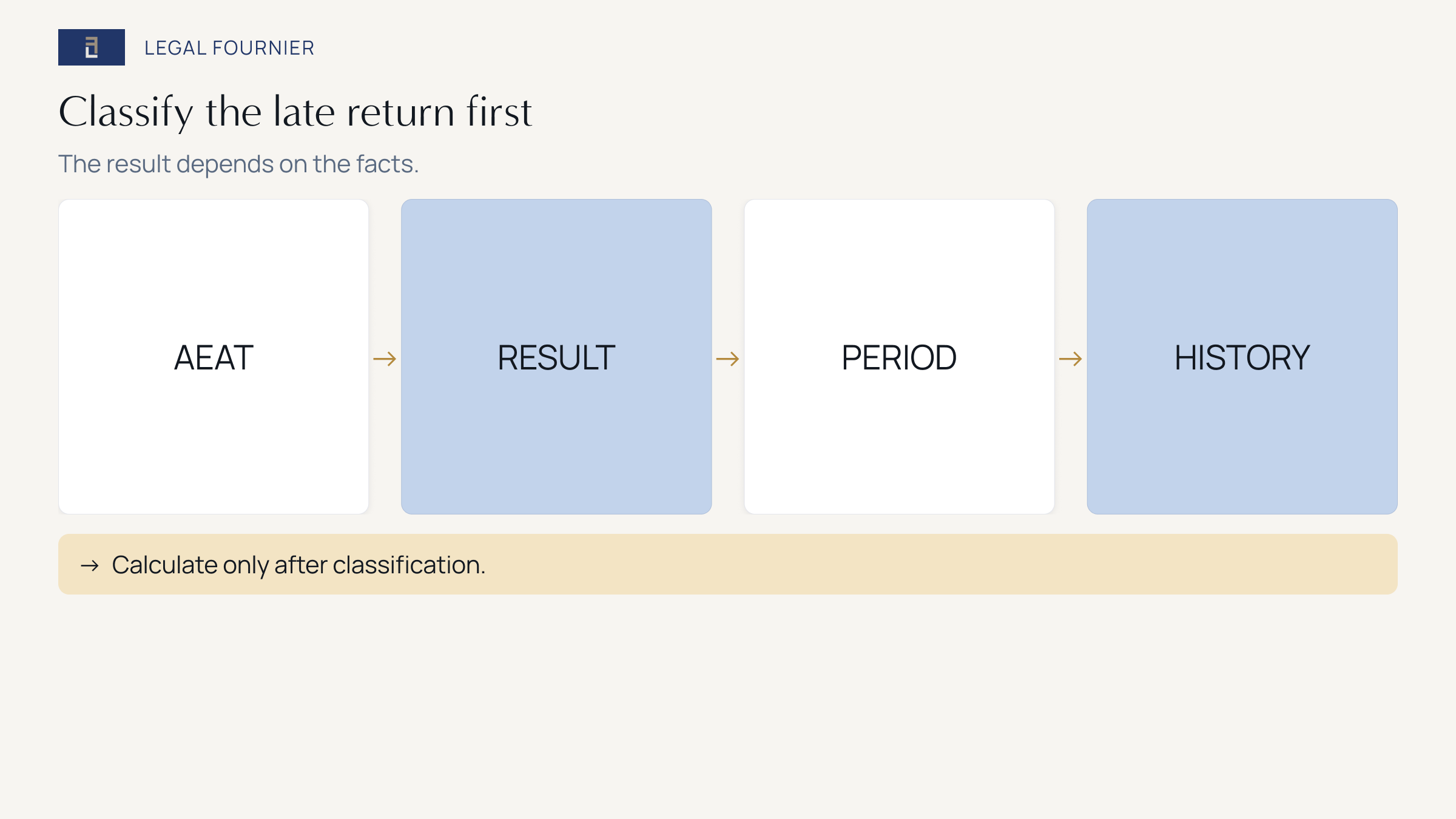
A late return is a tax position, not a single filing button. If the company sends a return with an incomplete accounting close because it wants to stop the clock, it may later need a rectification, complementary filing, or explanation. Article 122 LGT allows complementary self-assessments after the deadline where the legal conditions are met and the administration’s right has not prescribed, but this is not a substitute for preparing the original late return properly.
The connection with a Spanish permanent establishment
Modelo 200 can also apply beyond Spanish companies. Its Spanish permanent establishment implications explain why. AEAT’s Modelo 200 procedure also covers Non-Resident Income Tax for permanent establishments. AEAT’s help guidance for permanent-establishment taxpayers states that non-resident income taxpayers obtaining income in Spain through a permanent establishment may have to present the same model used by resident entities, Modelo 200, subject to the specific rules for those taxpayers.
For foreign founders, the Spanish SL and the permanent establishment question can overlap. A group may incorporate an SL after already selling, hiring, negotiating, storing goods, managing employees or signing contracts from Spain through a foreign company. If the SL then files Modelo 200 late, the delay may reveal only the newest problem. The older question may be whether there was an unreported Spanish permanent establishment or other Spanish tax exposure before the SL was ready.
This is why a late Modelo 200 for a foreign controlled SL should be reviewed with the operating timeline. Did revenue start before incorporation? Were contracts signed by the foreign parent while management was in Spain? Were local employees or dependent agents already active? Was the Spanish company invoicing correctly, or was the foreign company still collecting Spanish-source revenue? A penalty for late Modelo 200 may be manageable; an unresolved permanent establishment file can be much more sensitive.
Are the penalty and surcharge deductible?
For corporate tax purposes, the company should not assume that a late-filing surcharge or administrative penalty can simply reduce taxable profit. AEAT’s practical Corporate Income Tax manual section on fines, penalties and surcharges refers to Article 15(c) of the Corporate Income Tax Law and states that criminal and administrative fines and penalties, enforcement-period surcharges, and late-filing surcharges without prior requirement are not tax deductible.
The accounting entry and the tax treatment are therefore not the same question. The company may record the cost in its accounts, but the corporate tax return may need a positive adjustment so the expense does not reduce the tax base. This is a common point missed by small SLs that handle the late penalty as just another supplier bill.
For foreign-owned companies, the non-deductibility point also matters commercially. A EUR 1,000 surcharge is not only EUR 1,000 of cash. It can create accounting clean-up work, board explanations, investor questions, bank KYC concerns and tax-adjustment tracking in a later Modelo 200.
How we review a late Modelo 200
We begin by reconstructing the file: company tax period, filing deadline, accounting close, return result, notification history, prior AEAT action, payment route, and whether any related obligations were also missed. For foreign controlled companies, we also review director residence, shareholder loans, group charges, bank KYC, payroll, VAT and any permanent establishment facts.
The record then determines the procedural route. If the company can still file voluntarily, the priority is to prepare a defensible late filing and control payment or deferral. If AEAT has already issued a requirement, the priority is different: respond within the procedural window, preserve evidence, assess penalties, and avoid admissions that create unnecessary exposure. If the return was filed but wrong, the question becomes whether a complementary or rectifying route is available and commercially sensible.
For ongoing control, Legal Fournier can coordinate the corporate tax calendar, accounting review and compliance pack through our monthly accounting service. For founders still deciding whether an SL is the right structure, the better entry point is Spanish company formation. Where the issue is already live, a focused consultation with a Spanish lawyer can clarify the penalty exposure before filing, paying or responding.
FAQ
Is Modelo 200 late after July 25?
Not always. The legal rule is 25 calendar days after the six months following the end of the tax period. For many calendar-year SLs that usually points to July 1 to July 25. But if the last day is a Saturday or holiday, the deadline can move. For the 2025 Corporate Income Tax return, AEAT currently lists July 27, 2026 as the final day for calendar-year taxpayers.
What is the penalty if a Spanish SL files Modelo 200 late voluntarily?
If the late return is filed voluntarily, before AEAT requirement, and tax is payable, the Article 27 LGT late-filing surcharge is usually the starting point: 1 percent plus 1 percent for each complete month of delay before 12 months have elapsed; once 12 months have elapsed, 15 percent, with late-payment interest from the day after the 12-month period until filing. If there is no tax to pay and no economic damage, Article 198 fixed penalties may be relevant instead.
Does a dormant Spanish SL have to file Modelo 200?
Usually, yes. Lack of activity does not automatically eliminate the corporate tax filing obligation for an SL. The file still needs to be reviewed because there may be accounting entries, incorporation costs, bank movements, shareholder transactions or tax attributes that should be reflected correctly.
What happens if AEAT has already sent a requirement?
The company may lose the more favourable voluntary late-filing treatment for that obligation. Depending on whether tax was unpaid and on the facts, the case can move into the ordinary sanction regime, including Article 191 LGT penalties where tax that should have been paid was not paid on time.
Can the company deduct the surcharge or penalty?
Normally no. AEAT guidance on Corporate Income Tax states that administrative fines and penalties, enforcement-period surcharges and late-filing surcharges without prior requirement are not tax deductible under Article 15(c) of the Corporate Income Tax Law.
Why can a Spanish permanent establishment matter in a Modelo 200 article?
Modelo 200 can also be relevant for non-resident taxpayers with a Spanish permanent establishment. For foreign groups, a late SL return can sit beside a deeper question: whether the group was already operating from Spain before the SL was fully implemented. That should be reviewed separately from the fixed late-filing amount.