
Modelo 720 penalty notice: checks before paying or appealing
A Modelo 720 penalty notice can expose more than the stated fine. For a person with foreign assets, the file may open the wider tax history: where the person was resident, how foreign accounts were funded, whether overseas securities were already taxed, and whether Spanish tax filings were coordinated with the information return.
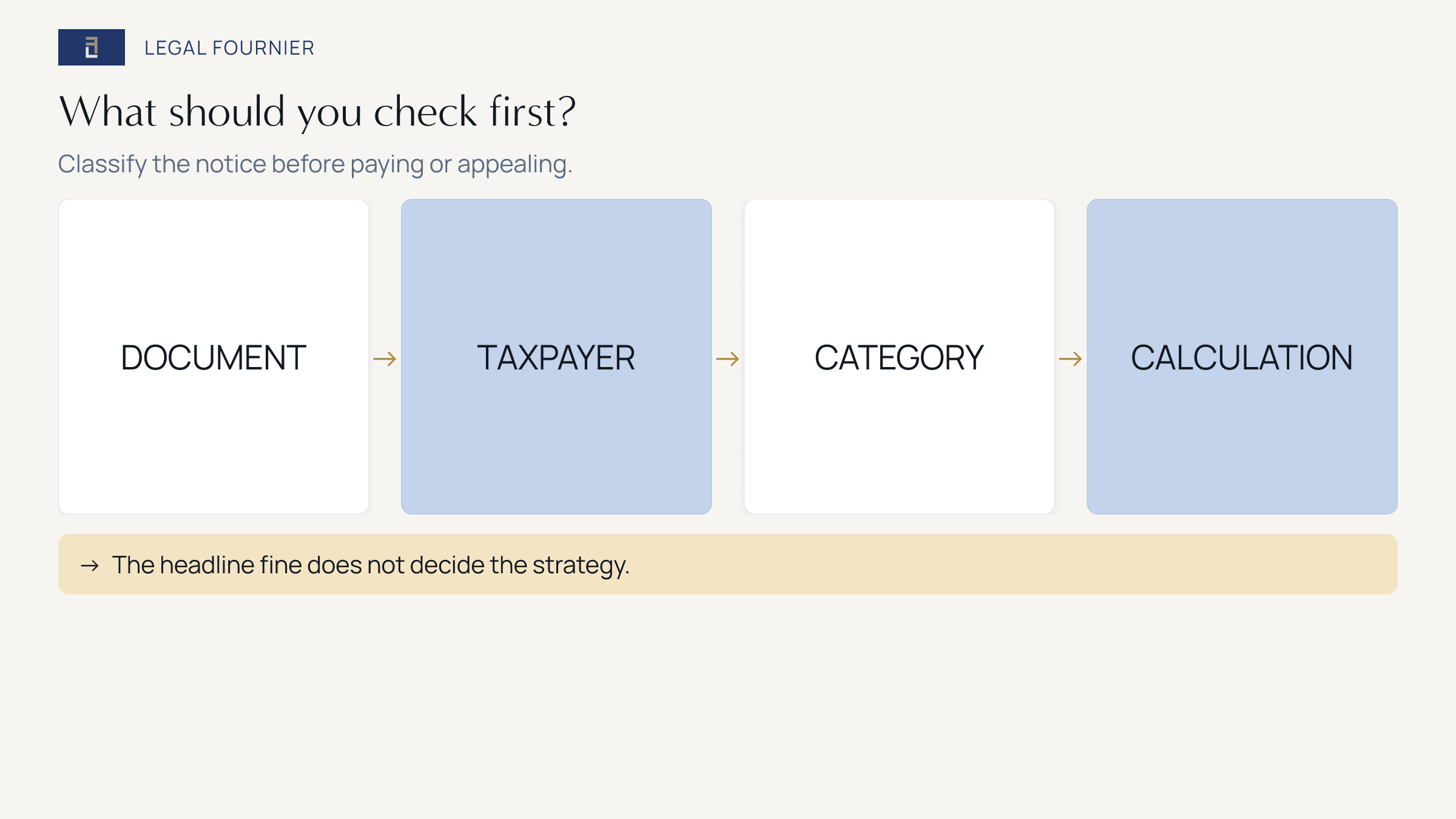
Before paying or appealing a modelo 720 sancion, check whether the Spanish Tax Agency identified the correct obligation, asset category, data sets, penalty article and taxpayer. That review should happen before any payment decision, because prompt payment may resolve the immediate notice in one case but weaken the wider strategy in another.
Legal Fournier advises private clients, LATAM families and internationally structured entrepreneurs on Spanish tax exposure, foreign asset reporting and administrative defence. If the notice is connected to a wider move to Spain, inherited foreign wealth, company shares or real estate outside Spain, the matter should be reviewed with the broader family and tax position in mind. Our private client work for LATAM and Spain and our Talk to a Spanish lawyer are designed for exactly this type of international assessment.
If the filing obligation itself is in doubt, start with our Modelo 720 guide, then move to the sanction notice and appeal grounds.
Published: 28 July 2026.
- Current AEAT guidance states that Modelo 720 penalties are handled under the general penalty regime in articles 198 and 199 of the Spanish General Tax Law, not under the old specific fixed-penalty regime.
- The old 150 percent penalty and uncapped fixed fines were condemned by the Court of Justice of the European Union in Case C-788/19 and Spain amended the regime afterwards.
- A penalty notice should be checked against the three separate Modelo 720 information obligations: foreign accounts, foreign securities/rights/insurance/income, and foreign real estate.
- Appealing a sanction in time usually suspends the sanction without a guarantee, but the treatment of a tax assessment or related debt can be different.
- Payment can preserve certainty and sometimes reductions; appeal can protect against an incorrect or disproportionate penalty. The choice depends on the file, not on the headline amount alone.
Identify the document and legal basis
Modelo 720 is still associated with the former regime: extremely high fixed fines, a 150 percent sanction and the threat that an undeclared foreign asset could be treated as an unjustified capital gain without an effective limitation period. Those historic risks matter because they explain why many taxpayers are anxious when they receive a notice. They do not, however, tell you whether the notice in front of you has been correctly issued under the current law.
The Court of Justice of the European Union held in January 2022 that Spain’s earlier system went beyond what was necessary to protect tax control and prevent evasion. The official CJEU press release on Case C-788/19 explains that the old limitation consequences, the 150 percent proportional fine and the high fixed fines created disproportionate restrictions on the free movement of capital. After that judgment, the current legal analysis is different.
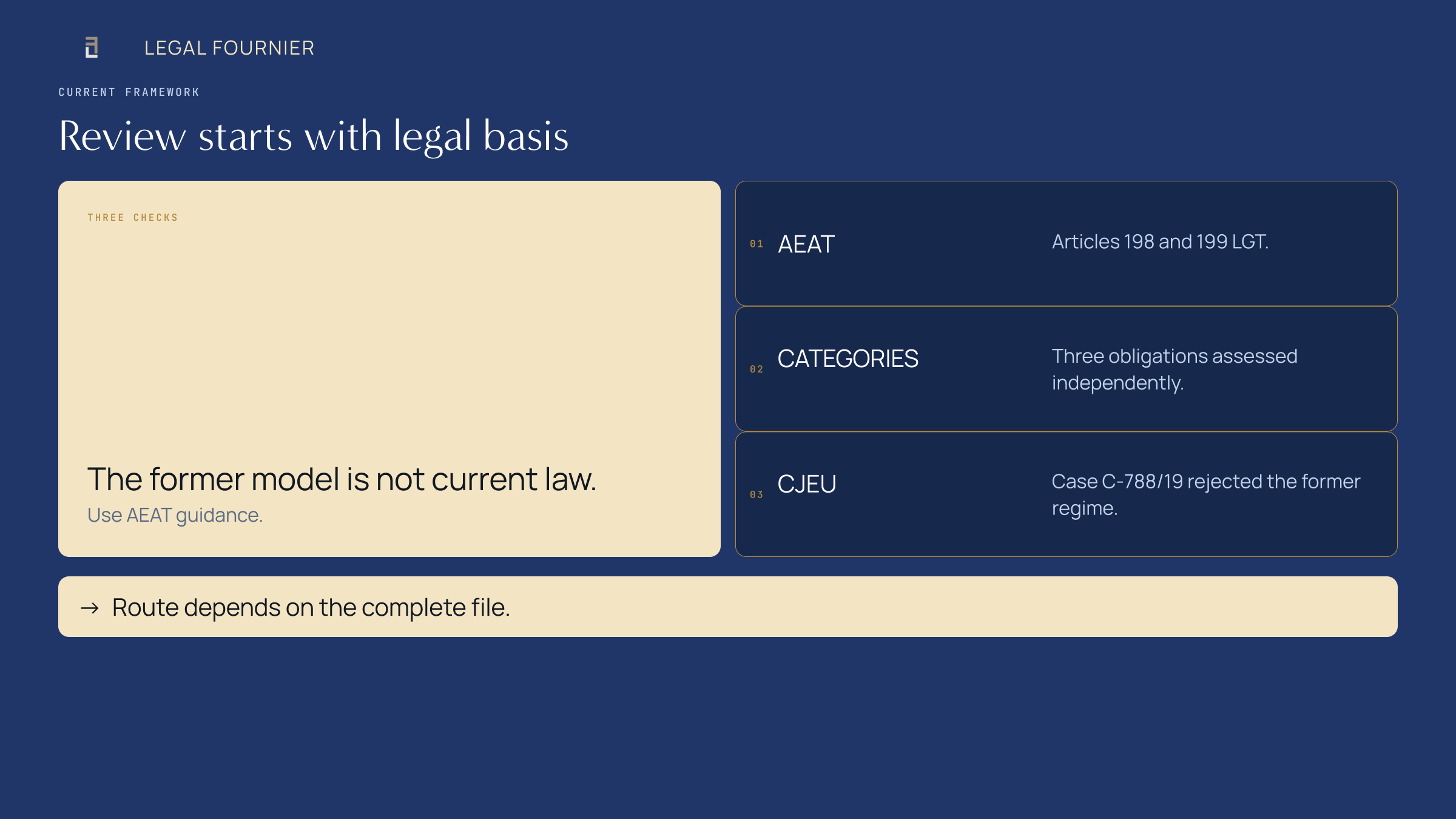
The current AEAT FAQ on Modelo 720 sanctions and effects states that the applicable sanctioning regime is now the general one in articles 198 and 199 of the Spanish General Tax Law. It also states that those penalties apply independently to each of the three information obligations contained in Modelo 720.
Start with the document received before choosing payment, appeal or a narrower position: a request for information, a proposed sanction, a final sanction, a tax assessment linked to undeclared income, a collection notice, or a combination of several acts. Each one opens a different response path.
What Modelo 720 actually covers
Modelo 720 is an informative return for certain assets and rights situated outside Spain. It is not itself an income tax return, wealth tax return or inheritance tax return. The problem is that an error in the information return can alert the Tax Agency to a larger tax issue if the asset values, income, funding history or ownership records do not match the taxpayer’s Spanish filings.
The official AEAT guidance on foreign income for Spanish residents summarises the three broad categories: accounts in foreign financial institutions; securities, rights, insurance and income deposited, managed or obtained abroad; and real estate or rights over real estate situated abroad. The same AEAT page states that the Modelo 720 obligation is generally fulfilled between 1 January and 31 March of the following year, that each category has a EUR 50,000 threshold, and that a later filing may be required when a previously reported category increases by more than EUR 20,000.
Those thresholds are often misunderstood. The EUR 50,000 test is not a single global test for all foreign wealth. It is reviewed by category. A person may have no filing obligation for foreign real estate but still have one for securities, or vice versa. After the first filing, the annual review asks whether there has been a reportable increase, a termination of ownership, or another reporting event under the applicable category rules.
For high-net-worth families, the difficult cases are often not obvious bank accounts. They are foreign brokerage portfolios with many lines, inherited interests, life insurance wrappers, usufruct rights, foreign companies, family trusts, nominee arrangements, or property owned through structures. A penalty notice based on one line of data may be pointing to a deeper classification problem.
Start with the obligation: a Modelo 720 defence starts with the precise reporting obligation, the asset holder, the valuation method and the evidence for the taxpayer’s position. The amount of the fine comes after that review.
The five checks before paying
When a client brings us a multa modelo 720, we usually separate the review into five questions. Factual and legal basics come before arguments about proportionality or EU law.
1. Was the taxpayer actually obliged to file?
The notice should be tested against tax residence, category thresholds, family status and the specific year. The AEAT FAQ confirms that persons who are Spanish IRPF taxpayers on their worldwide income can fall within the obligation. It also states that a person under the special inbound worker regime in article 93 of the IRPF Law is not obliged to file Modelo 720, although family members may be obliged if they are Spanish tax residents in their own right.
Executives, founders and internationally mobile families may have different tax profiles within the same household or structure. A spouse, adult child or family holding vehicle may have a different tax profile from the person who moved to Spain for work. A penalty addressed to the wrong person, or based on a year in which residence was not established, should not be paid without review.
2. Did AEAT use the correct asset category?
The current AEAT sanctions FAQ says each of the three information obligations is treated independently: accounts, securities/rights/insurance/income, and real estate. That independence can affect both whether there was an obligation and how a penalty is calculated. A portfolio of listed shares is not the same as a bank account. A foreign property is not the same as a right to receive income. A notice that mixes categories can inflate the calculation or obscure the real defect.
Virtual currencies require particular care. The consolidated text of the General Tax Law now refers to information obligations for certain virtual currencies abroad, but the AEAT procedure page for Modelo 720 warns that virtual currencies are not reported on Modelo 720 itself. If a notice or preparatory communication appears to mix crypto reporting with Modelo 720, the model and year should be checked carefully before any payment decision.
3. Is the value and exchange-rate position correct?
Valuation errors are common. The AEAT valuation FAQ explains that securities, accounts and real estate have specific valuation references, and that foreign currency balances normally need conversion into euros using the relevant exchange rate. For accounts, the balance at 31 December and average balance rules can matter. For foreign property, acquisition value and the effect of later exchange-rate movements may be treated differently from financial assets.
Broker statements and bank exports require careful reading. A platform may show market value, cash balance, cost basis and transaction value in different currencies. If the taxpayer or the Tax Agency selected the wrong figure, the penalty base may be wrong even if a filing obligation existed.
4. Is the sanction article correctly applied?
Under current AEAT guidance, a late or missing Modelo 720 is analysed through article 198 of the General Tax Law when there is no economic loss to the Treasury, while incorrect or incomplete data is analysed through article 199. The consolidated General Tax Law on BOE states, in article 198, that failure to present information returns in time can be sanctioned by data or data set, with minimum and maximum limits, and that voluntary late filing without prior request can reduce the sanction and limits by half. Article 199 separately regulates incomplete, inaccurate or false declarations.
The notice should therefore show the legal basis, the number of data sets, the minimum or maximum applied, and whether the Tax Agency is treating the issue as late filing, non-filing, inaccurate data, wrong filing medium, or another form of non-compliance. If the notice jumps from an omitted value to a penalty amount without explaining the calculation, the calculation requires closer scrutiny.
5. Has culpability been justified?
Spanish tax penalties are not supposed to be automatic in the abstract. Article 179 of the General Tax Law recognises the principle of responsibility and excludes liability in certain cases, including where the taxpayer acted with necessary diligence, under a reasonable interpretation of the rule, or in line with published administrative criteria. Article 183 defines tax infringements as intentional or negligent acts or omissions that are classified and sanctioned by law.
A taxpayer cannot defeat every Modelo 720 penalty by claiming ignorance of the rule. The sanction file still needs reasoning rather than a bare conclusion. For a foreign client, relevant facts may include reliance on a Spanish tax adviser, ambiguity over residence, genuine classification doubt, conflicting platform data, prior voluntary correction, or evidence that the asset was fully disclosed elsewhere even if Modelo 720 was technically late or incomplete.
Pay, appeal or correct: the strategy matrix
There is no universal answer. A low, correctly calculated sanction with weak defence facts may be a payment case. A notice based on the wrong taxpayer, wrong category, incorrect calculation, poor motivation or an outdated legal theory may be an appeal case. A notice linked to undisclosed income or wealth tax exposure may need a broader regularisation strategy before the sanction question can be answered.
| Route | When it can make sense | Main risk |
|---|---|---|
| Pay and close | The obligation is clear, the amount is modest, the calculation is correct and wider tax risk is already controlled. | Payment may accept a weak calculation or lose room to challenge if the file later expands. |
| Appeal sanction only | The penalty is poorly motivated, disproportionate in the specific facts, or culpability is weak. | Appeal can affect reductions and requires a coherent evidence record. |
| Appeal sanction and assessment | AEAT links Modelo 720 to additional tax, alleged unjustified gains, wealth tax or another substantive tax issue. | Debt suspension, guarantees and interest need separate analysis. |
| Voluntary correction | The taxpayer identifies an error before a formal requirement or before a wider inspection position crystallises. | Late correction can still generate sanctions or invite questions if not documented properly. |
Payment strategy should also include the reduction rules. Article 188 of the General Tax Law provides a 40 percent reduction for the amount of a sanction to be paid where the legal conditions are met, including payment within the applicable period and no appeal against the liquidation or sanction. The same provision states that the reduction can be demanded back if a timely appeal is filed against the liquidation or sanction. In plain English: a reduced payment is often a settlement choice, not a neutral procedural step.
Separate the commercial decision from the legal one. A family may choose to pay a defensible but small sanction to avoid distraction before a property purchase or relocation. Another client may need to appeal a larger notice because accepting the reasoning could damage a later year, a wealth tax position, or a future defence around asset origin.
Appeal timing and suspension
Tax notices are deadline-driven. The General Tax Law states that a recurso de reposicion is optional and, if used, must be filed before an economic-administrative claim on the same act. Article 223 gives a one-month period from the day after notification for the recurso de reposicion. Article 235 gives a one-month period for the reclamacion economico-administrativa in first or single instance. The exact deadline should always be calculated from the actual notification date and the specific act received.
The suspension point is especially important. Article 212 states that filing an administrative appeal or claim against a sanction in time and form suspends the execution of the sanction in the voluntary period without a guarantee until it is final in administrative proceedings. That is a major difference from many tax debts, where automatic suspension often requires guarantees or a separate suspension request. If the Modelo 720 file contains both a sanction and a tax assessment, they should not be treated as one single payment object.
For foreign clients, notification control is often the weak link. Electronic notifications, Spanish tax mailbox access, representative authority, travel and language barriers can compress the practical response time. Even a well-drafted appeal fails if the legal window has closed. The first operational step is therefore to preserve the file: download the notice, proof of notification, expediente, proposed calculations, prior communications and any previous filings.
Evidence that changes the outcome
The record determines the strength of a Modelo 720 penalty appeal. A strong file is organised, not emotional. It shows residence dates, the taxpayer’s status, the asset category, acquisition documents, account statements, the valuation method, exchange rates, prior tax returns, communications with advisers and any steps taken to correct the position.
For a foreign property, we would expect to review title, acquisition value, taxes and costs inherent to the purchase, ownership percentages and whether the property was held directly or through a company. For securities, we would review broker statements by year, ISIN-level data where relevant, market value, cash balances, account holder information and currency conversion. For life insurance or annuities, we would look at policy terms, surrender value and beneficiary rights.
Where the asset belongs to a foreign company, trust, foundation or estate, identify whether the Spanish taxpayer is holder, beneficial owner, authorised person, beneficiary, representative, person with power of disposal or another reporting subject under the relevant rule. These distinctions can decide whether the notice is correct, partially correct or addressed to the wrong person.
Clients who also own or manage Spanish companies should be particularly cautious. A Modelo 720 notice can connect with company formation, shareholder loans, director remuneration, dividends, foreign retained earnings or future investment into Spain. If your foreign asset issue is linked to a Spanish business plan, our guide to opening a company in Spain may be a useful internal reference, but the penalty file should still be treated as a tax defence matter.
When to involve counsel
A simple late filing with a small sanction may be handled administratively. Specialist counsel is useful when the notice is substantial, when AEAT links the foreign asset to undeclared income, when the taxpayer’s residence is debatable, when family members or foreign entities are involved, or when the penalty reasoning is based on an old understanding of Modelo 720 law.
Counsel is also useful when payment looks commercially attractive but may damage the wider position. Paying a small sanction may look efficient, but if the underlying facts are wrong, the payment can leave a poor record for later years. Conversely, appealing every notice as a matter of principle can be expensive and unnecessary where the issue is clean, the amount is low and the client needs certainty.
Legal Fournier’s role in these cases is to map the exposure and choose a disciplined response: pay, appeal, correct, disclose, request the expediente, separate sanction from debt, or prepare a broader tax regularisation. The response should protect the client’s position without unnecessary litigation or friction.
Decision: do not decide from the payment letter alone. Decide from the full expediente, the calculation, the legal article, the proof of notification and the client’s wider Spanish tax position.
FAQ
Is the old 150 percent Modelo 720 penalty still the normal rule?
No. The old regime was condemned by the Court of Justice of the European Union in 2022, and the current AEAT FAQ refers to the general penalty regime in articles 198 and 199 of the General Tax Law. If a notice appears to rely on the old penalty logic, it should be reviewed carefully.
Can I appeal a Modelo 720 sanction without paying first?
Often, yes. Article 212 of the General Tax Law states that a timely administrative appeal or claim against a tax sanction suspends its execution in the voluntary period without a guarantee until it is final in administrative proceedings. This does not automatically solve the position for a related tax debt, so the documents need to be separated.
Will I lose reductions if I appeal?
It depends on the reduction and the act being appealed. Article 188 includes a 40 percent reduction linked to payment and not appealing. If preserving that reduction is important, the payment and appeal decision must be made before filing anything.
What if I was under the Beckham regime?
The AEAT FAQ states that a person under the special inbound worker regime in article 93 of the IRPF Law is not obliged to file Modelo 720. However, that answer does not automatically extend to all family members. Each person’s Spanish tax residence and filing status needs to be checked.
Is Modelo 720 the same as declaring foreign income?
No. Modelo 720 is an information return about certain foreign assets and rights. Foreign income, gains, wealth tax, inheritance issues or company distributions may require separate Spanish filings. A Modelo 720 notice can trigger those wider questions, but it is not the same filing.