

Tax inspection in Spain: what to check before answering AEAT
If an AEAT letter mentions an inspection, do not start by assembling every tax document you have. Start with the letter. The procedure name, code, taxes, periods and stated scope determine what AEAT is doing and what the next response must address.
A request for information, a verificación de datos, a comprobación limitada and a formal inspection do not give AEAT the same powers or follow the same path. The generic AEAT inspection procedure is IZ01. GZ27 is narrower: it concerns an inspection procedure for taxpayers under estimación objetiva.
Before responding
Keep the complete communication and the evidence showing when and how it was served. Transcribe the procedure code, tax, period, scope, requested act, response wording and deadline exactly as they appear. Do not infer an electronic service date from the date printed on the PDF.
First establish what proceeding AEAT opened
An inspection allows AEAT to check and investigate tax compliance and, where appropriate, regularise the taxpayer’s position through one or more assessments. Articles 141 and 145 of the Ley General Tributaria (LGT) distinguish between checking declared acts, elements and valuations and investigating relevant facts that were not declared or were declared incorrectly.
Other AEAT procedures are more confined. A verificación de datos is limited to the grounds in LGT articles 131 to 133, such as formal or arithmetic defects, mismatches, a plainly visible misapplication of the rules, or clarification of a datum that does not concern an economic activity. A comprobación limitada has the powers listed in articles 136 to 140. The current wording of article 136 permits the restricted accounting comparison described there, so the old shorthand that AEAT can “never examine accounting” in a limited check is unsafe.
The heading and legal references in the communication are more reliable than an informal description given over the phone. If the document is still unclear, the English AEAT notice guide explains how to classify a communication. A discrete request for information or documents may instead fall within the AEAT requerimiento guide. Neither guide replaces an inspection-scope review once IZ01 or another inspection code appears.
Use a first-page control card
A short transcription exercise is safer than relying on memory or a translated summary. Leave any field marked “unclear” until the original communication resolves it.
| Notice field to transcribe | Decision it controls |
|---|---|
| Exact procedure name and code | Whether this is an inspection, verification, limited check or another proceeding |
| Issuing body and response channel | Who is acting and where an authorised response belongs |
| Tax, period and stated scope | Which records and entities enter the initial review |
| Required appearance or submission | The immediate operational obligation |
| Deadline wording and service evidence | The facts needed for a case-specific time calculation |
| Named representative and authority | Who may act and whether authority must be evidenced |
| Requested attachments or evidence | Who holds each item and why it may be relevant |
| Current document stage | Whether the file is at initiation, instruction, hearing, minutes or assessment |
For a company file, a separate custody note can identify whether a document sits with the company, a director, the accountant, a bank, a payroll adviser or a foreign group company. That is a location map, not an instruction to send everything. Relevance, personal data, privilege and consistency still need review.
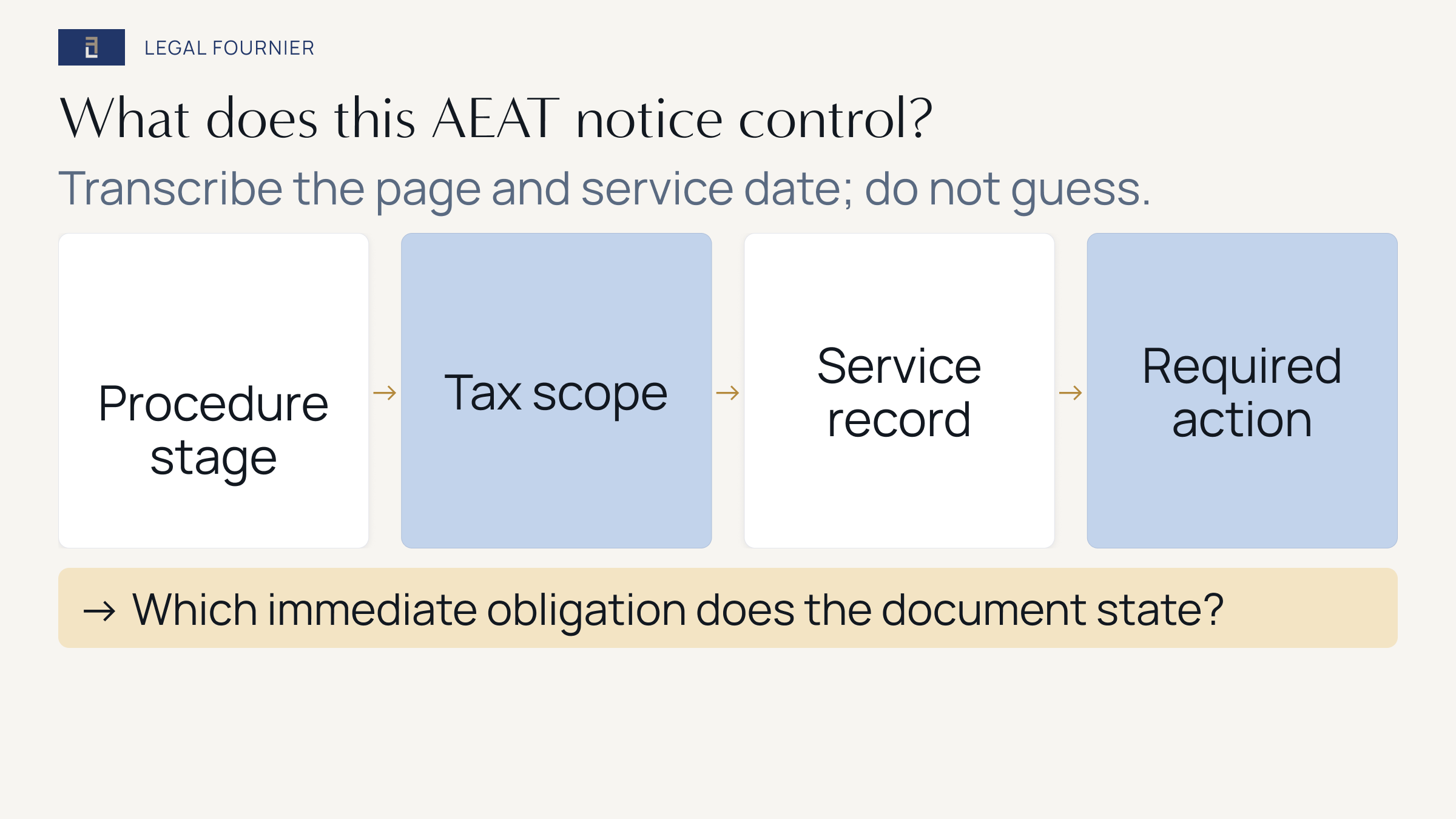
Scope and stage change the response
At the start, AEAT must inform the taxpayer of the nature and scope of the inspection and of the relevant rights and duties. An inspection can be general or partial under LGT articles 147 and 148. Copy the listed taxes and periods instead of assuming the file covers every return or every company in a group.
The generic IZ01 entry describes an ex officio start by initiation communication, followed by instruction, a hearing, inspection minutes and an assessment process that depends on the type of minutes. Those documents are not interchangeable. A request made during instruction calls for a different response from proposed minutes or a final assessment.
LGT article 149 gives a taxpayer in a partial inspection 15 days from notification to request general scope for the relevant tax and periods. That is a strategic option, not a routine application. It does not stop the partial inspection, and the article gives AEAT six months to expand the existing scope or begin a general inspection. The 15-day period is not the response deadline for every inspection letter.
Why the 18- or 27-month headline is not a deadline answer
The current general maximum duration is 18 months. It is 27 months where one of the conditions in LGT article 150.1 applies: the taxpayer meets the audit-threshold turnover condition, the inspection concerns an entity in a tax-consolidation or VAT group in the circumstances stated there, or the Complementary Tax is being inspected. The initiation communication must state the applicable period. A condition discovered later can change the period to 27 months calculated from the original start.
That summary is not enough to calculate the end date. The clock runs from notification of initiation until notification or deemed notification of the resulting administrative act, and article 150 contains its own suspension and extension rules. A taxpayer-requested period during which no inspection action is taken can total no more than 60 calendar days and extends the maximum duration. Specified late evidence can add three or six months. The complete procedural chronology is needed before drawing a conclusion.
If the maximum duration is exceeded, the inspection does not simply lapse through caducidad. Article 150.6 provides different legal effects. A claim that the file has “expired after 18 months” may therefore be wrong even when the dates look straightforward.
Evidence, access and representation
Inspection powers extend to the records listed in LGT article 142. The statute draws a legal distinction between access to business premises and entry into a constitutionally protected home. Article 151 also addresses the places where inspection work can occur, including access to digital systems with the taxpayer’s consent. A routine document response is not the place for generic advice about entry disputes.
AEAT records inspection activity through communications, diligencias, reports and actas. Under LGT articles 143 and 144, inspection minutes are public documents. Facts accepted in an acta are presumed true and can be corrected only by proving a factual error. That is a reason to read the document and its factual wording carefully before signing, not a blanket reason to refuse a signature.
LGT article 34 records rights that include information about the procedure, its status and the official responsible, as well as copies, allegations, a hearing and access to a copy of the file in the circumstances the law provides. Voluntary representation is governed by article 46. Appointing a representative does not pause a deadline. The authority should identify who may act and for which procedural step.
What to prepare for a focused review
For an initial legal review, provide the opening communication or the most recent act, the full service or access record, and the pages showing the named taxes, periods and scope. Add every numbered request, the deadline exactly as printed, prior submissions, evidence of representation and a simple index of the available documents.
Do not send identity numbers, bank credentials or a large unfiltered archive through an unrequested channel. A lawyer reviewing the file needs enough material to identify the proceeding and preserve the immediate obligation before deciding which evidence belongs in the response.
Legal Fournier can review the inspection document and its procedural position through the English contact page. Any advice will depend on the actual communication, valid service evidence and the file’s chronology. A review cannot guarantee an extension, assessment or outcome.