

Filming in Spain: Legal, Tax and Visa Checklist for Foreign Productions
Filming in Spain
Start with the boring legal work before the exciting production work. A foreign production should check permits, local production structure, tax incentive eligibility, crew authorization, payroll and social security, insurance and contracts before confirming Spanish shoot dates or committing local spend. A location brief does not make a shoot compliant; the file behind the shoot does.
This checklist is for producers, production service companies, agencies, studios and non-EU crew coordinators who need a practical legal view before shooting in Spain. It is not a city guide and it is not a recruitment article. Madrid, Barcelona, Mallorca and the Canary Islands can all host serious productions. The harder question is whether the production can be executed lawfully, documented properly and defended later if a public authority, insurer, tax adviser, client or platform asks how the Spanish work was structured.
Film commissions are useful starting points for location coordination and local information. Spain Film Commission, regional film offices and city offices can help a production understand practical permit routes, local contacts and territorial incentives. They are not a substitute for legal, tax or immigration review. If the production will rely on Spanish tax incentives, bring non-EU crew, close streets, use drones, sign a production services agreement, employ or pay people in Spain, or commit significant local spend, legal review should happen before the final production calendar is locked.
Legal Fournier can review the Spanish legal, tax and visa structure of a foreign production before dates, crew, contracts, local spend or a production service company are confirmed. That is when the advice still has room to change the plan. After the budget and travel are locked, the same advice usually becomes more expensive and less useful.
The pre-production legal checklist
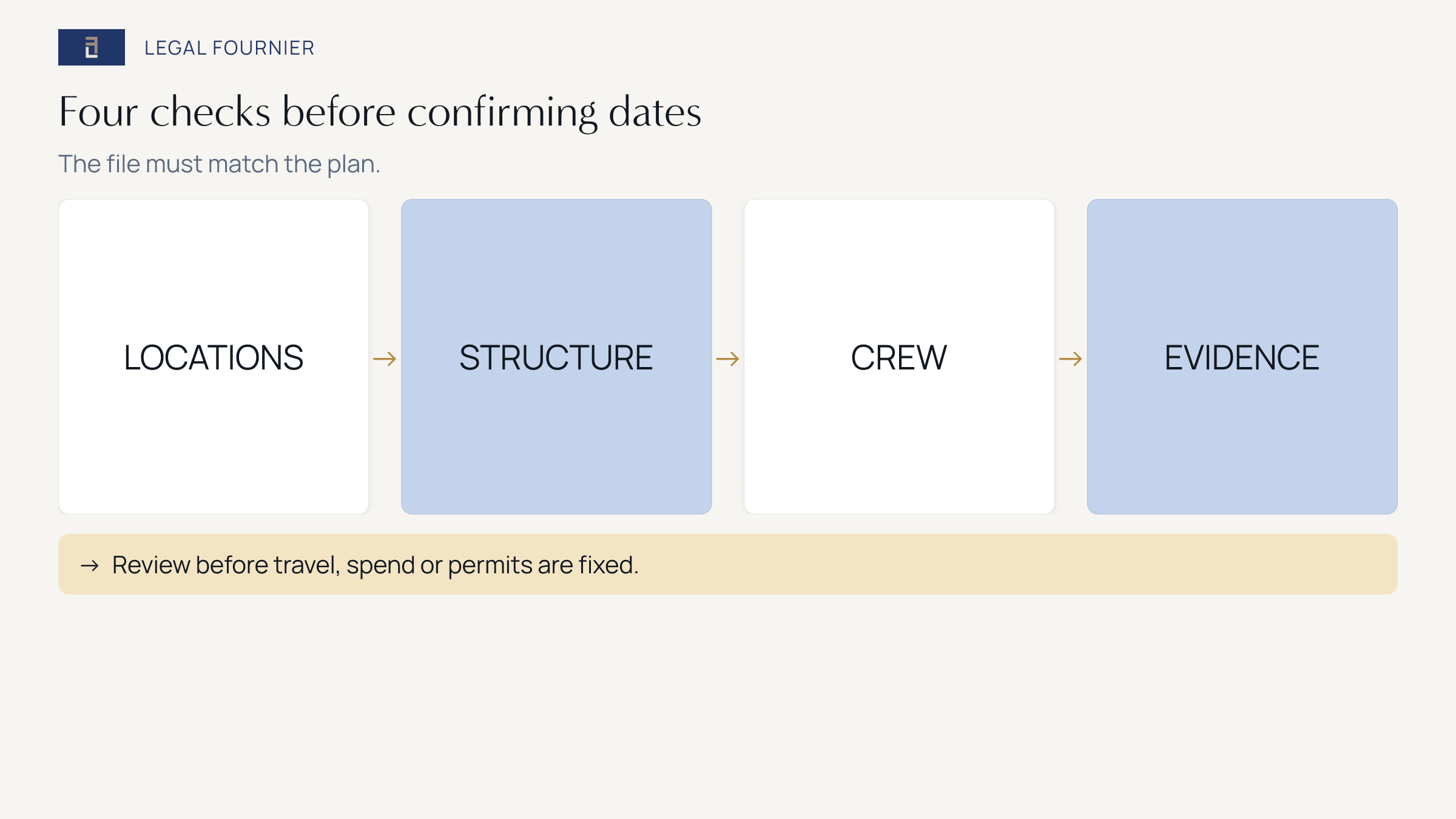
A serious Spain shoot should be reviewed through seven workstreams. Identify every public and private location and the authority or owner whose approval is required. Decide whether the foreign producer will contract directly in Spain or work through a Spanish production service company. Test whether the intended Spanish spend could fall within the Article 36.2 foreign production incentive, without assuming that every invoice will qualify. Map each non-EU crew member, artist, technician and executive against the correct immigration route. Decide who is the employer, payer or contracting party for local personnel and whether Spanish payroll or social security issues arise. Confirm insurance coverage for the actual Spanish risks, rather than relying on the general production policy. Then make the contracts match the operational reality.
These issues are connected. A production service agreement can affect tax incentive documentation, insurance responsibility, local payroll exposure, location permit liability and data or image rights. A crew authorization issue can change call sheets, travel dates and whether a person may perform work in Spain. A permit condition can affect working hours, traffic plans, neighborhood notices, police presence and insurance. The legal checklist should therefore be managed as a joined-up pre-production process, not as a set of disconnected administrative tasks.
1. Permits and location permissions
Spain does not have one single national filming permit for every location. Public space filming is normally handled through the relevant municipality or public authority, while private locations require owner or operator consent. Roads, ports, airports, heritage buildings, beaches, natural parks, military or security-sensitive sites, rail infrastructure and drone work may require additional permissions. A production that is simple on a creative deck can become complex once it touches traffic, public safety, protected property or multiple authorities.
For example, Barcelona Film Commission describes permit application routes connected to filming in the city. Madrid Film Office gives information on filming conditions and types of permits for the city. The Balearic Islands Film Commission provides permit guidance for shoots in Mallorca and the islands. Canary Islands Film is a relevant territorial source when a production is assessing island locations and incentives. These bodies are useful coordination resources. They should not be treated as the production’s legal adviser, tax adviser, immigration lawyer or insurer.
Permit planning should start from a complete location matrix. For each location, the producer should list the owner or authority, the dates, crew size, equipment, vehicles, drones, generators, lighting, stunts, animals, weapons, minors, public disruption, night work, noise, security, road use and any exclusive occupation of public space. The local production manager may know the administrative route, but legal counsel should still review the risk allocation in the contracts: who applies, who warrants compliance, who pays fees, who handles delays, and who bears losses if approval is refused or conditioned.
Foreign productions sometimes assume that a low-footprint crew can operate informally. That assumption is unsafe. Even small units may need notification, authorization or private consent depending on location and activity. A fine is rarely the worst outcome. A stopped shoot, unusable footage, insurer questions, missed delivery deadlines or a dispute with the Spanish service company can cost far more than the permit work.
2. Local production structure
The second question is who is legally doing what in Spain. A foreign production can work with a Spanish production service company, contract with local suppliers directly, set up a Spanish entity in more substantial cases, or use a mixed structure. The correct model depends on the budget, locations, tax incentive strategy, crew profile, contractual chain and risk appetite.
This is more than an accounting choice. The Spanish counterpart may be responsible for local contracting, invoices, permit applications, payroll support, supplier payments, insurance certificates, health and safety coordination, data processing, location releases and tax incentive documentation. If the production wants to examine the Article 36.2 incentive, the role of the Spanish registered producer or service producer becomes especially important. The Spanish Tax Agency’s guidance on Article 36.2 refers to producers registered with the ICAA registry who are responsible for executing a foreign production in Spain. The ICAA registry itself is administered through the Ministry of Culture.
The production services agreement should therefore be reviewed before it is signed, not after the Spanish work has started. It should state who is responsible for applications, tax documents, eligible expense support, supplier vetting, employment or contractor onboarding, social security documents, insurance coordination, health and safety, final credit obligations, promotional material obligations and delivery of a close-out file. If the contract says “the service producer will handle Spain” without defining these points, the wording is too thin for a high-value foreign production.
3. Article 36.2 tax incentive eligibility
Spain’s foreign production incentive under Article 36.2 of the Corporate Income Tax Law is often one of the first reasons international producers ask about shooting in Spain. The incentive is real, but it is not automatic. The official Spanish Tax Agency page on Article 36.2 for foreign film productions links the deduction to expenses incurred in Spanish territory and to a qualifying producer registered with the ICAA. It also describes categories of eligible expenses, minimum expenditure thresholds, caps and formal requirements such as cultural certification, final credits and promotional material authorization.
Spain Film Commission’s tax incentives overview is a useful practical entry point, and ICEX / Invest in Spain presents the audiovisual sector as a priority industry for foreign investment. Those sources are helpful, but the production should still obtain project-specific legal and tax advice. Eligibility depends on the Spanish production structure, type of work, budget, local spend, documentation, timing and satisfaction of the formal requirements. It should never be sold internally as a confirmed rebate before the facts have been reviewed.
This article keeps Article 36.2 at checklist level. For a dedicated discussion of eligible expenses, caps, documentation, ICAA points and production service company issues, see our dedicated guide to the Spain Film Tax Rebate under Article 36.2.
4. Audiovisual visa and crew authorization
Crew planning is a legal issue as much as a travel issue. EU nationals, Spanish residents, third-country nationals, posted workers, artists, technicians, directors, producers, agency staff and executives may be in different positions. The production should not apply one immigration assumption to everyone on the call sheet.
Spain has a specific framework for third-country nationals carrying out activity in the audiovisual sector. The official source is Order PCM/1238/2021, which sets out routes depending on the period of stay: up to 90 days in any 180-day period, more than 90 days and up to 180 days, and more than 180 days. The Ministry’s UGE audiovisual and cultural sector page is the practical institutional anchor for longer audiovisual authorizations.
The planning point is simple: identify who will perform work in Spain, what they will do, where they are resident, what passport they hold, how long they will stay, who contracts them, who pays them and whether they have already spent time in the Schengen area. Do this before travel is booked. A late immigration review can affect rehearsal dates, principal photography, post-production presence, family travel and insurance coverage. It can also create reputational problems if a client, platform or public authority asks why the crew authorization file was not prepared before arrival.
This checklist only flags the immigration issue. Before travel, confirm the correct work-authorisation or visa route for each non-EU crew member, artist and technician.

5. Payroll, social security and contractor classification
International productions often treat payroll as a production-accounting matter. In Spain, it can also become a labor, tax and social security issue. The starting point is to identify every person working in Spain and classify the relationship correctly. Is the person an employee of the foreign producer, an employee of the Spanish service company, a local freelancer, an artist engaged through a special arrangement, a posted worker, a company representative, or a supplier’s employee? The answer affects documentation and risk.
The production should also decide who is responsible for onboarding and retaining records. A Spanish service company may manage local payroll, but that does not automatically resolve every issue for the foreign producer. Contracts should allocate responsibility for tax forms, social security documentation, payslips, invoices, withholding, timesheets, union or collective agreement questions, health and safety coordination and confidentiality obligations. When the production brings non-EU personnel, immigration status and payroll status should be reviewed together.
There is a second reason to treat this carefully: tax incentive files depend on credible documentation. If costs are to be analyzed as Spanish eligible expenses, invoices, contracts, payment evidence and personnel classifications should be consistent. A rushed payroll structure can cause problems beyond employment law; it can weaken the production’s tax file and create avoidable questions at close-out.
6. Insurance, health and safety
Before shooting, the production should review whether its insurance actually covers the Spanish activity. General production insurance may not be enough if the shoot involves public space occupation, vehicles, drones, marine work, stunts, minors, animals, pyrotechnics, sets, rented equipment, heritage locations, weather exposure, or high-value cast travel. Local authorities and location owners may request specific coverage levels or named insured wording. The production services agreement should state who obtains certificates and who responds if a permit authority asks for changes.
Health and safety should be handled as an operational legal issue. Spain has its own occupational risk prevention culture and documentation expectations. A foreign production should not assume that a safety plan prepared for another jurisdiction will satisfy the Spanish location owner, local authority, insurer or service company. The practical legal question is whether the documents match the actual activity: call sheets, risk assessments, emergency plans, medical support, vehicle plans, crowd control, night work, child protection measures and weather contingency should be coherent.
7. Contracts and rights documentation
Foreign productions usually focus on the main production services agreement, but the legal file is wider. It may include location agreements, supplier terms, crew contracts, confidentiality agreements, data processing clauses, music and archive licenses, image releases, minor consent documents, drone operator terms, equipment rental terms, accommodation and transport terms, and client or platform delivery terms. The Spanish documents should not contradict the master production contract.
For a commercial, branded-content shoot or international series, the chain of rights can matter as much as the location permit. The client may require confirmation that the production has all rights to use the footage worldwide. A platform may require evidence of releases, music clearance, privacy compliance and insurance. A tax incentive file may require final credit wording or authorization to use materials for promotional purposes. These requirements should be built into the contract set before the shoot, not requested from exhausted suppliers after wrap.
How the checklist applies in Madrid, Barcelona, Mallorca and the Canary Islands
The legal checklist is the same across Spain, but the implementation changes by location. A Madrid shoot may involve city permits, regional considerations, road use and studio arrangements. A Barcelona shoot may involve municipal public-space rules, heritage sites, neighborhoods with high public sensitivity and coordination through the local film office. A Mallorca shoot may add island logistics, municipal differences, coastal or protected-area issues and seasonal pressure. A Canary Islands production may combine location planning with a specific tax incentive analysis and local producer review.
These examples matter because foreign producers sometimes treat Spain as one uniform permit environment. It is not. The national tax and immigration framework matters, but locations are local. The legal review should start with the production map: where, when, who, what activity, what equipment, what public impact, what spend and what Spanish counterpart. Once those facts are known, the lawyer, tax adviser and service company can work from the same reality.
Recommended order of work
The safest order is not complicated. First, prepare the location and crew matrix. Second, choose the Spanish production structure. Third, review the production services agreement before signing. Fourth, test tax incentive assumptions against Article 36.2 and the Spanish registered producer role. Fifth, map non-EU crew and executives against the audiovisual immigration routes. Sixth, prepare permit applications and private location agreements. Seventh, align payroll, contractor and social security documents. Eighth, confirm insurance certificates and safety documentation. Ninth, build a close-out file for tax, client, insurer and audit requests.
This sequence gives the production a defensible paper trail. It also gives commercial leverage. If a permit is likely to be difficult, the producer can adjust the location before cast, travel and equipment are fixed. If a tax incentive assumption is weak, the budget can be corrected before the client relies on the number. If a crew member needs a different route, the production can revise travel dates before a border or consular issue affects the schedule.
When to obtain legal advice
Legal advice is most useful before commitments are made. A review after the shoot may still help with disputes or close-out, but it cannot always repair missing permits, poor tax documentation, incorrect crew status or weak contractual allocation. Foreign producers should seek advice before confirming Spanish dates, signing the production services agreement, approving the local spend budget, booking non-EU crew travel, promising the client a tax incentive result, or beginning permit-sensitive activity in public space.
A paid consultation should produce practical outputs: a list of legal blockers, documents to request from the Spanish service company, tax incentive questions for the tax adviser, immigration routes to check, permit categories to confirm, insurance wording to obtain and contract changes to negotiate. It should not be a theoretical lecture. The goal is to let the production move with a clear legal file and without overstating what Spain can offer.
FAQ
Can a foreign production shoot in Spain without a Spanish company?
Sometimes a foreign producer can contract directly for limited Spanish services, but many serious productions use a Spanish production service company for local execution, supplier coordination, permit support and tax documentation. If Article 36.2 is being considered, the Spanish registered producer or service producer role requires specific review.
Do film commissions issue legal advice?
No. Film commissions and film offices are coordination and information resources. They may help with permits, locations and local contacts, but legal, tax, immigration, employment and insurance decisions should be reviewed by qualified advisers.
Does the Spain film tax incentive apply automatically?
No. The official Article 36.2 framework has eligibility conditions, expense categories, minimums, caps and formal requirements. It should be reviewed before the production sells the incentive into its finance plan or client budget.
Does every non-EU crew member need the same visa?
No. The correct route depends on nationality, residence, role, duration, prior Schengen presence, contracting structure and the activity in Spain. The audiovisual framework distinguishes periods of stay, but the facts must be reviewed person by person.
What should be reviewed before signing a Spanish production services agreement?
At minimum: scope of services, authority to apply for permits, tax incentive documentation, supplier contracting, payroll support, crew authorization cooperation, insurance certificates, health and safety, liability for delays, final credits, promotional material rights, confidentiality, data processing and close-out documents.
Legal Fournier consultation: If your production is considering a shoot in Spain, arrange the legal review before confirming dates, crew, contracts, local spend or the Spanish production service company. Early advice can still affect the budget, schedule and allocation of risk.