

Spain Film Tax Rebate: Article 36.2, Eligible Expenses and Production Service Companies
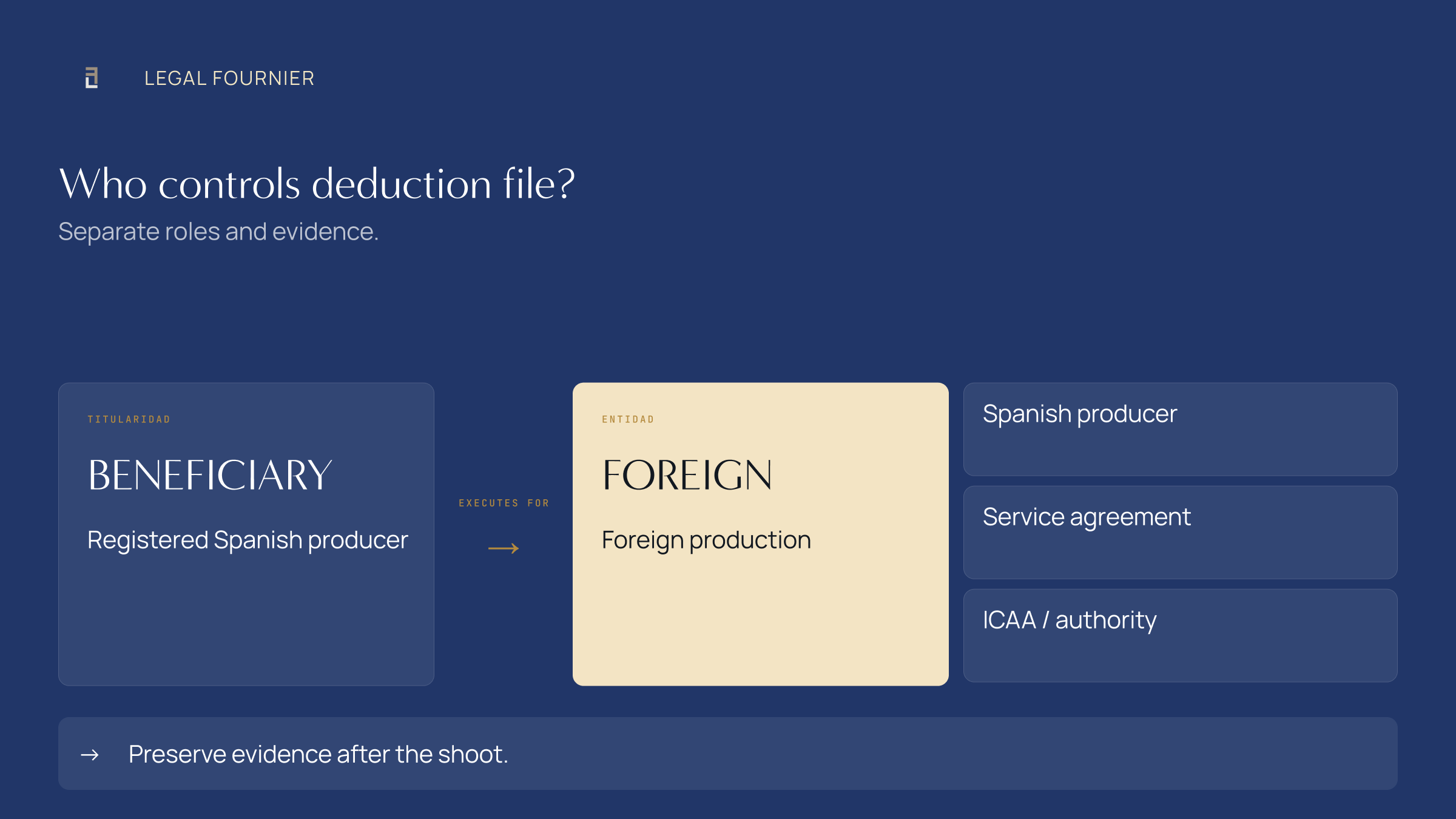
Spain’s Article 36.2 incentive can make a foreign film or audiovisual production economically attractive, but it is not a cash rebate paid to the foreign producer on demand. The right to apply the deduction belongs to the Spanish producer registered with the ICAA who is responsible for executing the foreign production in Spain. The foreign producer usually receives the economic benefit through the production service structure, pricing and contract terms agreed with that Spanish producer.
Review the Spanish film tax credit before confirming the Spanish spend, signing the production service agreement or relying on a quoted rebate percentage. The relevant questions are legal and evidentiary: who is the Spanish taxpayer, whether the producer is properly registered, what expenses form the Article 36.2 deduction base, whether the minimum cost and Spanish spend thresholds are met, and whether the ICAA certificate, final credits and promotional-material requirements can realistically be satisfied.
The core rules are in Article 36 of Law 27/2014, published in the BOE. The Spanish Tax Agency also maintains a practical explanation of the deduction for foreign film productions in Spain under Article 36.2 LIS. Those official texts should control over simplified market summaries or sales decks.
What Article 36.2 is, and what it is not
Article 36.2 is a Spanish corporate income tax deduction for certain expenses incurred in Spain in the execution of a foreign cinematographic or audiovisual production. The rule is intended for foreign feature films and audiovisual works where a Spanish registered producer is in charge of executing the production in Spain. It is often described in the market as a “rebate” because the economics may be passed to the foreign production through the service deal. Legally, however, the mechanism is a deduction for the Spanish taxpayer that meets the statutory and regulatory conditions.
This distinction matters. A foreign studio, platform or production company should not treat the incentive as a stand-alone receivable unless the Spanish structure supports that conclusion. The production service contract, the Spanish producer’s tax position, the local cost file, the audit process and the timing of the Spanish corporate income tax return all affect the commercial value of the incentive. A headline percentage is not a legal conclusion.
There is also a difference between a foreign production, a Spanish production and an international co-production. Article 36.2 is the foreign-production route. A genuine international co-production may sit under a different legal and tax analysis, including nationality certificates and co-production approvals. The choice should be made before contracts and budget assumptions are locked, not after the production has wrapped.
The registered Spanish producer controls the route
The Article 36.2 beneficiary is the registered Spanish producer, not any local fixer or location manager. The official rule refers to producers registered in the Administrative Registry of Cinematographic and Audiovisual Companies of the Institute of Cinematography and Audiovisual Arts, the ICAA, who are responsible for executing the foreign production. The production service company may be that registered producer, or the deal may involve a producer with the required registration and responsibilities. In either structure, the status and role of the Spanish party must be checked.
From a contractual perspective, the foreign producer should ask for more than a warranty that the Spanish party “can get the rebate.” The agreement should identify who applies the deduction, who controls the supporting documentation, who bears the risk of denied expenses, how audit requests will be handled, when the economic benefit is credited or paid, and what happens if final credits or promotional-material authorizations are not delivered. These terms determine whether the quoted value is bankable, delayed, reduced or unavailable.
The Spanish producer’s obligations usually continue after the shoot. Article 36.2 compliance may require cost support, certificate filings, corporate tax reporting and responses to later administrative checks. The foreign producer should therefore preserve access to invoices, cost reports, contracts, payroll information, supplier evidence and final delivery materials even after the main service invoice has been paid.

Eligible expenses: two categories, not the whole Spain budget
The deduction base is not every amount connected in some way with Spain. The Tax Agency explains that the base is made up of expenses incurred in Spanish territory that are directly related to the production and fall within two categories: expenses for creative personnel, provided that those persons have tax residence in Spain or in another Member State of the European Economic Area, and expenses derived from the use of technical industries and other suppliers.
The creative-personnel category needs its own evidence. “Creative personnel” is not the same as every person on a call sheet, and the residence condition is part of the rule. For principal cast, directors, writers, composers, heads of department or other creative contributors, the file should support why the expense is within the category and whether the tax residence condition is satisfied. Where a person works through a loan-out, service company or agency, the legal form should be reviewed before the expense is assumed to qualify.
The second category covers technical industries and other suppliers. In practice, this can include Spanish production services, equipment, studios, post-production, set construction, special effects, local transport, accommodation and other production suppliers where the cost is incurred in Spain, directly related to the production and properly invoiced. The wording is broad, but it is not unlimited. General overhead, non-production corporate costs, costs incurred outside Spain, intra-group allocations with weak support or expenses that cannot be tied to the foreign work may create audit risk.
For episodic works, allocation matters even more. The deduction, amount and cap are determined per episode for audiovisual series, and common expenses should be allocated by a reasonable criterion. If a production has shared writers’ rooms, standing sets, post-production packages, common travel, studio overhead or a blended service fee, the Spanish cost report should explain the allocation. A spreadsheet produced after the fact is weaker than a file built while invoices are approved.
Rates, thresholds and caps
The standard Article 36.2 rate is 30 percent on the first EUR 1 million of the deduction base and 25 percent on the excess. That headline must be read together with the minimum spend, minimum production cost, maximum base and maximum deduction limits.
| Issue | Article 36.2 position |
|---|---|
| General rate | 30 percent on the first EUR 1 million of deduction base, and 25 percent on the excess. |
| Spanish spend threshold | At least EUR 1 million of eligible expenses incurred in Spanish territory. For animation productions, the threshold is EUR 200,000. |
| Minimum production cost | Only productions with a minimum cost of EUR 2 million generate the right to the deduction. For episodic works, the cost is considered for all episodes, including costs inside and outside Spain. |
| Maximum deduction base | The deduction base may not exceed 80 percent of the total production cost. |
| Cap | The deduction may not exceed EUR 20 million for each production. For audiovisual series, the cap is EUR 10 million per episode. |
| Aid intensity | The deduction, together with other aid received by the taxpayer, may not exceed 50 percent of the production cost. |
There is also a specific visual-effects rule where the producer is responsible for executing VFX services and the expenses incurred in Spain are below EUR 1 million. In that case, a 30 percent deduction can apply, subject to the applicable de minimis aid cap. This exception should be handled separately. It should not be used as a generic workaround for a production that fails the ordinary Spanish spend threshold.
Consider the calculation for a qualifying foreign production. With EUR 4 million of eligible Spanish deduction base, the headline calculation is 30 percent of the first EUR 1 million and 25 percent of the remaining EUR 3 million, before applying any applicable caps, aid-intensity limits and taxpayer-specific issues. That produces a starting figure of EUR 1.05 million. It is not the same as saying the foreign producer is automatically paid EUR 1.05 million. The actual commercial value depends on the Spanish producer’s ability to apply or monetize the deduction and the terms negotiated in the service arrangement.
ICAA, cultural certificate, credits and promotional materials
The Article 36.2 file involves more than a budget calculation. The production must obtain the relevant certificate confirming its cultural character in relation to its content or its connection with Spanish or European cultural reality, issued by the ICAA or the competent regional body. The Ministry of Culture describes the ICAA cultural certificate procedure for foreign shoots in Spain as a procedure for production companies executing a foreign production in Spain that need cultural certification for the Article 36.2 deduction.
The official ICAA procedure confirms the kind of project for which the certificate is intended and who may request it. It is not a general certificate for any audiovisual activity. Advertising, live broadcasts, television reports and similar formats may fall outside the procedure. A production should verify this point before assuming that a commercial shoot or branded-content project can use the same incentive pathway as a feature film or qualifying audiovisual work.
The final credits and promotional-material requirements should be addressed at contract stage. Article 36.2 requires a specific reference in the final credits to the tax incentive, and where applicable to the collaboration of the Government of Spain, autonomous communities, film commissions or film offices directly involved, as well as the specific filming locations in Spain. It also requires rights-holder authorization for the use of the title and graphic and audiovisual press material that expressly includes specific filming locations or other production processes carried out in Spain, for cultural or tourism promotion by public bodies and relevant film offices.
These obligations can create friction if the foreign producer, distributor, platform or completion bond documents restrict credit language or marketing-material use. They should therefore be written into the production service agreement, delivery checklist and rights clearances. A tax provision hidden in an annex is rarely enough. The parties need a practical process for approving the credit wording, identifying the Spanish locations, delivering promotional stills or footage, and preserving the authorization after exploitation rights are sold or licensed.
Documentation that should be built before the shoot
A defensible Article 36.2 file is not built at the end of principal photography. It should begin when the Spanish production service structure is selected. At a minimum, the parties should keep the Spanish producer’s registration evidence, the production service agreement, the foreign production agreement or mandate, the approved budget, the Spanish cost report, supplier contracts, invoices, proof of payment, payroll or service-company support, tax residence evidence for relevant creative personnel, episode-by-episode allocation criteria where applicable, insurance and permit support, and the certificate, credits and promotional-material records.
The cost report should distinguish Spanish eligible expenses from non-eligible Spanish expenses and from foreign expenses. It should also distinguish the legal categories of cost. A single “Spain production services” line may be commercially convenient, but it is not the same as a tax file. The Spanish producer should be able to explain what the service fee includes, which suppliers were used, where the services were performed, why the cost is directly related to the production and how VAT, withholding, payroll and social security issues were handled.
Foreign producers should also ask how the Spanish party will treat changes. Additional shoot days, weather cover, script changes, post-production work, pickups, VFX, cancellation fees and currency fluctuations can affect the budget and the tax file. If the contract only prices a fixed rebate percentage and says little about change orders, the parties may later disagree about which new costs are eligible and who carries the risk of a reduced deduction.
Production service agreement: points to review before signing
The production service agreement is where the Article 36.2 analysis becomes operational. The foreign producer should check that the Spanish producer is correctly identified, that the scope of services matches the intended eligible spend, and that the parties have agreed how the economic benefit of the deduction will be reflected. Some deals apply a discount to the service budget, some use staged payments, some defer a portion until the Spanish producer has applied the deduction, and some include financing or assignment structures. Each model has legal and tax consequences.
The agreement should also deal with audit cooperation. The Spanish taxpayer may need information held by the foreign producer, and the foreign producer may need visibility over the Spanish file because the rebate economics affect the production budget. The contract should specify document retention periods, access rights, confidentiality, language of records, responsibility for translations, deadlines for certificate and credit materials, and consequences if either party fails to provide support.
The tax clause also has to fit the rest of the contract. The indemnity section, force majeure clause, delivery schedule, production insurance, rights provisions and credit obligations can all affect incentive eligibility or timing. A service producer cannot promise the legal effect of actions controlled by a platform, distributor, insurer or foreign completion guarantor unless those parties are bound by the necessary obligations.
Common mistakes by foreign productions
Do not treat the percentage as secured. The Spain Film Commission tax incentives summary helps with orientation, but the legal right depends on the statute, the taxpayer and the evidence file. Marketing summaries should not replace legal and tax review.
Do not choose the Spanish production service company on the quoted rebate value alone. The cheaper or larger quote may not be the better legal structure if the service company is not the correct registered producer, cannot evidence its costs, has unclear tax capacity or resists audit rights. A foreign producer should review the Spanish party’s legal role instead of relying on its production reel.
Handle the ICAA and final-credit requirements before post-production. Those obligations affect deliverables controlled by creative, legal, distribution and marketing teams. They need to be incorporated into the production calendar. Leaving them late can turn a tax issue into a delivery problem.
Separate the general route from special regional regimes. This article addresses the general Article 36.2 route. The Canary Islands, Navarra and the Basque territories may have different percentages, caps, requirements and administrative practice. A production comparing Madrid, Barcelona, Valencia, Mallorca or the Canary Islands should not assume that one incentive memo covers every territory.
When to seek legal review
Review the legal structure before confirming the Spanish spend or signing the production service arrangement. At that point, the parties can still adjust the Spanish producer role, documentation duties, payment mechanics, certificate timeline and credit obligations. After signature, the review often becomes a damage-control exercise.
Legal Fournier advises foreign producers, studios, agencies and production service companies on Spanish legal, tax and immigration planning for productions in Spain. For Article 36.2, test the structure before committing money: confirm the Spanish registered producer, map the eligible expense categories, review the service agreement, identify ICAA and credit obligations, and flag where a tax specialist or auditor must be involved.
If your production is budgeting Spanish spend, negotiating with a production service company or comparing Spain against another jurisdiction, book a paid consultation before signing the Spanish service arrangement. A short review at that stage is more useful than trying to repair the incentive file after the shoot.