
A term sheet calls for a €500,000 préstamo participativo and says: “Variable interest equals 4% of EBITDA, with a floor of zero and a cap of 6% of outstanding principal.” The arithmetic can be run only after filling gaps that the term sheet leaves open. It does not define EBITDA, identify the accounts from which it comes or say what happens after a restatement. Those points should be settled before anyone debates whether the rate is attractive.
Keep the Spanish statutory term in the agreement. A préstamo participativo is a loan with required performance-linked return and a particular subordination and early-repayment framework. “Equity loan” suggests a balance-sheet and ownership result that the name cannot establish. The instrument may remain a liability and does not give the lender shares or votes.
Stress-test the variable return in the term sheet
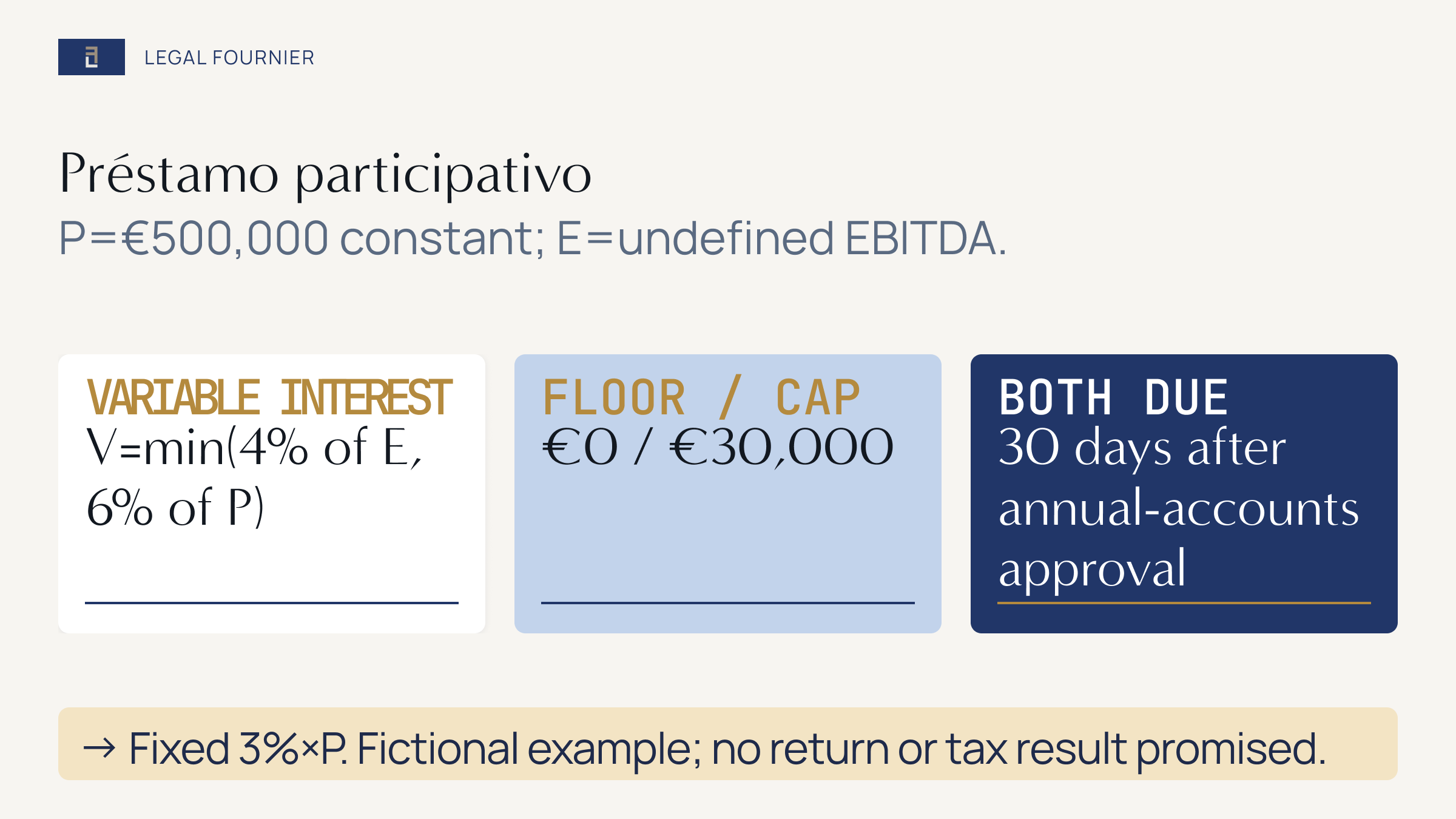
Start with symbols. Let P be the principal outstanding on the calculation date. Let E be “EBITDA” for the relevant financial year, a term the specimen has not yet defined. Under its words, variable interest V is:
V = the lesser of (4% × E) and (6% × P), but never less than €0.
Assume only for the illustration that P remains €500,000 throughout the year, fixed interest is 3% of P, and both components fall due 30 days after approval of the annual accounts. The 6% cap is therefore €30,000. These are fictional terms, not a market benchmark or a recommendation.
| Assumed E | 4% × E | Variable interest after floor and cap | Fixed interest | What remains uncertain |
|---|---|---|---|---|
| −€200,000 | −€8,000 | €0 because of the floor | €15,000 | Whether a negative amount carries forward; the draft is silent |
| €0 | €0 | €0 | €15,000 | Whether later adjustments reopen the calculation |
| €500,000 | €20,000 | €20,000 | €15,000 | Which items are included in E |
| €1,000,000 | €40,000 | €30,000 because of the cap | €15,000 | Whether the excess disappears or carries forward; the draft is silent |
The arithmetic is reproducible only after pretending that everyone agrees on E. EBITDA is not a single line identified in the specimen. It could be taken from the borrower’s standalone accounts, a consolidation, a management report or a reconciliation written for this contract. Acquisition costs, related-party charges, accounting-policy changes and exceptional transactions could alter it. The formula should identify the source accounts, period and adjustments, state how a later restatement is handled, and set an information-delivery date. It also needs a route for resolving a calculation dispute.
Article 20(1)(a) of Royal Decree-Law 7/1996 requires variable interest determined by the evolution of the borrower’s business. It names net profit, turnover and patrimonio total, while allowing another criterion agreed by the parties. Keep patrimonio total in Spanish until the agreement defines the intended accounting measure; translating it silently as either total assets or net equity creates a new ambiguity. The parties may add fixed interest, but a fixed-only loan does not meet the statutory return requirement.
Track the loan through five separate analyses
The same €500,000 instrument can receive different answers for statutory qualification, accounting, a narrow company-law test, insolvency and tax. Put each answer in its own row with the rule and the missing fact. “Quasi-equity” supplies none of that information.
| Issue | Source rule | Document fact needed | Reviewer question |
|---|---|---|---|
| Article 20 qualification | Article 20 requires variable return that tracks the borrower’s business; fixed return may be added. | Defined E, calculation period, floor, cap and fixed component. | Does the final formula genuinely measure business evolution and satisfy every article 20 feature? |
| Balance-sheet presentation | The current PGC rules depend on the instrument’s characteristics; a qualifying liability remains presented as a liability. | Full repayment, return and contingent-interest terms, plus the applicable PGC framework. | Which measurement and expense-recognition treatment applies to this contract? |
| Specified corporate-law own-funds test | Article 20 and the ICAC resolution give a limited net-equity effect for determining mandatory capital reduction or loss-based dissolution causes. | Amount outstanding and the figures used for the relevant company-law test. | Does that limited treatment affect the calculation at the relevant date? It does not make the loan share capital. |
| Insolvency ranking | Participatory loans rank after common creditors; Insolvency Act articles 281 to 283 also address contractual subordination and claims of specially related persons. | Lender identity, shareholder/director/group relationship, contract ranking and each claim component. | How would the principal, fixed return and variable return rank on the actual facts? |
| Corporate tax | Article 15(a) covers same-group remuneration under the non-deductible equity-return rule, subject to the statutory transitional boundary; other finance costs still face applicable limits and related-party rules. | Parties, residence, group relationship, grant date, amendments, tax period and pricing support. | Which rule applies to this borrower and lender for the period under review? |
The accounting distinction is especially easy to blur. The ICAC Resolution of 5 March 2019 says a participatory loan is shown as a liability when it meets the definition of a liability, although it is treated as net equity for the specified capital-reduction and loss-based dissolution tests. Following the 2021 reform, the General Accounting Plan amendments give contingent-interest participatory loans specific cost-based treatment. The borrower recognises financial expenses on accrual and accounts for transaction costs under the prescribed financial criterion or, where it does not apply, on a straight-line basis. A participatory loan with the characteristics of an ordinary loan falls under amortised cost. The exact entries require the agreement and the accounting framework actually used.
Subordination needs the lender’s identity
Article 20 places the participatory lender after common creditors. The current Insolvency Act, articles 281 to 283, includes claims contractually subordinated to all other claims, including participatory loans. It separately addresses claims held by persons specially related to the debtor and contains exceptions. A useful review therefore records whether the lender is a shareholder, director, group company or another related person. The word “subordinated” alone does not resolve how each part of the claim would rank.
The parties should also check the loan against existing bank facilities, intercreditor terms and payment blocks. Information covenants do not arise as automatic shareholder rights. If the lender needs annual accounts, a formula reconciliation or notice of a proposed transaction, the contract must say what is delivered, when and in what form.
Early repayment is not solved by a fee
The loan may include a contractual penalty for early repayment. There is a separate statutory restriction: under article 20(1)(b), the borrower may repay early only if the repayment is offset by an ampliación de igual cuantía de sus fondos propios, and those funds must not come from an asset revaluation.
A funding round, sale or refinancing may create the cash to repay without satisfying the statutory own-funds condition in the required way. The agreement should coordinate maturity and early repayment with those transactions, but drafting cannot declare in advance that an unspecified future step will work.
Tax depends on the parties and the date
For a participatory loan granted by one company to another in the same group within Commercial Code article 42, article 15(a) of the Corporate Tax Law treats the remuneration as a return on equity and includes it in the non-deductible item. The rule applies regardless of residence or a duty to prepare consolidated accounts. Transitional provision 17 says article 15(a) does not apply to participatory loans granted before 20 June 2014. The original grant date, amendments and current parties need checking before relying on that boundary.
Article 20(2)’s former general tax statement has been repealed. For other loans, the absence of the same-group rule does not establish deductibility. The current finance-cost limit and related-party market-value rules in articles 16 and 18 of the Corporate Tax Law, along with any cross-border and withholding questions, require the actual terms, parties and tax period.
ENISA terms belong in an ENISA comparison
At the 4 September 2026 review date, ENISA’s general financing page for startups and SMEs states product amounts from €25,000 to €1.5 million, terms generally up to seven years, principal grace generally up to two years, a two-part return and no real or personal guarantees. Those are dated statements about ENISA products. They are not statutory features of every privately negotiated préstamo participativo and should be rechecked when an ENISA application is considered. The separate ENISA financing guide covers that route.
The review file the formula needs
Place the term sheet and draft loan beside an ownership and group chart, the latest accounts, the exact reconciliation for the variable metric, existing senior finance documents and the proposed repayment or own-funds papers. Mark whether the accounts are standalone or consolidated, final or provisional, audited or unaudited. Record the effect of a later restatement and who decides a disagreement. The lender’s information rights should deliver the material needed to run the agreed formula.
Legal Fournier can review those documents and map the proposed instrument across article 20, repayment, accounting, the specified corporate-law test, insolvency and tax. That review cannot promise funding, ENISA eligibility, deductibility, a balance-sheet outcome or an insolvency result before the parties and terms are known. Contact the firm about the proposed transaction.
This article provides general information about Spanish law. It is not legal, tax, accounting or financial advice for a particular transaction.