Spanish company bank account blocked: KYC, UBO and source of funds evidence
When a Spanish company account is blocked, payroll, supplier payments and tax instalments may stop with it. Foreign-controlled companies may also lose access to rent payments, escrow movements or card settlements. The bank may describe the issue as KYC, UBO review, source of funds evidence or prevencion del blanqueo de capitales. Whatever term it uses, the company must resolve the bank’s risk questions before normal payments can resume.
Our guide to opening a bank account in Spain covers ordinary onboarding. This article addresses a different problem: the account already exists, but the bank has restricted it because its anti-money-laundering file on the company, beneficial owners, activity or transactions is incomplete or outdated.
For foreign founders, holding companies, family companies, real-estate vehicles and groups entering Spain, this is primarily a legal and evidence problem. A branch complaint alone is unlikely to resolve it. If the account is connected to a new Spanish entity, company acquisition or business relocation, the corporate file can be reviewed through our company formation service or a focused paid review through our consultation options.
Published: 4 July 2026
- A Spanish bank can request documentation on the company, its representatives, its activity, its real owners, and the origin of funds when anti-money-laundering rules require it.
- The Bank of Spain states that restrictive measures may be justified when the customer does not answer KYC requests, answers insufficiently, or the bank considers the measure legally required.
- UBO evidence means more than a shareholder list. Banks usually need to identify the natural persons who ultimately own or control the company, directly or indirectly.
- Source-of-funds evidence should connect the specific money movement to contracts, invoices, shareholder funding, loans, asset sales, dividends, tax records, or audited accounts.
- For foreign groups, the bank may also test whether the Spanish account fits the declared activity, tax profile, and possible permanent establishment Spain exposure.
- The fastest response is usually a structured evidence pack, not repeated informal emails to the branch.
Why a Spanish company account gets blocked
Spanish banks must comply with anti-money-laundering and counter-terrorist-financing duties throughout the customer relationship, not only when the account is opened. A review may begin when company details change, documents expire, transactions become unusual or the activity no longer matches the profile held by the bank.
The Bank of Spain’s client portal explains that, to block an account, a bank should have justified cause and normally warn the account holder to avoid avoidable damage from returned payments or rejected receipts. It also states that anti-money-laundering rules require banks to ask for documentation they consider necessary to identify and monitor the account holder and its operations; if the customer does not respond to that request, the block may be justified. In a separate good-practice note on restrictive measures, the Bank of Spain says financial institutions may request information on identity, economic activity and account activity, ask for periodic updates, and block or cancel the account where requests are not answered sufficiently or where the entity considers itself legally obliged to act.
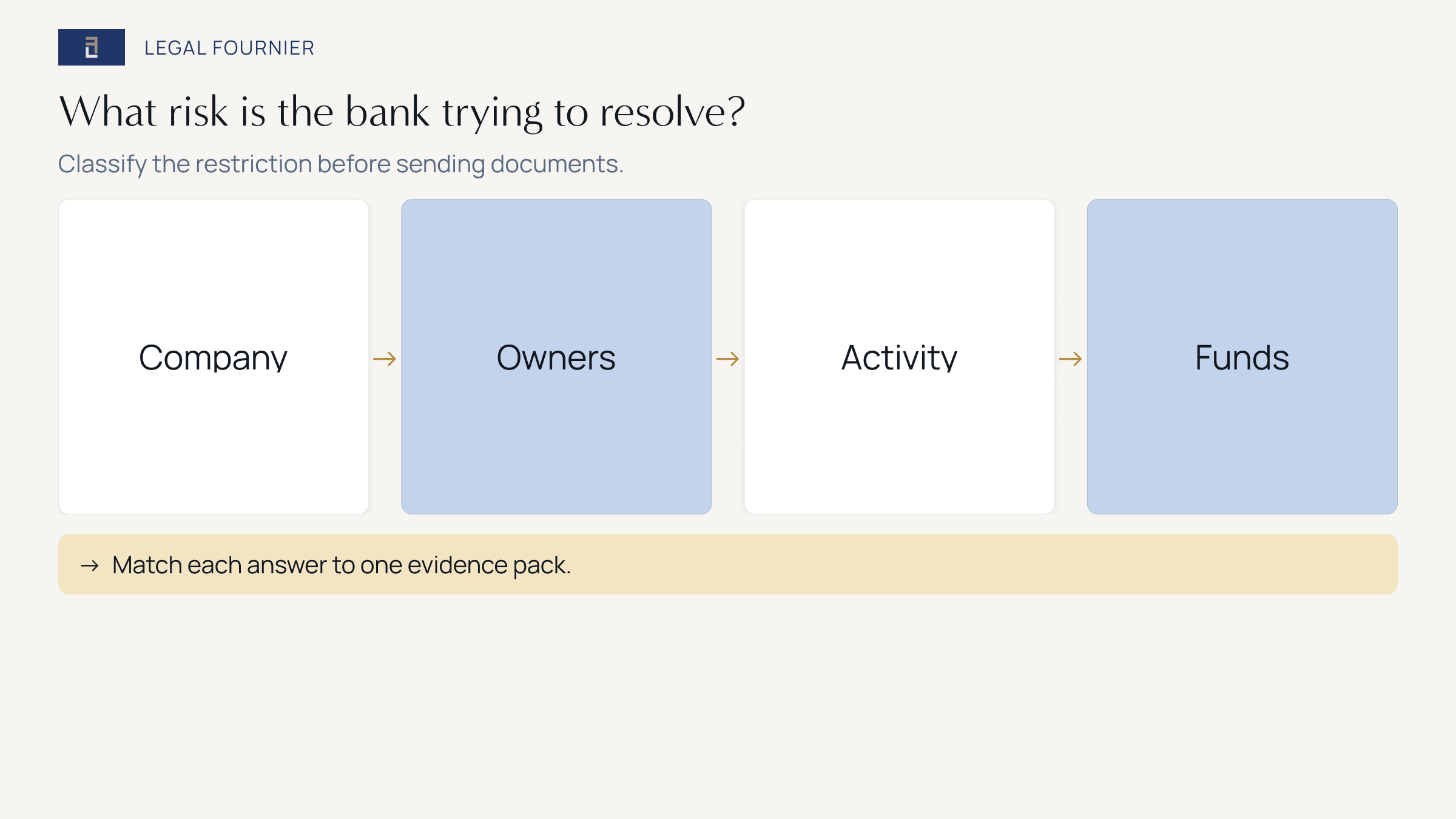
Not every restriction is handled correctly. Even so, the useful first question is: “What risk is the bank trying to resolve?” The evidence response, legal route and any complaint strategy depend on the answer.
The bank is not only checking who signed the account form. It is trying to document whether the company, the real owners, the declared activity, and the transaction pattern still match the risk profile it can defend to supervisors.
The legal logic behind KYC in Spain
In Spain, the core source is Law 10/2010 on prevention of money laundering and terrorist financing, developed by Royal Decree 304/2014. The law requires obliged entities, including banks, to identify people and legal entities that seek to establish business relationships or carry out operations. For a company account, that formal identification includes the legal person, the representative, and the natural persons behind ownership or control.
Law 10/2010 also requires the bank to identify the titular real, usually translated as beneficial owner or UBO. The law and its regulation look through the legal entity to the natural person or persons who ultimately own or control it. Under the regulation, direct or indirect ownership or control of more than 25 percent of capital or voting rights is a central test, but it is not the only control test. If no natural person is identified through ownership or other control, the administrator or administrators may be treated as exercising control for identification purposes.
The same law requires banks to obtain information about the purpose and intended nature of the business relationship. In practical company-bank language, that means the bank wants to understand what the company does, who pays it, who it pays, why the account exists in Spain, and whether the activity explains the money movements.
Finally, the law requires ongoing monitoring. Article 6 of Law 10/2010 refers to scrutiny of transactions during the relationship to ensure they match the bank’s knowledge of the customer, its business and risk profile, including the origin of funds, and that documents, data and information remain updated. This is why a company can pass onboarding and still face a block later.
UBO evidence: what the bank is really asking for
When the bank asks for UBO evidence, it is often not satisfied by a short email saying “the shareholder is a foreign company” or “the owner is the founder.” It usually needs a documented chain from the Spanish account holder to the natural persons who ultimately own or control the company.
For a simple Spanish sociedad limitada owned by one individual, the file may be relatively straightforward: deed of incorporation, tax identification number, certificate or extract from the Registro Mercantil, updated administrator details, shareholder information, and identification documents for the beneficial owner and representative. For a foreign controlled Spanish subsidiary, the chain may require foreign registry extracts, certificates of good standing, articles, shareholder registers, group charts, board appointments, powers of attorney, and apostilled or translated documents where the bank requests them.
Spain now also has the Registro Central de Titularidades Reales, created under Royal Decree 609/2023. The register is designed to centralize beneficial-ownership information for Spanish legal persons and certain entities or structures connected with Spain. For bank purposes, a register entry is helpful, but it is not always the whole answer. The bank may still ask for additional documents if the structure is complex, the beneficial-owner information is outdated, the foreign chain is incomplete, or the transaction pattern raises separate source of funds questions.
Common UBO problems in foreign controlled companies
- Layered ownership: the Spanish company is owned by one or more foreign companies, trusts, foundations, funds, or family vehicles.
- Outdated filings: the bank sees a director, shareholder, address, or corporate name that no longer matches the registry or tax records.
- Nominee or proxy arrangements: the person signing bank documents is not clearly the real decision-maker or properly empowered representative.
- Family ownership: funds come from relatives, family offices, inheritance, or intercompany loans without a clean paper trail.
- Non-transparent jurisdictions: the bank cannot easily verify a foreign company, trust, or register extract.
None of these facts proves wrongdoing, but each increases the documentary burden. The response should show ownership, control, authority and funding clearly enough for a compliance reviewer who has never met the client.
Source of funds is not the same as source of wealth
Bank requests often use broad wording: origen de fondos, procedencia de fondos, actividad economica, justificacion de ingresos, or source of funds. These labels are related but not identical.
Source of funds usually means the origin of the specific money entering or leaving the account. For example: a shareholder loan paid from a foreign bank account; proceeds from the sale of a company; rental income from Spanish property; client payments under service contracts; capital contributions; dividends; financing from a parent company; or proceeds from a property sale.
Source of wealth is broader. It explains how the beneficial owner or group accumulated the wealth that now funds the company. In a substantial or higher-risk file, the bank may need to understand both: where this transfer came from, and why the person or group had the economic capacity to make it.
Royal Decree 304/2014 confirms that, in higher-risk situations, obliged entities may apply enhanced due diligence and request additional information or documentation on the purpose and nature of the relationship, the origin of funds, the origin of the client’s assets and the purpose of transactions. The regulation also refers to examining and documenting the economic logic of operations. A technically complete pack may still fail if the documents do not explain the transaction coherently.
| Bank question | Evidence that often helps | Risk if ignored |
|---|---|---|
| Who owns or controls the company? | Registry extracts, cap table, group chart, UBO declarations, IDs, powers of attorney. | The bank cannot verify the real owner and may maintain or escalate restrictions. |
| What does the company do in Spain? | Contracts, invoices, website, tax registrations, lease, payroll, accounting ledgers, business plan. | Transactions look inconsistent with the declared activity. |
| Where did this money come from? | Sale agreements, bank statements, loan agreements, capital contribution deeds, dividend minutes, tax returns. | A legitimate transfer still looks unexplained. |
| Why is the Spanish account involved? | Spanish contracts, supplier invoices, tax filings, property purchase documents, employees, local operations. | The account may look like a pass-through or inactive shell. |
Why foreign groups trigger more KYC questions
Foreign ownership does not make a Spanish company suspicious, but it often makes the file harder to verify. A local company with one director, domestic clients and a simple ownership structure is easier to document. A foreign-controlled company may involve several legal systems, directors abroad, different naming conventions, group services, intercompany loans and transfers from accounts outside Spain.
For international groups, one of the most delicate questions is whether the Spanish account fits the declared business model. A company may say it has no Spanish operating activity, but the bank sees recurring Spanish supplier payments, staff expenses, warehouse costs, sales contracts, or local management. That mismatch can also create tax questions, including whether there is a permanent establishment Spain risk. The bank is not the tax authority, but compliance teams often ask for documents that expose the same factual pattern: where management decisions are made, where contracts are performed, where revenue is earned, and why funds are moving through Spain.
If the company is being used for Spanish operations, accounting and tax evidence should be aligned before it is sent to the bank. Our monthly accounting support is designed for companies that need their books, tax filings, and business documentation to tell the same story. Where the structure itself is being built or changed, our guide to forming a Spanish limited company explains the company-law side, while this article focuses on the bank-compliance file.
How to respond when the account is already restricted
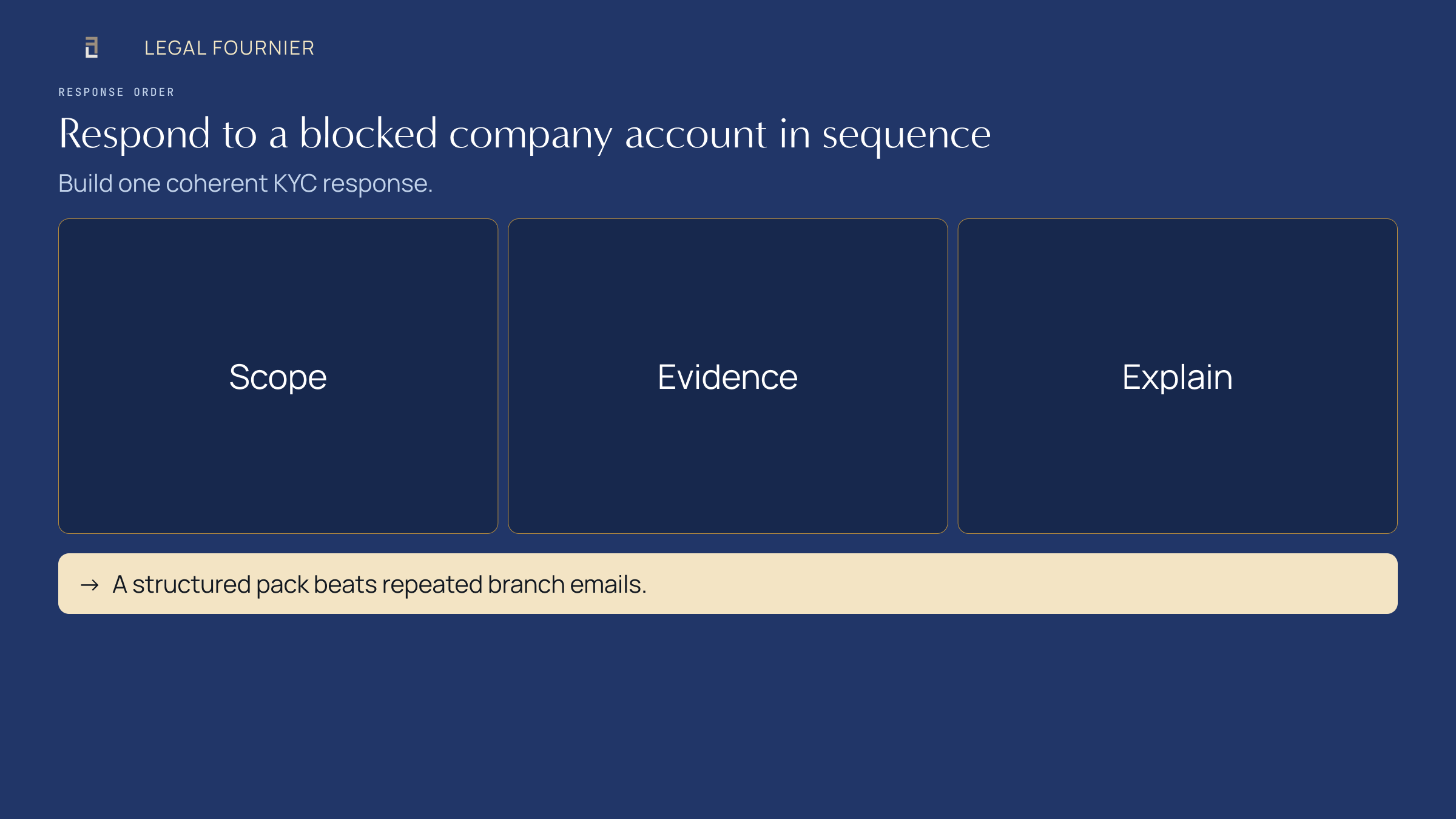
During the first 48 hours, identify the exact restriction: incoming or outgoing transfers, cards, direct debits, payroll, tax payments, online access or only specified transactions. Ask for the request in writing, the list of missing items, the upload channel and reference number. Also ask whether urgent payments can be reviewed manually. Keep the exchange factual; an angry branch complaint rarely speeds up a compliance review.
Then build one indexed evidence pack instead of sending a series of partial emails, unless the bank specifically asks for staged uploads. Include a short cover letter, company narrative, UBO chart, source-of-funds explanation, supporting documents and a note on any urgent operational consequences.
The cover note should answer the compliance question
The cover note should be concise and structured. It should say who the company is, what it does, who owns and controls it, why the account exists, which transaction triggered the review if known, and which documents prove the explanation. If the matter involves a shareholder loan, say so. If the money is capital for a property acquisition, explain the property, the purchase route, and the source of investor funds. If the account receives payments from a foreign parent for Spanish payroll, explain the group-service relationship and attach the intercompany documents.
The document pack should be current
Royal Decree 304/2014 requires documents to be current when relationships are established or occasional operations are executed, and it requires obliged entities to keep due-diligence documentation. In practice, outdated passports, expired corporate extracts, stale powers of attorney, old addresses, or unsigned shareholder charts slow down the review. If documents are foreign, check whether the bank wants legalization, apostille, sworn translation, or only an internal translation for compliance review.
The money trail should be transaction-specific
A common mistake is to answer a source of funds request with general wealth evidence only. For example, a founder may send a personal tax return to prove wealth, but the bank is asking why a particular EUR 300,000 transfer arrived from a foreign holding company into a Spanish SL. The better answer usually links the transfer to the board approval, loan agreement or capital contribution, sending bank statement, receiving bank statement, source of the parent funds, and business purpose in Spain.
Present the money trail chronologically. Show where the money was generated and held, who approved its movement, why it was transferred and how the Spanish company will use it.
Mistakes that make a bank block last longer
Do not dismiss the request as bureaucracy. It may feel excessive, but Spanish AML rules allow banks to ask for evidence about the customer, its activity, UBOs and transactions. A refusal, delay or inconsistent answer gives the bank more reason to maintain the restriction.
Check the pack for contradictions. The registry extract may name one administrator while the bank form names another. Invoices may describe consulting while the website describes investment holding. The shareholder chart may show a British company, but the transfer may come from a Delaware LLC. Any of these facts may have a legitimate explanation; include it rather than leaving the reviewer to infer one.
The bank response must also match the tax and accounting records. An unusual capital injection, intercompany loan, international service payment or Spanish property acquisition may appear in tax filings, accounting entries, transfer-pricing support and corporate minutes. Solving the immediate restriction with an explanation that contradicts those records creates another problem.
Do not rely only on the branch. Relationship managers can help, but AML decisions often sit with a central compliance department. Write the file for a reviewer who does not know the client and will decide from the documents, risk indicators and internal policy.
When legal review changes the outcome
Legal review is especially important where the block affects a live closing, salary payments, tax deadlines, company sale, real-estate purchase, residency investment, family transfer, crypto-to-fiat history, high-risk jurisdiction, politically exposed person, trust, foundation, or complex foreign group. In those cases, the issue is not just whether documents exist. It is whether the documents can be presented without creating a worse problem elsewhere.
For example, a family may fund a Spanish company from offshore investment proceeds. The bank asks for source of funds. The family can send account statements, but those statements may reveal undeclared Spanish tax exposure, foreign asset reporting issues, or a mismatch with the beneficial-owner declaration. Or a group may explain that the Spanish company has no activity, while the account shows payments that suggest local operations. That may require analysis of corporate tax, VAT, employment, and permanent establishment Spain risk before the bank response is finalized.
Where the bank has already decided to close the account, the strategy changes again. Sometimes the priority is unlocking enough functionality to pay taxes, payroll or suppliers. Sometimes it is obtaining written reasoning for a complaint route. Sometimes it is opening a parallel account with a better-prepared KYC file while preserving evidence of the original bank’s handling. The right step depends on the documents, the urgency, and the bank’s stated basis.
FAQ: company bank account blocked in Spain
Can a Spanish bank block a company account for KYC reasons?
Yes, where there is justified cause. The Bank of Spain recognizes that banks may request documentation on identity, economic activity and operations, and may block or cancel an account when those requests are not answered sufficiently or where the bank considers itself legally obliged to act. The specific facts matter.
Does the bank have to tell us exactly why the account is blocked?
Usually the bank should communicate the restrictive measure and provide at least a general reason or reference to the applicable regulatory basis. However, AML rules can impose confidentiality duties, so the explanation may be limited. That is why a structured evidence response is often more effective than trying to force a detailed internal risk explanation first.
What documents prove UBO for a Spanish company?
Common documents include the deed of incorporation, registry extract, shareholder register or cap table, UBO declaration, identification documents for beneficial owners, administrator details, powers of attorney, group chart, and foreign registry documents where the Spanish company is owned through non-Spanish entities. Complex structures usually need a tailored document list.
What is good source of funds evidence?
Good evidence links the specific transfer to its legal and economic source. Depending on the case, that may include contracts, invoices, bank statements, loan agreements, capital contribution documents, sale deeds, dividend minutes, audited accounts, tax returns, inheritance documents, or parent-company approvals.
Can we open another account while one bank reviews us?
Sometimes, but the same KYC issues may follow the company. A second bank may ask the same or more detailed questions, especially if the old account was restricted or closed. It is usually better to prepare the evidence file first, then decide whether to repair the existing relationship, open a parallel account, or do both.
Is this connected to tax or permanent establishment Spain risk?
It can be. A bank KYC review is not a tax audit, but the documents requested by the bank may reveal facts relevant to Spanish tax residence, VAT, payroll, corporate tax, transfer pricing, or permanent establishment Spain analysis. If the company has international operations, the bank response should be coordinated with tax and accounting advice.