

Factoring Finance in Spain: With Recourse, Without Recourse and Contract Risk
An invoice has reached maturity and the debtor has not paid. The factoring agreement says “without recourse”, but that phrase does not yet tell the finance director who bears this particular loss. The answer may change if the debtor is insolvent, merely late, disputing performance, asserting set-off, or pointing to a credit note. It may also change because the receivable fell outside an eligibility limit.
Put four documents on the desk before drawing a conclusion: the master agreement, the eligibility or assignment schedule, the invoice and performance evidence, and the debtor correspondence. Match the reason for non-payment to the exact risk accepted by the factor. Banco de España describes factoring as the acquisition of receivables, often combined with an advance and collection services, either with or without assumption of default risk. Its description does not decide the signed terms. See Banco de España’s factoring guide.
Start with the event, not the label
Use a ledger built from a fictional Spanish supplier and a provider-neutral agreement. It sorts the file; it does not predict liability. Complete each row with the wording and evidence from the real documents.
| Event | Contract question | Evidence to locate | Cash or reserve issue | Do not assume |
|---|---|---|---|---|
| Debtor insolvency | What event counts as covered default, and is there a waiting period? | Accepted debtor, credit limit, maturity, insolvency evidence | Whether the reserve stays blocked pending the defined event | That the factor always files or receives the insolvency claim |
| Late payment | Does delay alone trigger cover? | Due date, notice and collection history | Continuing interest, availability or reserve effect | That every overdue invoice is a covered loss |
| Performance or quality dispute | Is a disputed receivable eligible? | Order, delivery, acceptance and complaint records | Possible chargeback, repurchase or indemnity | That a dispute is debtor insolvency |
| Set-off | When did the debtor learn of, consent to or reject the assignment? | Notice chronology and underlying counterclaim | Net collection and any reversal | That assignment automatically defeats set-off |
| Credit note or return | How does the agreement define dilution? | Credit note, return and reconciliation | Reserve reduction or repayment | That the original face value remains collectible |
| Fraud or duplicate financing allegation | Which representation or exclusion applies? | Original invoice trail and prior assignments | Immediate recourse may be claimed under the contract | That credit cover validates the invoice |
| Excluded, over-limit or concentrated debtor | Was the invoice within the accepted schedule and limit? | Approval, limit history and concentration calculation | Uncovered portion and reserve allocation | That the facility label covers every assigned invoice |
| Missing notice or payment to the supplier | Was notice effective, and what did the debtor know? | Notice, delivery proof and payment instructions | Reconciliation of the misdirected payment | That the debtor must pay twice |
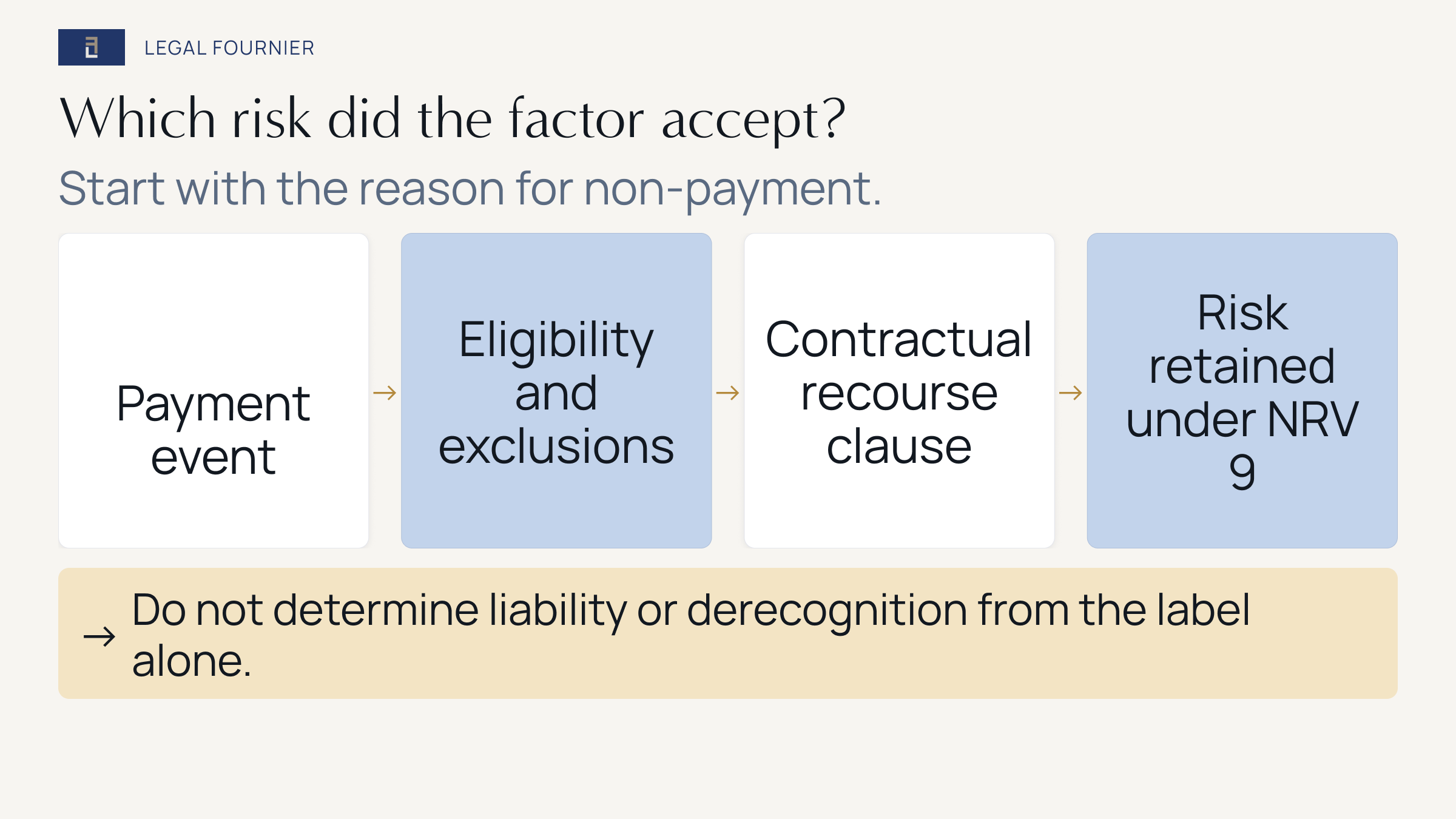
The contract cannot be reduced to its product label. A 2004 tax resolution describes factoring as a mixed arrangement that may combine management, finance and guarantee functions. When discussing non-recourse factoring, it connects the transfer of insolvency risk to insolvency occurring on the terms agreed in the contract. This is an interpretive description of the product, not a shortcut to a tax answer. See DGT Resolution 1/2004.
Do not guess who controls an insolvency claim, settlement or distribution. That depends on the effective assignment, title to the receivable, retained rights and the procedure actually opened. Preserve the assignment documents and any authority granted to collect or litigate. A live insolvency requires a fact-specific review under the current Consolidated Insolvency Act; the ledger only identifies the question.
Notice changes the payment chronology
For non-endorsable commercial claims, articles 347 and 348 of the Commercial Code address transfer, notice and the assignor’s responsibility for the legitimacy of the claim. They do not make the assignor responsible for debtor solvency unless that responsibility was expressly agreed. Applicability still depends on the receivable. The text is available in the Commercial Code.
The Civil Code adds a point that is easy to miss in a cash-flow summary. A debtor who pays the former creditor before knowing of the assignment is released under article 1527. Article 1198 treats set-off differently depending on the debtor’s consent, notice or lack of knowledge. Dates and delivery evidence therefore matter. Read articles 1526 to 1530 together with article 1198. Neither provision erases the contract’s eligibility rules or warranties.
Trace provisional cash separately from transferred risk
Suppose the face amount of the fictional accepted invoice is F. The agreement advances a fraction a and retains the balance as a reserve. Writing the transaction this way avoids the false impression that money received on day one is final.
| Movement | Illustrative amount | Separate question |
|---|---|---|
| Invoice assigned | F | Does the receivable exist, and was this invoice eligible and effectively assigned? |
| Initial advance | a × F | Can the factor reverse it for a dispute, breach, exclusion or uncovered amount? |
| Reserve held | (1 − a) × F | Which fees, adjustments and unpaid items may be netted against it? |
| Fees and interest | Use the signed rate and period | Which charge pays for finance, servicing or risk cover, and who bears tax? |
| Debtor payment and reserve release | Collection less valid deductions | Has every reconciliation and waiting condition been satisfied? |
| Possible reversal | Only the amount supported by the contract | Is this a retained credit risk, an eligibility breach, an indemnity, or something else? |
The arithmetic is deliberately incomplete. The real advance percentage, reserve, availability limits, fees and adjustment rules must come from the signed agreement and settlement statements. A promise of early liquidity is not the same thing as a transfer of every legal or accounting exposure.
Reconcile the settlement invoice by invoice. Record the amount accepted by the factor, the date cash arrived, the reserve movement, each deduction, any debtor payment and the contractual reason for a reversal. A facility-level balance can conceal that one receivable was excluded while another paid normally. If currencies differ, keep the contractual conversion rule and the accounting question separate.
The accounting test follows the retained exposure
Spanish PGC NRV 9 looks at economic substance. Derecognition requires expiry of the cash-flow rights or a transfer that passes substantially all risks and rewards. The rule gives factoring without retained credit or interest risk as an example of substantial transfer. Factoring with recourse is an example in which the receivable remains and the cash received is recognised as a financial liability. Cases between those poles require the rest of the test, including control and continuing involvement. See Royal Decree 1/2021, NRV 9.2.7.
That analysis cannot be done from the cover page. The accountant needs the same clauses used in the event ledger: limits, reserves, repurchase obligations, guarantees, interest exposure and control over collection. Tax treatment also needs its own current review; no general VAT or corporation-tax benefit follows from calling the transaction factoring.
Check who the provider is, then check the contract
Article 6 of Law 5/2015 lists factoring among the activities an authorised financial credit establishment may carry on. Banco de España also explains that offering factoring does not, by itself, require a provider to be a bank or an EFC. If regulated status matters to the decision, identify the contracting entity and check the Banco de España entity register. A registration entry identifies status; it does not approve the agreement or guarantee collection.
This article gives general information about Spanish business receivables. It is not legal, insolvency, accounting, tax or financial advice for a particular invoice or agreement.