


Moving from Canada to Spain is a project. With the right plan, it's manageable. This is our roadmap for turning the idea of a life in Spain into a concrete set of steps.
Your Relocation Roadmap from Canada to Spain
A move across the Atlantic doesn’t just happen. It's a sequence of deliberate actions, and for Canadians, the first step isn't packing a single box. It’s choosing the right legal pathway to residency. Everything else you do will flow from that initial decision.
We break the process down into three general phases.
First comes the groundwork in Canada. This is where you research and lock in the correct visa for your situation. Then, you begin the process of gathering every document, from bank statements to police clearances.
Next is the application itself. You'll submit your full package to the Spanish Consulate in Toronto, Montreal, or Ottawa and wait for their decision.
Finally, once you arrive in Spain with your visa in hand, you'll tackle the last bits of bureaucracy: getting your TIE card, registering at the town hall (empadronamiento), and sorting out social security.
Planning Your Timeline and Key Steps
A successful move is all about timing. The single biggest mistake we see Canadians make is underestimating how long it takes to get their documents legalized and translated.
Because Canada is not part of the Hague Apostille Convention, your official documents need a different, more complex legalization process to be valid in Spain.
We see this constantly. A client gets a standard criminal record check from their local police, only to find it's completely useless without the proper multi-step legalization and a sworn Spanish translation. Starting this part early is absolutely critical.
Your plan needs to account for these specific hurdles. For example, if you're targeting the Non-Lucrative Visa, you need to show €28,800 in savings for the main applicant, and the bank statements must cover a specific period. If the Digital Nomad Visa is your goal, you have to prove a stable remote income of at least €2,763 per month.
Don't forget to factor in logistics like international pet travel if you're bringing an animal. Every piece of the puzzle, from your visa choice to your arrival paperwork, is connected.
We've detailed every step in our complete guide on residency in Spain for Canadians. The goal here is to give you a clear, no-nonsense picture of the journey ahead. Understand the full process from the start, and you can navigate the move with confidence.
A Canadian's Guide to Spain's Top Visas
Choosing the right visa isn't just a box to tick; it's the foundation of your entire move to Spain. Get it right, and your transition is smooth. Get it wrong, and you’re looking at months of delays and frustration. This isn't about legal jargon. It's about matching your life and career goals to the right legal pathway.
With several options available, it's easy to get lost. We've created this comparison table to give you a quick, at-a-glance overview of the most popular visas for Canadians.
Spanish Visa Comparison for Canadian Citizens
| Visa Type | Ideal Candidate | Minimum Annual Income/Savings | Allows Work in Spain? |
|---|---|---|---|
| Digital Nomad | Remote workers & freelancers with foreign clients/employers. | Approx. €33,156 income. | No, only for your foreign employer/clients. |
| Non-Lucrative | Retirees or those with significant passive income/savings. | Approx. €28,800 in savings. | No, work is strictly forbidden. |
| Highly Qualified Professional | Professionals with a job offer from a Spanish company. | N/A (based on employment contract). | Yes, but tied to the specific employer. |
| Entrepreneur | Founders with an innovative, approved business plan. | N/A (based on business plan). | Yes, for your own approved business. |
This table provides the headlines, but the details are what truly matter. Let’s dig into what these requirements actually mean for you.
The Digital Nomad Visa
If you’re a Canadian who can work from your laptop, this visa was built for you. It’s for salaried employees of a non-Spanish company or freelancers with clients outside of Spain.
The key is proving consistent income. You must show earnings of at least 200% of Spain’s Minimum Interprofessional Salary (SMI). The SMI is currently €1,134 per month paid over 14 instalments, so the real monthly threshold for immigration purposes is closer to €2,763. This isn’t a small amount, and you’ll need contracts, invoices, and bank statements to back it up.
For a deeper dive into making a remote career work in Spain, this guide to Work From Home Spain is a great resource. A huge perk of this visa is eligibility for the Beckham Law, a special tax regime that can significantly lower your tax burden.
The Non-Lucrative Visa (NLV)
The NLV is for anyone who can support themselves in Spain without working. Think retirees, investors living off dividends, or anyone with substantial savings.
Here, the focus shifts from monthly income to annual savings. You have to prove you have 400% of Spain’s IPREM (a public income indicator, around €600/month) in the bank. That comes out to a minimum of €28,800 for the main applicant for the first year.
We see many Canadians underestimate what’s needed for the NLV. It’s not enough to just have the funds. You must prove the money is yours, accessible, and has been in your account for a period of time. In our experience helping clients, we spend a lot of time structuring their finances to satisfy the consulate’s strict standards.
The name says it all: non-lucrative. You cannot legally perform any work in Spain on this visa. You can learn more in our detailed guide to the Non-Lucrative Visa.
This flowchart breaks down how your initial visa choice affects every subsequent step of your move.
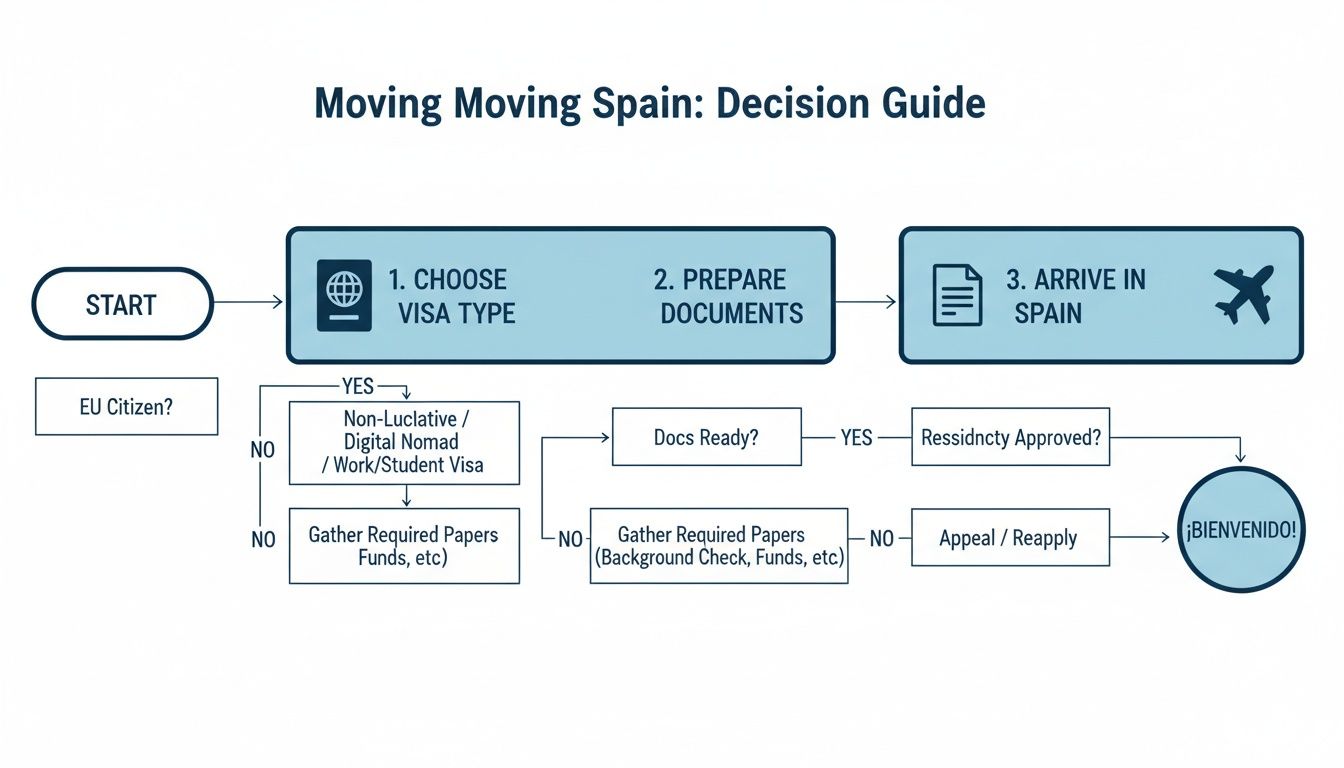
As you can see, everything from the documents you gather in Canada to the registrations you complete in Spain hinges on this first decision.
Highly Qualified Professional and Entrepreneur Visas
What if you want to work for a Spanish company or start your own? That’s where these visas come in.
-
The Highly Qualified Professional Visa is for when you have a job offer from a company in Spain. Your employer has to start the process, proving they couldn’t find an EU candidate for the role. Your residency is tied directly to that job.
-
The Entrepreneur Visa is for founders with an innovative business concept. You need a solid business plan that gets approved by an official body like ENISA. They’re looking for projects that are tech-focused or bring special economic interest to Spain. It’s a lot of up-front work but a direct path to running your own company.
Student and Family Visas
Other pathways exist for specific situations. The Student Visa is for anyone enrolling in an accredited Spanish school or university. A recent and very welcome reform now allows students to work up to 30 hours per week, making it a far more practical option than before.
The Family Reunification Visa is how you join a spouse, parent, or child who is already a legal resident in Spain. The resident in Spain initiates this process on behalf of the family member in Canada.
Not sure which path fits? Contact us and we’ll map out the best option.
The Application Process Demystified
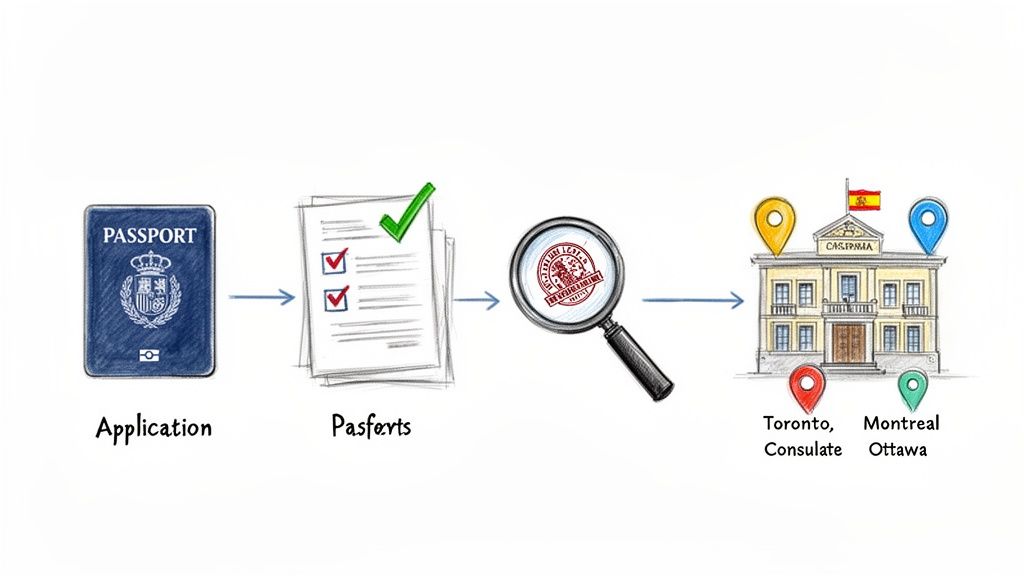
Once you’ve settled on the right visa, the real work begins. This stage is all about meticulous execution. Every single document has to be perfect.
Your entire visa application must be submitted in person, in Canada, before you move. You can’t just land in Spain as a tourist and try to change your status.
Spain has three Consulates General in Canada: Toronto, Montreal, and Ottawa. You must apply at the one serving your province of residence. No exceptions.
Gathering Your Core Documents
Your application will have a lot of paperwork, but two documents have long lead times and need your attention first.
Start with your criminal record check and your medical certificate. For the criminal record check, you’ll need a specific version issued by the RCMP that includes your fingerprints. A standard local police check will be rejected.
You’ll also need a medical certificate using the exact template provided by the consulate. Your doctor must complete it, confirming you don’t have any diseases that pose a public health risk under International Health Regulations.
In our experience, one of the most frequent delays comes from incorrectly legalized documents. It’s a multi-step process that can be confusing, and a single missed step means the consulate will reject your paperwork.
The Legalization Hurdle for Canadians
This is where most Canadian applicants get stuck. Canada is not part of the Hague Apostille Convention, which means you can’t just get a simple apostille stamp.
Instead, your documents must go through a two-step process to be valid for Spain:
- Authentication: Your document (like the RCMP check) first goes to Global Affairs Canada in Ottawa to be authenticated.
- Legalization: After that, it must be taken to the Spanish Consulate to be legalized. Only then will Spanish authorities accept it.
This whole process can take weeks, sometimes months. You have to build this delay into your timeline. It dictates when you can even think about booking your consulate appointment.
Sworn Translations: A Critical Final Step
After your documents are fully legalized, they need to be translated into Spanish. This isn’t a job for your bilingual friend. It must be a sworn translation (traducción jurada).
This has to be done by a translator who is officially recognized by the Spanish Ministry of Foreign Affairs. Their stamp and signature make the translation a legally valid document. Using a standard translation is a classic mistake that gets applications denied. We manage this for our clients to make sure it’s done right.
Different paths to residency have different requirements. Immigration is a story of personal success, with naturalizations peaking at 261,295 in 2013 and settling at 126,266 by 2020. While many are from Latin America, Canadians find their own success, often through entrepreneur or self-employed visas. Our firm handles the entire process for freelancers registering as autónomos or those incorporating a business in Spain. You can see more data on immigration trends in Spain on Wikipedia.
The Consulate Appointment and Beyond
With your complete, legalized, and translated document package ready, it’s time to book an appointment at the correct Spanish Consulate. You’ll submit everything, pay the fees, and give your biometric data.
Then, you wait.
Processing can take anywhere from a few weeks to several months. It depends on the visa type and how busy the consulate is. There’s no way to speed this up.
Once approved, the consulate will call you back to put the visa sticker in your passport. This visa is your ticket to Spain, usually valid for 90 days from the issue date. Once you land, a new set of tasks begins.
Taxes for Canadian Expats and the Beckham Law Advantage
Moving to Spain means getting to know the Spanish tax system. The sooner you understand your obligations, the fewer surprises you’ll have. Once you spend more than 183 days in Spain during a calendar year, you are almost always considered a Spanish tax resident. This has major consequences for your worldwide income.
For most people, tax residency means paying progressive income tax rates that can climb to nearly 50%. But for many skilled Canadians making the move, there’s a much better option on the table.
The Beckham Law: A Game Changer for Expats
Spain’s Special Expatriate Tax Regime, widely known as the “Beckham Law” (officially regulated by Law 35/2006), was created specifically to attract foreign talent. If you qualify, you can choose to be taxed at a flat rate of 24% on your Spanish employment income, up to a cap of €600,000. Any income above that amount is taxed at 47%.
This favourable tax treatment can be applied for the year you arrive plus the following five years, giving you a six-year window of significant tax savings.
In our experience, the Beckham Law is one of the single biggest financial advantages for Canadians relocating for work. Whether you’re joining a Spanish company or working remotely on the Digital Nomad Visa, the savings are substantial. But the application window is famously strict.
To benefit, you must formally apply to the Spanish Tax Agency (Agencia Tributaria) within six months of registering with Spanish Social Security (Seguridad Social). If you miss this deadline, the opportunity is gone for good.
Who Qualifies for This Favourable Tax Rate?
Eligibility for the Beckham Law has broadened in recent years, opening it up to more Canadian professionals than ever before. It now includes:
- Highly Qualified Professional Workers who have a job offer from a company in Spain.
- Digital Nomads who are working remotely from Spain for a foreign employer.
- Administrators of a Spanish company, as long as they don’t own more than 25% of the entity.
- Entrepreneurs undertaking an approved innovative business activity in Spain.
The Beckham Law is a perfect example of how Spain is actively recruiting skilled talent. Attracting 119,811 new immigrants in Q2 2026 alone, as reported by immigration trend analysis on VisaHQ.com, shows the country’s reliance on foreign professionals for economic growth. The OECD has noted that immigrants contribute a net positive fiscal impact of 0.54% of GDP, and policies like this are designed to keep that momentum going.
Non-Resident Tax Considerations
What if you buy a holiday home in Spain but remain a tax resident of Canada? You still have tax obligations here. As a non-resident property owner, you will need to file an annual non-resident income tax return, known as the Impuesto sobre la Renta de no Residentes (IRNR).
This tax is calculated on an “imputed” income from your property, and it applies even if you never rent it out. Planning ahead is just as important for part-time owners as it is for full-time residents. You can explore a complete breakdown of how the Beckham Law works and who qualifies in our detailed guide.
Whether you’re a digital nomad, a future homeowner, or an employee starting a new job, understanding your tax status from day one is key. We can help you structure your finances correctly for a smooth and predictable move.
Your First 90 Days in Spain Checklist
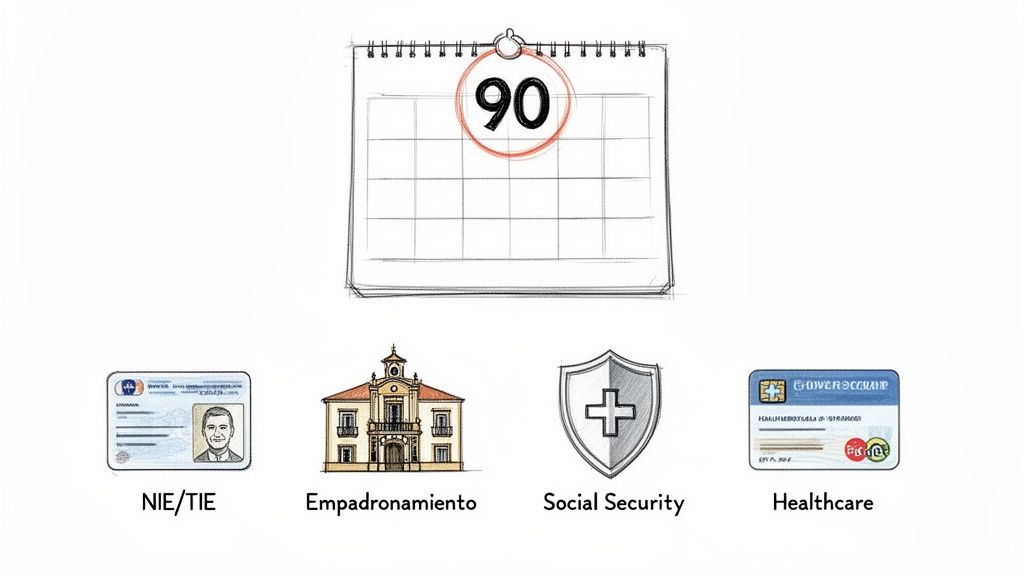
Landing in Spain with a visa in your passport feels like the finish line, but it’s really just the starting gun. Your visa is just a travel document; it gets you in the door. The real work begins now.
You have roughly 90 days to turn that entry visa into a proper residency card and get yourself fully plugged into the Spanish system. Think of it as an administrative sprint where each step unlocks the next. Getting the sequence wrong or missing a deadline can create serious problems that are difficult to unwind later. We handle this entire post-arrival maze for clients all over Spain, but here’s the roadmap you need to follow.
The TIE Card Appointment: Your Top Priority
First, and most urgently, you need your Foreigner Identity Card, or TIE (Tarjeta de Identidad de Extranjero). This is the physical card with your photo, fingerprint, and Foreigner Identity Number (NIE) that proves your legal residency. You have to apply for it within 30 days of arriving in Spain.
The process is broken into two parts:
- Get the appointment: You have to book a “Toma de Huellas” (fingerprint) appointment online at a National Police station in your province.
- Go to the appointment: You’ll submit your paperwork, pay the fee (via a specific government form), and get your fingerprints scanned.
The biggest hurdle here is getting the appointment itself. The booking system releases a handful of slots at random times, and they’re gone in seconds. This is, without a doubt, where most newcomers get stuck. It takes persistence, checking the portal constantly, often at odd hours like early in the morning.
Don’t wait. The lack of appointments is a well-known, nationwide problem. If your 30-day window is about to close and you still can’t book a slot, make sure you have proof (screenshots work) that you’ve been trying.
Empadronamiento: Registering Your Address
While you’re fighting for a TIE appointment, you can and should get your empadronamiento. This is simply the act of registering your address at the local town hall (ayuntamiento). In Canada, it’s a bit like getting on the electoral roll, but in Spain, it’s fundamental to your daily life.
Your padrón certificate is required for practically everything:
- Finalising your TIE card application.
- Registering for the public healthcare system.
- Enrolling your kids in a local school.
- Proving your residency period when you go to renew your visa.
To get registered, you’ll just need your passport, your rental agreement (or a signed letter from the property owner), and the application form. It’s usually a quick process, and you’ll walk out with the certificate the same day.
Getting into the System: Social Security and Healthcare
If your visa allows you to work, whether for a Spanish company or as a self-employed autónomo, you have to register with the Social Security system (Seguridad Social). For employees, your company’s HR department will usually take care of this. If you’re going freelance, the responsibility is yours.
Once you’re registered and making contributions, you get access to Spain’s public healthcare. If you’re here on a visa that doesn’t grant work rights, like the Non-Lucrative Visa, you’ll need to maintain the private health insurance you used for your visa application.
This entire sequence of post-arrival tasks is non-negotiable for anyone moving to Spain from Canada. From choosing the right visa to hitting these on-the-ground requirements, every piece connects.
Not sure which path fits your situation? Contact us, and we’ll help you map out the best strategy.
Trying to manage the TIE, empadronamiento, and social security bureaucracy is a tall order, especially when you’re also navigating a new language and culture. Our team handles these appointments and filings for our clients, ensuring a smooth registration so you can actually focus on building your new life in Spain.
If you’d rather have an expert handle all of this for you, contact us to talk about our post-arrival support services.
Your Questions Answered: Moving to Spain from Canada
We field questions from Canadians every day. Most aren’t about the weather or the wine; they’re about the practical, real-world hurdles of making this move happen. Here are the answers we give, based on years of getting people like you from Canada to Spain.
How Much Money Do I Really Need to Move to Spain?
This is the big one. The official visa requirements are just the entry ticket, not the full cost of the show.
For a Non-Lucrative Visa (NLV), the government wants to see you have at least €28,800 in the bank. For the Digital Nomad Visa, they require a monthly income of about €2,763. Those numbers get your visa approved, but they don’t cover the reality of setting up a new life from scratch.
In our experience, you need to budget for a hefty chunk of startup costs on top of those figures. Think about it:
- Rental Deposits: Landlords typically ask for two months’ rent as a deposit, plus the first month upfront. For an apartment at €1,200 a month, that’s €3,600 gone on day one.
- Agency Fees: If you use a rental agent, expect to pay a fee of one month’s rent plus VAT.
- Getting Started: Furniture, utility hookups, internet, a new phone plan… it all adds up fast.
A much more realistic number for a comfortable landing, separate from your visa’s financial proof, is an extra €8,000 to €10,000 per person.
Can I Bring My Family with Me?
Yes, most residency visas allow you to bring your immediate family. But the definition of “family” and the process can be tricky.
For the Digital Nomad and Non-Lucrative visas, you can generally bring your spouse or registered partner and your dependent children. You’ll have to prove you have extra funds for each person—for the NLV, that’s an additional €10,800 per family member.
The real challenge comes with proving dependency. For adult children or elderly parents, you need to show they are genuinely financially or physically dependent on you. This isn’t just a signed affidavit; it means providing bank records showing consistent financial support, medical reports, and other hard evidence.
What Is the Biggest Mistake Canadians Make?
By far, the single biggest mistake we see is underestimating the document legalization process. It trips up almost everyone.
Because Canada is not a member of the Hague Apostille Convention, your official documents can’t just be stamped with an apostille. Every single one—your RCMP criminal record check, birth certificates, marriage certificates—has to go through a painful, two-step authentication and legalization process. This involves Global Affairs Canada and then the Spanish Consulate. It can take months.
Other common pitfalls include getting sworn translations that aren’t compliant with Spanish law or simply misunderstanding the specific type of financial proof the consulate demands. These aren’t small details; they’re the things that get applications delayed or rejected flat out.
Do I Need to Speak Spanish to Move to Spain?
The honest answer? No, not to get the visa. But you absolutely should learn it to have a life here.
In the international areas of cities like Barcelona, Madrid, and Málaga, you can survive with English, especially in the tech and business world. But your life will be limited. Dealing with any kind of official paperwork, shopping at the local market, making friends with your neighbors, or even just getting your internet fixed—all of this runs on Spanish.
Your life will be infinitely richer, and easier, with at least a conversational grasp of the language. You don’t need it to arrive, but you’ll need it to stay.
Planning your move involves a lot of moving parts. At our firm, we offer end-to-end guidance to make sure every step, from picking the right visa to planning your taxes, is handled correctly. Contact us today and get personalized advice for your move to Spain.
Immigration and relocation cases can vary depending on each person’s circumstances. You may schedule a 45-minute legal consultation with Legal Fournier to review your case and discuss the available options.
Schedule a Consultation
