

So, you’re a qualified nurse looking to work in Spain. The good news is, Spain needs you. The path, however, involves navigating some bureaucracy. You’ll need to get your professional qualifications recognised, secure the right visa or residency, and register with the Spanish nursing council.
It all starts with the biggest hurdle: getting your degree officially validated. For non-EU nurses, that validation stage is often the longest part of the process, so it makes sense to start there first.
The First Hurdle: Degree Recognition for Foreign Nurses
Before you can even think about job hunting or visas, the Spanish government has to approve your nursing degree. This is the non-negotiable first step. The process you’ll follow depends entirely on where you trained.
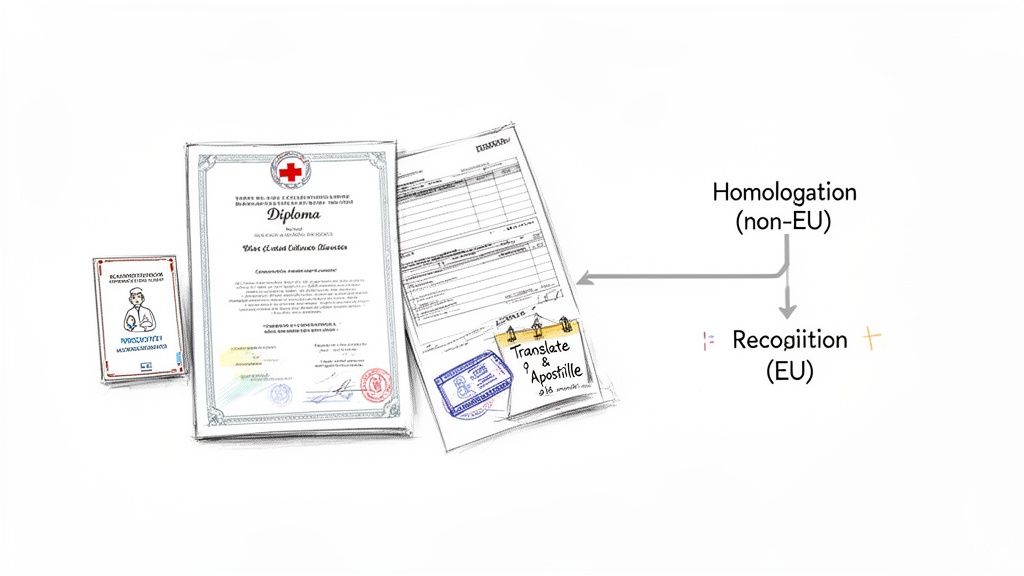
For nurses with degrees from outside the European Union, the process is called homologación de título. Think of it as a deep dive where the Spanish Ministry of Universities compares your curriculum, subjects, and clinical hours against the Spanish nursing degree standard.
Nurses who trained within the EU, EEA, or Switzerland have a much simpler route called reconocimiento de título. This is an official recognition of your existing professional qualification under EU mutual recognition directive (Directive 2005/36/EC).
Homologación for Non-EU Nurses
If your nursing degree is from outside the EU, the homologación is your most time-consuming task. You’ll submit a detailed application and a thick file of supporting documents directly to the Spanish Ministry of Universities.
Homologación can take many months, and badly prepared files often take longer. The more complete and consistent the application is from day one, the lower the risk of avoidable delays.
The entire game is won or lost in the document preparation stage. A single mistake here can set your plans back by months. You need to gather several official documents from your home country and university.
Essential Documents for Homologation
Your application packet needs to be comprehensive. While the specifics can shift slightly, the core documents are always the same:
- Official Degree or Diploma: The certificate that proves you graduated.
- Complete Academic Transcripts: A detailed record of every subject studied, the hours dedicated to each, and the grades you received.
- Detailed Course Syllabus: This is often the hardest document for people to get. It needs to describe the content of every single course you took during your nursing programme.
- Proof of Nationality: A certified copy of your passport.
- Application Form and Fee Payment: You’ll need the official form (Modelo 790, code 107) and proof you’ve paid the processing fee, which is currently €166.50.
All your foreign documents must be officially legalized (usually with an Apostille of The Hague) and then translated into Spanish by a government-approved sworn translator, known as a traductor jurado. This is a frequent point of failure; a standard translation will be rejected. You can learn more about our specific services for healthcare professionals and how we manage this entire process.
This visual lays out the basic workflow, from gathering your documents to getting the final approval.
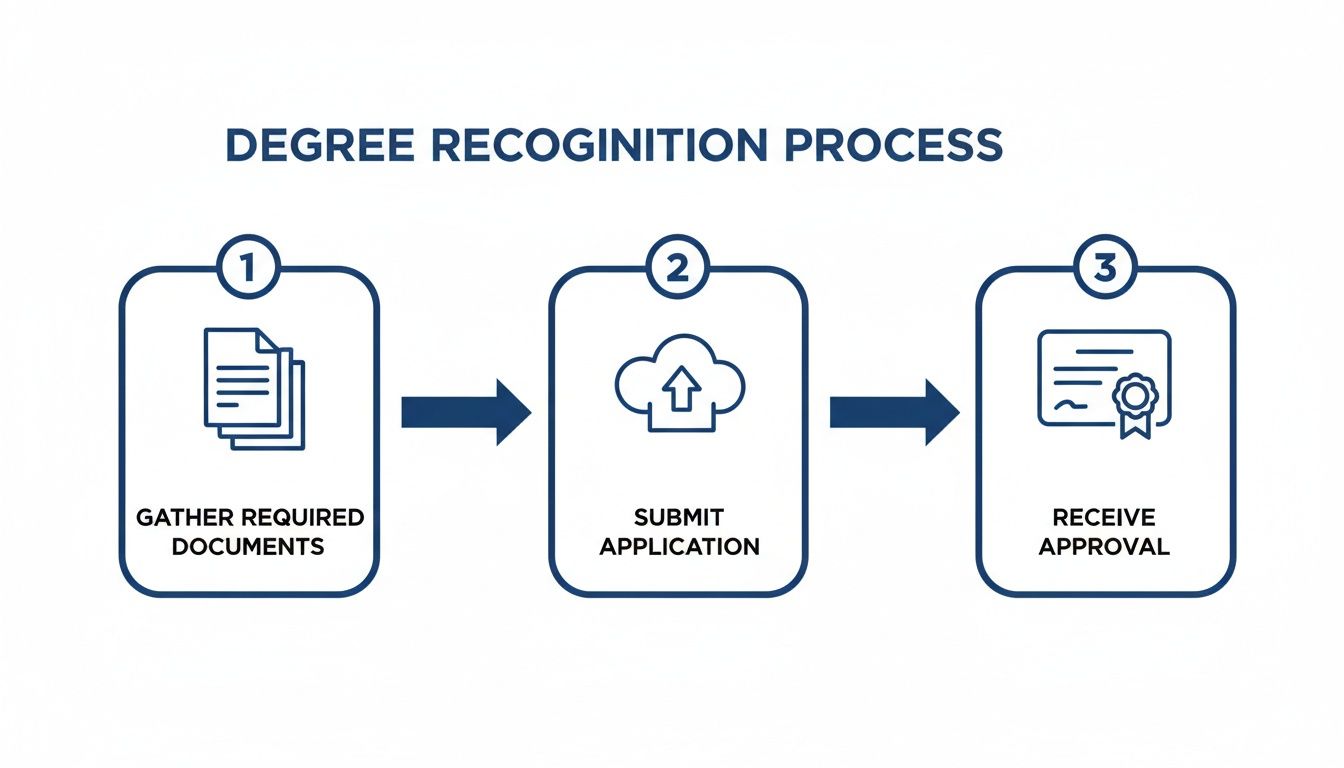
Success hinges on submitting a complete and perfectly prepared application from day one.
Reconocimiento for EU Nurses
If you are an EU citizen and also have a nursing degree from an EU country, things are usually more straightforward. This reconocimiento process is handled under the EU professional recognition framework, but the timing still depends on the file and the authority handling it.
While it’s quicker, it still demands precise paperwork. You’ll need your diploma, proof of nationality, and a Certificate of Good Standing from your home country’s nursing board.
Demand for qualified nurses exists across Spain, but the practical opportunities vary by employer, region, and specialism. It is better to treat salary and hiring conditions as case-specific rather than rely on broad national averages.
Whether you need a full homologación or the faster reconocimiento, getting this step right is everything. It’s the key that unlocks the door to the next stages of your move to Spain.
Securing Your Spanish Visa and Residency Permit
Need help with your case in Spain?
If this article applies to your situation, contact our team for tailored legal guidance and clear next steps.
With your qualifications on their way to being recognised, the next step is sorting out your legal right to live and work in Spain. The path you take depends entirely on your passport, and getting it wrong can mean months of delays or an outright rejection.
It’s absolutely vital to choose the correct route from the very beginning.
The Straightforward Path for EU Citizens
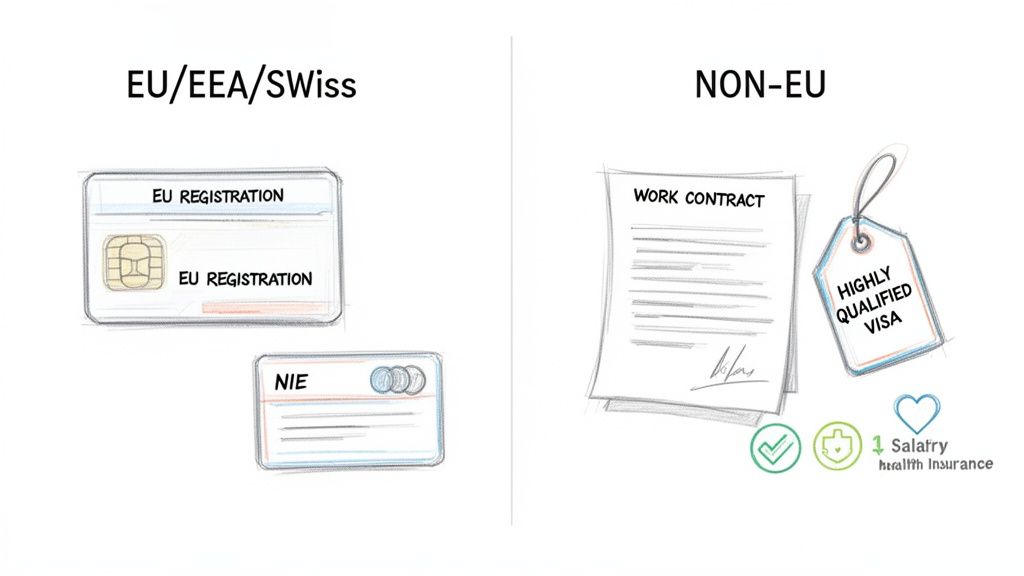
If you hold a passport from an EU/EEA country or Switzerland, things are much simpler. You don’t need a visa to work in Spain. Your main job is to formalise your residency after you arrive.
You’ll need to get your Certificado de Registro de Ciudadano de la Unión. This is a green A4-sized paper (not a card, as many assume) that confirms you’re a resident. To get it, you must prove you have a job offer, or enough money to support yourself, plus private or public health insurance. The application is made at the local Foreigners’ Office (Oficina de Extranjería) or a designated police station.
Navigating Visas as a Non-EU Nurse
For non-EU citizens, the process is more involved and starts well before you pack your bags. You must secure a work visa from a Spanish consulate in your home country. For nurses, this usually means one of two routes: the Highly Qualified Professional Visa or a standard Work Permit.
Highly Qualified Professional Visa
The Highly Qualified Professional (HQP) Visa is often the best option for experienced nurses who already have a specific job offer lined up. It’s designed to attract skilled workers to Spain.
To use this route, the role and salary package have to meet the rules in force at the time of the application. The exact thresholds can change, so they should be checked before filing rather than assumed from older summaries.
Some specialised private-sector roles may fit this route. One of the usual advantages is that the process can be more streamlined than the standard permit, but it only works when the underlying offer genuinely qualifies.
Standard Work Permit (Por Cuenta Ajena)
If your job offer doesn’t hit the HQP salary marks, the standard work permit (autorización de residencia y trabajo por cuenta ajena) is the alternative. This is a more traditional route where your employer must start the process for you in Spain.
In our experience, the main challenge here is proving necessity. The job typically needs to be on Spain’s official shortage list, or the employer has to prove they couldn’t find a suitable EU candidate. This makes it a tougher visa to secure.
For either visa, you’ll need a pile of documents: your employment contract, passport, criminal record checks, a medical certificate, and proof your qualifications are being processed (the homologación receipt). You can see a more detailed breakdown in our guide on the Spanish work permit for employees.
Each visa has different rules for salary, employer input, and processing times. It’s easy to get lost in the details.
Not sure which path fits? Book a consultation and we’ll map out the best option.
Choosing the wrong visa is a common and expensive mistake. We’ve seen nurses with high-paying specialist roles waste months on a standard permit application when they could have used the faster HQP route. On the flip side, applying for an HQP visa with a salary below the threshold is an automatic rejection. We can assess your specific situation and point you toward the most efficient immigration path.
Language and Professional Registration Requirements
Once your degree recognition is in motion and you know which visa you’re getting, two final steps stand between you and legally working as a nurse in Spain. You must prove your Spanish language skills and register with a professional nursing body. Neither is optional.
Proving Your Spanish Language Proficiency
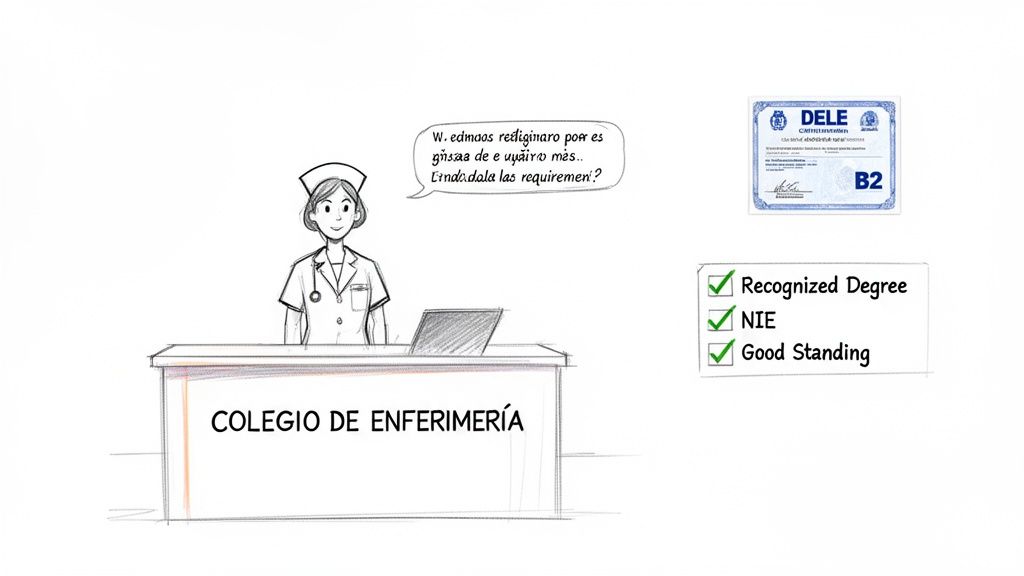
Patient safety depends on clear communication. In practice, many employers and professional bodies expect at least a workable B2-level command of Spanish for clinical work.
A B2 level means you can speak with native speakers without major strain on either side, grasp complex medical texts, and write clear, detailed notes. In a hospital or clinic, this is non-negotiable. It’s the minimum standard to ensure you can understand a patient’s history, read charts correctly, and explain a care plan.
Depending on the employer or the professional body involved, you may be asked to evidence your Spanish with recognised certificates such as:
- DELE (Diploma de Español como Lengua Extranjera): This is the classic, globally recognised diploma from Spain’s Ministry of Education. The certificate never expires.
- SIELE (Servicio Internacional de Evaluación de la Lengua Española): A more modern, computer-based exam that tests all four skills (reading, writing, listening, speaking). It’s valid for five years.
Finding the best way to learn Spanish should be a priority from day one. Start studying while you wait for your degree homologation to come through. Don’t wait.
Registering with a Spanish Nursing Council
With your language certificate and recognised degree, the final administrative hurdle is professional registration. You cannot legally practise as a nurse anywhere in Spain, public or private, without being registered with the Colegio Oficial de Enfermería.
This is where we see people get stuck. Your recognised degree doesn’t let you work; it lets you register. It’s the registration with the Colegio that grants you a licence to practise. Until a Colegio signs off, you are not a nurse in Spain.
Spain is divided into 52 provincial Colegios. You must register in the province where you’ll be working. If your job is in Madrid, you register with the Colegio de Madrid. If you find work in Barcelona, you register there. You can always transfer your registration if you move to another province later.
Each Colegio has slight variations, but they all ask for the same core documents.
Core Documents for Colegio Registration
- Proof of Recognised Degree: The final resolución confirming your homologación or reconocimiento.
- Identification: Your passport and your NIE or TIE card.
- Bank Details: For the direct debit of your annual membership fees.
- Passport-Sized Photos: Usually two for your ID card.
- Certificate of Good Standing: This is key. It’s a formal letter from your home country’s nursing board stating you have a clean record. It must be recent (issued within the last three months), apostilled, and accompanied by a sworn translation into Spanish.
Getting these documents in order is the last piece of the puzzle. It officially connects your immigration status to your professional licence. Once you’re registered, you get a membership number. That number is your licence to work. You’re finally ready.
Finding Nursing Opportunities in the Spanish Job Market
With your paperwork sorted, or at least moving along, it’s time to focus on the real goal: landing a nursing job in Spain. The Spanish healthcare system is split into two very different worlds, public and private. Your job search will look completely different depending on which one you target.
For most foreign nurses we’ve worked with, especially those from outside the EU, the private sector is the only practical way in. It’s your most direct route to getting your feet on the ground.
Public Sector Jobs: The Oposiciones Challenge
Working in the public healthcare system, the Sistema Nacional de Salud, is the dream for many nurses in Spain. It means job security, great benefits, and a stable career. But getting a permanent job there requires passing a brutal civil service exam called the oposiciones.
These exams are notoriously difficult. You’re not just competing on clinical knowledge; you’re tested on Spanish public administration law, all in Spanish. They are only held every few years, and the preparation is intense. While you might find temporary work in the public system, a permanent role is locked behind this exam.
The Private Sector: Your Most Direct Route
From experience, we can tell you that private hospitals and clinics offer a much faster path to a job. Their hiring is more flexible, they’re often recruiting aggressively, and they’re used to dealing with international candidates. This is where the vast majority of foreign nurses find their first role in Spain.
The private sector here is big and well-established. Several major hospital groups operate across the country and are often the ones willing to sponsor a Highly Qualified Professional Visa.
We always advise clients to go straight to the source. Check the careers pages of these major private hospital groups directly:
- Quirónsalud: The largest private group in Spain. They have facilities everywhere.
- HM Hospitales: A huge presence, especially around Madrid, but expanding nationally.
- Vithas: Another key player with hospitals and medical centres in most provinces.
- Sanitas: Well-known for both health insurance and its network of top-tier hospitals in Madrid and Barcelona.
Where Is the Demand for Nurses?
Demand exists across Spain, but the real opportunities vary a lot by region, employer, and specialism. In practice, private hospital groups and care providers are often the most accessible entry point for foreign nurses because their recruitment is more flexible and they are more used to reviewing international profiles.
Realistic Salary Expectations and Contracts
Pay varies materially by region, employer, seniority, shifts, and specialisation. It is better to look at the exact contract than rely on national averages, especially if the offer also needs to support a residence application.
It is also common to start with temporary or probationary arrangements before moving into a more stable position. From an immigration perspective, what matters is that the contract genuinely fits the route being used.
Your First Steps on the Ground in Spain
You’ve landed in Spain with a visa and a job offer. The big hurdles are behind you, but a few administrative tasks still need your immediate attention.
Getting these things done right away isn’t just about ticking boxes. This is the bedrock of your legal residency and your ability to work and get paid in Spain. Based on our experience helping professionals settle in, handling these steps methodically from day one saves a world of bureaucratic pain later on.
First Priority: The TIE Card for Non-EU Nurses
If you’re from outside the EU, your first and most urgent task is getting your Tarjeta de Identidad de Extranjero (TIE). This is your physical foreigner ID card, your proof of legal residency, and the photo ID you’ll use for everything.
You must apply for your TIE within 30 days of arriving in Spain.
The process is straightforward but requires precision. You’ll need to book an appointment (cita previa) online at a police station, fill out the EX-17 form, and pay the fee, which is currently €16.08 (via Modelo 790, code 012). You’ll attend the appointment with your passport, visa, a recent photo, and proof of your address (empadronamiento).
Don’t confuse the TIE with the NIE. The NIE is just a number for tax and admin purposes. The TIE is the physical card that proves you are a legal resident. You can’t work without it.
You won’t get the card on the spot. After submitting your documents and having your fingerprints taken, you’ll have to return in about 30-45 days to collect the finished card. It’s non-negotiable for opening a bank account, signing contracts, and basically living your life here.
Get Your Social Security Number and Register Your Address
Next, you need a Spanish Social Security number (Número de Afiliación a la Seguridad Social). This number is what ties you to Spain’s public system for healthcare, pensions, and other benefits.
Your employer will typically handle this for you once you have your TIE, as it’s essential for drawing up your work contract.
At the same time, you must register your address at the local town hall (ayuntamiento). This is called empadronamiento. It’s a free and simple process. Just bring your passport, your TIE (or the application receipt), and proof of where you live, like a rental agreement. The certificate they give you is vital for many other administrative steps.
We cover the details of these essential numbers in another guide. You can read more about the NIE and other crucial numbers for Spain here.
Understanding the Spanish Tax System
As a working resident, you are also a tax resident. You’ll be required to pay Spanish income tax, known as IRPF (Impuesto sobre la Renta de las Personas Físicas).
IRPF is a progressive tax, so the rate increases with your income. Your employer will automatically withhold a percentage from your monthly salary to cover both your IRPF and social security contributions.
Some newly arrived professionals also ask about the Beckham Law. It can be relevant in the right employment setup, but eligibility is technical and should be reviewed separately rather than assumed.
Navigating this initial paperwork can feel like a full-time job, especially in a new language. We manage these administrative and tax setups for foreign professionals every day, making sure your transition into your new role is as smooth as possible.
Common Questions About Working as a Nurse in Spain
These are the issues foreign nurses most often raise when planning a move to Spain.
How long does the process usually take?
The timeline depends mainly on the title-recognition stage and the immigration route. For non-EU nurses, the full process can stretch significantly if the academic documentation is incomplete or the visa route is chosen too early.
Can I work while I wait for homologación?
That depends on the exact role, the level of recognition already obtained, and the immigration position. Some people explore more auxiliary roles while the full nursing recognition is pending, but this should be reviewed case by case before accepting an offer.
What helps avoid delays?
Good academic records, correct legalisation and sworn translations, a realistic immigration strategy, and early attention to language and colegiación requirements are usually the biggest factors.
Working as a nurse in Spain as a foreign professional is possible, but it requires careful coordination of every stage. If you want to review your case in detail, contact us and we can help you structure it properly.
