


So you’re thinking about moving to Spain from Saudi Arabia. It’s an exciting thought, but the visa process can feel overwhelming. The key is picking the right path from the start. Your entire application hinges on one simple question: where does your money come from?
The answer determines everything. Spain has different residency routes for different financial situations. We see people make the wrong choice all the time, and it leads to denied applications and months of wasted effort. Let’s make sure that doesn’t happen to you.
The Three Main Visa Pathways
Your journey begins by matching your income to the right visa. It’s that simple. There are three main options for long-stay residency, and understanding which one is yours is the first and most important step.
- Non-Lucrative Visa (NLV): This is for people who can support themselves with savings or passive income, like rent or investments. You must prove you have enough money to live in Spain without working.
- Digital Nomad Visa (DNV): Perfect for professionals who work remotely for companies outside of Spain. The main requirement here is showing a stable monthly income from your remote job.
- Work Visa: This is for those who have a job offer from a Spanish company. In this case, your future employer in Spain kicks off the process for you.
This decision tree shows you exactly how your source of income points you to the correct visa.
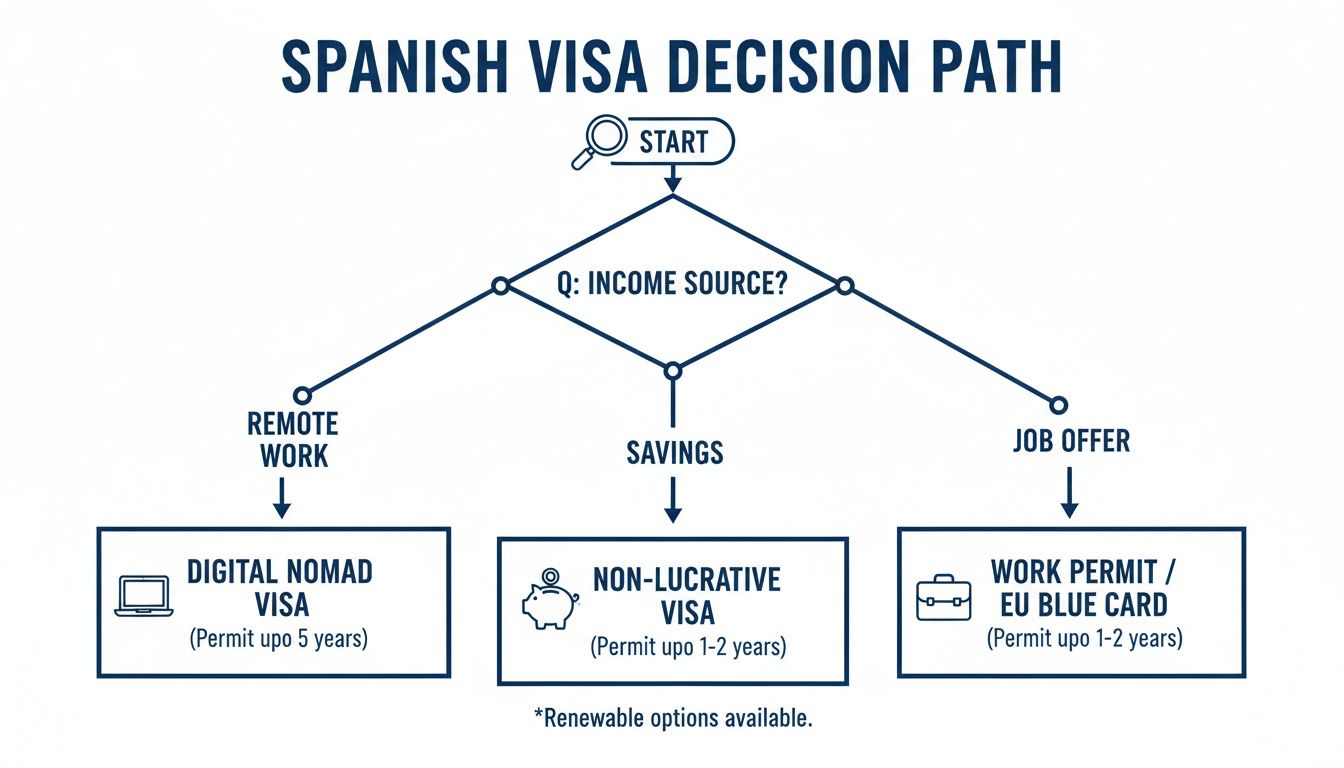
As you can see, the first question is always, “What is my source of income?” Answering this honestly is the single most important factor in your entire visa strategy.
To make it even clearer, here’s a quick side-by-side look at the most common visa options for residents of Saudi Arabia.
Spanish Visa Options from Saudi Arabia at a Glance
| Visa Type | Minimum Financial Requirement (per applicant) | Can you work in Spain? | Best for… |
|---|---|---|---|
| Non-Lucrative Visa | €28,800 per year (from savings/passive income) | No, active work is not permitted. | Retirees, financially independent individuals, or those living off investments. |
| Digital Nomad Visa | €2,763+ per month (from remote work) | Yes, for non-Spanish companies. | Remote workers, freelancers, and online business owners. |
| Work Visa (Highly-Qualified) | Salary-based (e.g., over €40,077 for some roles) | Yes, for the sponsoring Spanish company only. | Professionals and specialists with a job offer in Spain. |
These figures are the starting point for a single applicant and are based on official Spanish metrics like the IPREM and minimum wage. The required amount increases for each dependant you bring with you. Our complete guide on Spanish residency for Saudi citizens gets into more detail on family applications.
In our experience, clients often apply for a Non-Lucrative Visa while planning to work remotely. That’s an immediate rejection. Don’t let a simple misunderstanding derail your plans.
Not sure which path fits? Book a consultation and we’ll map out the best option.
The Digital Nomad Visa for Saudi-Based Remote Workers
If you work remotely from Saudi Arabia for a company outside Spain, this visa was built for you. The Digital Nomad Visa (DNV) is a modern residency path for remote professionals, freelancers, and online business owners. It’s a straightforward route to living and working legally in Spain while keeping your international career.
The core of this visa is proving you have a stable income. The magic number is 200% of Spain’s minimum wage (SMI). Right now, that means you need to show a steady income of more than €2,763 per month. This amount goes up for each family member you plan to bring along.
Key Eligibility Requirements
The Spanish consulate in Riyadh will want to see solid proof that your remote work is legitimate and ongoing. It’s not enough to just say you work online; you have to document it properly.
Here’s what they’ll look for:
- Proof of Remote Work: A work contract or freelance agreements showing you’ve had a professional relationship for at least three months with a company (or clients) located outside of Spain.
- Sufficient Income: Your monthly income needs to be above the €2,763 threshold. You’ll need bank statements, payslips, and contracts to back this up.
- Clean Criminal Record: You must provide a criminal record certificate from Saudi Arabia and any other country where you’ve lived for over six months in the last five years. This document needs to be legalised with the Hague Apostille.
- Private Health Insurance: A policy from a Spanish insurer that gives you full coverage across Spain with no co-payments is non-negotiable. It must cover you for your entire stay.
From our experience, the most common reason for rejection is weak income documentation. Just showing bank transfers isn’t enough. You must connect that money to a real professional activity with contracts and official company paperwork.
Not sure if your remote work setup qualifies? You can quickly review the main requirements with our free Digital Nomad Visa eligibility checker.
The Beckham Law Advantage
One of the biggest draws of the Digital Nomad Visa is its link to a special tax regime known as the Beckham Law. This is a massive financial incentive we help many of our clients secure. It lets you live in Spain but be taxed like a non-resident.
Under the Beckham Law, you pay a flat tax rate of 24% on your Spanish income up to €600,000. Your foreign income—like dividends or capital gains from outside Spain—is typically not taxed by Spain at all.
This is a huge deal compared to Spain’s standard progressive tax rates, which can climb as high as 47%. To get this benefit, you must apply within six months of registering with Spanish Social Security. The deadline is strict, so getting the timing and paperwork perfect is absolutely essential.
Once you have your visa, the next step is the move itself. Putting together an ultimate digital nomad packing list can help make sure your remote work setup is ready to go from day one in Spain.
The DNV grants an initial one-year residency permit. You can then renew it for longer periods, which puts you on a clear path toward permanent residency after five years of living here continuously. It’s a solid foundation for building a real life in Spain.
The Non-Lucrative Visa Path for Financial Independence
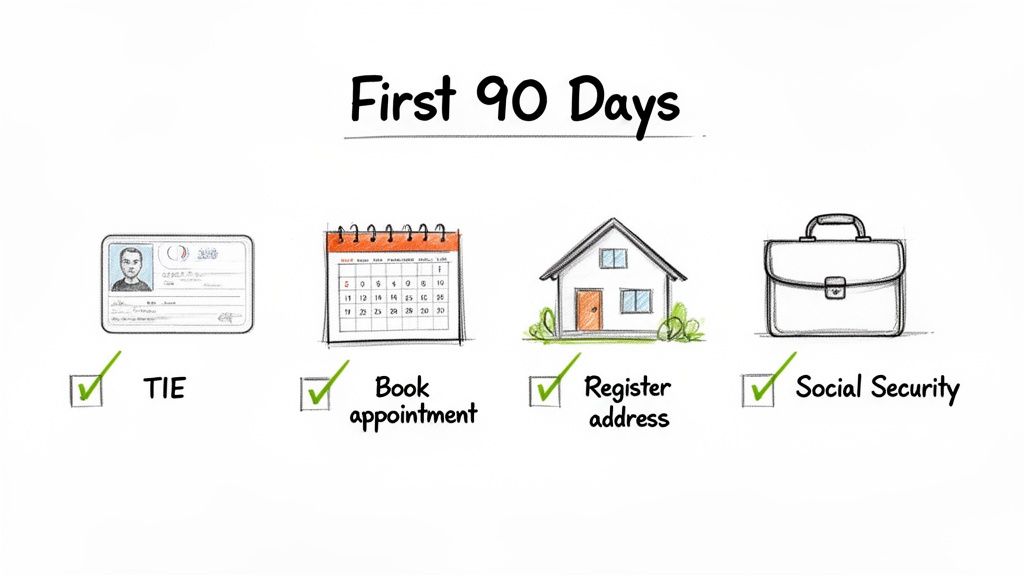
If you have enough savings or passive income to live on and have no plans to work in Spain, the Non-Lucrative Visa (NLV) is your most direct route. This visa was designed for exactly this situation: for retirees, investors, and financially independent families from Saudi Arabia who can support themselves without entering the Spanish job market.
It’s a straightforward path to residency based entirely on your financial stability.
Understanding the Financial Requirements
At its core, the NLV is all about proving you have enough money. The Spanish government uses a benchmark called IPREM (Indicador Público de Renta de Efectos Múltiples), currently around €600 a month, to calculate the requirement.
For the main applicant, you must prove you have 400% of the annual IPREM. That comes to €28,800 for your first year of residency.
Bringing family? The number goes up. You’ll need to add another 100% of the annual IPREM for each dependant, which is €7,200 per person.
Example for a Family of Three:
A family moving from Riyadh with one primary applicant, a spouse, and a child would need to show funds of at least €43,200 to cover their first year. That’s €28,800 for the applicant, plus €7,200 for the spouse and €7,200 for the child.
What Counts as Financial Means?
When you walk into the Spanish Consulate in Riyadh, they won’t be impressed by a single, large last-minute deposit. They need to see a stable financial picture, not just a snapshot.
Acceptable proof usually includes:
- Bank Statements: Official statements from the last 6-12 months showing a consistent, healthy balance.
- Passive Income: Proof of reliable, recurring income from outside Spain. Think rental properties, investment dividends, or pensions.
- Proof of Assets: Certified documents for things like stocks or investment portfolios that can be converted to cash.
A common mistake we see is people relying on a recent inheritance or a large gift without any history. The consulate is trained to spot this. Stability is the name of the game. Our in-depth guide on the Non-Lucrative Visa dives deeper into what documentation works best.
Common Pitfalls and How to Avoid Them
The NLV application is precise, and small mistakes can lead to a quick rejection. One of the most common tripwires is health insurance.
You must buy a private Spanish health insurance policy that gives you full coverage everywhere in Spain for the entire year. It must have no co-payments or deductibles. Your travel insurance from Saudi Arabia won’t cut it.
Another frequent issue is improper document legalisation. Official papers from Saudi Arabia, like your criminal record check, must be certified with a Hague Apostille. Then, they must be translated into Spanish by a sworn translator, known as a traductor jurado. Get this wrong, and your application stops dead.
The visa itself is the first step towards long-term residency. You start with a one-year permit. You can then renew it for two consecutive two-year periods. After five years of continuous living in Spain, you’re eligible for permanent residency, which lets you live and even work here indefinitely.
The NLV is perfect if you have passive income and want a relaxed Spanish lifestyle. But if you plan to do any remote work, even for a non-Spanish company, you need the Digital Nomad Visa instead. The lines are not blurry here.
Securing a Spanish Work Visa as a Skilled Professional
If a company in Spain has offered you a job, you’re on a completely different path. Forget the Digital Nomad or Non-Lucrative visas. This process isn’t led by you; it’s driven entirely by your future employer in Spain.
This is a critical distinction. The responsibility for initiating and navigating the bureaucracy falls on the company, not on you. Your role is to provide the correct documents when they ask.
There are two main ways to get residency through employment when moving from Saudi Arabia: the standard work permit and the far more efficient Highly Qualified Professional (HQP) Visa. Knowing the difference can save you months of frustration.
The Standard Work Permit vs. The HQP Visa
The standard work permit, or autorización de trabajo por cuenta ajena, is a tough route. It forces your employer to prove that no suitable candidate could be found anywhere in Spain or the entire EU. Given the national unemployment situation, this is a massive hurdle. Frankly, it’s often a non-starter.
This is why we almost always steer our clients and their employers toward the Highly Qualified Professional (HQP) Visa. The Spanish government created this route specifically to attract foreign talent, and it completely bypasses that local labour market test. It’s a faster, more direct path to getting you here.
Qualifying for the Highly Qualified Professional Visa
The HQP visa isn’t for just any job; it’s for specific, high-value roles and requires a certain salary. Your position must be either managerial or one that needs specialised technical skills.
To be eligible as a Highly Qualified Professional, the application your employer files must tick these boxes:
- Role Type: The job must be a manager, director, or a technical specialist role that requires a university degree or equivalent professional experience.
- Salary Threshold: Your gross annual salary has to meet a minimum. For technicians and specialists, this is usually over €40,077. For managers, the bar is higher, typically above €54,142.
- Your Credentials: You’ll need to provide your university degree. It must be officially legalised with a Hague Apostille from Saudi Arabia and then translated into Spanish by a sworn translator.
A common mistake we see is the Spanish employer trying to use the standard work permit process out of habit. Many just don’t know the HQP route exists. We often have to step in and educate the company, saving them months of bureaucratic headaches and ensuring their new hire actually makes it to Spain.
Work-related visas are a huge part of Spain’s immigration strategy. In fact, employment is the main reason around 460,000 foreigners have migrated to Spain, making them a key driver of the economy. You can dig into more numbers in a recent report on immigration trends in Spain from Statista.
Once your employer’s application is approved in Spain, you’ll get an official authorisation. With that in hand, you can then finalise your visa at the Spanish Consulate in Riyadh, allowing you to enter Spain and get your residency card.
Not sure if your job offer fits the HQP path? Book a consultation and we’ll map out the best option for you.
Essential Next Steps After Your Visa Approval
Getting that visa stamped in your passport feels like the finish line. It’s not. It’s the starting gun.
Once you land in Spain, a critical 90-day clock starts ticking to formalise your residency. We see clients stumble here all the time, turning what should be an exciting start into a mess of delays and stress.
Think of it this way: your visa is your ticket into the country. These next steps are what actually build your legal life here. Here are your priorities for the first few months after moving to Spain from Saudi Arabia.
Priority One: Your TIE Card
Your absolute first task is getting your Tarjeta de Identidad de Extranjero (TIE). This is your physical foreigner identity card, the document that proves you are a legal resident in Spain. You will need it for almost everything, from opening a bank account to signing a rental contract.
The process is exact. Get the steps in the wrong order, and you’ll be turned away.
- Book an Appointment (Cita Previa): You have to book this online at a designated police station handling immigration. Slots are notoriously scarce, especially in big cities. Start looking the day you arrive. Don’t wait.
- Fill Out Form EX-17: This is the official application form for the TIE. It’s a standard government form, but a single mistake can get your application rejected.
- Pay the Fee (Tasa 790 012): Before your appointment, you must download this form, take it to a bank, and pay the fee. The bank stamps it as paid. You must bring this stamped proof. The fee is currently €16.08.
In our experience, the single biggest reason people are turned away from their TIE appointment is incomplete paperwork. A missing payment receipt, the wrong-sized passport photo, a forgotten copy. We make sure our clients walk in with a perfectly organised folder, so this simply doesn’t happen.
Priority Two: Register Your Address
Right after you’ve secured your TIE appointment, you need to register your address at your local town hall. This is called getting your empadronamiento.
The certificate you get, the Certificado de Empadronamiento, is another cornerstone document. You need it for:
- Finalising your TIE application
- Registering for public healthcare
- Enrolling children in school
- Buying a car in Spain
You’ll need your passport, your visa, and proof of your address (like a rental contract or a utility bill). If you’re staying with friends or family, they might need to sign a form authorising your registration. The process is usually fast, and you often leave with the certificate the same day.
Priority Three: Get Your Social Security Number
If you’re coming on a work visa or as a digital nomad, getting a Spanish Social Security number is non-negotiable. If you have an employer, they might handle this. If you’re self-employed, it’s on you.
This number is the key to Spain’s public healthcare system and allows you to contribute to the pension system. You’ll need your passport, visa, and your TIE appointment confirmation (or the card itself) to apply. This is also a crucial step before you can apply for the Beckham Law tax regime, if that’s part of your plan.
Navigating these steps in a new country is a known headache. The language barrier, unfamiliar bureaucracy, and a chronic shortage of appointments can derail your entire settlement plan. Our firm handles these administrative hurdles for clients across Spain every single day. We manage the entire sequence—booking appointments, ensuring every form is perfect—so you can focus on starting your new life, not on paperwork. If you want it done right the first time, contact us for personalised advice.
Your Complete Relocation Partner
Our firm is built to handle your entire move, from the first question to your first day in Spain. We don’t just point you to a visa; we manage the whole complex process for you.
- Visa Strategy: We analyse your income and goals to pinpoint the most successful visa option.
- Document Preparation: We guide you through getting every single document right, from apostilles in Saudi Arabia to the specific Spanish health insurance policy the consulates look for.
- Application Management: We take over the submission and all the follow-up, ensuring every detail is filed correctly and on schedule.
- Tax Planning: Our tax team works with you from the start, structuring your move to make the most of opportunities like the Beckham Law from day one.
Of course, the visa is just one part of the puzzle. There are dozens of practical details to manage when moving countries. You can find some essential tips for moving abroad to get you started.
We see clients from Saudi Arabia who are perfectly eligible, but their applications fail. Why? Poor documentation or simply choosing the wrong visa from the start. Our job is to eliminate that risk and give you a clear, confident path forward.
Let our team across Spain handle the bureaucracy. You have enough to focus on with the excitement of starting a new life.
Common Questions About Moving to Spain from Saudi Arabia
How Long Does the Visa Application Process Take?
Count on one to three months. That’s the typical timeline from the moment you submit a complete application at the Spanish Consulate in Riyadh until you get a decision.
This timeframe can shift based on the specific visa you’re after and how busy the consulate is at that moment. In our experience, the single biggest cause of delays is paperwork errors. One missing signature, a document that isn’t properly apostilled, or a translation flaw can send you right back to square one. Getting it perfect the first time is the fastest way through.
Can I Bring My Family with Me to Spain?
Yes, absolutely. All the main long-stay residency visas we work with—Digital Nomad, Non-Lucrative, and Highly Qualified Professional—are designed to include your immediate family. It’s a standard part of the process.
This generally covers:
- Your spouse or registered civil partner.
- Your dependent children under 18.
- Dependent adult children or parents, provided you can prove they are financially or medically reliant on you.
You will need to show you can support them. For the Non-Lucrative Visa, for instance, this means adding an extra €7,200 per year for each family member. You’ll also need their personal documents, like birth and marriage certificates, all correctly apostilled and translated into Spanish.
What Are the Initial Tax Implications of Becoming a Resident?
This is a critical point many people miss. Once you spend over 183 days in a calendar year in Spain, you become a Spanish tax resident. That means Spain can tax you on your worldwide income.
But here’s the game-changer. For professionals moving on the Digital Nomad or Highly Qualified Professional visas, Spain offers an incredible tax break called the Beckham Law. We help the majority of our professional clients secure this regime.
Under this law, for your first six years in Spain, you’re taxed like a non-resident. You’ll pay a flat 24% tax rate on income you earn in Spain (up to €600,000), and most of your foreign income isn’t taxed by Spain at all. It’s a massive advantage over the standard progressive rates that climb as high as 47%. The deadline to apply is tight, so this needs to be part of your plan from day one.
Your move to Spain should be an exciting new chapter, not a battle with bureaucracy. Our team manages the entire process—from picking the right visa to setting up your taxes correctly. Schedule your consultation and let’s get you started.
Immigration and relocation cases can vary depending on each person’s circumstances. You may schedule a 45-minute legal consultation with Legal Fournier to review your case and discuss the available options.
Schedule a Consultation
