

Hidden defects in Spanish property: claim deadlines after purchase
A hidden defect in a Spanish property is not just a repair problem. For a foreign buyer, it can become a deadline problem almost immediately. The buyer completes at notary, receives the keys, starts renovation or moves in, and then discovers damp, structural movement, defective installations, sewage smells, roof leaks, illegal works or other issues that were not visible during visits. At that point the question is not only “who should pay?” It is also “which legal clock is already running?”
This article is narrower than our broader guide to critical pitfalls when buying property in Spain. Here we focus on vicios ocultos vivienda, the Spanish hidden-defects route after completion, and the claim deadlines that can decide whether a strong technical case is still legally usable. For pre-purchase risk planning, our Spain property buyer cost and risk calculator can help frame the commercial exposure before legal review.
The practical warning is simple: do not spend the first months after discovering a serious defect only gathering quotes, arguing with the agent, or waiting for the seller to “think about it”. Spanish law has short and separate routes. The correct one depends on the type of property, the defect, the seller, the contract, the date of delivery, the construction timeline, and the evidence available.
Last updated: 18 June 2026 – Based on BOE Civil Code, BOE Building Act, BOE Civil Procedure Act and Registro de la Propiedad sources checked during preparation.
Key takeaways for foreign buyers
- The six-month deadline from delivery applies under Article 1490 of the common Civil Code; Catalan-law sales have a different conformity regime. Check the applicable law and contract date.
- Not every post-purchase defect is a hidden defect. The issue must usually be hidden, pre-existing, serious enough to affect use or price, and not something a buyer in that position should easily have detected.
- New-build and construction defects use a different clock. The Building Act separates one-, three- and ten-year liability periods and a two-year prescription period for actions under that regime.
- Serious breach or aliud pro alio arguments are not a casual extension. They may be relevant in extreme cases, but they require a tailored legal assessment and should not be used as an excuse to let the six-month route expire.
- Evidence must be controlled before repairs. Photos, technical reports, communications, invoices, registry documents and seller disclosures should be preserved before the factual scene changes.
Why the deadline Is the first Legal question
Foreign buyers often approach hidden defects in the wrong order. They first ask whether the seller “should have known”, whether the defect is expensive, or whether the estate agent has some responsibility. Those questions matter, but the first legal triage is the deadline. A claim that would have been viable in month two can become much harder if the buyer waits until month seven to obtain legal advice.
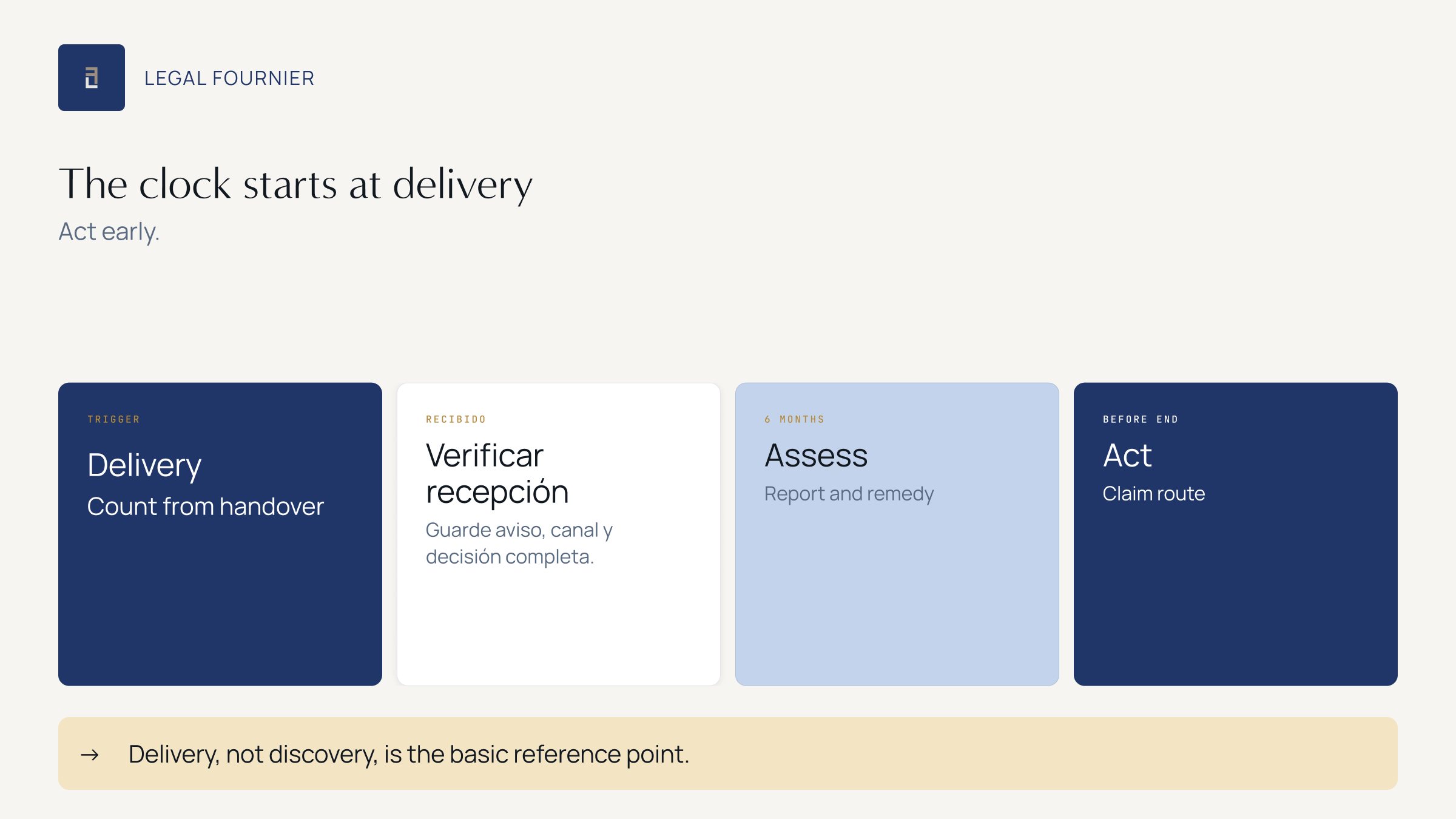
The main reason is Article 1490 of the Spanish Civil Code. It states that the actions arising from the preceding hidden-defects articles expire after six months counted from delivery of the thing sold. In a property purchase, the exact delivery analysis can depend on the file, but buyers should assume that completion, key handover and possession are legally sensitive dates.
This is why speed matters even when the buyer is still investigating. You may need a technical inspection, moisture testing, an architect or engineer report, a review of the deed and pre-contract documents, and a formal notice to the seller. Waiting for informal goodwill can consume the period that would have supported a stronger negotiated or court position.
The hidden-defects strategy is not just proving the defect. It is proving the defect, choosing the right legal route, and acting before the relevant clock weakens the file.
What counts as vicios ocultos vivienda
The Civil Code route for vicios ocultos vivienda is not a general warranty for every disappointment after buying a home. Article 1484 says the seller is liable for hidden defects in the thing sold if they make it unfit for its intended use, or reduce that use so much that the buyer would not have bought it, or would have paid less, had the buyer known. The same article excludes defects that are manifest or visible, and also excludes non-visible defects where the buyer is an expert who, because of their profession or trade, should easily have known them.
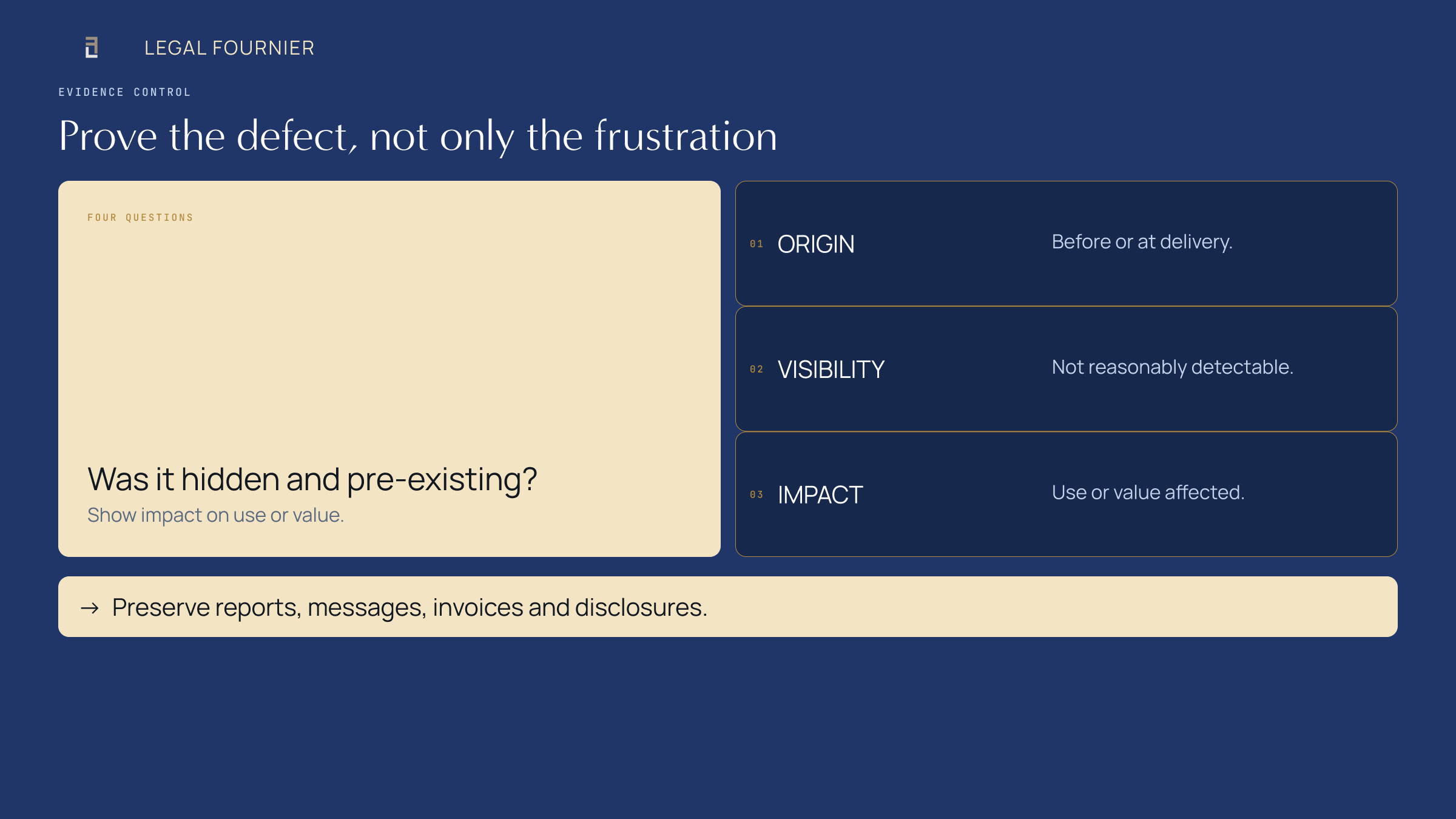
For a residential property, that usually makes four questions central. Was the defect already there when the sale took place? Was it hidden rather than apparent on reasonable inspection? Is it serious enough to affect use or value? And can the buyer prove those points with more than frustration and photographs?
Common examples that may require analysis include persistent damp behind recently painted walls, concealed leaks, defective waterproofing, faulty electrical or plumbing systems, serious sewage smells, roof defects not visible during visits, structural cracking masked by cosmetic work, or installations that cannot perform their normal function. But labels are dangerous. A defect that looks serious to the buyer may be treated as maintenance, wear, a visible issue, a community problem, or a construction-liability issue depending on the evidence.
The defect must usually be pre-existing
The buyer normally needs to show that the relevant cause existed before or at delivery. A leak that starts because the buyer carries out renovation work after completion is a different case from a leak caused by long-standing roof failure concealed by the seller. The timing of discovery is not the same as the timing of origin. Technical evidence should address both.
This distinction is especially important for non-resident buyers who may not occupy the property immediately. If the home remains closed for weeks, if renovation teams enter, or if seasonal rain later reveals damp, the seller may argue that the defect was not present at sale or was not as serious as claimed. The evidence pack should be built to answer that argument.
The defect must usually be hidden
A buyer who saw visible cracks, damp marks, exposed defective wiring, or obvious illegal works before signing may struggle to frame the issue as hidden. The analysis changes if the visible symptom was minor but the true cause was concealed and serious. For example, a small repainting area is not the same as disclosed structural movement; a minor smell during viewing is not the same as a concealed sewage defect. The legal work is in connecting what was visible with what was hidden.
Buyers should also be careful with inspection reports. A pre-purchase report can help show diligence, but it can also create a record of what was noticed. A weak or superficial inspection does not automatically convert visible problems into hidden defects. For substantial purchases, especially villas, rural homes and renovated apartments, technical review before signing is part of the risk strategy.
The six-month civil code clock
The deadline most buyers search for is the Civil Code hidden-defects deadline. Article 1490 is short and strict: the actions under the preceding five articles are extinguished after six months from delivery. That is why “plazo vicios ocultos vivienda” is not a secondary detail. It is often the central issue in the first call with a lawyer.
The six-month period should not be treated as a comfortable negotiation window. Within it, the buyer may need to inspect, obtain a technical report, identify the correct defendant, review seller disclosures and the deed, quantify the claim, decide between rescission or price reduction, and send a formal claim. If court action may be needed, the timing becomes even more sensitive.
A formal notice can be important evidence and may matter for some prescription routes, but buyers should not assume that an extrajudicial claim preserves the short Article 1490 hidden-defect action. A lawyer should confirm whether court action or another procedural step is needed before the six-month period expires.
Delivery is not the same as discovery
A common mistake is assuming that the six months starts when the buyer discovers the defect. Article 1490 refers to delivery of the thing sold, not discovery. There may be legal arguments in unusual cases, and the facts of delivery can be more complex than a single date, but a foreign buyer should not build a strategy on a generous interpretation without advice.
In practice, the lawyer will want the date of the public deed, the date keys were handed over, the date possession was taken, any earlier private-contract handover, the date the defect was first noticed, the date the technical cause was identified, and every message sent to the seller or agent. Those dates are not administrative details. They shape the legal route.
What the buyer can usually ask for
Article 1486 gives the buyer a choice in the hidden-defects route: withdraw from the contract with recovery of paid expenses, or obtain a proportional reduction of the price assessed by experts. If the seller knew the hidden defects and did not disclose them, the buyer may also claim damages if choosing rescission.
This does not mean every case should seek rescission. In many property disputes, a price reduction or repair-value negotiation may be commercially more realistic, especially where the buyer wants to keep the property. In substantial or severe cases, rescission may be strategically relevant, but it raises practical issues around financing, taxes, possession, improvements, and market changes. The legal remedy should match the defect and the client’s objective.
| Scenario | Main deadline issue | Strategic note |
|---|---|---|
| Second-hand home bought from a private seller | Civil Code hidden-defects route may require action within six months from delivery. | Move quickly from discovery to technical report and formal claim. |
| New-build or recent construction defect | Building Act periods may be relevant: one, three or ten years, plus two years for action under that regime. | Identify whether the issue is finishing, habitability, or structural, and who the liable agents may be. |
| Very serious defect making the property essentially unusable | Lawyers may assess breach or aliud pro alio, but this is not automatic. | Do not let the six-month hidden-defect route expire while hoping for a broader claim. |
New-build and construction defects: A different clock
Some buyers use “vicios ocultos” to describe any construction problem, but Spanish law has a specific building-liability regime for certain defects. The Ley 38/1999, de Ordenacion de la Edificacion separates liability periods for different types of material damage in buildings.
Article 17 sets three main periods counted from reception of the works without reservations, or from correction of reservations. Agents involved in the building process can be liable for ten years for defects affecting structural elements and directly compromising mechanical resistance and stability; three years for defects in construction elements or installations that cause breach of habitability requirements; and the builder is liable for one year for execution defects affecting finishing or completion elements. The promotor has a particularly important position because Article 17 also states that, in any case, the promotor is jointly liable with other agents before possible purchasers for material damage caused by construction defects.
Article 18 then adds a separate prescription rule for actions under Article 17: actions for material damage arising from those vices or defects prescribe after two years counted from when the damage occurs, without prejudice to contractual liability actions that may subsist. This creates a two-clock problem. The defect must fit within the relevant one-, three- or ten-year liability period, and the action must be brought within the prescription period once the damage occurs.
For new-build and construction defects, the question is not simply “six months or not?”. The first issue is whether the case belongs under the Building Act, ordinary sale hidden defects, contract breach, consumer law, or a combination of routes.
The libro del edificio matters
Article 7 of the Building Act requires documentation of the completed works, including the reception act, identification of agents involved in the building process, and use and maintenance instructions, to form the Libro del Edificio and be delivered to final users. Article 16 also places obligations on owners to conserve the building and receive, keep and transmit the executed-work documentation and guarantees.
For a buyer with a construction defect, those documents can be more than paperwork. They help identify the promotor, builder, architect, technical architect, reception date, guarantees and maintenance obligations. Without them, it can be harder to decide who should receive the claim and which clock applies.
When a serious defect may be more than vicios ocultos
Some defects are so serious that the buyer is not simply complaining about a repair. The argument may be that the seller delivered something substantially different from what was contracted, or that there is a serious breach of contractual obligations. Spanish lawyers may describe this as an aliud pro alio or serious non-performance analysis in appropriate cases.
The Civil Code gives the general architecture for contract breach. Article 1101 addresses liability for damages where a party acts with fraud, negligence, delay or otherwise contravenes the obligation. Article 1124 allows the injured party in reciprocal obligations to choose performance or termination with damages and interest in both cases, where the other party does not perform. Article 1964 provides a five-year prescription period for personal actions without a special period, counted from when performance can be required, while Article 1969 gives the general rule that prescription runs from when actions could be exercised unless a special rule says otherwise.
But this broader route should be handled with discipline. It is not a way to re-label every missed six-month hidden-defects claim. Courts examine whether the defect is truly incompatible with the contracted object or amounts to serious non-performance, and the evidence burden can be demanding. In a property case, the difference between a hidden defect, construction defect, visible defect, maintenance problem and serious breach can be decisive.
Evidence to preserve before you repair
The buyer’s instinct is often to repair immediately. That can be necessary where there is water entry, electrical risk, health risk or continuing damage. But where possible, the buyer should preserve evidence before changing the scene. Spanish civil procedure places real weight on proof. Article 217 of the Ley de Enjuiciamiento Civil sets the burden-of-proof framework, and Article 336 deals with expert reports prepared by party-appointed experts for litigation.
In practice, a buyer should not rely only on a contractor’s WhatsApp message or a repair quote. The evidence should explain what the defect is, where it is, likely origin, whether it appears pre-existing, why it was hidden or not reasonably detectable, how it affects use or value, and what repair or reduction value is technically justified.
A controlled evidence pack
- Purchase file. Keep the deed, private contract, arras contract, seller declarations, agency materials, property listing, emails, inspection report and all before signing disclosures.
- Delivery chronology. Record deed date, key handover, possession, first occupation by the buyer, first discovery, first technical visit and all seller communications.
- Technical proof. Obtain an architect, technical architect, engineer or relevant specialist report before major repair work where feasible.
- Visual record. Preserve dated photographs, videos, humidity readings, access difficulties, concealed areas opened, and the condition before and after urgent mitigation.
- Registry and building documents. Request or preserve the nota simple, community documents, licences, technical certificates, guarantees and Libro del Edificio where relevant.
- Formal notice. Send a legally controlled communication before the deadline, identifying the defect, evidence, legal basis and requested remedy, while confirming whether the correct action must also be filed or otherwise exercised within the six-month period.
The Registro de la Propiedad explains that an online nota simple has informative value and identifies current registry entries for the property, including the property identification, registered right holders and the nature, extent and limitations of rights. It is not a substitute for a technical report, but it can be important when the defect is connected to legal description, charges, ownership or use limitations.
Seller defences buyers should expect
A hidden-defect claim is rarely answered with immediate agreement. Sellers often argue that the buyer inspected the property, bought it “as seen”, accepted its age, renovated after completion, failed to maintain it, or is exaggerating an ordinary repair. Some of those arguments may fail, but they need to be anticipated.
Article 1485 of the Civil Code states that the seller is liable for hidden defects even if the seller did not know about them. It also recognises that the rule will not apply where the parties have stipulated otherwise and the seller was unaware of the hidden defects. That means exclusion wording and seller knowledge can be central. A generic “as seen” clause is not always the end of the analysis, but it can change the negotiation and litigation risk.
Seller knowledge is especially important where there was concealment: fresh paint over damp, blocked access to affected areas, misleading assurances, previous repair invoices, community complaints, insurance claims, or technical reports not disclosed. If the seller knew and did not disclose the defect, Article 1486 can open damages when the buyer chooses rescission. The evidence must be specific. Suspicion is not the same as proof.
Foreign-buyer risk map
Foreign buyers are often more exposed because the defect is discovered after they have left Spain, transferred funds, arranged rentals, started renovation, or planned a family relocation. That commercial context affects the strategy.
For a buyer who lives abroad, the first step is usually to stabilise evidence through a trusted local team. The lawyer should coordinate the technical expert, review deadlines, preserve communications, and control the first formal claim. If the buyer simply instructs a contractor to repair everything, the seller may later argue that the original condition was not proven, that repair costs were excessive, or that the buyer caused additional damage.
For higher-value homes, the hidden-defects file should also be integrated with tax, insurance, community and financing issues. A major structural defect can affect mortgage obligations, resale, rental licensing, habitability, insurance cover, and the buyer’s wider relocation plan. A damp or sewage problem in a luxury apartment may become a family relocation crisis if children, tenants or guests cannot safely occupy the property.
This is where specialist review changes the outcome. The legal question is not only whether a claim exists. It is which claim creates leverage, how quickly it must be made, whether repair or rescission is commercially preferable, and how to avoid damaging the evidence while protecting the property.
Frequently asked questions
What is the deadline for vicios ocultos vivienda in Spain?
Under the common Civil Code, Article 1490 sets a six-month deadline from delivery for hidden-defect actions; Catalan-law sales follow a different conformity regime, so check the applicable law and contract date. In a property purchase, delivery facts should be reviewed immediately, but buyers should treat the period as urgent from completion and key handover.
Does the six-month deadline start when I discover the defect?
Not under the basic wording of Article 1490, which refers to delivery, not discovery. There may be case-specific arguments, but a buyer should not wait on the assumption that the clock starts only when the defect becomes visible or technically diagnosed.
Can I claim if the seller did not know about the defect?
Possibly. Article 1485 says the seller responds for hidden defects even if unaware. However, the article also recognises the relevance of contractual stipulation where the seller was unaware. The exact deed, private contract and seller conduct need review.
What if the property is a new build?
New-build and construction defects may fall under the Building Act rather than only the ordinary hidden-defects route. Article 17 separates one-year finishing, three-year habitability and ten-year structural periods, counted from reception of works, while Article 18 gives a two-year prescription period for actions under that liability regime from when damage occurs.
Should I repair before making the claim?
If there is urgent risk, mitigation may be necessary. But where possible, preserve evidence first: photos, video, expert inspection, written diagnosis and formal notice. Repairing without proof can make it harder to show the defect’s origin, seriousness and pre-existing nature.
Can I ask for the full purchase to be cancelled?
Sometimes, but not every defect justifies rescission. Article 1486 allows withdrawal from the contract or proportional price reduction in hidden-defect cases, and serious breach analysis may be relevant in exceptional files. The remedy should be chosen after reviewing the defect, evidence, costs, contract and commercial objective.
Conclusion: treat hidden defects as an urgent file
A hidden defect discovered after buying property in Spain is not a matter to handle informally for months. The Civil Code route can be short, the Building Act route has separate clocks, and serious breach arguments require careful legal framing. The buyer who controls evidence and deadlines early is in a materially stronger position than the buyer who waits for voluntary cooperation.
For international buyers, the best response is structured: identify the legal route, preserve the technical proof, calculate the deadline, send a controlled claim, and decide whether the commercial objective is repair contribution, price reduction, damages, rescission or settlement. The strategy should be built before the deadline is in dispute.
MASC and the six-month hidden-defects period
A buyer relying on the Civil Code hidden-defects action must coordinate its six-month period with the pre-action negotiation requirement. A documented MASC request can suspend expiry from receipt or attempted communication. The clock resumes under the statutory rules when there is no response, no first meeting, an unanswered proposal or the end of negotiations.
The separate one-year period after an unsuccessful negotiation concerns the procedural prerequisite. It does not safely extend the shorter six-month period. Plan the technical report, formal demand, proof of delivery and draft claim together.