


If you're planning to work in Spain, you'll need to understand the Salario Mínimo Interprofesional (SMI). It's the legal wage floor. No employer in Spain can legally pay you less than this amount for a full-time job, regardless of the industry.
The government sets and updates the SMI to keep pace with the economy. The current figure in force for 2026 was approved by Royal Decree 126/2026, of February 18, 2026, with effect from January 1, 2026.
That means the current reference is €1,221 gross per month in 14 payments, and this figure comes with a very Spanish twist.
What Is the Minimum Wage in Spain?
The official figure the government announces is based on a pay structure of 14 payments a year. This often catches newcomers by surprise.
Many Spanish employment contracts include two extra salary payments, known as pagas extras, typically paid out in summer and just before Christmas. So, the government sets the minimum wage at €1,221 per month, assuming you get these two bonus paychecks.
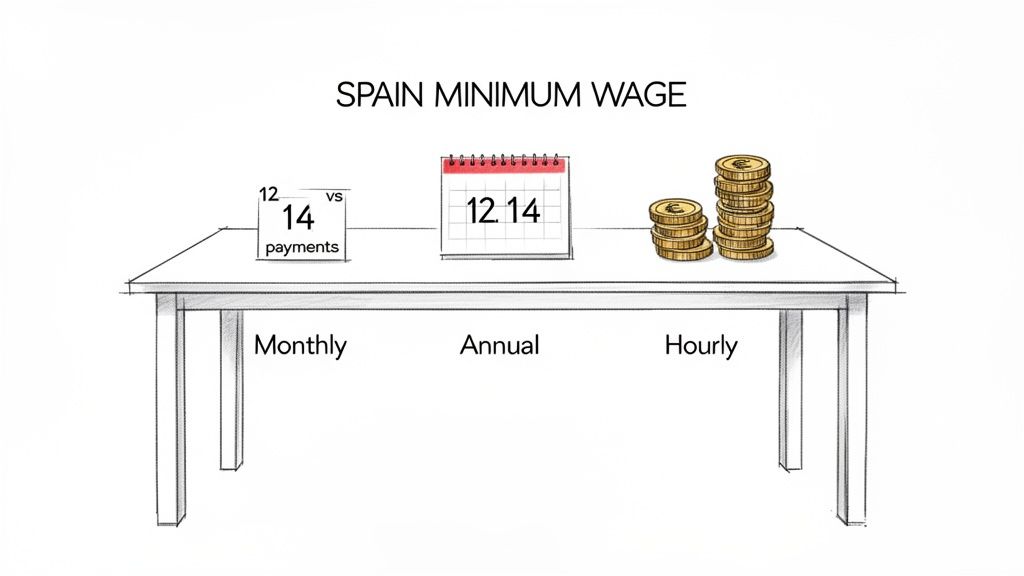
However, some companies "prorate" these extra payments. This means they divide the total annual salary by 12, giving you a slightly higher monthly wage but without the two lump-sum payments.
Either way, the annual total is the same. It's just a different way of distributing your pay.
The Official Numbers: A Clear Breakdown
To clear up any confusion, here are the figures currently in force in Spain for 2026.
Official Minimum Wage (SMI) in Spain (2026 figure in force)
A breakdown of the statutory minimum wage currently being applied in Spain under Royal Decree 126/2026.
| Payment Period | Gross Amount (Full-Time) | Notes |
|---|---|---|
| Annual | €17,094 | This is the annual SMI currently in force. |
| Monthly (14 Payments) | €1,221 | The standard structure used in the 2026 decree. |
| Monthly (12 Payments) | €1,424.50 | Equivalent monthly amount if the extra payments are prorated. |
| Daily rate | €40.70 | Daily SMI for work paid by the day. |
| Temporary-worker daily rate | €57.82 | Reference daily amount for temporary workers whose services do not exceed 120 days. |
The key thing to check in practice is whether your contract pays in 12 instalments or 14.
How Your Minimum Wage Salary Is Calculated
The official Salario Mínimo Interprofesional (SMI) figure is the starting point, not what lands in your bank account. It’s the gross amount before taxes and social security. In our experience, this is one of the biggest points of confusion when clients see their first Spanish payslip, or nómina.
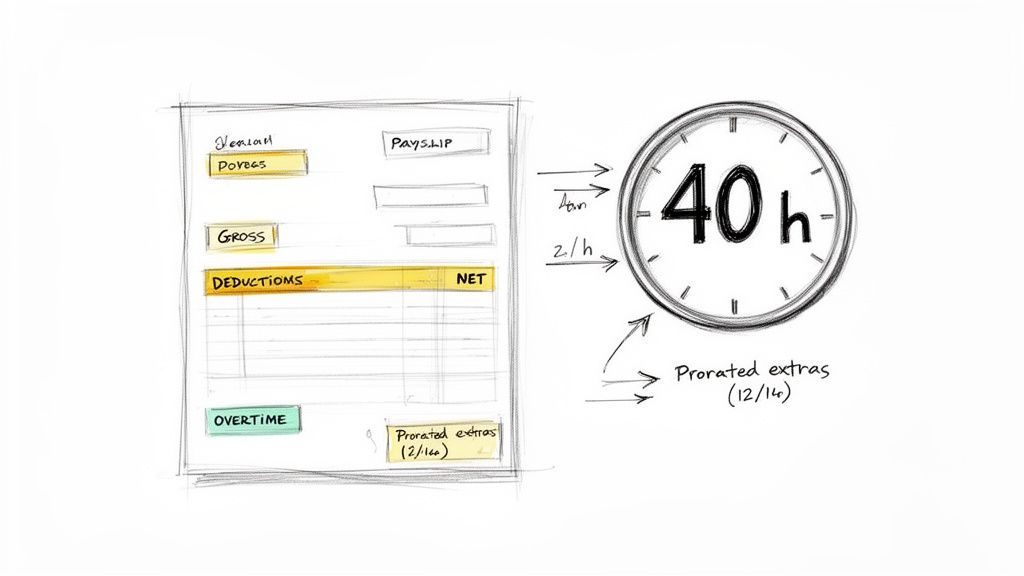
The minimum wage is always based on a standard 40-hour workweek. Anything you work beyond that is overtime and must be paid separately; it’s not part of the base SMI calculation. The same goes for special bonuses or allowances for things like transport unless your specific collective bargaining agreement folds them in.
Gross Salary vs Net Salary
Your employment contract will always state your gross salary (salario bruto). This is the total amount your employer commits to paying you. From there, two main deductions are taken out before you see a cent.
- Social Security Contributions (Seguridad Social): This is your ticket to Spain’s public healthcare, pension system, and unemployment benefits. As an employee, you'll typically contribute around 6.4% of your gross salary.
- Income Tax (IRPF): Your employer withholds this on behalf of the tax agency. It's a progressive tax, meaning the percentage rises with your income. For someone earning the minimum wage, it’s usually quite low, often just 2%.
The final amount you receive is your net salary (salario neto). These deductions are directly tied to your earnings and legal status. You can get a much deeper look into the tax side of things in our guide about Spain tax residency explained.
Part-Time and Prorated Payments
If you work part-time, your minimum wage is calculated proportionally. If you’re on a 20-hour-per-week contract (50% of full-time), your minimum gross salary will be exactly 50% of the full-time SMI.
The idea of pagas extras prorrateadas (prorated extra payments) can be tricky. If your contract says you'll be paid in 12 instalments instead of 14, it doesn't mean you're earning more each month. It just means those two "extra" paychecks have been chopped up and added to your regular monthly salary.
Example Calculation: 12 vs 14 Payments
- With 14 payments: You get €1,221 gross each month, plus two lump-sum payments of €1,221 (usually in summer and winter).
- With 12 payments: You get €1,424.50 gross each month, with no extra lump-sum paydays.
Both lead to the same annual gross salary of €17,094. Always double-check your contract to see which payment structure applies to you.
Who Is Covered by the Minimum Wage?
Need help with your case in Spain?
If this article applies to your situation, contact our team for tailored legal guidance and clear next steps.
One of the questions we hear most from clients is: does the minimum wage in Spain apply to my job?
The answer is simple: yes, it does. The Salario Mínimo Interprofesional (SMI) is a universal floor.
It protects every worker in Spain, no matter their age, gender, or contract type. Whether you're on a permanent (indefinido), temporary (temporal), or seasonal contract, the law guarantees you this minimum salary. This legal floor cuts across every economic sector, from agriculture and hospitality to professional services and tech.
There are no loopholes for employers to exploit based on the type of work you do.
Who Is Covered? A Few Specific Cases
While the rule is universal, some work arrangements can create confusion. Let’s clear up a couple of common scenarios we see in our practice.
- Domestic Employees (Empleados de Hogar): People providing domestic services like cleaning or childcare in a private home are fully protected by the SMI. Their minimum pay is calculated based on the hours they work, using the same annual gross salary of €17,094 as the starting point. If they work part-time, their salary is simply prorated.
- Temporary Agency Workers (Trabajadores de ETT): If a temp agency (Empresa de Trabajo Temporal or ETT) hires you and places you at another company, you are also guaranteed at least the SMI. Your pay should match the collective bargaining agreement of the company where you actually work, but it can never legally dip below the national minimum.
The core principle is straightforward: if you have an employment contract in Spain, you are covered by the minimum wage. It's a non-negotiable legal standard that ensures a basic level of income.
Busting Common Myths
Over the years, we've heard some wild misconceptions about who gets the minimum wage. It's important to be clear on what the law actually says.
The SMI is a legal right for every employee and is not affected by:
- Your nationality or residency status: Whether you're a Spanish citizen, an EU resident, or a non-EU national with a work permit, the law applies to you equally.
- Your age: The SMI applies to all workers of legal working age. Spain doesn't have a lower rate for younger employees.
- Company size: Small startups and huge multinational corporations are all bound by the exact same minimum wage rules.
This universal coverage is a pillar of Spanish labour law. If you're unsure if your salary meets the legal standard or need a professional eye on a work contract, Contact us for personalized advice.
How the SMI Affects Your Immigration and Visa Options
The SMI matters in immigration, but it should not be confused with IPREM. They are different reference figures and they are used for different legal purposes.
SMI vs. IPREM
In broad terms, the SMI is the labour-law minimum salary floor, while IPREM is the reference indicator used in many visa and residency files to measure financial means. A work contract may need to respect the SMI, but a non-lucrative or student-type file is usually checked against IPREM or another specific legal benchmark.
Why the distinction matters
This is where people often get confused. Seeing a salary figure in one immigration route does not mean the same figure applies everywhere else. The correct benchmark depends on the permit you are applying for, the type of work, and the regulations in force at that time.
What Employers and Autónomos Need to Know
If you run a business or work for yourself as an autónomo in Spain, the Salario Mínimo Interprofesional (SMI) isn't just a number in the news. It's a fundamental part of the legal and financial framework you operate in.
For employers, the rules are straightforward. When the government raises the minimum wage, you must adjust your payroll. This isn't optional. We’ve seen companies get into serious trouble for failing to update employment contracts to reflect the new SMI, leading to significant legal penalties.
This responsibility extends beyond just the base salary. Your social security contributions are calculated as a percentage of an employee's gross pay. A higher SMI means a higher gross salary, which directly increases the amount you pay into the system for each worker.
Your Legal Responsibilities as an Employer
Getting payroll right is one of your core legal duties. Here’s what you need to have locked down:
- Contract Updates: Every employment contract must reflect, at a minimum, the current SMI. A common mistake is forgetting to update older contracts when the minimum wage goes up.
- Payslip Accuracy: Your employees' payslips, or nóminas, must clearly detail their gross salary, all deductions, and the final net pay. This entire calculation must start from a legally compliant base wage.
- Social Security Payments: Paying your employer contributions accurately and on time is non-negotiable. Any delays or underpayments can trigger fines from the authorities.
In our experience, being proactive with compliance is far less painful and expensive than reacting to a problem later. It's important to have a process for reviewing and adjusting salaries every time the SMI changes, which has been happening annually.
A Note for Autónomos
One of the most frequent questions we get from freelancers is how Spain's minimum wage applies to them. The short answer is: it doesn't, at least not directly to your own income.
As an autónomo, your monthly social security payment (the cuota) is based on your real income (rendimientos netos), not the SMI. You select a contribution base within a set range that aligns with your actual earnings. This system demands careful financial planning. It's vital to get this right from day one, and our guidance on social security registration can walk you through the process.
That said, the SMI still affects your business indirectly. The moment you consider hiring your first employee, the minimum wage becomes your minimum labour cost. Even if you remain a one-person operation, a rising SMI pushes up wages across the economy, which can impact the rates your own suppliers charge. A good business owner always keeps an eye on it.
If you’re an employer or an autónomo trying to navigate these obligations, Contact us for personalized advice.
Where Spain's Minimum Wage Is Heading
The SMI is politically sensitive and can change with a new decree, so the practical rule is simple: check the figure in force for the year in which the contract or payroll issue arises instead of relying on older headlines.
Common Questions About the Minimum Wage in Spain
Let's wrap up with a few real-world questions we get all the time. These are the practical details that often trip people up.
Can My Employer Pay Me Below the SMI if I Agree to It?
Absolutely not. This is a common and dangerous misconception.
The Salario Mínimo Interprofesional (SMI) is a hard legal floor. Any contract or verbal agreement to work for less is illegal and has zero legal standing. It doesn't matter what you sign or agree to; you are always entitled to the full, official minimum wage for your working hours.
Is Overtime Included in the Minimum Wage?
No, it isn't. The SMI is calculated based on a standard 40-hour workweek.
Any hours you work beyond that are considered overtime. Overtime has to be paid separately, on top of your base salary, at whatever rate is specified in your contract or the collective agreement for your industry.
Your gross monthly salary must meet the SMI threshold before any overtime is added. In our experience, employers who try to bundle overtime into the base salary are often acting unlawfully.
Do I Have to Pay Taxes on a Minimum Wage Salary?
Yes, you do. All employment income in Spain is subject to tax (IRPF) and social security contributions (Seguridad Social).
Even if you’re earning the minimum wage, your employer will withhold a portion for both. The good news is that the IRPF rate for minimum wage earners is very low, often just 2%. But it’s not zero. You aren't exempt.
Does the Minimum Wage Apply to Internships?
This one is tricky. It depends entirely on the type of internship.
If you have a formal training contract (contrato formativo), your salary is determined by the relevant collective agreement and can't be less than the SMI, proportional to the hours you work.
However, if it's a "curricular internship" that's a mandatory part of a university or academic programme, the rules change. Any payment you receive is considered an allowance or a stipend, not a salary. As such, it isn't governed by SMI rules.
Navigating Spanish employment law requires clarity and expert guidance. If you have questions about salary, contracts, or your legal obligations, we're here to help. Schedule your consultation today to get started.
