
Set Up an SL in Spain: A Founder’s Guide
Starting a business in Spain almost always leads to one question: what’s the right legal structure? For most foreign founders we work with, the answer is the Sociedad Limitada (SL), Spain’s version of a limited liability company.
The appeal is straightforward. It walls off your personal assets from your business debts, and with the minimum capital requirement now just €1, it’s more accessible than ever.
Why a Sociedad Limitada Is The Smart Choice For Founders
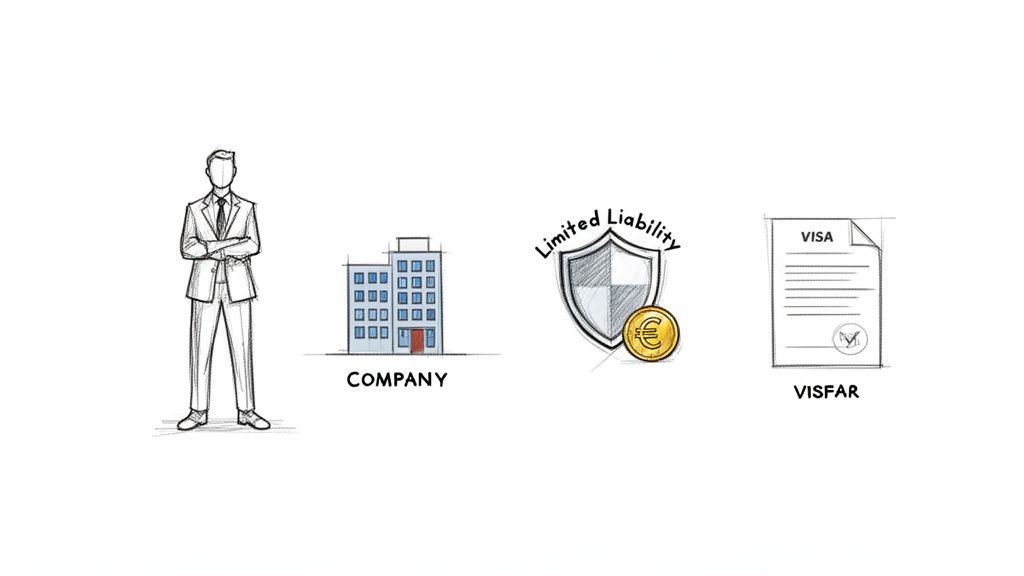
When clients come to us for the constitución de la sociedad limitada, they’re usually after three things: legal protection, professional credibility, and a structure that works for their long-term plans in Spain. The SL delivers.
The biggest win is limited liability. If the business racks up debt or gets sued, your house, car, and personal savings are off-limits. Your financial risk is capped at whatever you invested in the company. This is the single most important difference compared to operating as a sole trader (autónomo), where there’s no legal distinction between you and your business.
A Structure Built For Growth and Well-Planned Projects
An SL is not just a defensive move. It can also be a useful vehicle for organising growth, dividing responsibilities, and presenting a more robust business structure. In some entrepreneurship or self-employment files, a properly formed company and a credible business plan can strengthen the overall case, but it should not be framed as a universal visa or permit requirement: the answer depends on the specific procedure and the substance of the project.
We see this constantly with:
- Professionals and consultants who need a Spanish company structure to hire, subcontract, or work with local clients in a more organised way.
- Freelancers ready to scale up and hire their first employee.
- Founders chasing investment or partnerships. An SL looks far more stable and professional to investors and banks.
In practice, the SL remains the structure many projects choose once they move beyond one-person trading, because it combines asset protection, governance, and a stronger profile in front of banks, partners, and suppliers.
In our experience, over 90% of the foreign entrepreneurs we help set up an SL. It hits the sweet spot: simple enough to manage but with the legal protection and corporate image needed to do business properly in Spain.
SL Company vs Autónomo (Sole Trader): Key Differences
Deciding between an SL and registering as an autónomo is the first major fork in the road for any founder in Spain. To make the right call, you need to understand the trade-offs.
| Feature | Sociedad Limitada (SL) | Autónomo (Sole Trader) |
|---|---|---|
| Liability | Limited to company assets. Your personal wealth is protected. | Unlimited. Your personal assets are at risk for business debts. |
| Taxes | Corporate tax applies at the general 25% rate, while reduced rates only apply in specific cases defined by law. | Progressive personal income tax (IRPF) from 19% to 47%. |
| Setup Cost | Higher. Notary, registry fees, and legal help typically run €1,000-€2,000. | Lower. Can be done for under €100, often for free. |
| Admin Burden | More complex. Requires formal accounting (contabilidad) and annual filings. | Simpler. Quarterly tax filings are more straightforward. |
| Credibility | Higher. Seen as a more serious, stable business by clients and investors. | Lower. Can be perceived as a one-person, less permanent operation. |
| Hiring | Straightforward. The company is the employer. | More complex. You personally are the employer. |
The autónomo route is faster and cheaper to start, no question. But as soon as your revenue grows, that progressive income tax starts to bite, and the lack of liability protection becomes a serious risk.
If your plan involves hiring people, seeking investment, or simply building a brand that's bigger than just you, the SL is the strategic move. It builds a proper foundation from day one.
Not sure which path fits your venture? Contact us for personalised advice, and we'll map out the best option for your business in Spain.
Your Pre-Incorporation Checklist
Before you can officially form your sociedad limitada, there’s some essential groundwork to cover. In our experience, getting these preliminary steps right is the single biggest factor in a smooth and fast incorporation. Almost every delay we see comes from a misstep here.
Think of it as laying the foundation before you build the house. You need Spanish tax identification, normally an NIE, a company name certificate and the appropriate evidence of capital contributions.
Securing Your NIE Number
Foreign directors and shareholders need appropriate Spanish tax identification, normally an NIE; qualifying individuals without one may obtain an NIF M from the Tax Agency. Neither identifier grants residence or work permission.
There are two main ways to get it:
- In Spain: You can apply in person at designated National Police stations. This means navigating the online appointment system which can be a nightmare and submitting form EX-15 with all your supporting documents.
- Abroad: You can also apply through the Spanish consulate in your home country. The process is similar, but the timelines can vary wildly from one consulate to another.
Founders get stuck on the NIE all the time. Appointments are scarce, and the smallest paperwork error can get you sent away. To sidestep this, we often act on our clients' behalf. With a specific power of attorney, we can apply for and collect the NIE for you and your co-founders entirely online across Spain. It saves you a trip and a major bureaucratic headache. You can learn all about getting your Spanish NIE number in our detailed guide.
A common mistake we see is founders waiting until they're in Spain to even think about the NIE. We strongly advise starting this process as early as possible, even from your home country. It has the longest and most unpredictable timeline of all the pre-incorporation steps.
Reserving Your Company Name
Once the NIE is in motion, the next move is to lock down your company's name. You can't just pick one and run with it. The name has to be officially approved and reserved by the Central Mercantile Registry (Registro Mercantil Central). This is done by requesting a Certificado de Denominación Social.
You'll submit a list of five potential company names, ranked in order of preference. The Registry then checks them against every existing company name in Spain to make sure yours is unique.
Here’s some practical advice based on hundreds of applications:
- Be specific. Names like "Global Solutions SL" or "Madrid Consulting SL" are almost guaranteed to be rejected. They’re far too generic.
- Avoid protected terms. Don't use words like "Spain," "National," or anything that suggests an official status.
- Do a quick search first. A simple Google search and a trademark check can save you a lot of time by weeding out obvious conflicts before you even submit your list.
The certificate is valid for three months; the name remains reserved for six months. Renew the certificate after three months while the name remains reserved. The approval usually takes 3-5 working days, but if all your choices are rejected, you have to start over.
Opening the Corporate Bank Account
With your NIE and name certificate in hand, you're ready to open the company's Spanish bank account. This is where you’ll deposit the initial share capital. For an SL, the bank certificate can be replaced by the founders’ declaration of joint and several liability to the company and its creditors for the reality of the cash contributions.
Opening a corporate account as a non-resident founder can be tough. Banks have incredibly strict anti-money laundering protocols. Besides your NIE and the name certificate, they'll almost certainly ask for:
- Your passport
- A business plan or proof of your economic activity
- Tax returns from your home country
The requirements can change from bank to bank, and sometimes even branch to branch. We have long-standing relationships with several major Spanish banks, which helps our clients get through this step with fewer hurdles. We can point you to banks that are more receptive to foreign founders and help you get all the paperwork in order to avoid a rejection.
Once these three foundational pieces are in place, you’re ready for the main event: drafting the bylaws and signing the deed of incorporation.
Not sure how to tackle this checklist? Contact us for personalised advice, and we can manage the entire pre-incorporation process for you.
The Notary's Office: Making Your Company Official
You’ve got your tax identification, capital-contribution evidence or permitted founders’ declaration, and approved company name. Now it’s time for the most formal step in the constitución de la sociedad limitada: signing the Public Deed of Incorporation (Escritura de Constitución) before a Spanish public notary.
This is the moment your company is legally born. The deed is your company’s DNA, a detailed legal document that sets out its purpose, its structure, and the rules it will live by.
Getting the deed right is critical. We see founders spending hours on product and marketing but only minutes on their bylaws, a mistake that often comes back to bite them. The drafting process itself has become easier with modern contract generation tools, but knowing what to put in those clauses is where the real value lies.
Before you can even book the appointment, you need these three things sorted. No exceptions.
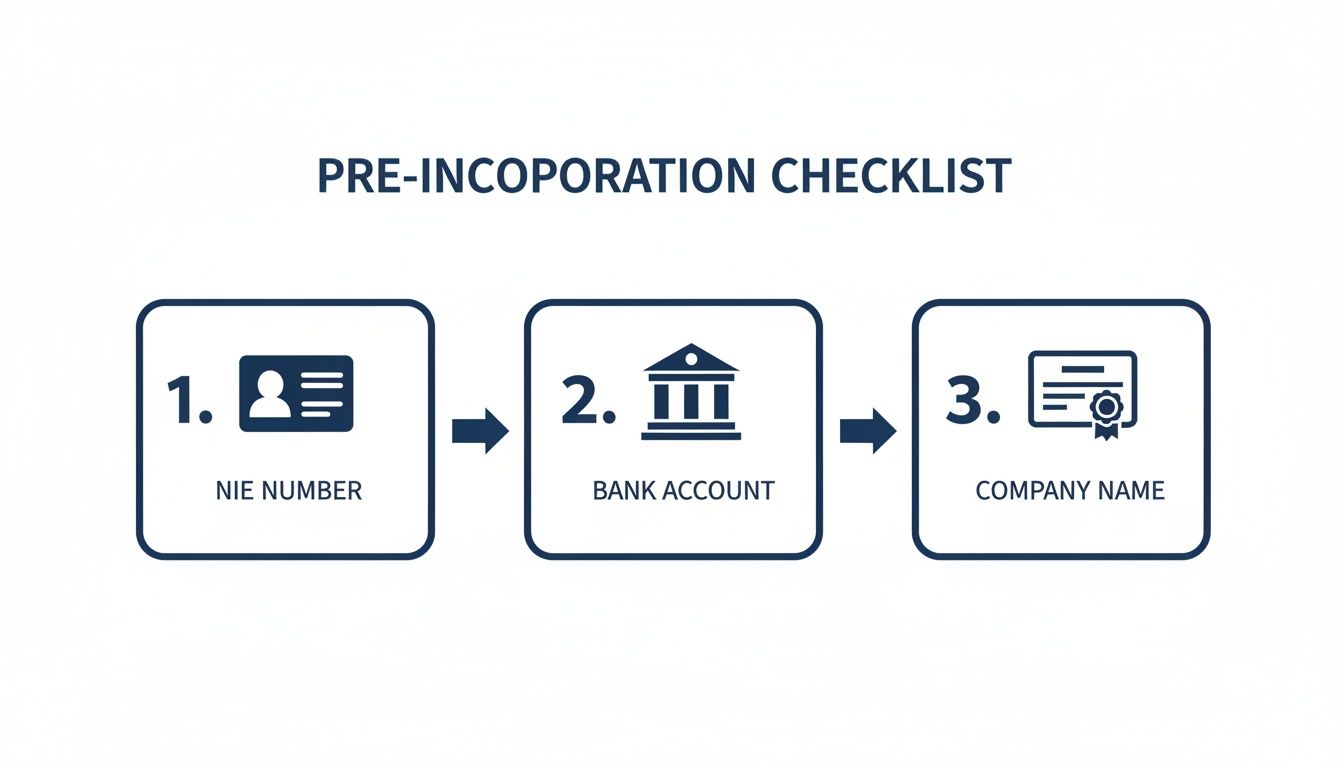
Having these ready to go is the difference between a smooth process and weeks of frustrating delays.
The Bylaws and Corporate Purpose
At the heart of the deed are the company's bylaws, or estatutos sociales. Think of these as the internal rulebook for your SL, covering everything from how shares can be sold to the procedure for calling a shareholder meeting.
One of the most important clauses is the corporate purpose (objeto social). This defines exactly what business activities your company is legally allowed to perform. And here, founders often back themselves into a corner.
A client might register their company for "online sales of handmade jewellery." A few months later, they want to start offering paid workshops or consulting. Legally, they can't. They’re stuck until they go through the costly process of amending the bylaws, which means another trip to the notary and more fees.
We’ve seen this happen too many times. Our approach is to draft a broad objeto social from day one. We’ll include specific activities but also add wider clauses like "the creation, development, and marketing of digital products and services." This gives you the flexibility to expand or pivot later without hitting an administrative wall.
Choosing Your Administrative Body
Another key decision baked into the bylaws is the company's administrative body (órgano de administración). This defines who has the legal power to run the company and sign contracts. For most startups, it boils down to one of three setups:
- Sole Administrator (Administrador Único): A single person has total authority. This is the simplest and most agile structure, perfect for a solo founder. All decisions are yours to make.
- Joint Administrators (Administradores Mancomunados): Two or more administrators who must act together. Every important decision needs all their signatures. It creates a system of checks and balances but can seriously slow down day-to-day operations.
- Solidary Administrators (Administradores Solidarios): Two or more administrators are appointed, but each has the power to act independently on behalf of the company. It’s flexible and fast, but it requires absolute trust. One partner can bind the company to a major contract without the others even knowing.
For solo founders, the Sole Administrator model is a no-brainer. For co-founders with a strong working relationship, Solidary Administrators usually provide the best balance of speed and shared control.
The Notary Appointment: What to Expect
The final step is the signing itself. The notary is a public official whose job is to verify your identities, confirm the bylaws are legal, and witness the signing. They aren't your lawyer; their role is to ensure the process follows Spanish law to the letter.
You’ll need to bring a small folder of documents to the appointment:
- Your original passport and appropriate Spanish tax identification
- The original company name certificate (Certificado de Denominación Social)
- The bank certificate for the cash contribution, or the permitted founders’ liability declaration
During the meeting, the notary reads the entire deed aloud. This is a legal requirement to ensure every founder understands what they’re signing. If you don't speak Spanish, you must have an official translator present.
Once everyone signs, the notary officially registers the act. That's it your company exists. You'll leave the office with a temporary copy of the deed, which you can use immediately to get your provisional tax ID and start operating.
Official Registration and Tax Obligations
You’ve signed the public deed at the notary. Legally, your company now exists. But it can’t do business yet. Think of it like a car that’s been built but still needs licence plates and insurance to hit the road. This next phase is all about getting your SL registered, compliant, and ready to operate.
This part of the constitución de la sociedad limitada is purely administrative, but it’s packed with deadlines and details where things can easily go wrong. We handle this entire sequence for our clients to make sure nothing falls through the cracks.
Making It Public: The Mercantile Registry
First up, the Escritura de Constitución must be registered with the Mercantile Registry (Registro Mercantil) in the province where your company is based. This is a vital step. It makes your company’s existence, its administrators, and its bylaws a matter of public record. It's how clients, suppliers, and banks can verify that your company is legitimate.
The notary often starts this process electronically, but simply sending it off isn't enough. The registry will scrutinise the deed to ensure it complies with every aspect of Spanish corporate law. If they spot any errors and they often do they'll issue a notice (calificación negativa) demanding a correction. That means another trip back to the notary to fix it, causing delays.
The registration process typically takes between 15 and 20 working days. Once completed, your company is officially inscribed and its legal life truly begins.
Getting Right With the Tax and Social Security Agencies
While the Mercantile Registry is doing its work, a parallel process needs to happen with the Spanish Tax Agency (Agencia Tributaria) and Social Security (Tesorería General de la Seguridad Social). These steps are extremely time-sensitive.
You’ll start by activating your company's definitive NIF (tax ID number) and informing the tax authorities of your business activities. This is done by filing a census declaration using Form 036.
This single form registers your company for a few key things:
- Impuesto sobre Actividades Económicas (IAE): This officially declares what your business actually does.
- Impuesto sobre el Valor Añadido (IVA): This registers you for Value Added Tax, which is essential for issuing invoices and reclaiming VAT on your expenses.
Getting this wrong can lead to incorrect tax filings and fines down the road. If you need clarity on your company's fiscal duties, you can learn more about our corporate tax services in Spain.
A common pitfall we see is confusion over international documents. Founders often need personal documents from their home country for the incorporation. To ensure everything is accurate and valid, you may need professional servicios de traducción de documentos legales.
The Most Overlooked Step: Registering the Administrators
This is, without a doubt, the most urgent and most frequently missed step for new founders. Social Security registration depends on actual duties and control; founders actively running the company may need to register under the Régimen Especial de Trabajadores Autónomos (RETA).
Where RETA applies, registration must precede activity and can be requested up to 60 calendar days beforehand.
We see this constantly. A founder may think their job is done at the notary, but any required RETA registration must be completed before activity begins. It's a costly and stressful mistake that is so easy to avoid. We make sure this registration is filed correctly and on time, securing your personal compliance from day one.
Once the deed is registered, and your company is active with the Tax Agency and Social Security, your SL is fully operational. You can now legally issue invoices, hire employees, and get down to business.
Costs, Timelines, and Common Mistakes to Avoid
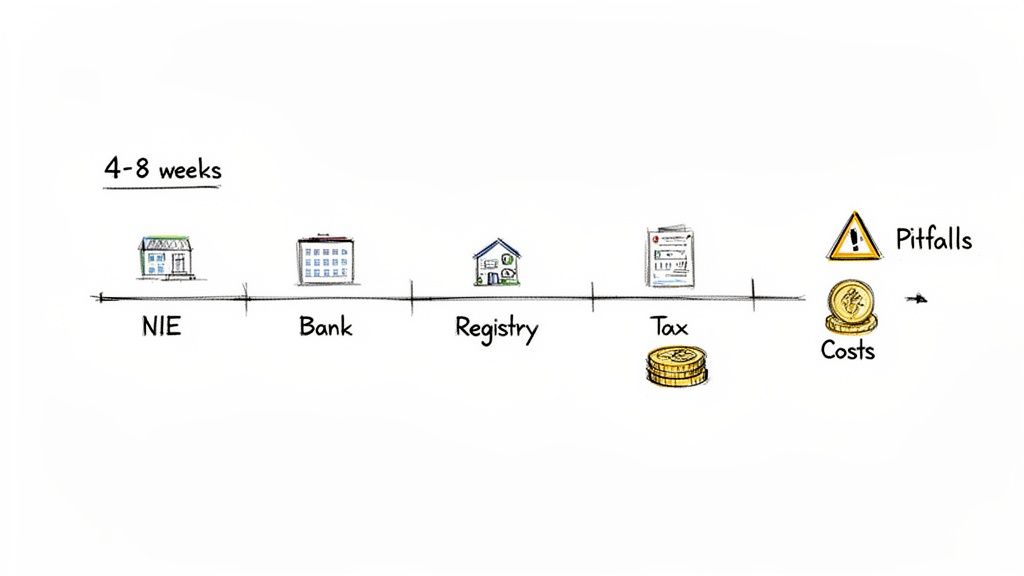
When you're planning to set up your Spanish company, you need a realistic view of the time and money involved. After handling over 300 company formations, we've mapped out exactly what foreign founders should expect.
How Much Does It Really Cost?
Setting up an SL involves several non-negotiable official fees on top of professional services. While each company is unique, here’s a typical cost breakdown to help you budget.
- Company Name Reservation: A small but mandatory fee paid to the Central Mercantile Registry. This is usually around €15–€20.
- Notary Fees: The notary charges for drafting and authorising the public deed. This is a regulated cost that depends on share capital but typically lands between €400 and €800.
- Mercantile Registry Fees: This is the cost to officially register the company deed. It's also regulated and usually falls in the €200 to €400 range.
- Professional Service Fees: This is what you pay a firm like ours to manage the whole process. Our fixed fee for our company formation service covers everything from document prep to navigating the bureaucracy for you, preventing errors that cost you time and money.
All in, a standard SL formation in Spain will cost between €1,500 and €2,500. That includes all official fees and our services. We give you a detailed quote upfront so there are no surprises.
A Realistic Timeline from Start to Finish
Ignore any service promising a 24-hour company. For a foreign founder, that’s not reality. The process involves multiple government bodies, each with its own schedule. A realistic timeframe is 4 to 8 weeks from start to fully operational.
Here’s a typical breakdown of that time:
- NIE & Bank Account (1–3 weeks): This is almost always the longest pole in the tent. Getting an NIE appointment and clearing the bank's due diligence can move slowly.
- Deed Signing & Tax Registration (1 week): Once the prerequisites are done, booking a notary and getting a provisional tax ID happens fast.
- Mercantile Registry Inscription (2–4 weeks): The registry legally has up to 15 working days to review and inscribe your company deed.
Any serious delays usually happen right at the beginning. That’s why getting the NIE and bank account sorted efficiently is our first priority.
Common Pitfalls We See All the Time
We’ve guided hundreds of foreign entrepreneurs through this process. We see the same mistakes trip people up again and again.
Many founders underestimate Spanish bureaucracy. The system is formal and unforgiving of mistakes. One small error on a form or a missing apostille can set you back weeks. We prevent this by making sure every document is perfect before it’s submitted.
Choosing the wrong administrative structure is another common pitfall. For instance, setting up as Joint Administrators (Administradores Mancomunados) seems like a safe way to require consensus, but it can paralyse your business if a co-founder goes silent. We help you choose a structure that actually works for how you plan to operate.
The biggest oversight? Forgetting about ongoing compliance costs. The setup fee is just the start. You’ll face monthly Social Security payments for administrators where applicable (which can be over €300), quarterly tax filings, and annual corporate tax returns. These can easily add up to several thousand euros a year.
Getting the structure right from day one gives the business a much stronger operating base. What matters most is not a headline statistic but whether incorporation, tax setup, governance, and ongoing compliance are aligned with how the company will actually run.
Understanding these costs, timelines, and traps is half the battle. We’re here to handle the other half. Schedule your consultation, and we'll give you a clear roadmap and a personalised quote for your new venture.
Common Questions About Forming a Spanish SL
We’ve walked through the constitución de la sociedad limitada, but the real questions often pop up when you get into the details. Here are the answers to the queries we hear most from founders. These are the practical points that make or break a smooth incorporation.
Can I Set Up My Spanish Company From Abroad?
Yes. In fact, most of the foreign founders we work with start the process from their home country. You don't need to be in Spain. We can handle the entire setup remotely for you.
To make this happen, you grant us a specific Power of Attorney (PoA). We draft the document for you. You’ll sign it either at the nearest Spanish consulate or before a local notary in your country, which then requires an Apostille of The Hague to be valid in Spain. This PoA gives us the authority to act on your behalf.
This includes every step:
- Applying for your Spanish NIE number.
- Signing the Public Deed of Incorporation before the Spanish notary.
- Filing all necessary tax and registry documents in Spain.
This is a standard, efficient method that saves you a trip and a lot of time. We’ll walk you through the PoA process to make sure it’s signed and apostilled correctly from the start.
What's the Real Minimum Share Capital for an SL?
The legal minimum share capital for a Sociedad Limitada is now just €1. This changed from the old €3,000 requirement, making it much easier for startups to get off the ground.
But just because you can start with one euro doesn't mean it's always the best idea. We usually advise clients to put in a bit more, maybe a few hundred euros. This shows a little more solvency to banks and helps cover your initial setup costs.
The cash contribution must be real. For an SL, the founders may replace bank certification with a declaration of joint and several liability to the company and its creditors for that contribution.
What Are My Responsibilities After the Company Is Formed?
Getting your SL registered is just the start. From that moment on, you have ongoing legal and tax obligations. Staying on top of these is non-negotiable if you want to avoid fines and legal trouble.
Your main recurring tasks will be:
- Quarterly Tax Filings: Every three months, you’re responsible for VAT returns (Form 303) and corporate tax withholdings.
- Annual Filings: Once a year, you must file the full corporate tax return (Form 200) and submit the company's annual accounts (cuentas anuales) to the Mercantile Registry.
- Social Security: Registration depends on your actual duties and control. If RETA applies, register before activity begins and budget for the monthly contributions.
These administrative duties are complex and time-consuming. We provide fixed-fee accounting and tax services for foreign-owned SLs, managing all of this for you. You stay compliant while you focus on actually running your business.
Every founder's situation is different. The process of setting up a company in Spain is full of small details that have big consequences. We give you the strategic advice you need to build your business on a solid foundation from day one.
See our company formation service in Spain for help with your project. Tell us the planned activity, shareholders and target start date when requesting a quote.