

Arras contract with mortgage condition in Spain: protect the deposit
An arras contract with a mortgage condition is not a small wording preference. For a foreign buyer in Spain, it can decide whether a bank refusal is a recoverable financing problem or a lost deposit. The risk usually appears after the buyer has already paid the arras, the estate agent is pushing for a notary date, and the bank then refuses the mortgage, reduces the approved amount, or delays final approval because of valuation, income, documentation or registry issues.
This piece is narrower than our broader guide to contrato de arras modelos for foreign buyers in Spain. Here we focus on one edge case: the buyer needs financing, the seller wants a serious deposit, and the parties need a clause that says exactly what happens if the bank says no. For a wider cost and risk view before committing funds, use our Spain property buyer cost and risk calculator as a planning tool, then obtain legal review before signing.
The central point is simple but often missed: Spanish law does not automatically rewrite an arras contract just because the buyer expected mortgage approval. The protection has to be drafted into the contract, connected to objective evidence, and triggered before the contractual deadline expires.
Last updated: 9 June 2026 – Based on BOE, Banco de Espana, Registro de la Propiedad and CENDOJ sources checked during preparation.
Key takeaways for mortgage-dependent buyers
- A bank refusal is not automatic protection. If the arras contract does not make financing an express condition, the seller may argue that the buyer has simply failed to complete.
- Article 1454 is not enough by itself. The Civil Code rule on arras explains the usual withdrawal consequence, but it does not create a mortgage contingency unless the contract says so.
- The condition must be measurable. Amount, percentage, deadline, lender evidence, buyer cooperation and deposit-return mechanics should be stated in the clause.
- Mortgage timing matters. A commercial pre-approval is not the same as a FEIN or final mortgage signing process under Law 5/2019.
- Foreign buyers need a paper trail. The buyer should be able to prove timely application, full document delivery, valuation outcome and written bank refusal or insufficient offer.
Why bank refusal does not automatically save the deposit
Many buyers assume the seller must return the deposit if a bank refuses the mortgage. That is not a safe assumption. The starting point is contractual. Under the Spanish Civil Code, a sale becomes binding once buyer and seller agree on the property and the price, even if neither the property nor the price has yet been delivered. A promise to buy or sell, where there is agreement on property and price, can also give each side rights to demand performance.
Article 1454 of the Civil Code gives the classic rule for arras: where arras or a deposit have been given in a sale contract, the buyer may withdraw by losing them, and the seller may withdraw by returning double. But that rule does not answer the financing question. It says what happens when a party uses the arras exit mechanism. It does not say that the buyer is excused whenever a bank later refuses funding.
The legal problem is not “did the bank say no?”. The legal problem is “did the contract make bank refusal a condition for returning the arras, and did the buyer prove that condition properly?”.
This is why the wording matters more than the heading. A contract titled arras penitenciales can still leave a financing gap if it says nothing about mortgage approval. A clause that says “subject to mortgage” can still be too vague if it does not define the amount, the deadline, the required bank evidence and the consequence for the deposit.
The Legal route is a condition, not a hope
The Civil Code allows parties to establish clauses and conditions, provided they are not contrary to law, morality or public order. It also regulates conditional obligations: rights can depend on the event that constitutes the condition. That is the conceptual basis for a properly drafted condicion suspensiva or financing condition in an arras contract.
But the condition cannot be left entirely to the buyer’s arbitrary will. The Civil Code states that contractual validity and performance cannot be left to one party’s sole discretion, and that a condition depending exclusively on the debtor’s will is problematic. In practice, the clause should depend on an objective third-party event: refusal by a bank, failure to obtain financing for a stated minimum amount, or valuation below a stated threshold, provided the buyer has acted diligently.
CENDOJ case-law summaries also illustrate why this drafting is not academic. In one 2023 Barcelona Provincial Court case listed by CENDOJ, the court considered a clause under which arras would be returned if the bank did not grant mortgage financing within a defined period. The relevant point for planning is not that every buyer will win the same way. It is that courts look closely at the agreed condition, the deadline and the buyer’s conduct.
There is also an important regional caveat for Catalonia. Book VI of the Catalan Civil Code includes a specific rule on third-party financing in property sales. Where the contract foresees financing by a credit institution, the buyer may be able to withdraw if financing is refused, subject to the agreed period, documentary proof, lack of buyer negligence and any contrary pact. That is why a Barcelona or Catalonia file should be reviewed under Catalan civil law as well as the general Civil Code framework.
What a mortgage condition should actually define
A useful mortgage condition is not a sentence copied from an agency template. It is a risk-allocation mechanism. The seller wants certainty that the buyer is serious. The buyer wants protection if financing fails despite a serious application. Both objectives can be compatible if the clause is drafted with precision.
The most dangerous version is short: “the sale is subject to mortgage approval”. That line may help in a negotiation, but it often creates disputes because it does not answer the operational questions. Approval for how much? By which date? From any bank or a specific lender? What if the bank approves less than the buyer needs? What if the property valuation is low? What document proves refusal? What happens to the deposit and when?
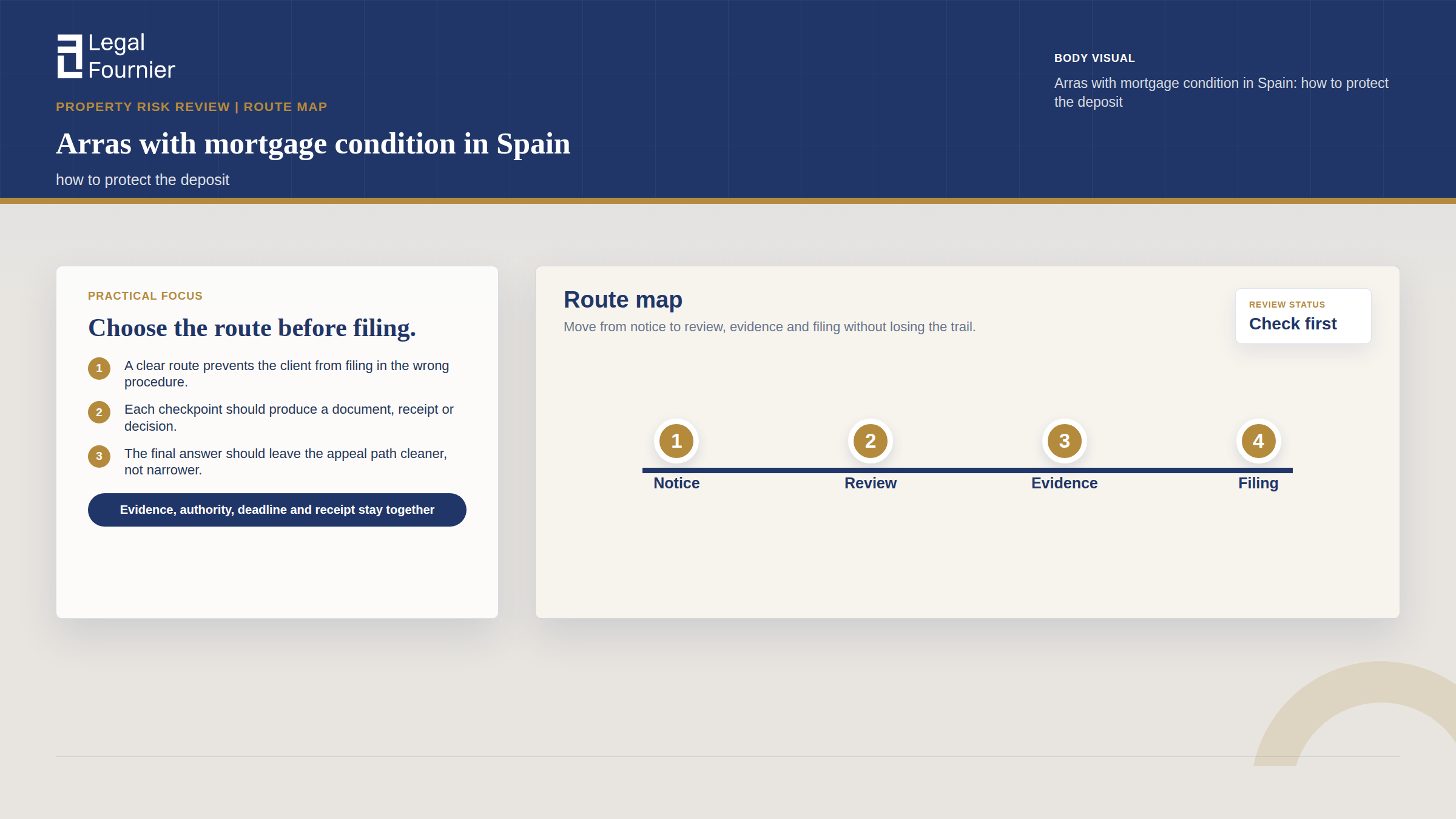
Core points the clause should cover
| Drafting point | Why it matters | Practical wording issue |
|---|---|---|
| Minimum financing amount | A bank may approve a loan but for less than the buyer needs. | Define the minimum principal, percentage of price, or loan-to-value threshold. |
| Deadline for approval | A notary date can arrive before the mortgage process is legally ready. | Set a date for financing evidence and a separate completion date or extension mechanism. |
| Acceptable evidence | The seller may dispute a verbal refusal or broker message. | Require written refusal or written insufficient-offer evidence from the lender or intermediary. |
| Buyer diligence | A condition can be challenged if the buyer created the refusal. | State the buyer must apply promptly and provide requested documents within reasonable deadlines. |
| Valuation risk | A low valuation can reduce the loan even where the buyer is solvent. | Say whether valuation below a stated figure triggers return of the arras. |
| Deposit return mechanics | Even a valid condition can lead to delay if repayment is not operationally clear. | Define who returns the money, to which account, by when, and whether any documented costs are deducted. |
For foreign buyers, two additional points are usually important. First, the clause should address document timing if the buyer needs translations, overseas tax documents, foreign income evidence, or a Spanish NIE. Second, the clause should not allow the seller or agency to treat a bank delay as buyer default when the delay was caused by seller-side documentation or unresolved registry issues.
Mortgage approval in Spain: the timing trap
A buyer often hears “the bank has approved you” before the legal mortgage process is complete. That phrase should be treated carefully. Where the mortgage falls within its scope, especially in natural-person and residential-real-estate contexts, Law 5/2019 on real estate credit contracts requires lenders to evaluate the potential borrower’s solvency before entering into the loan. The law also states that the lender will only make the loan available if the solvency assessment indicates that the obligations are likely to be met.
That matters because a commercial indication, simulation, broker email or preliminary risk approval may not be enough to complete at notary. The lender still has to complete its checks, the property has to be valued, and the mortgage documentation must follow the statutory transparency process.
Solvency, valuation and written refusal
Law 5/2019 requires lenders to evaluate solvency based on relevant factors such as employment, current and foreseeable income, assets, savings, fixed expenses and existing commitments. If the loan application is refused, the lender must inform the potential borrower in writing and without delay, giving a motivated result, and providing additional information where the refusal is based on database consultation.
The same law also requires real estate used as mortgage security to be valued before the loan contract is entered into. A valuation issue can therefore affect financing even where the buyer’s income profile is strong. For an arras clause, that means the condition should not be limited to “personal mortgage approval” if the real risk is also the bank’s valuation of the property.
The Banco de Espana mortgage-access guide is also useful context because it frames mortgage contracting as a process with practical steps before and during the life of the loan. The arras contract should respect that process rather than compress it into an unrealistic completion date.
Why the FEIN stage changes the risk
Under Law 5/2019, the lender must deliver personalised pre-contractual information through the FEIN, and Article 14 states that the FEIN has the character of a binding offer for the lender during the agreed period until signing, with a minimum period of ten calendar days. The borrower must also receive other documentation, including the FiAE warning sheet and the draft loan contract, sufficiently in advance.
The notarial stage is also structured. Article 15 requires the borrower to appear before the chosen notary for before signing advice, and the notary must verify documentary compliance. If the required documentation and timing are not properly accredited, or the borrower does not appear in time, the public mortgage deed cannot be authorised.
A serious arras deadline should leave room for the mortgage process that Spanish law actually requires. A deadline that ignores the FEIN and notarial transparency stage puts the buyer’s deposit under unnecessary pressure.
Evidence to preserve if the bank says no
If financing fails, the buyer’s first move should not be an emotional message to the seller. The buyer needs to activate the contract correctly. That means checking the exact wording, confirming the deadline, and sending the evidence required by the clause through the notice method stated in the arras contract.
The evidence file should show two things: the external financing event occurred, and the buyer acted diligently. The second point is often the one that decides whether the seller can argue that the buyer frustrated the condition.
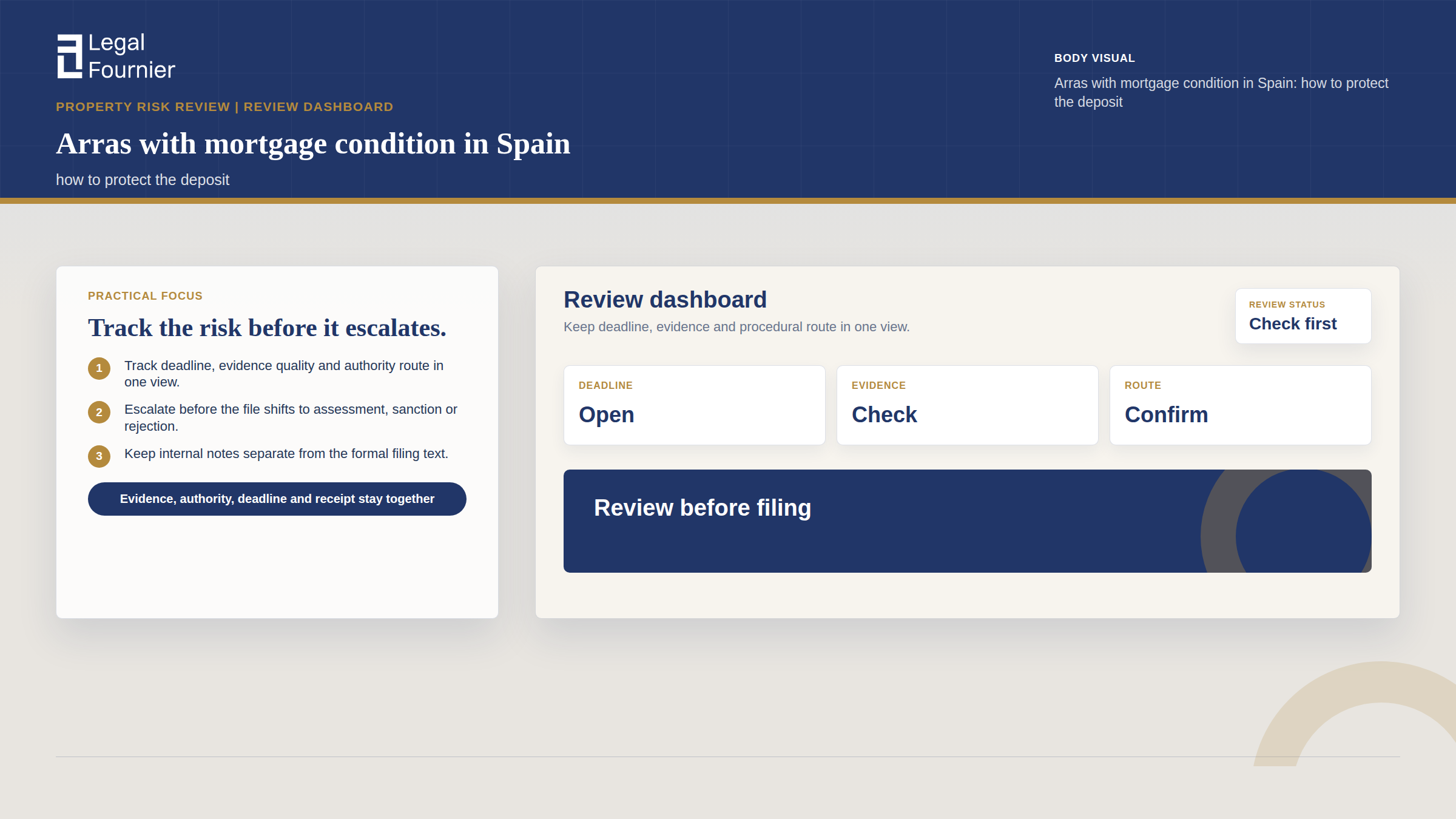
A controlled evidence pack
- Full signed arras contract. Include every annex, amendment, agency email incorporated into the deal, and payment receipt for the deposit.
- Mortgage application timeline. Record when the application was submitted, to whom, and when requested documents were provided.
- Bank or intermediary refusal. Preserve written refusal, insufficient-offer communication, or written evidence that the minimum stated financing was not obtained.
- Valuation report or valuation outcome. If the issue is low valuation, connect it to the clause and the minimum financing amount.
- Seller-side documents. Keep the nota simple, registry information, debt certificates, licences or community documents that the bank requested or queried.
- Notice to seller. Send a formal notice before the contractual deadline, attaching or identifying the required evidence and requesting return of the deposit.
The Registro de la Propiedad explains that a nota simple identifies the property, the registered owner or rights holders, and the nature, extent and limitations of registered rights such as ownership, mortgage or usufruct. It is informative, while certification has public-document evidentiary value. For a financed purchase, this distinction matters because a bank, notary or lawyer may need more than the agency’s informal description of the property.
Where bank refusal is linked to a title defect, unresolved charge, mismatch in property description, missing licence or other seller-side issue, the buyer’s position is different from a simple personal credit refusal. The arras clause should anticipate that distinction. Otherwise the seller may still try to characterise non-completion as a buyer problem.
Red-flag clauses for foreign buyers
Some arras drafts appear neutral but quietly move financing risk onto the buyer. This is especially common when the seller or agency wants a quick signature before the buyer’s bank has finished the process. The buyer should slow down where the contract contains any of the following patterns.
- “The buyer has arranged financing at their own risk.” This can neutralise a later argument that financing was a shared condition.
- “The deposit is non-refundable for any reason.” If the parties intend a financing exception, it must be carved out clearly.
- “Subject to mortgage” without more detail. This sounds protective but may fail to define the triggering event.
- A completion date before realistic FEIN timing. The mortgage process can be legally blocked if the transparency stage is not completed properly.
- Acceptance of the property “as seen” while documents remain pending. This can weaken the buyer’s ability to argue that a bank refusal was caused by legal or registry risk.
- No formal notice route. If the clause does not say how the buyer must notify refusal, the dispute can shift from substance to proof of communication.
Foreign buyers should also be cautious where the agency holds the deposit but the contract does not clearly say when and on whose instruction it must be released. If the seller disputes the condition, the agency may refuse to return funds without agreement or court direction. The release mechanism should be considered before the money is transferred.
Structuring options before you sign
There is no universal mortgage-condition clause that fits every purchase. A cash buyer, a non-resident buyer with foreign income, a founder buying through a Spanish company, and a family relocating with employment income have different evidence issues. The structure should match the risk.
Option 1: full financing condition
This is the strongest buyer-side structure. The arras become refundable if financing for a defined minimum amount is not obtained by a defined date, provided the buyer has applied diligently and supplies the agreed evidence. Sellers may resist it, but it is often reasonable where the buyer is openly mortgage-dependent and the seller wants a meaningful deposit before final bank approval.
Option 2: low initial reservation, larger arras after FEIN
Where the seller wants commitment but the buyer’s bank file is still early, a staged structure can be cleaner. The buyer pays a limited reservation amount while legal and bank checks advance, then pays the larger arras only after sufficient financing evidence exists. This can reduce the litigation value of the early-stage risk.
Option 3: financing condition tied to property defects
If the buyer’s personal solvency is strong but the property may create bank risk, the clause can be focused on title, registry, licence or valuation problems. This is often relevant for rural properties, homes with extensions, inherited property, properties with unresolved charges, or buildings where the registry and physical reality do not align.
Option 4: no financing condition, but longer completion period
Sometimes the commercial deal will not allow a refundable financing condition. In that case, the buyer should understand the risk clearly and may negotiate a longer completion period, a smaller deposit, or a completion date tied to objective mortgage milestones. This is not as protective, but it is better than signing a strict deadline that the bank process is unlikely to meet.
The premium legal work is not adding a magic sentence. It is matching the clause to the buyer’s financing profile, the seller’s documents, the bank’s process and the amount actually at risk.
When Legal review changes the outcome
Legal review matters most before the arras are signed, not after the bank refusal arrives. Once the deposit has been paid under a weak clause, the legal strategy is narrower: reconstruct evidence, interpret the wording, negotiate return, and prepare for a dispute if needed. Before signature, the risk can often be priced, allocated or avoided.
For international clients, our review usually focuses on four linked questions. Is the buyer’s financing need stated realistically? Is the seller’s property documentation sufficient for a bank and notary process? Does the contract preserve the buyer’s deposit if financing fails for objective reasons? And does the completion calendar respect the buyer’s international documentation and the Spanish mortgage transparency process?
The answer may be a financing condition, a delayed arras payment, a narrower property-defect condition, or a decision not to sign until bank risk has matured. The correct choice depends on the file. What should not happen is signing a generic template while assuming the bank’s later decision will be treated fairly.
Frequently asked questions
If the bank says no, do I automatically get my arras deposit back?
No. You usually need an express clause that makes mortgage refusal or insufficient financing a condition for returning the deposit. Without that wording, the seller may argue that you failed to complete and that the arras consequences apply against you.
Is a FEIN enough to protect me?
A FEIN is a stronger stage than a preliminary bank conversation because Law 5/2019 treats it as a binding offer for the lender during the agreed period until signature, with a statutory minimum period. But the arras contract still needs to align its deadlines and conditions with the mortgage process. A FEIN does not automatically repair a weak deposit clause.
What if the bank approves less than I need?
That should be covered expressly. A good clause defines the minimum financing amount or percentage. If the clause only says “mortgage approval”, the seller may argue that any approval, even an insufficient one, means the condition was met.
Can the seller require me to apply to several banks?
Only if the contract says so, or if the parties later agree it. Some sellers negotiate a duty to apply to one or more lenders. If that obligation is included, it should be realistic, measurable and compatible with the buyer’s profile. A vague duty to “try everything” creates avoidable conflict.
What if the low valuation is caused by the property, not by me?
The clause should distinguish personal credit refusal from property-based financing problems. If the valuation, registry status or legal condition of the property prevents the expected financing, the buyer should not be treated the same as a buyer who simply changed their mind. That protection must be written clearly.
Should I sign arras before mortgage approval?
Sometimes that is commercially unavoidable, but it should not be done blindly. Before signing, the buyer should understand the bank stage, valuation timing, seller documentation, completion deadline and exact deposit risk. Where financing is not mature, the contract should use a condition, staged payment, smaller deposit or longer timeline.
Do non-resident buyers need different wording?
Often yes. Non-resident buyers may need foreign income evidence, translations, tax residency documents, overseas funds, NIE timing, powers of attorney, and additional bank compliance checks. A local cash-buyer template rarely reflects those realities.
Conclusion: protect the deposit before the bank decision arrives
A mortgage condition in an arras contract is a planning tool. It should be drafted before the buyer transfers a serious deposit, not reconstructed after the bank says no. The strongest position is created when the contract defines the financing target, evidence, deadline, buyer diligence, valuation risk and deposit-return process in advance.
For foreign buyers, the practical lesson is direct: do not let a property negotiation move faster than the legal and financing evidence. The seller may want certainty. The bank may need time. The contract is where those pressures must be reconciled.
Before filing an arras claim
Since 3 April 2025, most civil and commercial claims require proof of a suitable attempt to resolve the dispute before filing. In an arras case, a precise written demand followed by negotiation between the parties or their lawyers may satisfy this requirement.
The demand should identify the contract, breach, amount and proposed remedy. Its subject must match the later claim, and the sender needs proof of receipt or attempted delivery. If the other side does not meet or answer in writing within 30 calendar days, the negotiation is normally treated as ended.
A properly delivered request can affect limitation or expiry periods, but the calculation depends on the claim and how negotiations end. It is not an informal extension of the completion date, mortgage-condition deadline or contractual notice period.