

AEAT request for foreign accounts or shares: how to answer safely
An AEAT request for foreign bank accounts or shares is rarely just a request for paperwork. For a foreign resident, founder, executive or high-net-worth family, it can be the first visible sign that Hacienda is comparing Spanish tax filings with foreign banking, broker, CRS, FATCA, Modelo 720 or wealth-tax data. The risk is not only whether the account or portfolio should have been declared. The risk is that a rushed answer creates a penalty file that was avoidable.
This piece is narrower than a general guide to a notificacion AEAT. It focuses on the difficult edge case: a requerimiento AEAT cuentas extranjeras file asking about foreign bank accounts, broker statements, shares, investment funds, account balances, dividends, sale proceeds or beneficial ownership. In those files, the answer should be aligned with the taxpayer’s Spanish income tax filing position, any Modelo 720 history, and the evidence trail behind the assets.
The safest approach is not to upload every foreign document and hope the matter closes. The safer approach is to identify the legal category of the request, calculate the deadline, reconcile the facts, and file a response that answers the notice without making unnecessary admissions.
Last updated: 11 June 2026 · Based on AEAT guidance, the Ley General Tributaria, RD 1065/2007 and Modelo 720 official FAQ material checked for this draft.
Key takeaways
- Do not answer generically. A request about accounts is different from a request about shares, dividends, portfolio sales, or beneficial ownership.
- Separate Modelo 720 from income tax. Foreign-asset reporting, IRPF taxation, wealth tax, and proof of origin of funds are connected but not identical legal questions.
- The notice controls the response route. AEAT tells taxpayers to review the notification before choosing the correct online channel, because some procedures require a specific route.
- Penalty risk can be procedural. Silence, incomplete answers or inaccurate responses can create separate exposure under the Ley General Tributaria.
- Evidence should be curated. Bank statements, broker reports and tax certificates should be indexed, translated where needed, reconciled and explained.
Why AEAT asks about foreign accounts or shares
Foreign accounts and portfolios are now visible to tax administrations in ways that many taxpayers underestimate. A Spanish tax file may be triggered by a Modelo 720 declaration, an omitted Modelo 720, CRS or FATCA information received by Spain, a mismatch between declared dividends and broker data, unexplained bank movements, a wealth-tax inconsistency, or a prior IRPF return that does not match the taxpayer’s foreign financial footprint.
Under Article 93 of the Ley 58/2003, General Tributaria, taxpayers and other persons or entities can be required to provide tax-relevant data, reports, background information and supporting documents. For foreign assets specifically, the additional eighteenth provision of the same law requires information on foreign accounts, securities, rights, insurance, annuities, real estate and cryptoassets in the terms set by regulation.
That does not mean every foreign account or shareholding is taxable in Spain in the same way. It means that, when AEAT opens a file, the taxpayer must treat the answer as a formal evidentiary submission. A bank account may show salary, savings, a loan, a capital contribution, a gift, sale proceeds or family support. A broker statement may contain dividends, interest, capital gains, fund switches, withholding tax, custody movements and valuations. Each has a different tax effect.
The strategic question is not only “Do I have the documents?” It is “What story will these documents tell once AEAT reads them against my Spanish filings?”
The foreign-client profiles most exposed
The risk is higher where the taxpayer moved to Spain recently, has a non-Spanish brokerage platform, holds founder shares abroad, receives foreign dividends, has exercised stock options, transferred savings into Spain, uses an overseas family company, or has changed tax residence during the year. It is also common in Beckham Law-adjacent profiles, even though the special regime needs separate analysis and should not be confused with ordinary Spanish tax residence rules.
For wealthy LATAM families and internationally mobile founders, the same bank statement can sit inside several legal conversations at once: tax residence, source of funds, wealth tax, Modelo 720, company distributions, succession planning, and future property purchases in Spain. A reply that solves only the first visible question may create problems in the others.
First step: identify the procedure before you reply
AEAT’s own guidance on answering notices says to review the content of the requerimiento before using the response route, because the notice may direct the taxpayer to “Aportar documentacion complementaria” or to a specific model or procedure. The same guidance explains the CSV-based access route, attachment upload, explanatory field and registration receipt for online submissions.
That matters because a request about foreign accounts or shares may appear inside different files. It may be a simple request for documents, a comprobacion limitada, a verification of informative returns, a proposed liquidation, a sanction proposal, or an appealable act. The required answer changes with the procedural stage.
What to extract from the notice
- Procedure type. Look for comprobacion limitada, verification, informative-return review, sanction, collection, appeal or another stated procedure.
- Tax period and model. A request for IRPF 2024, Modelo 720 2023, wealth tax, Modelo 721 or company tax will not be answered in the same way.
- Requested data. Separate bank balances, average balances, account opening dates, account closures, share valuations, dividends, sale transactions and proof of source of funds.
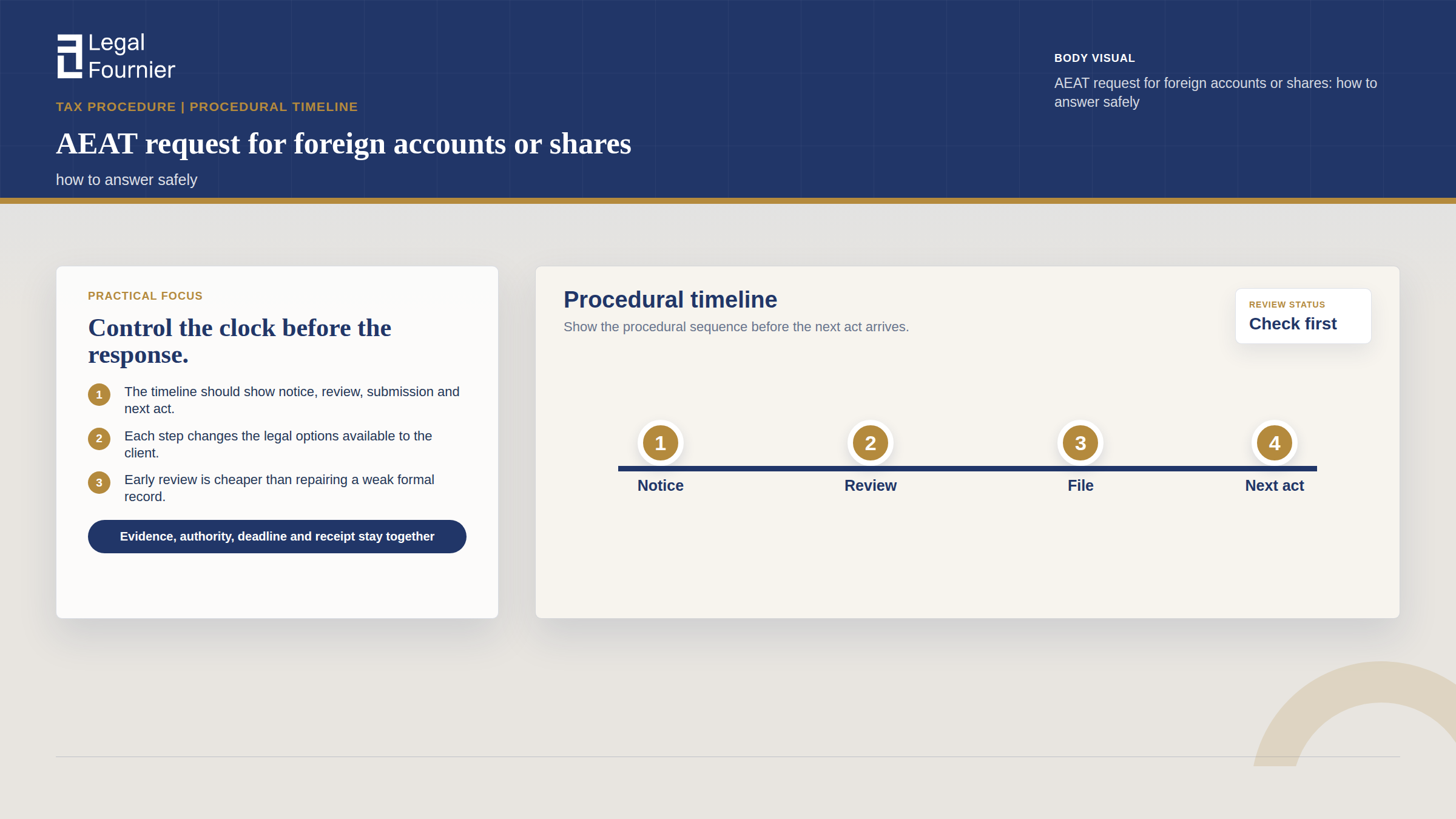
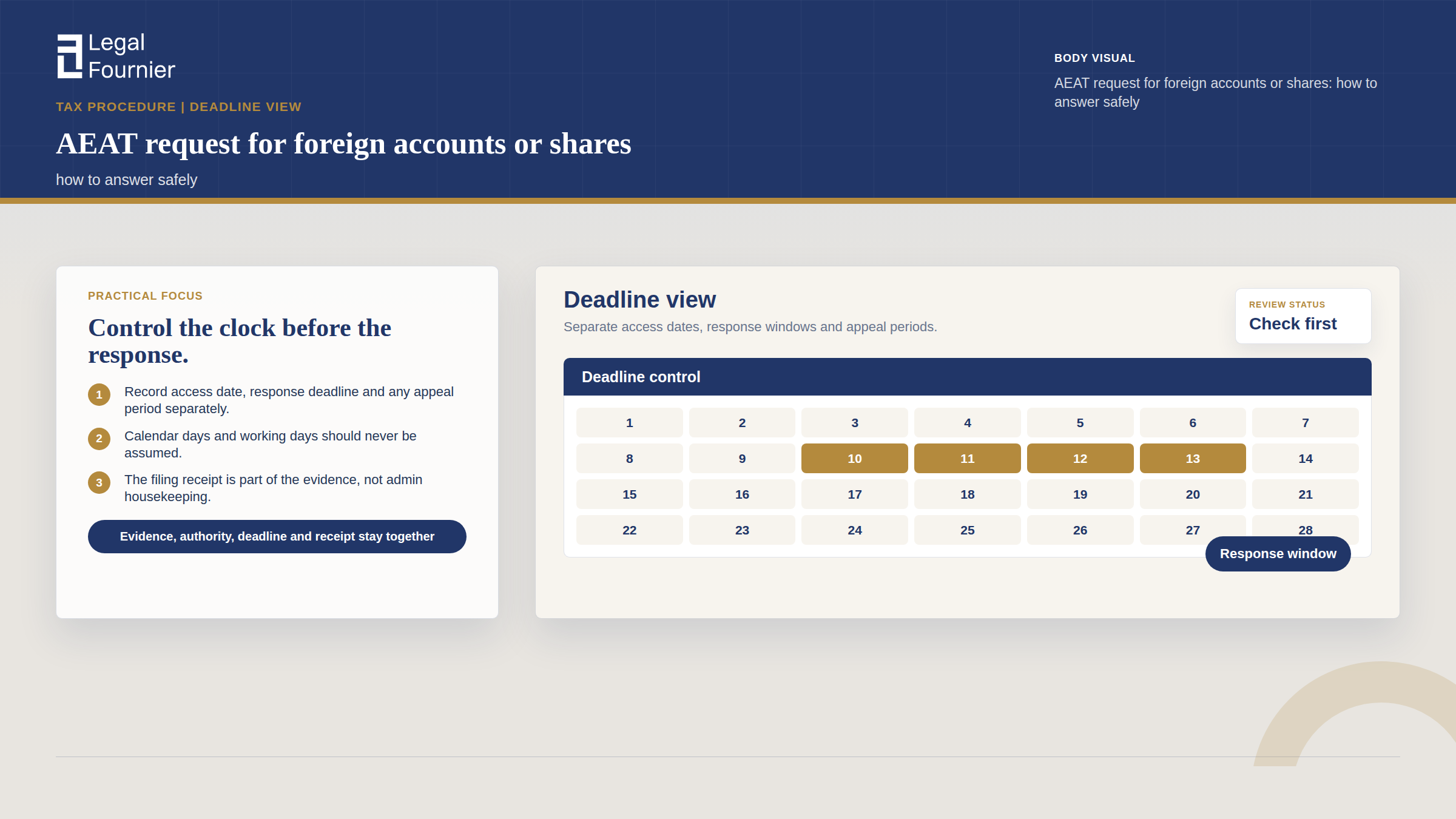
- Response deadline. Use the deadline stated in the notice and calculate it from the legally effective notification date, not from an email alert.
- Consequence of non-response. Check whether AEAT says it may issue a provisional assessment, deny a claim, continue with the data it holds, or start or continue a sanction file.
For electronic notifications, Article 43 of Law 39/2015 treats electronic service as made when the taxpayer or authorised representative accesses the content. Where electronic notification is mandatory or expressly chosen, the notification can be treated as rejected after ten calendar days from being made available without access. That ten-day access rule is not a universal answer period for every AEAT request. The notice itself must still be read.
Foreign bank accounts: what the evidence pack should prove
For foreign bank accounts, the answer must usually do more than show that the account exists. Article 42 bis of RD 1065/2007 regulates the reporting of accounts in foreign financial institutions for Modelo 720 purposes. It refers to accounts where the taxpayer is holder, representative, authorised person, beneficiary, person with powers of disposal, or beneficial owner, and it requires identifying information, opening or cancellation dates and relevant balances. For Modelo 720, it also contains the EUR 50,000 block threshold and the subsequent-year filing rule tied to an increase of more than EUR 20,000, subject to the exact facts and exceptions.
A request may therefore be focused on the account’s reporting status, but the same records may also show income, transfers, gifts, loans or unexplained wealth. Treating the account only as a balance problem can be dangerous.
Documents that often matter
| Document | Why it matters |
|---|---|
| Account certificate | Confirms the account number, bank, jurisdiction, holder, authorised persons and opening or closure date. |
| Year-end and Q4 balance proof | Supports the Modelo 720 balance analysis and any EUR conversion explanation. |
| Movement statements | Explains inflows and outflows that AEAT may compare with IRPF, wealth tax or source of funds data. |
| Source documents | Contracts, payslips, sale deeds, loan agreements, inheritance documents or dividend vouchers show why money arrived. |
| Foreign tax certificate | May support foreign withholding or treaty analysis, but it does not by itself solve Spanish reporting duties. |
AEAT’s Modelo 720 valuation FAQ confirms that, for accounts in foreign currency, the relevant balances are converted using the exchange rate in force on 31 December for the year concerned, and the same date is used for the last-quarter average balance. If the account ceased during the year and a declaration obligation exists, the FAQ refers to the exchange rate on the date the ownership ceased. This is the type of detail that should be documented, not improvised in the response box.
Foreign shares and broker accounts: different data, different risk
Foreign shares are often handled badly because taxpayers download a broker statement and assume it is self-explanatory. It rarely is. Article 42 ter of RD 1065/2007 covers values, rights, insurance and annuities deposited, managed or obtained abroad. For shares, participations, debt instruments, collective investment schemes and other securities, it requires identifying information and values at the relevant date. If ownership ended during the year in cases covered by the rule, the date of extinction can become relevant.
For a foreign brokerage account, AEAT may need to understand at least four distinct layers: the reporting of the asset, the taxation of income, the taxation of disposals, and the origin of the capital used to acquire the position. A single annual broker PDF may not separate those layers clearly enough for a Spanish file.
What needs reconciliation before filing
- Holdings at 31 December. Confirm the number and class of shares, fund units or rights held, and the valuation method used.
- Dividends and interest. Reconcile gross income, foreign withholding tax and Spanish reporting in IRPF or company tax, as applicable.
- Sales and exchanges. Identify acquisition dates, acquisition values, sale dates, sale values, fees and currency conversions.
- Corporate actions. Stock splits, mergers, spin-offs, return of capital and broker migrations should be explained rather than left as unexplained balance changes.
- Beneficial ownership. If an offshore company, trust, foundation, nominee or family vehicle appears, the answer needs legal review before any statement is made.
AEAT’s Modelo 720 valuation FAQ refers to Wealth Tax rules for valuing many securities and notes specific treatment for listed shares, non-listed participations and debt instruments. In practice, the response should state the source of the value used and attach the supporting market, balance-sheet or broker evidence. A portfolio valuation with no explanation can leave AEAT to choose a less favourable interpretation.
Do not send broker data as a pile of screenshots. Send a map: what the instrument is, where it was held, what value was used, what income arose, and how that income was treated in Spain.
Modelo 720 Is not the whole case
Modelo 720 is an informative declaration, not the tax return that charges income tax. The AEAT procedure page states that Modelo 720 articulates three information obligations contained in Articles 42 bis, 42 ter and 54 bis of RD 1065/2007. The official FAQ also explains that each of the three blocks is a separate information obligation, even though they are filed through one model: foreign accounts, foreign securities/rights/insurance/annuities, and foreign real estate.
That distinction is critical. A taxpayer may have correctly declared the asset in Modelo 720 but omitted dividends in IRPF. Another taxpayer may have declared foreign income correctly but failed to file a Modelo 720 for an account that crossed the relevant threshold. Another may have no Modelo 720 obligation because the relevant threshold or exemption was not met, but still need to explain a transfer or capital gain. These are not the same defence.
The four files to align
| File | Question to answer |
|---|---|
| Modelo 720 | Was there an obligation to report the account or securities, and was the reported data complete and accurate? |
| IRPF or company tax | Were dividends, interest, gains, losses or foreign withholding taxes correctly reflected? |
| Wealth tax / solidarity tax | Should the foreign assets affect Spanish net-wealth reporting for the relevant year? |
| Source of funds | Can the taxpayer prove the asset or transfer is consistent with declared income, pre-Spain savings, inheritance, loan or sale proceeds? |
Foreigners often focus only on the first row because Modelo 720 is the visible foreign-asset form. AEAT may be looking at the other three rows. A response that says “the account was declared” may be inadequate if the notice asks why the account received EUR 300,000 or why the broker reported dividends that do not appear in the Spanish return.
Penalty exposure: what the answer must avoid
There are several penalty paths that can appear in these files. The most obvious is the underlying tax adjustment if income, gains or wealth were omitted. But foreign-account and share requests also create formal and procedural exposure.
Articles 198 and 199 LGT deal with failures to file certain declarations on time and with incomplete, inaccurate or false declarations or responses to individualised information requests, where there is no economic loss to the Treasury in the terms of those provisions. Article 203 LGT separately treats resistance, obstruction, excuse or refusal to tax-administration actions as an infringement, including not attending a duly notified request.
For Modelo 720, the official AEAT sanctions FAQ states that Law 5/2022 modified the legal regime after the Court of Justice of the European Union judgment of 27 January 2022 in case C-788/19, and that the general regime in Articles 198 and 199 LGT applies to the informative declaration. This is why generic online memories of the old Modelo 720 sanction regime can be misleading. The current file still needs legal analysis, but it should be analysed under the current framework.
Risky wording versus safer framing
| Avoid | Safer approach |
|---|---|
| “I forgot to declare everything.” | Identify precisely which account, security, income item or period is affected, and whether the omission is admitted, disputed or still being reviewed. |
| “These are just savings from abroad.” | Attach evidence of source: employment records, sale deed, inheritance documents, loan agreement, prior tax returns or bank history. |
| “My broker report proves it.” | Explain what each broker line represents and reconcile income, disposals, values and withholding taxes with Spanish filings. |
| “I was non-resident.” | Support tax residence with day-count evidence, centre-of-interests analysis, certificates, treaty position and consistency with Spanish records. |
| Uploading documents with no index. | File a numbered document index and a concise explanation linking every attachment to the requested item. |
A practical response framework
A premium response is controlled, not long for the sake of length. It should help the AEAT officer understand the file while preserving the taxpayer’s legal position.
1. build a response matrix
Create a table with the exact request in one column, the document that answers it in the second, the explanation in the third, and any caveat or unavailable evidence in the fourth. If the request asks for “bank accounts abroad”, do not attach a portfolio statement and assume it answers the question. If it asks for “values, rights, insurance and annuities”, do not answer only with cash balances.
2. reconcile before filing
Reconcile the documents against prior Spanish returns, Modelo 720 filings, foreign tax certificates, bank transfers into Spain and any pending correction. If a discrepancy exists, decide whether it is a factual misunderstanding, a reporting error, a tax position to defend, or a matter requiring regularisation. These are different legal conclusions.
3. explain foreign evidence problems early
Foreign banks and brokers often issue statements in formats that do not match Spanish expectations. They may report by fiscal year, calendar year, trade date, settlement date, base currency, local currency or consolidated household account. If the document is incomplete or delayed, the response should explain the problem and show what has been requested from the third party. Silence can look like non-cooperation.
4. preserve proof of filing
AEAT’s online response guidance states that, after a successful filing, the system shows a registration receipt. Download it. Keep the receipt with the final PDF, attachment index and timestamped evidence pack. If the case later moves into a provisional assessment, sanction proposal or appeal, proof of what was filed and when becomes part of the defence.
When specialist counsel changes the outcome
Some AEAT requests can be answered administratively. Foreign-asset requests are different when the numbers are material, the evidence crosses jurisdictions, the taxpayer recently moved to Spain, a family company or trust appears, a prior Modelo 720 may be missing, or AEAT has already mentioned penalties. In those cases, the answer is a litigation-risk document, not an administrative upload.
Legal counsel is particularly important where the response may need to argue tax residence, treaty treatment, Beckham Law effects, beneficial ownership, prescription, absence of culpability, proportionality, or whether a foreign institution’s report has been misunderstood. These arguments are difficult to add cleanly after a broad, informal admission has already been filed.
If the file already includes a proposed assessment or sanction, the matter may also need an appeal strategy. In that situation, do not wait until the final act arrives before preparing the record. The facts and documents submitted now may determine what can be argued later.
Frequently asked questions
Should I answer an AEAT request about foreign bank accounts myself?
Only if the request is simple, the documents are complete, the Spanish tax treatment is clear, and no penalty language appears in the file. If the account is substantial, linked to foreign income, connected to a move to Spain, or inconsistent with prior Spanish filings, a self-managed response can create avoidable risk.
Does a foreign bank account automatically require Modelo 720?
No. Modelo 720 depends on the specific reporting block, thresholds, exemptions, ownership status and timing. For accounts, RD 1065/2007 refers to the aggregate EUR 50,000 threshold for relevant balances and later filing where the relevant block increases by more than EUR 20,000, but the facts needs to be checked before concluding that no filing was required.
If I declared the account in Modelo 720, can AEAT still ask questions?
Yes. Modelo 720 is an informative declaration. AEAT may still ask about income, gains, withholding tax, wealth tax, source of funds, account ownership, valuation or inconsistencies between the declaration and other information received by the administration.
What if the broker statement is in english or another language?
Foreign-language documents can be useful, but the response should make them easy to understand. Depending on the file, a translated summary, document index or selected translation may be needed. The goal is to prevent AEAT from misreading the data or treating unexplained entries as omissions.
Will answering late always create a penalty?
Not automatically. The effect depends on the notice, the procedure, the delay and the taxpayer’s conduct. However, the Ley General Tributaria does create formal and procedural penalty risks for non-response, incomplete or inaccurate responses, and resistance or obstruction. Late filing should therefore be handled as a legal issue, not merely as a technical upload problem.