

Eviction warranty in Spain: title problems after buying property
For foreign buyers, the most expensive property risk in Spain is often not the tax bill, the notary appointment, or the mortgage approval. It is the later discovery that the seller did not give you the title you believed you had bought. A third party appears with an older right, a court claim challenges the seller’s title, an undisclosed easement limits the property, or the Registry position is not as clean as the purchase file made it look.
This is where the Spanish concept of saneamiento por evicción matters. It is not a general complaint that the home was disappointing. It is a legal warranty problem: the buyer is deprived of all or part of the purchased property because of a right that existed before the purchase and is recognised through the proper legal route. If you are still before completion, start with a structured property risk review such as Legal Fournier’s Spain property buyer cost and risk calculator. If you are already comparing general acquisition risks, our guide to pitfalls of buying property in Spain gives the wider context.
This article is narrower. It is for the buyer who has already completed, or is about to complete on a file where a title problem is beginning to surface, and needs to understand when saneamiento por evicción is the correct legal frame, what evidence matters, and when the issue should be escalated before it becomes a full dispute.
Last updated: 16 June 2026
- Saneamiento por evicción is triggered by loss of all or part of the thing bought through a final judgment based on a right that pre-dated the purchase.
- The seller’s warranty exists even if the contract is silent, although clauses can sometimes modify the risk allocation.
- A title scare, a difficult neighbour, or a bad nota simple is not automatically evicción. The legal category depends on the documents and procedural stage.
- Registry protection can be powerful for a good-faith buyer who acquires for value and registers, but it is not a substitute for pre-completion due diligence.
- If a claim is filed against you, seller notification and procedural strategy should be handled immediately; timing can affect the later warranty claim.
What evicción means in A Spanish property purchase
The Spanish Civil Code regulates the seller’s warranty obligations in a sale. Article 1474 states that, under the warranty referred to in Article 1461, the seller is responsible to the buyer for legal and peaceful possession of the thing sold and for hidden defects. The first part is the title-and-possession risk. The second part is the physical or functional defect risk.
Article 1475 then gives the core definition of evicción: it occurs when the buyer is deprived, by final judgment and by virtue of a right prior to the purchase, of all or part of the thing bought. The same article says the seller responds for evicción even if nothing was written in the contract, although the parties may increase, reduce, or suppress that legal obligation, subject to limits such as bad faith.
In plain English, the question is not simply “did something go wrong after buying?” The question is whether the buyer loses the property, or a relevant part of the property, because someone else’s older legal right defeats the buyer’s acquisition. That is why saneamiento por evicción sits at the intersection of purchase contracts, Registry law, litigation strategy, and seller solvency.
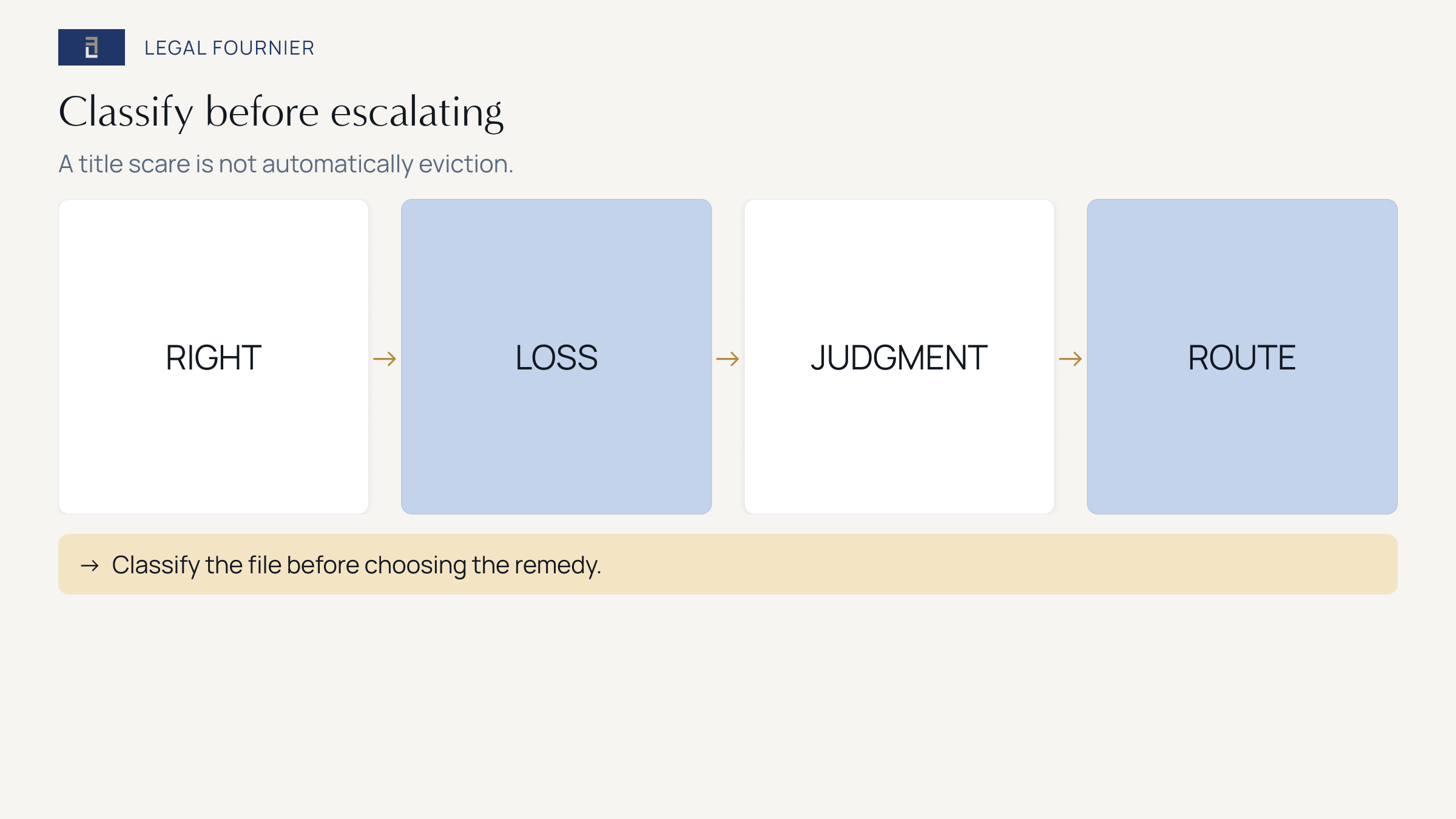
The practical legal insight: evicción is usually not the first letter you send. It is the end-stage warranty frame if the title challenge matures into a loss recognised by judgment. Before that, the buyer’s strategy is usually about preserving rights, notifying the seller, protecting the Registry position, and deciding whether settlement, rectification, or litigation gives the best commercial result.
For a foreign buyer, this distinction matters because the commercial damage can be wider than the legal label. A disputed title can block resale, disturb bank financing, interfere with rental plans, alarm family-office reporting, or make a relocation plan impossible. The legal remedy may come later, but the commercial triage begins as soon as the title concern appears.
Common situations that are often confused
Many buyers use saneamiento por evicción as a shorthand for any unpleasant after completion title issue. That is understandable, but it can lead to the wrong legal route. The first task is to classify the problem.
| Problem discovered | Likely legal frame | Why it matters |
|---|---|---|
| An heir, former owner, or claimant says the seller’s title was defective. | Potential evicción or Registry rectification issue. | The file turns on title chain, registration, good faith, and whether a court claim can affect your registered right. |
| The property was sold twice or a prior buyer claims priority. | Civil Code priority and Registry analysis. | For immovable property, registration can be decisive, but facts and good faith still matter. |
| An undisclosed easement, charge, or non-apparent burden appears after the deed. | Often Article 1483 hidden charge or servitude analysis, not classic eviction. | Remedies and deadlines may be different from full title loss. |
| The home has serious physical defects or unreported technical problems. | Vicios ocultos or contractual liability. | This is usually a defects claim, not eviction, even if the economic impact is severe. |
| Cadastre and Registry descriptions do not match. | Registry-Cadastre coordination, boundary, or description issue. | It can become serious, but the solution may be technical rectification rather than seller warranty litigation. |
The distinction is not academic. It affects whom you notify, what you ask for, whether you preserve a claim against the seller, whether the Registry can protect you, and whether the case should be settled before a full loss occurs.
Why the registry helps, but does not replace due diligence
The Spanish Registro de la Propiedad is central to title security. The Ministry of Justice explains that the Property Registry records acts, contracts, and judicial or administrative decisions affecting ownership and other real rights over immovable property. It also describes Registry principles such as priority, legality, successive chain of title, and publicity.
For buyers, the Registry has several important effects. The Ministry guidance notes that registered real rights are presumed to exist and belong to the registered holder in the manner stated by the entry. It also explains that unregistered titles generally do not prejudice third parties and that a good-faith purchaser for value who acquires from someone who appears in the Registry with authority to transfer can be maintained in the acquisition once the buyer registers, even if the transferor’s right is later invalidated for reasons not shown in the Registry.
This reflects the logic of the Mortgage Law. Article 34 protects the good-faith third-party purchaser who acquires for value from a person who appears in the Registry with power to transfer and then registers the right. Article 32 states that unregistered titles of ownership or other real rights over immovable property do not prejudice third parties. Article 38 establishes the presumption that registered real rights exist and belong to their registered holder as recorded.
That said, Registry protection is not a magic shield. Article 33 of the Mortgage Law states that registration does not validate acts or contracts that are null under the law. Article 40 deals with rectification of Registry inaccuracies and, depending on the cause, may require the relevant holder’s consent or a court decision. A buyer’s position therefore depends on the exact defect, the timing, whether the buyer acted in good faith, what was visible in the Registry, and whether the buyer registered promptly.
A nota simple is useful, but it is not the same as a full legal opinion. The Ministry of Justice explains that Registry publicity can be obtained through a nota simple informativa or certification, and that the nota simple is purely informative while certifications attest to the Registry entries and have public-document status. For a substantial purchase, a lawyer should read the note, the deed, the chain of title, charges, pending entries, easements, community position, urban planning risks, and any seller declarations together.
What the buyer may claim against the seller
If evicción actually occurs, the Civil Code gives the buyer a warranty claim against the seller. Article 1478 provides that, where warranty has been agreed or nothing has been agreed on the point, the buyer may demand items such as restitution of the value of the thing at the time of eviction, fruits or returns if the buyer had to deliver them to the successful claimant, litigation costs in the eviction case and the warranty case, contract expenses paid by the buyer, and damages in a bad-faith sale.
Article 1479 also matters in partial loss cases. If the buyer loses a part of the thing sold that is so important relative to the whole that the buyer would not have bought without it, the buyer may seek rescission of the contract, returning the property with only the burdens it had when acquired. This can be relevant where the lost part is commercially central: access, buildable land, an essential annex, a right of use, or a portion that makes the investment viable.
However, Article 1480 states that warranty for eviction cannot be demanded until a final judgment has condemned the buyer to the loss of the thing acquired or part of it. This is why early letters should be careful. A buyer may need to reserve rights, notify the seller, request cooperation, and protect evidence, while recognising that the full eviction warranty claim may not yet be ripe.
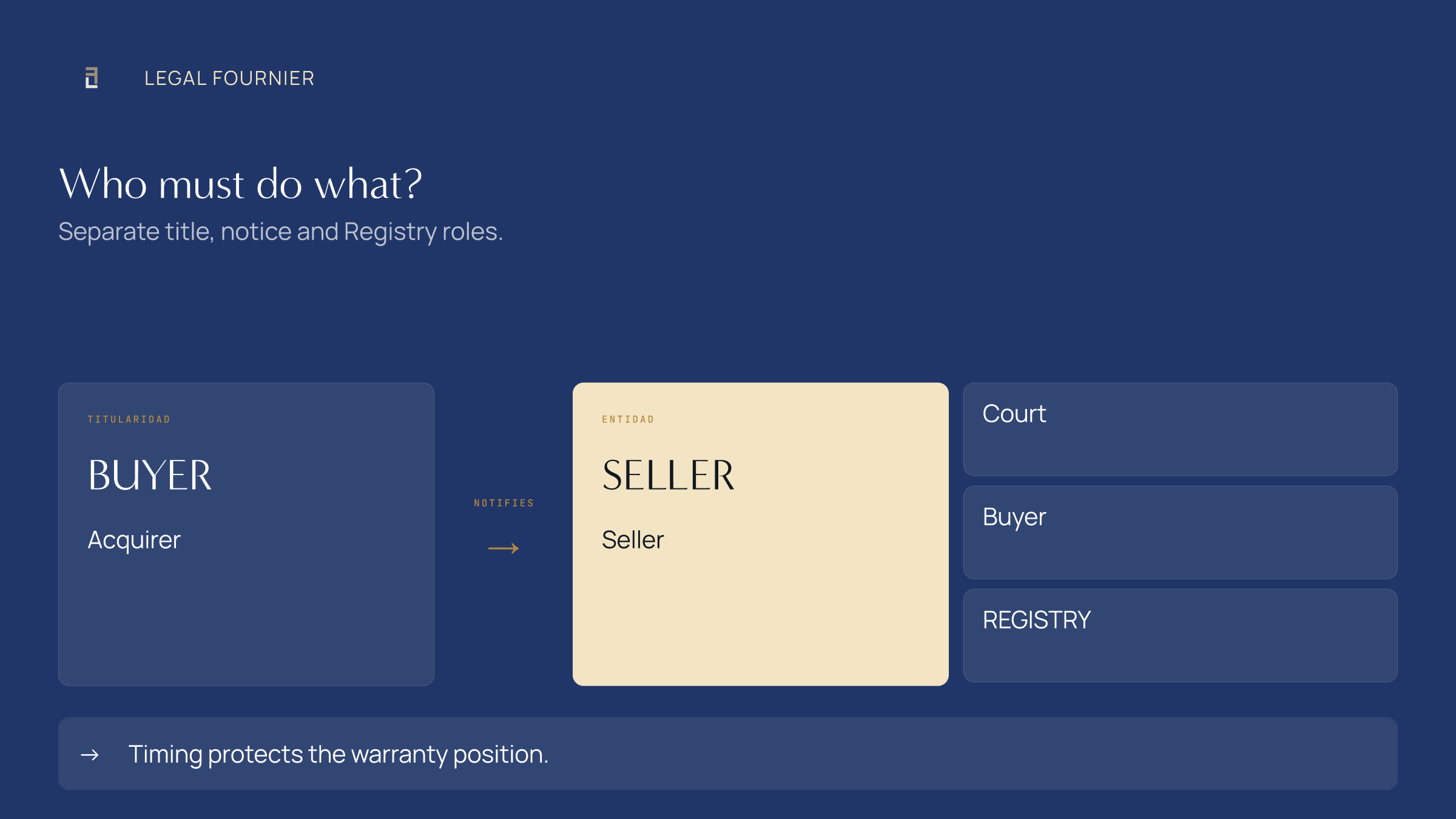
The Civil Code also contains an important procedural point: the seller is obliged to the corresponding warranty where it is proven that the eviction claim was notified to the seller at the buyer’s request. If that notification is missing, the seller may not be obliged to the warranty. Article 1482 then describes the buyer’s request for the claim to be notified to the seller within the procedural time for answering the claim. In practice, this is not a detail to handle casually or late; litigation counsel should calculate the procedural steps from the actual court documents.
Premium-file warning: the seller’s warranty is only valuable if the seller can be located, sued, and made to pay. In international and non-resident seller files, solvency, enforcement, escrow history, insurance, and documentary admissions can become as important as the legal theory.
Hidden charges, easements and defects are separate traps
Not every after completion surprise is eviction. Spanish law separately regulates hidden charges and hidden defects. Article 1483 of the Civil Code is especially relevant to property transactions. If the sold property is burdened, without mention in the deed, by a non-apparent charge or easement of such nature that it should be presumed the buyer would not have acquired the property had the buyer known of it, the buyer may seek rescission unless the buyer prefers compensation.
That article also contains specific timing rules: the buyer may exercise rescission or request compensation during one year from the granting of the deed; after that year, only compensation may be claimed for another equal period from the day the charge or easement was discovered. Those timings are specific to that legal route and should not be mixed casually with other claims.
Physical or functional defects are different again. Article 1484 addresses hidden defects that make the thing sold unsuitable for its intended use or reduce that use in such a way that the buyer would not have acquired it or would have paid less. Article 1486 gives the buyer options such as withdrawing from the contract with expenses paid or reducing the price through expert valuation, with possible damages if the seller knew and failed to disclose. Article 1490 sets a six-month extinction period for actions arising from the preceding hidden-defect provisions.
For a buyer, this classification changes the strategy. A hidden damp problem, an illegal extension, an undisclosed right of way, a competing registered claim, and a seller’s defective inheritance title may all feel like “title problems”. Legally, they may require different notices, experts, court actions, and settlement positions.
Immediate steps when A title problem appears
The correct response depends on whether the file is pre-completion, newly completed, or already in litigation. The following is a practical triage map, not a substitute for legal advice on a live dispute.
1. freeze the document record
Collect the private contract, reservation agreement, arras contract, public deed, Registry notes and certificates, mortgage documents, seller representations, agency communications, notary emails, survey material, Cadastre documents, community certificates, and any urban planning files. Keep the versions and dates. In title litigation, the chronology often decides whether a party acted in good faith and whether a defect was visible or concealed.
2. obtain a fresh registry position
Do not rely only on the note used at signing. Request an updated Registry check, and where the case is sensitive, consider whether a certification is needed. Check pending presentations, annotations, charges, ownership history, easements, and whether the description is coordinated with Cadastre where relevant.
3. separate Legal title from commercial pressure
A neighbour may be aggressive but legally weak. A bank may be cautious because of a minor Registry discrepancy. A claimant may have an old document but no registered priority. Conversely, a calm-looking letter from an heir or creditor may be dangerous if it can lead to a Registry annotation or court-ordered rectification. The file should be scored by legal effect, not anxiety level.
4. preserve seller-warranty rights
If a claim has been filed, seller notification must be handled with the procedural timetable in mind. If no claim has been filed, a carefully drafted reservation-of-rights letter may still be appropriate. The letter should avoid overclaiming before the facts are classified, but it should usually put the seller on notice that a pre-existing title or charge issue has emerged.
5. consider registry protection measures
The Mortgage Law allows preventive annotations in defined cases, including where someone sues over ownership or the constitution, declaration, modification, or extinction of a real right. Whether an annotation is available or advisable depends on who is claiming, what relief is requested, and whether you need to warn third parties or protect a pending action.
How to reduce the risk before completion
The best saneamiento por evicción case is the one you never need to bring. Before signing, a foreign buyer should treat the title file as a risk allocation exercise, not a document checklist. The minimum review is rarely enough for substantial acquisitions, rural properties, inherited properties, properties with old buildings, properties bought through companies, or properties intended for rental or redevelopment.
Key protections often include a current Registry review, seller identity and capacity checks, inheritance-chain review where applicable, confirmation that charges will be cancelled at completion, careful arras conditions, escrow or withholding where a cancellation is pending, confirmation of community and IBI exposure, review of non-apparent easements, urban-planning review, and clear seller representations in the deed or private contract.
For international buyers, the language layer is also important. A translated summary of the nota simple is not the same as legal advice. The lawyer should identify what is registered, what is not registered, what is visible from other documents, what is assumed by the parties, and what should be made a condition to completion.
Where the seller is non-resident, a company, an estate, or a family group, warranty value should be tested. If the seller disappears or has no reachable assets, a correct legal claim may still be commercially poor. In those cases, completion mechanics, retentions, bank certificates, cancellation evidence, and documentary admissions become central.
Official Legal sources used
This article relies primarily on the Spanish Civil Code published by the BOE, especially Articles 1474 to 1486 and 1490, the Mortgage Law published by the BOE, especially Articles 32 to 34, 38, 40, and 42, and the Ministry of Justice guidance on the Spanish Property Registry. Those sources support the core distinctions between seller warranty, Registry effects, informative notes, certifications, and preventive annotations.
FAQ
Is every title problem after buying a case of saneamiento por evicción?
No. Classic evicción requires deprivation of all or part of the property through a final judgment based on a pre-purchase right. Other issues may be hidden charges, hidden defects, Registry rectification, boundary disputes, urban planning problems, or contractual misrepresentation.
Can I claim against the seller if the purchase contract said nothing about eviction?
Often yes. The Civil Code states that the seller responds for eviction even if nothing was expressed in the contract. However, the contract, seller conduct, buyer knowledge, notification steps, and procedural stage all matter.
Does a clean nota simple eliminate the risk?
No. It is an essential document, but the Ministry of Justice distinguishes between an informative nota simple and a certification. A clean note is only one part of the legal review. The lawyer should also consider chain of title, pending entries, non-apparent rights, seller capacity, and facts outside the Registry.
What should I do if someone sues me claiming ownership?
Do not treat it as a routine complaint. The Civil Code links the seller’s warranty obligation to proper notification of the eviction claim to the seller. Court deadlines and notification mechanics should be reviewed immediately by litigation counsel.
Can Legal Fournier review a title problem before it becomes litigation?
Yes. That is often the best moment to intervene. Legal Fournier can review the Registry position, purchase documents, seller obligations, and commercial leverage before the dispute hardens into a more expensive court file. You can start with a Talk to a Spanish lawyer focused on the property file and decision options.
Negotiation before a title or eviction-warranty claim
A declaratory claim against the seller will generally require a documented MASC attempt. The request should identify the competing title or right, state the remedy sought and preserve any notices required by the Civil Code and the contract. A vague complaint about a title problem may not match a later claim for rescission, repayment or damages.
Enforcement, urgent interim relief and some statutory procedures have different rules. Identify the procedural route before sending the letter, especially if another title case is already pending.