Expediente de extranjería en trámite: what the status means and when to act
When a Spanish immigration file appears as expediente de extranjeria en tramite, the most dangerous mistake is to read the phrase as either good news or bad news. It is usually neither. It means the file is still being processed, but the legal risk depends on the application type, the date of filing, whether a notification has been issued, whether the applicant’s previous authorization is still protected, and whether the online status is lagging behind the real administrative file.
For foreign professionals, families and founders in Spain, this is not a curiosity about a public portal. A file that stays en tramite can affect travel plans, employment start dates, social security registration, family reunification, long-term residence timing or the deadline to challenge a refusal. That is why a pending status should be reviewed together with the underlying immigration route, especially where the matter is a renewal, a status change, a prior denial or a file that may need immigration appeal strategy.
This article is narrower than a general guide to Spanish immigration applications. It explains what the en tramite status does and does not prove, when waiting is usually reasonable, and when Legal Fournier would treat the file as an urgent legal matter rather than a routine status check. If the issue is an expiring card or renewal window, also review our residency renewal service in Spain.
Last updated: 13 June 2026 · Based on the official immigration status portal, Organic Law 4/2000, Royal Decree 1155/2024 and Law 39/2015.
Key takeaways before you act
- En tramite is not a decision. It normally means the file is pending, not that it has been approved, refused or archived.
- The status check is not the legal file. The official SMS and telephone routes are described as merely informative, and in every route formal notification and the administrative file control your legal position.
- Do not use one deadline for every file. The general maximum period is often three months, but specific procedures can have different periods and different silence rules.
- Renewals are different from first applications. Many timely renewals or extensions preserve the previous authorization while the file is pending, but the exact route needs to be checked.
- Action is needed if the status hides a notification. A request for documents, a refusal, an archive decision or a missed appeal clock can sit behind a casual online check.
What “expediente en trámite” means
The official Expedientes Extranjería portal allows users to consult the status of immigration files handled through Spanish immigration procedures. The related status consultation service can be accessed with Cl@ve or through a form that verifies the applicant’s identity and locates the file.
In practice, en tramite means the administration has not yet issued a final status visible to the user in that consultation system. It does not, by itself, tell you whether the file is legally complete, whether a police report has been received, whether the office has reviewed the documents, whether an internal proposal exists, or whether a notification has already been made available in another channel.
The phrase is especially misleading because applicants often use it as a single word for several different situations. A file can be en tramite because it is still within the normal review period. It can be en tramite because the office is overloaded. It can also be en tramite while a request for correction, a notification problem or a pending document is affecting the file. The visible phrase is the beginning of the analysis, not the answer.
The strategic question is not “why does the screen still say en tramite?”. It is “what legal clock is running behind this status?”.
Why the online status is not enough
The official information page for the status consultation service states that it provides information on the current status of the authorization file. It also reminds users that the information is merely informative when using SMS or telephone status routes. The same official page points users to the relevant Immigration Office where a case-specific issue needs clarification.
That distinction matters. The portal may help you see whether the file exists, whether the visible status has changed and whether the administration has marked a broad processing stage. It does not replace the filing receipt, the formal notification, the actual resolution, the administrative file or the legal deadlines attached to a refusal.
The official FAQ also shows why status checking has limits. If the system says the information cannot be found, the data may be wrong or the file may not yet have been computerized. If the system says preliminary steps are being carried out before recording the file, the administration may still be missing information needed to display the current status. If the file has stayed in tramite for a long time, the FAQ directs the applicant to the relevant Immigration Office for case-specific information.
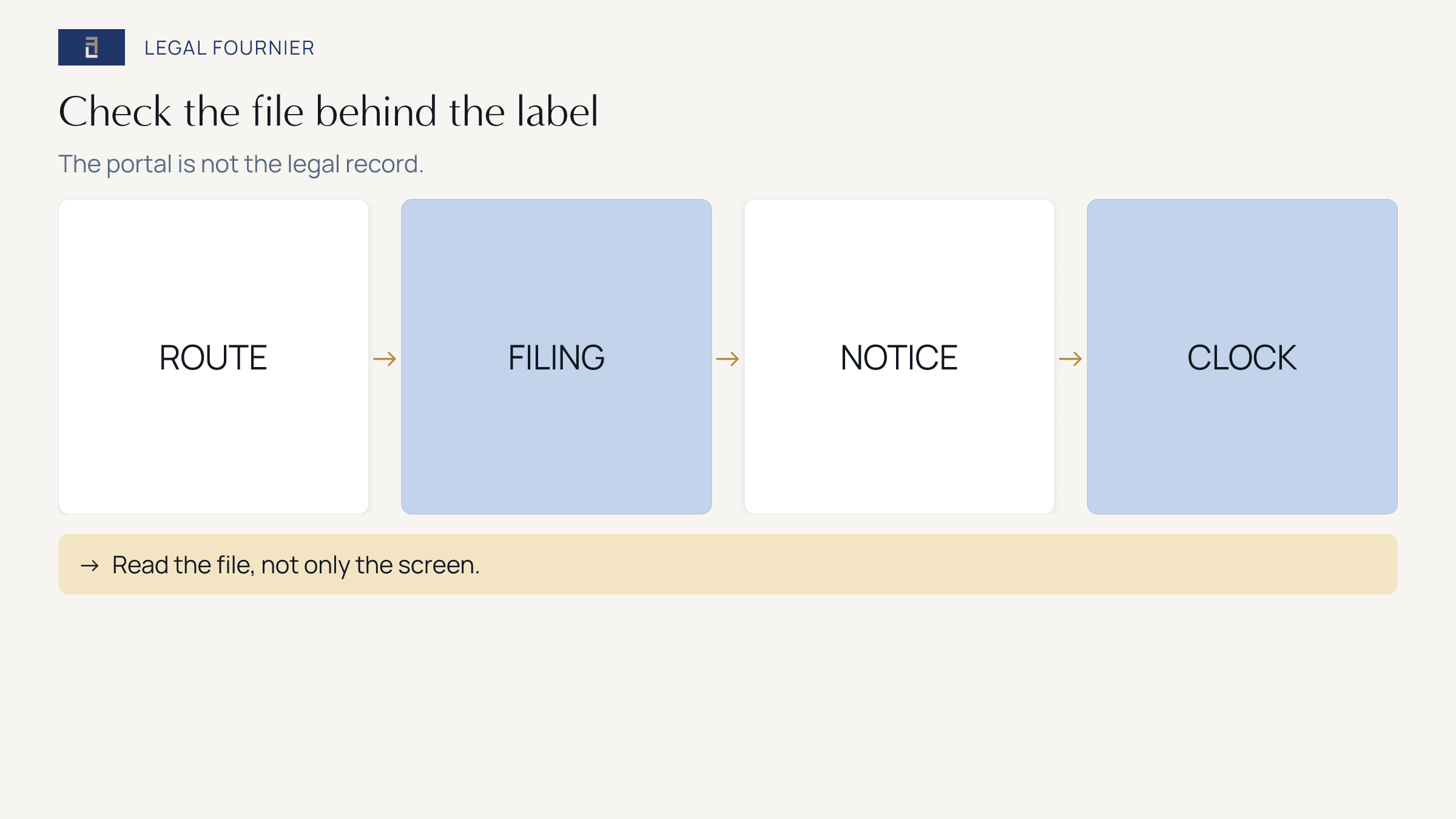
For high-stakes files, we usually compare five records before advising a client to wait:
- The filing receipt. This shows when the application entered the register and which body received it.
- The application type. Renewal, initial residence, long-term residence, family route, study extension and modification files do not always share the same risk profile.
- The applicant’s current status. An expiring TIE, a pending employer registration or a travel need changes the urgency.
- Any notification channel. The status screen should be checked against DEHu, the electronic office, Mercurio, postal notifications and representative access where applicable.
- The legal deadline. A file inside the normal period is different from one that has passed the maximum resolution period or generated administrative silence.
The main status messages and their real risk
Different provinces and systems can display wording differently, and a status message should never be treated as legal advice. Still, these are the practical readings we use when clients bring us a status screenshot.
| Visible message | Practical meaning | When to act |
|---|---|---|
| No information found | Data may not match the system, or the file may not yet be computerized. | Check the receipt number, NIE, dates and the competent office before assuming the application failed. |
| Preliminary steps before recording | The system may be waiting for information needed to display the file status. | Verify that the application was correctly registered and that no essential document or fee issue is blocking processing. |
| En tramite | The file is pending in the visible system. | Review the legal clock, notification channels and current authorization. Waiting may be reasonable, but only after those checks. |
| Favorable | The file appears approved in the consultation system. | Obtain or wait for formal notification and plan the TIE step where the authorization is longer than six months. |
| No favorable / denied | The visible status points to an adverse decision. | Do not wait for internet commentary. Get the notification and calculate appeal deadlines from the legally relevant date. |
| Archived / desistimiento | The file may have been closed, often after a procedural issue such as not correcting or completing the application. | Review whether there was a missed request, defective notification or appealable closure decision. |
The legal clocks behind a pending file
A pending immigration file sits inside several possible clocks. They do not all start on the same day and they do not all have the same legal effect.
1. The filing clock
The Additional Provision One of Organic Law 4/2000 sets a general maximum period of three months for decisions on authorization applications governed by that law, counted from the day after the application entered the register of the competent body. This default cannot be applied mechanically because specific procedures in Royal Decree 1155/2024 may set a different period or legal effect.
That does not mean every immigration file is automatically late after three calendar months from the day you uploaded documents. The starting point is the competent register date, not necessarily the day you began preparing the application, paid a fee, booked an appointment or created a draft online. Some procedures also set a specific shorter or different period. For example, the Regulation includes specific rules for certain study extensions and visa procedures, and the exact application route needs to be checked before relying on a default period.
2. The correction clock
If an application is incomplete, Article 68.1 of Law 39/2015 generally allows the administration to require correction within 10 days and warns that failure to comply may result in the applicant being treated as having withdrawn the application after the corresponding decision. A specific procedure may require a different check.
This is one of the reasons en tramite can be dangerous. A client may be watching the public status tool while a correction request has been notified elsewhere. If the correction window is missed, the file may later be archived even though the applicant believed nothing had happened.
3. The notification clock
When a decision is made, the available remedy and its deadline depend on the formal resolution and a valid notification, not on a public status screenshot. For electronic notifications that are mandatory or were expressly chosen, Article 43.2 of Law 39/2015 provides that the notification is deemed rejected after 10 calendar days from availability if its content has not been accessed.
Where an express act ends the administrative route, an optional recurso de reposición is generally subject to the one-month period in Article 124 of Law 39/2015. A contentious-administrative claim against an express act is generally subject to the two-month period in Article 46 of Law 29/1998. The decision and notification must be checked before calculating either period.
4. The administrative silence clock
Administrative silence in immigration is not one rule. The Additional Provision One of Organic Law 4/2000 contains a general rule and important exceptions for particular extensions, renewals, long-term residence applications and modifications. The exact authorization, filing date, specific regulation and any suspension of the time limit must therefore be identified before assigning a positive or negative effect to silence.
That is why a forum answer about one person’s renewal may be legally wrong for another person’s initial application. The silence result depends on the exact authorization, the applicable regulation, the filing date, whether the application was validly filed, and whether any interruption or request affected the file. In premium immigration work, we do not advise from the word tramite; we advise from the route and the file record.
A pending status after the maximum period may be an appeal problem, a silence strategy, a request for office information, or simply a file that needs formal notification. The difference is legal, not cosmetic.
When waiting is usually reasonable
There are situations where en tramite should not create panic. If the file was recently submitted, the receipt is clean, the correct office received it, fees were paid where required, no notification has been issued, and the legal maximum period has not expired, the sensible step may be controlled monitoring rather than a premature appeal or duplicate filing.
Waiting is also more defensible where a renewal or extension has been submitted within the applicable period and the rule for that category extends the validity of the previous authorization until the procedure is resolved. Royal Decree 1155/2024 contains this kind of protection in several renewal or extension contexts. For example, it states that a timely study extension request extends the previous authorization until resolution, and it contains equivalent language for certain work and residence renewal routes. Some late filings within the permitted post-expiry window may also preserve validity until resolution, while still carrying sanction risk in the specific cases where the regulation says so.
Even then, the applicant should keep evidence. A pending file should be backed by the filing receipt, proof of payment or exemption of fees where applicable, copies of uploaded documents, proof of representative authority if a lawyer or professional filed it, and screenshots of status checks. If employment, travel, banking or university enrollment depends on the file, this documentation becomes operationally important.
When “en tramite” needs action
The status should be escalated when the consequences of being wrong are serious. In Legal Fournier’s work, the following situations deserve case review rather than passive waiting.
- The maximum period appears to have passed. This does not automatically decide the case, but it opens the silence and remedy analysis.
- The applicant has an expired TIE or near-expiry authorization. The filing date, renewal window and extension rule must be confirmed before assuming residence or work rights continue.
- There was a request for documents. A 10-day correction period can be missed quickly, especially if the notification went to a representative, postal address or electronic channel the applicant is not checking.
- The status changed from pending to unfavorable. Appeal deadlines should be calculated from notification and reviewed immediately.
- The application affects work start dates or Social Security registration. A pending work authorization can block or condition the employment step depending on the route.
- The applicant plans to leave Spain. Travel while a renewal, TIE or return authorization issue is unresolved can create practical border and appointment problems.
- There is a previous denial, expulsion issue or irregularity. The pending file may interact with inadmissibility, sanction or appeal risks.
If the status becomes favorable
A favorable status is good news, but it is not the end of the file. The first step is to obtain and review the formal resolution. The second is to identify whether the authorization requires a physical card. Article 4.2 of Organic Law 4/2000 generally requires foreign nationals authorized to remain in Spain for more than six months to obtain the Tarjeta de Identidad de Extranjero personally within one month from entry or from the authorization taking effect, depending on the case.
This is where applicants often confuse the NIE number with the TIE card. The NIE is an identification number. The TIE is the physical foreigner identity card that usually displays that number and evidences the granted authorization. A favorable status may create the next procedural step, not a finished residence file.
If the status becomes unfavorable
If the file becomes no favorable, do not rely on the public status message to decide the remedy. The legal document must be obtained. The refusal may be based on missing documents, economic means, criminal record issues, residence continuity, filing outside the permitted period, defective representation, an employer problem or an interpretation of the applicable regulation. Each ground has a different evidentiary response.
The one-month administrative appeal window for an express act and the two-month contentious-administrative window are short in practical terms because the evidence has to be reconstructed. In a serious case, counsel should review the full submission, the exact legal basis of refusal, the notification date, whether a correction request was properly notified, and whether an appeal or a new application is strategically better. This is why refusals should be routed quickly to immigration appeals counsel instead of being treated as a generic administrative delay.
How we review a pending immigration file
For clients who come to us with an expediente en tramite, the work is not to refresh the portal repeatedly. The work is to classify the file, identify the legal clock and decide whether intervention is useful.
- Confirm the application route. We identify the exact authorization, renewal, modification or appeal route, not only the name used informally by the applicant.
- Read the filing evidence. We check the date of register entry, competent office, receipt, fees and documents submitted.
- Check notification exposure. We review whether a request, resolution or archive notice may have been sent to an electronic, postal or representative channel.
- Map the applicant’s current rights. We assess whether the previous card or authorization is extended, whether work is protected and whether travel should be avoided.
- Choose the next procedural step. Depending on the file, this may be monitoring, a formal office query, document contribution through Mercurio, silence strategy, administrative appeal or court review.
The premium value is judgment. Some files need nothing except disciplined monitoring. Others need immediate evidence work because the public status is masking an appealable event or a missed document request. The difference is visible only when the status is read against the underlying file.
Frequently asked questions
Does “expediente de extranjeria en tramite” mean approved?
No. It usually means the file is still pending in the visible consultation system. Approval is normally reflected by a favorable resolution or status, followed by formal notification and, where applicable, the TIE card process.
How long can an immigration file stay en tramite?
It depends on the procedure and the competent body. The general three-month rule in Organic Law 4/2000 is subject to specific periods, exceptions, possible suspensions and different silence effects. Once the applicable maximum period appears to have passed, the exact authorization and procedural record should be reviewed rather than guessed.
Can I work while my renewal is en tramite?
Often, a timely renewal or extension can preserve the validity of the previous authorization until the procedure is resolved, but this needs to be checked against the exact authorization. The answer is not the same for every initial application, renewal, modification or study-related file.
Can I travel while the file is en tramite?
Travel depends on your passport, visa position, current TIE, renewal status and whether you need a return authorization. Do not decide from the en tramite label alone. If your card is expired or close to expiry, review the file before leaving Spain.
What should I do if the file is still en tramite after the applicable legal period?
First confirm the true filing date, the competent office and whether the procedure has a specific period or interruption. Then review whether administrative silence is negative or positive for your route, whether a formal query is useful, and whether appeal strategy should be prepared. Do not file duplicate applications without legal review.
Does a favorable online status mean I can skip the TIE appointment?
No. Where Article 4.2 of Organic Law 4/2000 applies, the foreigner identity card must generally be requested personally within one month from entry into Spain or from the authorization taking effect, depending on the case. The favorable decision and the card procedure are separate steps.