
Nota simple in Spain: property charges, embargoes and buyer risk
A nota simple vivienda can look harmless: a short registry extract, a few names, a property description and a final section headed cargas. For a foreign buyer, that last section is often where the commercial risk sits. A mortgage, an embargo, a usufruct, a tax affection, a limitation on use or a pending filing can change the price, the financing, the closing timetable and, in some cases, whether the purchase should proceed at all.
The mistake is to treat the nota simple as a box-ticking document requested after the offer has already become emotionally or contractually fixed. In a serious Spanish property purchase, it should be read before the reservation deposit or contrato de arras, again before completion, and together with the community, tax, cadastral and urban-planning evidence that the registry extract does not fully replace.
This piece is narrower than our broader guide to pitfalls when buying property in Spain. Here we focus on the nota simple, charges and buyer risk. For an early commercial estimate of taxes and transaction exposure, you can also use our Spain property buyer cost and risk calculator, then move to legal review before signing documents or transferring funds.
Last updated: 20 June 2026
- A nota simple is useful because it usually shows the registered property, registered owner, rights, limitations and registered charges affecting the property.
- It is still an informative extract, not the same as a registry certification and not a full substitute for legal due diligence.
- The main risk is not the mere existence of a carga; it is whether the charge will be cancelled before completion, assumed in the price, or remain enforceable after purchase.
- Community debts, IBI, tax issues, urban-planning defects and cadastral inconsistencies may need separate checks even when the nota simple looks clean.
- Foreign buyers should request an updated nota simple close to signing and avoid paying substantial funds until the cancellation mechanics are documented.
- If the seller, agent or bank cannot explain a charge clearly, treat it as a negotiation and risk-allocation issue, not a translation problem.
What a nota simple actually shows
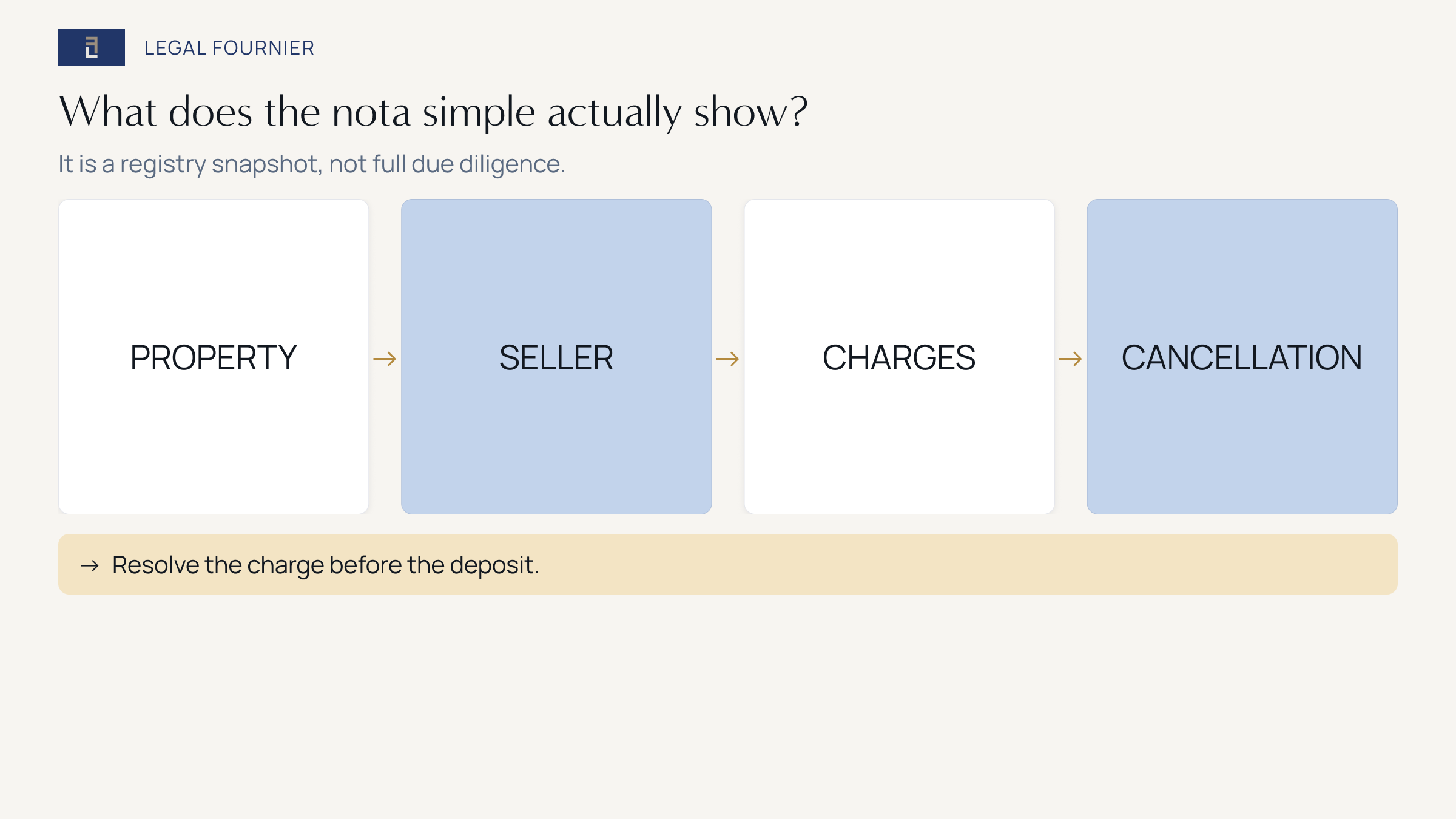
The Spanish Property Registry, or Registro de la Propiedad, records acts and contracts relating to ownership and other real rights over immovable property. The official Registradores property registry page explains that a nota simple includes the identification of the property, the identity of the registered holder or holders, the registered rights over the property, and the extension, nature and limitations of those rights.
In practice, the nota simple normally helps answer four questions.
- Is this the correct property? The description, registry number, location, boundaries, built area, cadastral reference where available, and sometimes division-horizontal details should be checked against the property you are actually buying.
- Who can sell? The registered owner or owners, their ownership percentages and the type of right held must match the people signing or authorising the sale.
- What rights limit the property? Usufructs, easements, use rights, administrative limitations, protected-housing rules or other restrictions can affect use and value.
- What charges are registered? Mortgages, embargoes, preventive annotations, fiscal affections, conditions and other entries may need cancellation, assumption or price retention.
The important limit is that the nota simple is not a full legal opinion. Article 222 of the Spanish Mortgage Law recognises registry publicity through nota simple and certification. The nota simple has an informative function; the registry certification has stronger evidentiary value. That distinction matters when a bank, court, notary, investor committee or foreign adviser asks for definitive proof.
A clean-looking nota simple is not the same as a clean transaction. It is a registry snapshot. The buyer still needs to verify debts, planning, tax, community, identity, price mechanics and cancellation documents.
The red flag Is the effect, not the word “carga”
Foreign buyers often panic when they see the word carga. That reaction is understandable but incomplete. Some charges are routine and can be cancelled at completion. Others are serious but manageable if the price, retention and notarial mechanics are correct. A smaller group can make the property unsuitable for the buyer’s intended use or financing.
The first review should separate the entries into risk categories.
| Entry on the nota simple | Typical buyer question | Practical risk |
|---|---|---|
| Mortgage | Will it be economically and registrally cancelled at completion? | The sale price may pay the bank, but the buyer still needs cancellation documentation and registration follow-up. |
| Embargo or preventive annotation | Who is enforcing, for what amount and with what priority? | It can affect financing, price, timing and whether the property can be transferred free of the claim. |
| Usufruct or use right | Can the buyer actually occupy, rent or redevelop the property? | Ownership without immediate use may be commercially unsuitable, especially for relocation or rental plans. |
| Easement or limitation | Does it restrict access, views, utilities, building works or future division? | It may reduce value even if no immediate debt is involved. |
| Fiscal affection | Is it a routine tax-affection entry or a sign of unpaid tax exposure? | Often manageable, but it needs to be read in context with the previous transaction and tax documents. |
| Protected housing or administrative limitation | Can this buyer buy, occupy, rent or resell under the applicable rules? | The issue may be legal eligibility, maximum price or authorisation, not only title. |
A charge can therefore be a closing condition, a price adjustment, a reason for a bank to pause the mortgage, or a reason to walk away. The answer depends on the exact text of the entry, the amount, the priority, the documents available and the buyer’s objective.
Why timing matters before arras and completion
The nota simple is a snapshot. Registradores’ own guidance warns that changes can occur between the time the nota simple is issued and the time it is delivered or used. That is why a note obtained weeks before signing should not be treated as final comfort for a substantial purchase.
The risk becomes acute around the contrato de arras. If the buyer signs arras without understanding existing charges, the deposit may become the battlefield. A seller may argue that the buyer knew, or should have known, the registry position. A buyer may argue that the property was promised free of charges or that cancellation was not properly documented. The better approach is to avoid ambiguity: the arras contract should identify material charges and state what must happen before completion.
Close to the notarial deed, Spanish notarial practice adds another protection layer. The Consejo General del Notariado explains that, before the sale, the notary requests registry information showing who owns the property and whether it is free of charges or affected by mortgages, embargoes or other burdens. For sensitive transactions, buyers should still have their own independent review before the notary appointment, not only at the signing table.
Charges that need separate documents
A nota simple can reveal a problem, but it rarely gives the whole solution. The buyer needs the supporting documents that prove how the problem will be removed, priced or accepted.
Mortgage cancellation
A registered mortgage is common. It does not automatically make the purchase unsafe. The key is whether the seller’s bank will issue the required payoff and cancellation documentation, whether the amount is retained from the price, and whether the cancellation deed and registry filing are handled correctly after completion.
Foreign buyers should be careful with a casual statement such as “the mortgage will be paid from the sale price.” That may be commercially true but legally incomplete. The buyer needs to know who attends completion for the lender, what amount is paid, how the cancellation is executed, and who follows the registration until the mortgage disappears from the registry.
Embargoes and court or tax annotations
An embargo or anotacion preventiva de embargo is more sensitive. It may come from a court, tax authority, Social Security, local administration or private creditor. The amount, creditor, priority and procedural status matter. Some can be cancelled with payment or a formal order. Others signal wider distress around the seller or property.
If the buyer is relying on bank finance, the bank may require cancellation or a clear structure before lending. If the buyer is paying cash, the legal risk still exists. A cash buyer does not become immune to registry priority simply because no mortgage lender is involved.
Fiscal affections
Fiscal-affection entries are common in Spanish property history. Some simply reflect that a previous transfer was subject to a tax period or possible review window. Others deserve closer attention, especially where the previous transfer involved inheritance, donation, exemption, non-resident seller issues or unpaid assessed tax.
The general tax principle is not invented by agencies or banks. Article 79 of the Spanish General Tax Law deals with affection of assets to payment of taxes that burden transfers, acquisitions or imports, subject to the legal protections and exceptions in the rule. For a buyer, the practical question is whether the notation is routine, expired, cancellable, or linked to a tax issue that still needs evidence.
Risks the nota simple may not fully show
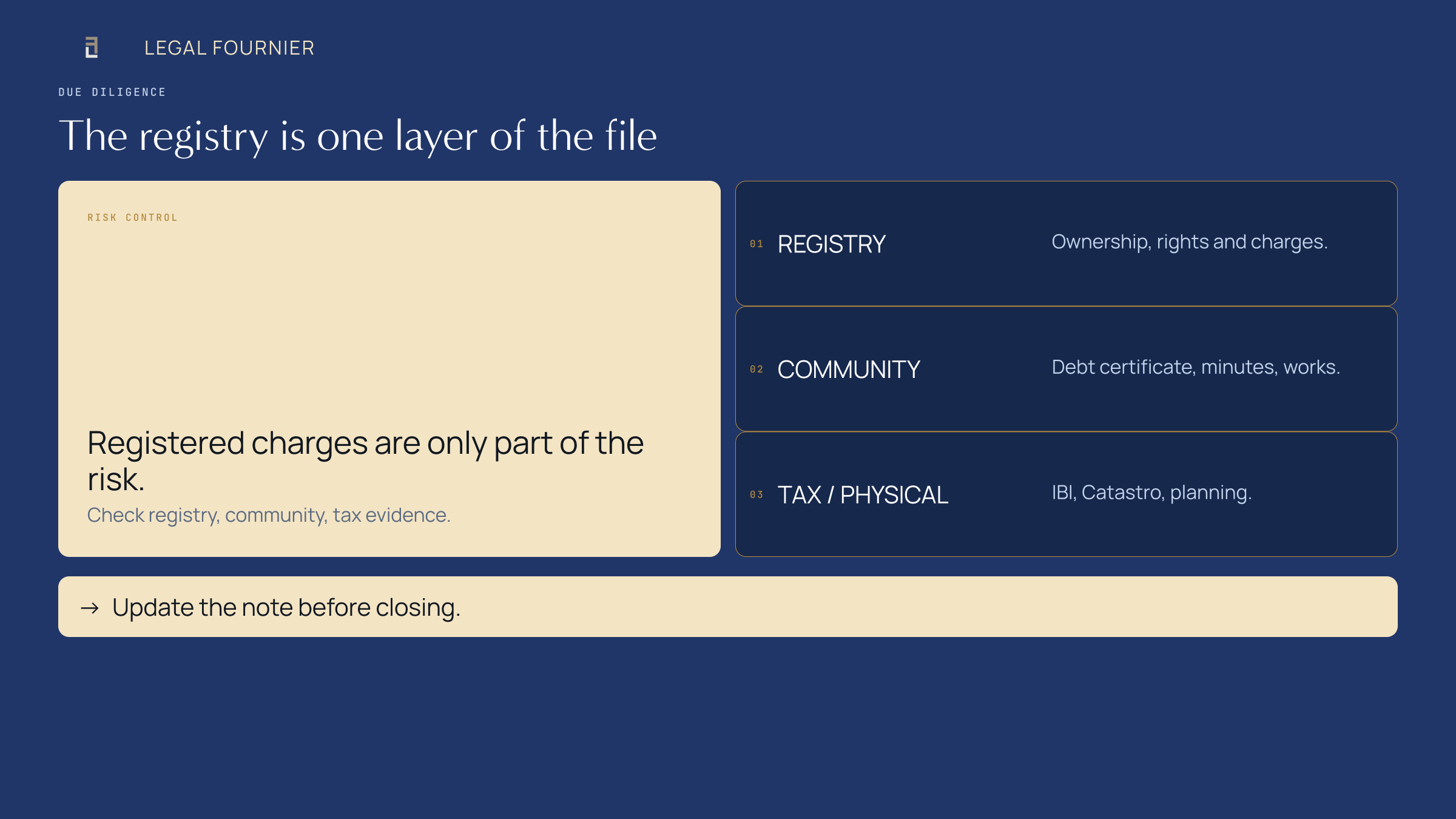
The section on registered charges is essential, but it is not the whole due-diligence file. Several risks can sit partly outside the registry extract or require separate confirmation.
Community debts and approved works
In apartment buildings and urbanisations, community debt can be more than a private dispute between the seller and the community. Article 9 of the Horizontal Property Law requires the transferor to provide a certificate on the state of debts with the community, unless the buyer expressly releases that requirement. The property answers for qualifying debts already due in the acquisition year and the preceding three calendar years; Catalan law extends the lookback to four preceding years.
That is why the buyer should request the community certificate, minutes of recent meetings and information on approved or expected extraordinary works. A nota simple may not tell you that the building has approved facade repairs, lift works, litigation, restrictions on tourist rentals or repeated arrears among owners.
IBI and municipal tax exposure
The annual Impuesto sobre Bienes Inmuebles (IBI) is a local property tax. The buyer should see recent receipts and understand whether any amount remains pending. Article 64 of the Spanish Local Tax Law addresses real affection in IBI transfers and provides that notaries request information and warn parties about pending IBI debts associated with the property, the reference-cadastral declaration context and the affection of the property to payment of the tax.
This is a good example of why “the nota simple is clean” is not a complete answer. The registry may be clean, but the municipal tax file still needs checking.
Catastro and physical description
The Catastro explains that each property has a unique cadastral reference that allows it to be located in cadastral mapping. The cadastral record is useful for location, surface, use and tax-related checks. It is not the same as the Property Registry.
Mismatch between the registry, Catastro, town hall records and the physical property is common enough to deserve attention. Extra square metres, closed terraces, pool works, rural buildings, changes of use, old extensions and divided properties may require technical and municipal review. The right question is not only “what does the note say?” but “does the legal description match the property being sold?”
How to review a nota simple before signing
A disciplined review does not start with translation. It starts with matching facts.
- Confirm the property identity. Compare address, registry number, cadastral reference, floor, door, parking space, storage room, surface and boundaries with the property shown to the buyer.
- Confirm seller authority. Check whether all registered owners are signing, whether there are spouses, heirs, company representatives, powers of attorney or guardianship issues.
- Read ownership percentages and rights. A seller may own full title, bare ownership, usufruct, an undivided share or another right. Those are not commercially equivalent.
- Classify every charge. Separate mortgage, embargo, tax affection, easement, administrative limitation, use right and pending entry. Do not accept “it is normal” without documents.
- Ask for cancellation evidence. For mortgages and embargoes, ask what document cancels the charge, who signs it, who pays, when it reaches the registry and what happens if it does not.
- Check off-registry items. Request IBI receipts, community certificate, meeting minutes, energy certificate, occupancy or habitability evidence where relevant, and municipal or technical checks for works.
- Update before completion. A note obtained at the first viewing is not enough for completion weeks or months later.
The official Spanish e-government guidance on buying real estate, notaries and property registers also points foreign buyers toward registry information and checks on whether the property is up to date with community payments and IBI. That is consistent with how a careful buyer should structure the file.
When the charge Is manageable, and when it Is not
There is no universal rule that a property with charges should never be bought. Many good properties are sold with a mortgage that is cancelled at completion. Some registry entries are historic, expired or technically cancellable. The question is whether the legal and commercial structure is precise enough.
A charge is usually more manageable where the creditor is identified, the amount is clear, the cancellation mechanism is standard, the notary can coordinate payment and cancellation, the buyer’s bank is comfortable, and the arras contract makes completion conditional on a clean or agreed registry result.
A charge becomes more serious where the seller cannot produce documents, the creditor is a public authority or court and no cancellation order is ready, several claims compete for priority, the property is in inheritance or divorce conflict, the registry description does not match the physical asset, or the intended use depends on a right that the seller does not fully hold.
The buyer’s leverage is strongest before signing arras. After a deposit is paid, the legal analysis may still be correct, but the negotiation is harder.
Foreign buyer profiles that need extra care
For a Spanish resident buying a standard flat with bank finance, several checks are usually forced by the bank, notary and gestor. Foreign buyers often have different exposure.
Non-resident cash buyers may move quickly and skip lender due diligence. That speed can be useful in negotiation but dangerous if the property has a charge that a bank would have flagged.
Families relocating to Spain often care about timing, schools, occupancy and renovations. A usufruct, tenant issue, community restriction or planning defect can be more damaging than a small financial debt.
Founders and company buyers should check whether the buyer should be an individual, Spanish company, foreign company or family structure, and how that choice affects tax, financing and future sale. The nota simple solves title questions; it does not solve acquisition-structure questions.
High-net-worth and LATAM private clients often combine property purchase with residency, tax residence planning, family relocation, wealth structuring and banking. In that setting, the nota simple is only one part of a wider risk map. The property may be clean, while the acquisition plan creates tax or reporting consequences elsewhere.
For these profiles, a paid legal review before signing can be less expensive than renegotiating after the deposit has become contested. Legal Fournier can review the registry note, supporting documents and acquisition context through our consultation options before you commit to the next step.
FAQ
Can I buy a Spanish property if the nota simple shows a mortgage?
Often yes, but only if the mortgage is properly paid and cancelled as part of completion. The sale documentation should make clear how the lender is paid, who signs the cancellation, who pays cancellation costs where applicable, and who follows the registry filing.
Does a clean nota simple mean there are no debts?
No. It means the current registry extract does not show registered charges of the type reflected there. Community debts, IBI, utility balances, approved works, planning issues and some tax or technical matters need separate documents.
Should I request the nota simple myself or rely on the agent?
You can request it through official registry channels or ask your lawyer to obtain and review it. The key is not only possession of the document. The key is an updated version, correct property identification and legal interpretation of the entries.
What if the seller says the charge is old?
Ask for proof. Some old entries can be cancelled, but the buyer should know the cancellation route before signing. “Old” does not automatically mean irrelevant.
Is the english translation of a nota simple enough?
A translation helps the buyer understand the document, but the Spanish registry text controls the legal analysis. If the matter is material, review the Spanish original and the supporting documents.
Tourist-rental check: the Land Register is only one layer. For a new activity, ask for evidence of the community’s prior express approval and review its statutes and minutes. Then verify regional and municipal licences. The May 2026 Supreme Court judgments partially annulled the national registration procedure; a nota simple still does not prove that tourist use is lawful.