

AEAT appeal in Spain: reconsideration, TEAR and when to pay
An AEAT appeal in Spain starts with the act and its remedy footer. The name of the act, the issuing body and the record of notification determine whether it can be challenged, which route is available and when the filing period begins. A preference between recurso de reposición and a TEAR claim comes later.
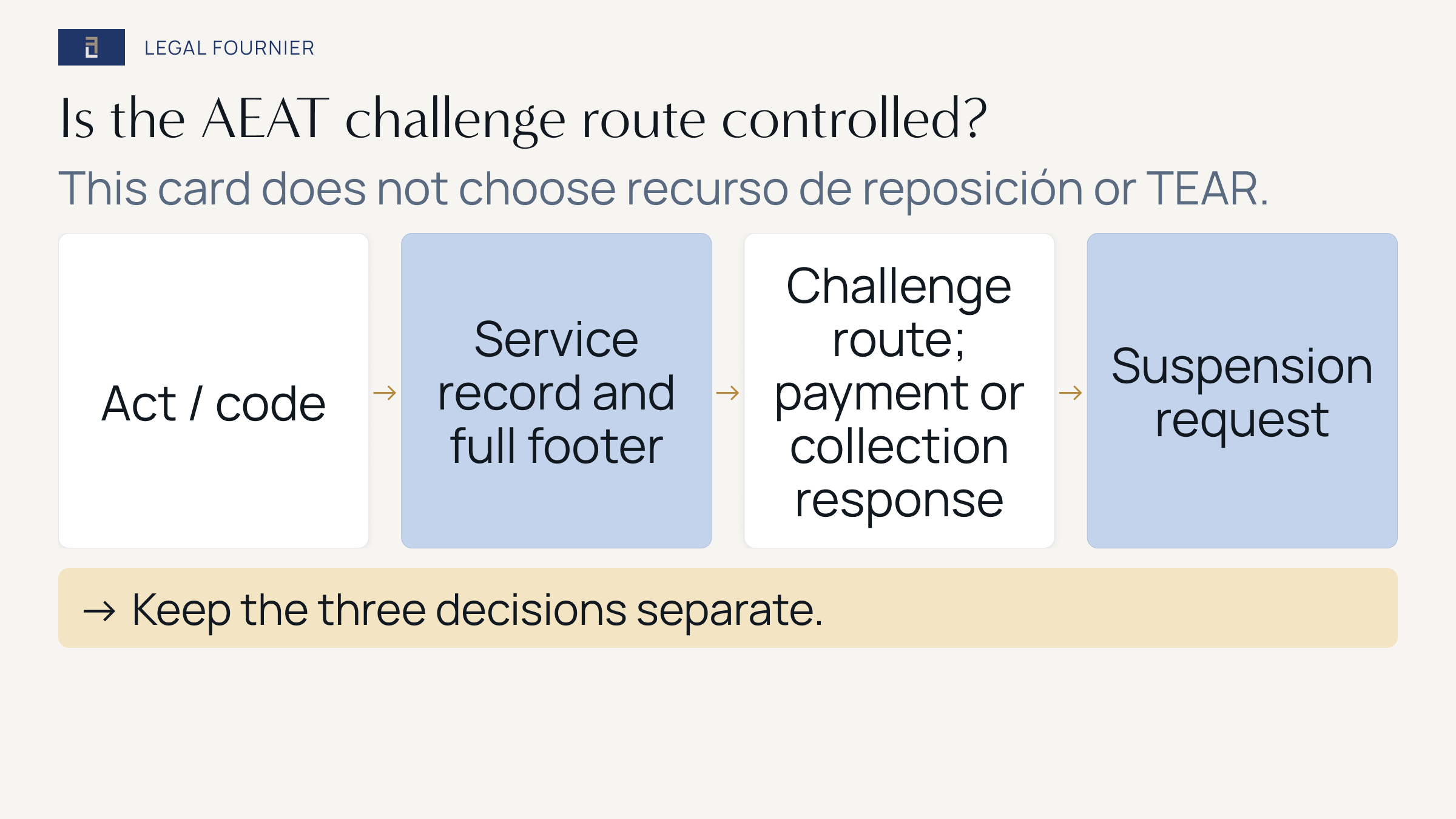
Payment needs a separate decision. Filing a challenge does not, by itself, suspend collection of a tax debt. The first review should therefore run on three tracks: preserve the challenge route, identify the payment or collection position, and decide whether a suspension request is needed.
Documents that control the first review
Keep the complete signed act, its appeal footer and reliable evidence of access, delivery or deemed service. Also keep later collection notices. A PDF date or an email alert is not necessarily the legally effective notification event.
Check that the document is challengeable
Economic-administrative review is available for the acts and matters within LGT articles 226 and 227. Article 227 includes provisional and final assessments, specified decisions, collection acts and penalties. It does not turn every AEAT document into an appealable decision. An information request, an invitation to make allegations during an open procedure, a rectification request and a final assessment have different functions.
The act should identify its issuing authority and the available remedies. Procedure codes also matter. AEAT entries GZ52 and GZ53 apply to acts in the Gestión Tributaria category. For Inspection acts, the corresponding entries are IZ05 and IZ06. Collection and other categories have their own entries. A code that is right for one act should not be copied into advice about another.
Transcribe the appeal footer before choosing a route
Transcribe these fields from the source documents. Leave a field unresolved if the act or service record does not answer it; the worksheet does not choose a route automatically.
| Source-document field | What the field determines |
|---|---|
| Exact act and procedure code | Whether it is challengeable and which AEAT category entry matches |
| Issuing authority and stated tribunal | The authority deciding reposición, the receiving authority and the likely tribunal or instance |
| Notification method, access or deemed-service evidence and date | The event from which the filing period may run |
| Routes and deadline wording in the footer | Whether each route can still be preserved |
| Tax, interest, surcharge and penalty, shown separately | Which payment and suspension rules apply to each amount |
| Voluntary or enforcement-stage status | The immediate collection exposure |
| Security available, value and date | Whether an automatic-suspension route may be available |
| File access and evidence gaps | Whether allegations can be prepared or the file is needed first |
After completing the worksheet, keep three separate notes headed “challenge route”, “payment or collection response” and “suspension request”. A decision on one does not settle the others.
How recurso de reposición works
Recurso de reposición is optional. If the taxpayer uses it, the same authority that issued the challenged act decides it. It comes before an economic-administrative claim against that act. Under LGT articles 222 and 225, the economic-administrative claim cannot proceed until reposición has been expressly decided or can be treated as rejected by silence. If both are filed on time, the first is processed and the second is inadmissible. They are not two parallel cases that remain open while the taxpayer waits to see which one goes better.
The ordinary filing period is one month from the day after notification of the appealable act, or from the relevant silence event. Periodically and collectively notified debts have a different starting rule. LGT article 223 and the matched AEAT procedure must be applied to the actual service record; a generic online calculator is not a substitute.
The filing contains the factual and legal allegations and the supporting documents. It does not automatically stop execution of the challenged act. Article 225 generally gives the issuing authority one month to notify a reposición decision, subject to the exclusions in the article. After that month, the interested person may treat the appeal as rejected for the purpose of moving to the next claim. That silence is a procedural option, not a decision that the arguments lack merit, and it does not prevent a later express decision.
The Spanish name should be retained in advice and filings. Describing reposición simply as “reconsideration” can suggest that it has the same effects as a procedure in another country when it may not.
The economic-administrative route is not always TEAR
An economic-administrative claim is decided by an Economic-Administrative Tribunal, which is institutionally independent of AEAT. The claim normally goes first to the authority that issued the challengeable act. That authority sends the filing and administrative file to the competent tribunal, as described in AEAT procedure IZ06 and LGT article 235.3.
Under LGT article 235, the ordinary period for a claim in single or first instance is one month from the day after notification, with separate rules for silence and specified private-party tax acts. Electronic filing is mandatory where the claimant must receive electronic communications and notifications. Use the effective service event, not just the date shown at the top of the act.
TEAR is not a universal label for the tribunal. Competence depends on the issuing body’s level, territorial rules, amount and instance rules, and the direct-TEAC option in LGT article 229. Check the footer and current competence rules before naming the tribunal or place of filing. A single promised resolution time would also be unsafe because the matched category and procedural form can differ.
Challenge and suspension answer different questions
For a tax debt, automatic suspension on request generally requires security covering the challenged amount, suspension interest and possible enforcement surcharges. The law also provides other routes concerning different security, difficult or impossible harm, and arithmetic, material or factual error. The detailed provisions differ between reposición and economic-administrative review in LGT article 224 and article 233. A request is not a guarantee that suspension will be granted.
A tax penalty follows a distinct rule. A timely administrative challenge suspends the penalty automatically in the voluntary period, without security, until it is final in the administrative route under LGT article 212.3. That rule does not automatically suspend the related assessment. If only part of a debt is challenged, the unchallenged remainder stays payable under the relevant suspension provisions.
If collection has reached an attachment act, the English AEAT embargo guide addresses that narrower stage. If the contested document is a penalty, the tax-sanction guide covers penalty-specific rules. Neither page chooses the route for a different act.
Requesting a file review
For a first review, provide the complete signed act, the service or access evidence and the full remedy footer. Add a breakdown of tax, interest, surcharge and penalty; every later collection notice; earlier allegations or challenges; any payment or suspension request; and an index of the evidence already in the administrative file.
Legal Fournier’s English appeals service can assess the available route and the separate collection position. The answer depends on the act, service event, procedural category, evidence and security. No review can promise suspension, a particular tribunal, a resolution date or success.