
AEAT embargo notice in Spain: how to verify the debt and respond
A diligencia de embargo AEAT is not a routine tax letter. It means the Spanish Tax Agency has moved into enforcement and is trying to seize money, bank balances, salaries, commercial credits, card-payment flows, securities or other rights connected to a tax debt. For a foreign founder, a LATAM family group, a Spanish SL or a holding structure with Spanish accounts, the first mistake is treating the document as a generic warning. The second mistake is assuming that the same deadline applies to every action.
The search query contestar diligencia embargo aeat usually comes from someone who has received the notice and needs to know what to do today: verify the debt, identify whether the recipient is the debtor or a third-party payer, preserve evidence, and decide whether to answer, pay, request a lift, or challenge the measure. In international files, this should be coordinated with Spanish tax representation and, where the debt comes from an income-tax, company tax or non-resident issue, with Spanish tax filing and regularisation advice.
This guide is written for substantial, practical cases: a Spanish bank account is frozen, a Spanish company receives a credit embargo for payments owed to a supplier, a director salary is affected, a LATAM shareholder finds an old AEAT debt through a DEHú notification, or a Spanish holding company discovers a collection problem during bank onboarding. The objective is not to give a universal template. It is to show how to read the notice, separate the response clock from the appeal clock, and avoid damaging the file.
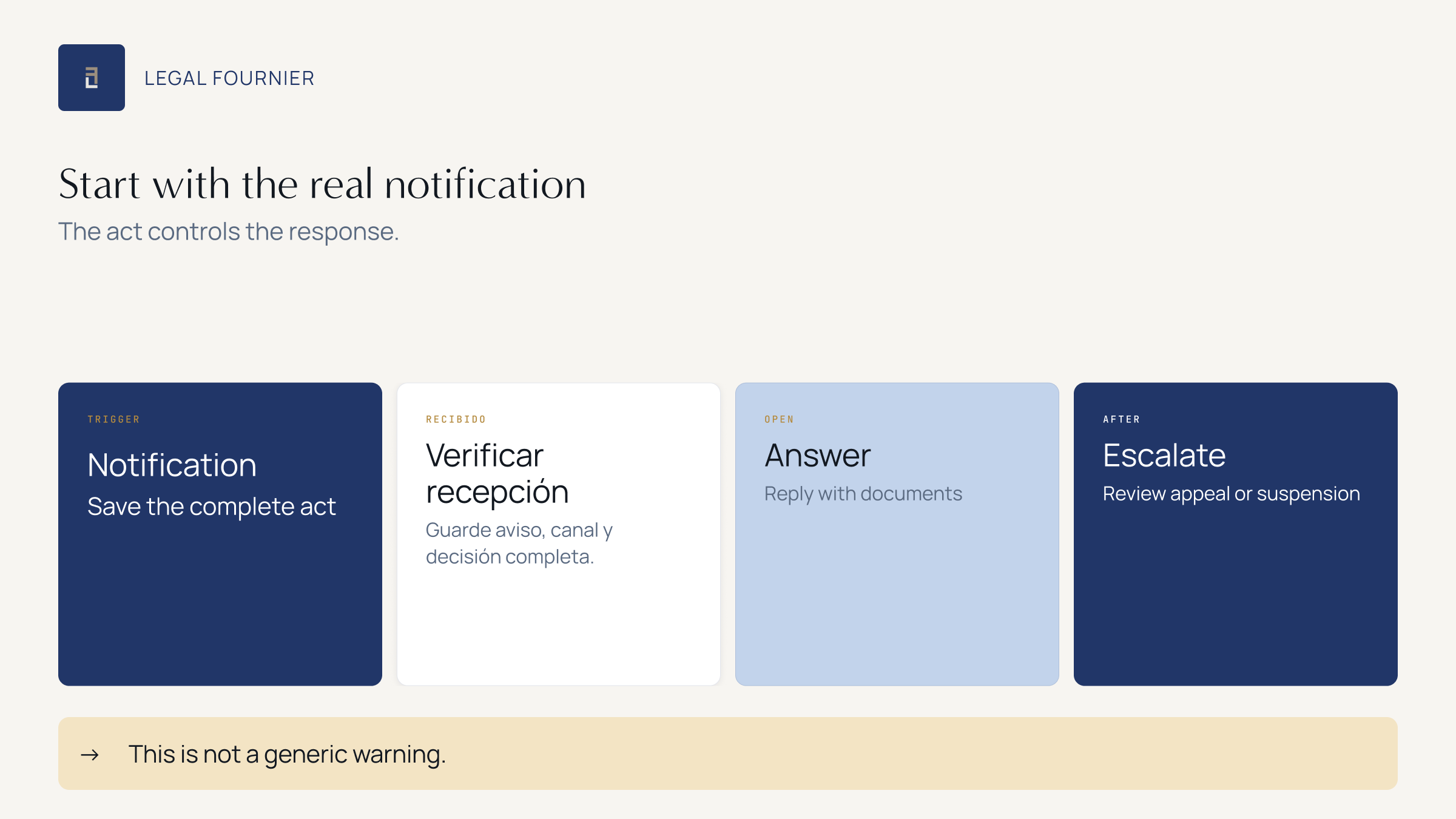
If the embargo follows an AEAT notice or a sanction proposal, read it together with our notificación AEAT guide and the possible appeal strategy, because collection and defence often move on different clocks.
Last updated: 23 June 2026 · Based on AEAT guidance on embargos and electronic notifications, the Ley General Tributaria, Ley 39/2015 and the Ley de Enjuiciamiento Civil.
Key takeaways
- Do not assume the debt is obvious. Verify the NIF, debtor, diligence number, expediente, source debt, notification history, amount and whether the recipient is the debtor or a third party.
- There are two clocks. The operational response to the diligence is different from a legal appeal. AEAT states that appeals against a diligence of embargo must be made within one month from the day after receipt.
- Opposition grounds are limited. The Ley General Tributaria restricts the grounds for opposing a diligence of embargo to specific collection-stage issues.
- Third-party recipients must answer. AEAT says answering a diligence is obligatory even if the debt has been paid or there is no relationship with the debtor.
- For companies, DEHú discipline matters. Legal entities are normally obliged to receive AEAT notifications electronically; a missed electronic notice can still start deadlines.
What a diligencia de embargo means in practice
A diligencia de embargo is the document used to record an enforcement seizure action. Under the Ley General Tributaria, each seizure action is documented in a diligence and notified to the person with whom the action is carried out. Once the embargo has been made, the diligence may also be notified to the tax debtor and, where relevant, to third parties connected to the seized asset or right.
This is later than a normal tax assessment or a standard requerimiento. In a typical collection sequence, the debt has passed through voluntary payment, then the executive period, then a providencia de apremio. Article 167 of the Ley General Tributaria states that if the debtor does not pay within the payment period after the providencia de apremio, the Administration proceeds to seize assets, as warned in that providencia.
That sequence matters because the arguments available at the embargo stage are narrower than the arguments that may have existed against the original tax assessment. A founder who wants to debate the whole tax year, the accounting treatment, the permanent-establishment analysis, or the company structure may be too late to make that debate inside the embargo appeal unless a collection-stage ground exists.
The strategic question is not simply “how do I answer AEAT?”. It is “which role am I answering in, which deadline is running, and which legal ground is still open at this stage?”.
First check: are you the debtor or a third-party recipient?
The same Spanish word embargo can hide very different positions. The recipient may be the debtor whose bank account, salary, shares or property is being seized. But the recipient may also be a third party: an employer, tenant, bank, card-payment processor, customer, platform, Spanish SL, group company or other person who owes money to the debtor and is being ordered to retain and pay that money to AEAT.
In a LATAM business or private-client file, this role check is essential. A Spanish holding company may receive a diligence because it owes management fees to a related company. A Spanish operating subsidiary may receive one because it pays a founder, landlord or supplier. A bank may freeze an account in the name of a company. A director may discover the matter only after a corporate account or payroll payment is affected.
Before taking a position, build a simple role map:
- Recipient of the diligence. Who received it and through which channel: DEHú, AEAT Sede, bank, email from an adviser, postal notice or company certificate?
- Tax debtor. Which NIF appears as the debtor: the individual, the Spanish SL, a non-resident company, an estate, a shareholder or another entity?
- Type of embargo. Is it a bank account embargo, salary embargo, commercial-credit embargo, TPV/card-payment embargo, securities embargo or another asset category?
- Payment relationship. If the recipient is a third party, what money is due to the debtor, when is it due, under which contract, invoice, payroll or lease?
- Decision maker. Who has authority to answer, appeal, pay, request a lift or instruct counsel?
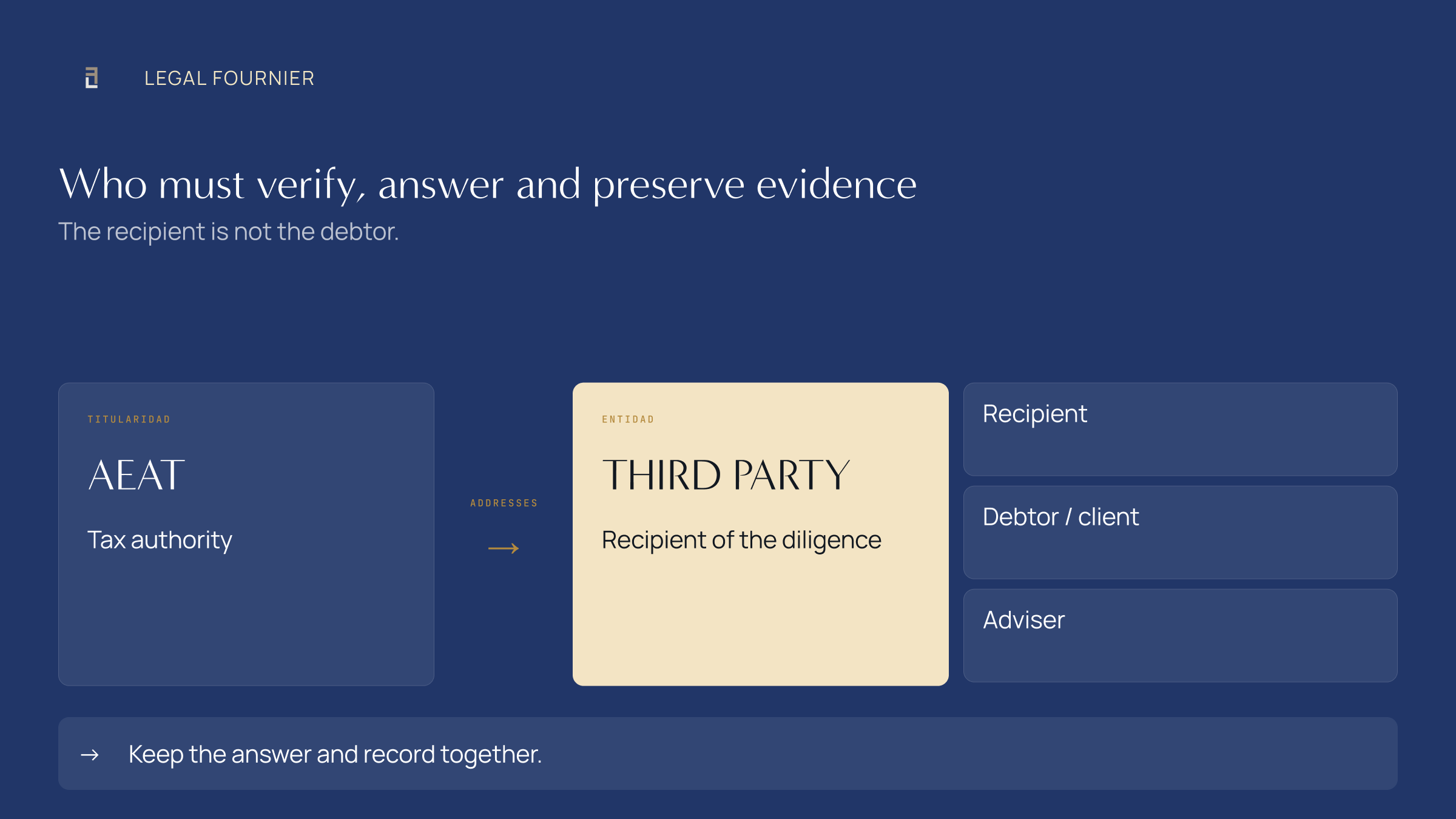
Do not let a foreign shareholder or director answer informally without verifying representation. For Spanish companies and foreign controlled groups, powers of attorney, digital certificates, representative certificates and adviser mandates should match the action being taken.
How to verify the debt before answering
The first working file should be evidentiary, not emotional. Many bad responses are written from panic: “this is impossible”, “we already paid”, “this belongs to another company”, “we never received anything”. Those may be true, but they must be proved in the collection file.
Verify at least these points before submitting a response:
| Check | What to confirm | Why it matters |
|---|---|---|
| Identity | NIF, company name, debtor name, recipient name, diligence number, CSV and expediente. | A group with several Spanish and foreign entities can easily confuse the debtor and recipient. |
| Source debt | Tax concept, period, liquidation key, sanction, surcharge, interest and costs. | The embargo may be only the latest document in a longer file. |
| Notification trail | Original assessment, voluntary payment deadline, providencia de apremio, electronic access or deemed notification dates. | Lack of notification of the providencia de apremio is one of the limited grounds against the diligence. |
| Current status | Paid, pending, partially paid, appealed, suspended, deferred, time-barred or subject to another collection measure. | Payment, suspension or prescription can change the response strategy. |
| Asset affected | Bank balance, salary, invoice, rent, TPV settlements, securities, shares or other right. | Different embargo types create different operational duties and evidence needs. |
For companies, also check who controls the digital certificate and DEHú access. The AEAT electronic-notification FAQ states that legal entities and several other categories are obliged to receive communications and notifications electronically, and that electronic notifications are effective when accessed or, if not accessed, after 10 calendar days from being made available. That can be decisive when a non-resident administrator says nobody physically received a letter.
The deadline problem: response clock vs appeal clock
The phrase “deadline to respond” is dangerous because it can mean at least two different things.
1. the operational response to the diligence
AEAT’s technical guidance on how to answer a diligence of embargo says the answer is obligatory regardless of whether the debt has already been paid or whether the recipient has no relationship with the debtor. It also explains that the recipient can choose the relevant situation with the debtor on the date the diligence was received, submit the answer, and then, once answered, generate payment letters where applicable.
That operational response should be handled as soon as the facts are checked. If the notice or AEAT portal states a specific response period, calendar it exactly. Do not assume that the one-month appeal period gives a company permission to keep paying the debtor, ignore retained amounts, or wait before answering as a third-party payer.
2. the Legal challenge against the embargo
If the debtor disagrees with the diligence and wants to challenge it, AEAT’s recursos page for embargo states that, once the diligence has been notified, the debtor must choose within a maximum period of one month counted from the day after receipt between a recurso de reposición and an economic-administrative claim.
These are not the same action. A third-party answer tells AEAT the relationship and retained amount. A legal challenge asks for the measure to be reviewed. A payment or request for a levantamiento may be a third route if the debt has been paid, suspended or otherwise should no longer remain attached to the asset.
In a company file, calendar the response date, the appeal deadline, the payment dates and any internal cash flow dates separately. One missed internal approval can turn a legal problem into an operational freeze.
What grounds can actually be used against the embargo?
At the embargo stage, the legal grounds are not open-ended. Article 170.3 of the Ley General Tributaria says that only the following grounds are admissible against a diligence of embargo:
- Extinction of the debt or prescription of the right to demand payment.
- Lack of notification of the providencia de apremio.
- Breach of the legal rules governing the embargo contained in the law.
- Suspension of the collection procedure.
AEAT repeats the same limited-ground approach in its own embargo resources guidance. That is why the first review must focus on the collection file. If the original tax assessment was wrong but was not challenged on time, the embargo appeal may not be the place to reargue the entire substantive tax position.
For foreign clients, the most common viable issues are often procedural or evidentiary: an apremio notice was not validly notified, the debt was already paid or compensated, a suspension existed, the wrong debtor was identified, the embargo exceeded what the law allows, or the recipient is being asked to retain money that is not actually owed to the debtor.
Bank accounts, salaries, commercial credits and TPV: why the type matters
AEAT’s embargo information pages distinguish several types of embargo. The category affects what the recipient must do and what evidence should be preserved.
Bank accounts
Article 171 of the Ley General Tributaria allows the Tax Administration to seize funds, securities and other assets held by a credit institution or depositary, within the relevant jurisdictional scope. If an account has several holders, the law provides a presumption of equal division unless a different material ownership is proved. If salary or pension payments are usually paid into the account, the law requires the limits established in the Ley de Enjuiciamiento Civil to be respected for the relevant salary or pension amount.
In private-client files, that means evidence of actual ownership can matter. A joint account between spouses, a founder and company, or a family member and Spanish resident should not be analysed casually. Bank statements, source of funds records, corporate accounting and matrimonial-property information may be relevant.
Salaries, wages and pensions
AEAT explains that a salary or pension embargo is a periodic deduction from the debtor’s salary, wage or pension, calculated by reference to the Spanish minimum wage. The Ley de Enjuiciamiento Civil contains the salary and pension protection rules in Article 607. Employers should not improvise the retention amount without checking the applicable salary base and AEAT calculator or official guidance.
Commercial credits and tpv/card-payment flows
AEAT states that an embargo of commercial credits is sent to persons or entities that have a relationship with the debtor because they carry out transactions with the debtor or pay rent or another amount to the debtor. When this type of embargo is received, the relevant payment or payments owed to the debtor are seized and must be paid to AEAT. AEAT also notes that recipients must continue retaining and paying while the commercial relationship exists until the total amount in the diligence is paid or a lift or termination communication is received.
This is where business groups make expensive mistakes. If a Spanish company receives a credit embargo affecting a supplier, related company, director, landlord or consultant, it should stop treating the payment as ordinary payables until the retention position is clear. Paying the debtor after receipt of the diligence can create a separate problem for the recipient.
A premium response file: what we would want to see
For a founder, HNW family, Spanish SL or LATAM holding structure, a good response file should be built before anyone submits a rushed portal answer. The file should usually include:
- The full notice pack. Diligence, CSV verification, attachments, envelope or electronic notification proof, screenshot of AEAT access dates and any bank communication.
- The debt map. Tax concept, period, amount, surcharges, interest, costs, prior assessments and the providencia de apremio.
- The relationship evidence. Contract, invoices, payroll, lease, loan agreement, board minutes, related-party agreement or accounting entry showing whether money is owed to the debtor.
- The payment status. Proof of payment, deferral, compensation, suspension, appeal, prescription argument or reason why no payment relationship exists.
- The authority file. Representative certificate, power of attorney, adviser authorisation, director authority and digital-signature access.
- The deadline chart. Receipt date, deemed electronic notification date, response deadline in the notice, one-month appeal deadline, internal approval dates and cash flow dates.
For Spanish companies with foreign directors, this file should also be integrated into accounting. Amounts retained for AEAT should be traceable. If a related-party payment is affected, the group should document why the payment was stopped, retained or redirected. This is particularly important where a Spanish company is part of a LATAM group and the affected payments are visible to auditors, banks or future tax reviewers.
When to seek a lift, appeal or payment route
Not every case should be appealed. Not every case should be paid immediately. The right route depends on the evidence.
| Scenario | Likely route to review | Key evidence |
|---|---|---|
| Debt already paid | Request lift or correction; preserve appeal if needed. | NRC, bank proof, AEAT receipt, allocation to the exact debt. |
| No relationship with debtor | Answer the diligence stating the situation; do not ignore it. | Contracts, accounting, supplier/customer records, termination evidence. |
| Wrong debtor or wrong recipient | Procedural correction and possibly appeal. | NIFs, group chart, registry extracts, invoices, ownership records. |
| Suspension or deferral exists | Request review of collection status and lift if appropriate. | Suspension agreement, deferral resolution, guarantee evidence, appeal record. |
| Debt is real and cash flow matters | Payment, instalment strategy where legally available, or coordinated treasury response. | Debt breakdown, bank position, operating cash flow forecast, affected contracts. |
Where the client also needs to fix historic Spanish tax filings, corporate accounting or non-resident positions, the embargo response should not be isolated. It should connect to the wider Spanish tax file. For a Spanish SL, that may include corporate tax, VAT, payroll, withholding, annual accounts and monthly accounting. For an individual founder or family shareholder, it may include Spanish tax residence, personal income tax, wealth tax, non-resident income tax or international reporting.
Common mistakes in cross-border embargo files
The same mistakes repeat in foreign-client cases:
- Checking only the bank app. A frozen account is the symptom. The legal file is in AEAT notifications, prior debts and collection documents.
- Confusing the individual and company. A founder, Spanish SL, holding company and foreign operating company may have different NIFs, debts and payment relationships.
- Arguing the wrong issue. At the embargo stage, the original tax merits may not be the admissible ground; the collection file needs review first.
- Ignoring the third-party duty. AEAT says the answer is obligatory even where the debt has been paid or there is no relationship with the debtor.
- Leaving DEHú unmanaged. A legal entity with foreign directors needs a real notification protocol, not an occasional login by whoever remembers the certificate password.
- Paying the debtor after receipt. If a commercial credit is embargoed, continuing to pay the debtor without resolving the diligence can create avoidable exposure.
FAQ: contestar diligencia embargo AEAT
Is answering a diligencia de embargo AEAT mandatory?
AEAT’s own guidance says that answering a diligence of embargo is obligatory, even if the debt has already been paid or the recipient has no relationship with the debtor. The answer should reflect the verified situation on the date the diligence was received.
What is the deadline to appeal a diligence of embargo?
AEAT states that, once the diligence is notified, the debtor who disagrees and wants to challenge it must choose within one month from the day after receipt between a recurso de reposición and an economic-administrative claim. This appeal clock should not be confused with the operational duty to answer the diligence or retain payments.
Can I challenge the original tax assessment through the embargo appeal?
Usually not in a broad way. At the embargo stage, the Ley General Tributaria limits the grounds of opposition to specific issues such as extinction or prescription of the debt, lack of notification of the providencia de apremio, breach of embargo rules, or suspension of collection. The original tax assessment may have had its own earlier challenge period.
What if my Spanish company does not owe money to the debtor?
The company should still answer the diligence, stating the verified situation and keeping evidence that no relationship or payable exists. Do not ignore the notice simply because there is no debt to retain.
Can AEAT embargo money in a joint bank account?
Article 171 of the Ley General Tributaria contains specific rules for accounts with several holders, including a presumption of equal division unless different material ownership is proved. In family, founder and company accounts, evidence of ownership and source of funds should be reviewed before responding.
Does an electronic notice count if nobody opened it?
For electronic notifications, AEAT states that the notification is effective when the content is accessed or, if not accessed, after 10 calendar days from being made available. Legal entities are normally obliged to receive AEAT notifications electronically, so foreign directors should not rely on lack of postal mail as a strategy.