

Commercial Mortgages in Spain: Business Premises and Investment Property
Take a fictional file. A Spanish company plans to buy business premises. The proposed borrower is the company, the asset is a commercial unit, the loan will fund the acquisition, and a director may give a personal guarantee. Those four facts matter more than the marketing label “commercial mortgage”. Change the guarantor, the security property or the purpose of the funds, and the legal-scope analysis may change as well.
The other immediate question sits in a different document: can the company become bound to buy before the lender becomes bound to advance? A valuation, an indicative term sheet or a verbal approval does not, by itself, close that gap. Put the purchase agreement and the bank’s conditions side by side before signing an unconditional commitment.
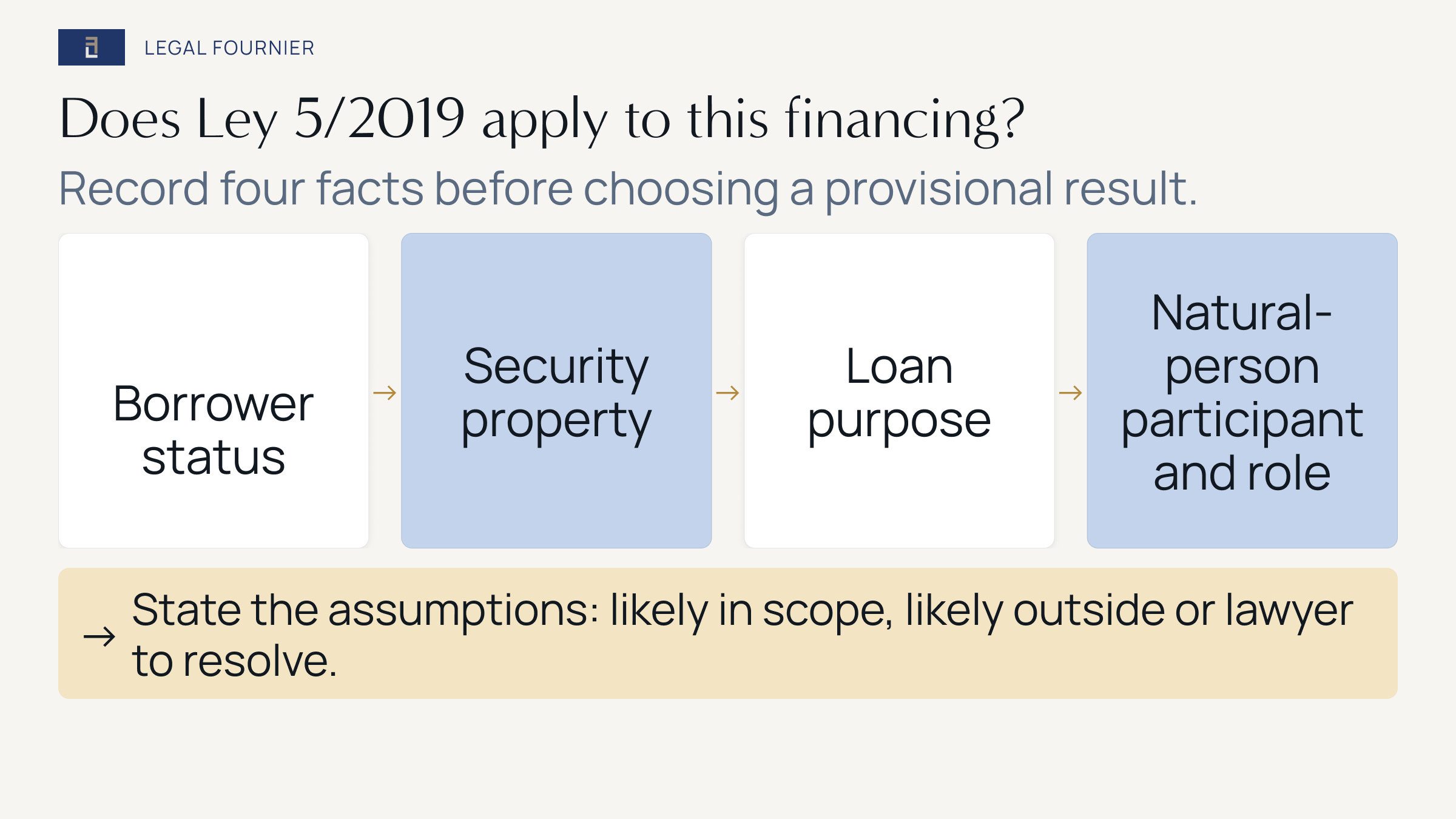
Fill four cells before assuming Ley 5/2019 applies
| Cell | Fact to record |
|---|---|
| Borrower | Company or natural person; if natural, acting as a consumer or for business purposes? |
| Security property | Residential property, commercial premises or no real-estate security? |
| Use of funds | Acquisition or preservation of ownership, refinance, later works, or business liquidity? |
| Natural-person participant | Borrower, surety, guarantor or non-debtor mortgagor, and in which capacity? |
Ley 5/2019 protects natural persons who are borrowers, guarantors or security providers in the transactions within its object and scope. Article 2.1(a) concerns loans secured on residential property when the borrower, surety or guarantor is a natural person. Article 2.1(b) concerns loans to acquire or preserve ownership rights over land or buildings when the borrower, surety or guarantor is a consumer. The consumer requirement in limb (b) should not be imported into limb (a), while limb (b) is not confined to residential property. Read the facts against articles 1 and 2 of Ley 5/2019.
Each row in this issue-spotting grid is fictional. Use the provisional labels only with the assumptions shown. If a relevant cell is unknown, record “lawyer to resolve”, not a firm yes or no.
| Combination | Provisional output | Question still open |
|---|---|---|
| Company buys a commercial unit; company-only security; no natural-person guarantor | Likely outside Ley 5/2019 | Confirm every party and security instrument; other banking and contract rules still apply. |
| Company buys a commercial unit; director guarantees in a genuine consumer capacity | Protected-guarantor perimeter needs legal review | Which duties and substantive limits attach to the natural-person guarantee, rather than the company debt? |
| Company takes working-capital finance; a natural person mortgages residential property | Likely article 2.1(a) issue | Confirm residential use, professional lender and the natural person’s role. |
| Natural-person trader buys premises solely for the trade, secured on those premises | Likely outside article 2.1(b), subject to review | Consumer capacity and any separate residential security or consumer guarantee. |
| Natural person already owns commercial premises and borrows for later business repairs | Fact-sensitive | Whether the precise purpose falls within the acquire-or-preserve limb. |
| Acquisition finance also refinances or releases an earlier title charge | Lawyer to resolve | Trace the use of funds and the relationship between the earlier debt and ownership. |
A 2019 DGRN instruction states that Ley 5/2019 does not apply to a corporate borrower simply because the company might be described as a consumer or client. It separately analyses a natural-person guarantor in a company loan. That distinction does not make the whole company obligation a consumer contract. See the DGRN Instruction of 20 December 2019.
Purpose also needs evidence. In a 2020 resolution, the DGRN treated a particular loan for repairs and improvements to non-residential premises, made after acquisition, as outside the relevant acquire-or-preserve limb on its facts. It is not a rule that all works or refinancing loans fall outside the Act. The comparison starts with the use-of-funds trail. See the DGRN Resolution of 21 January 2020.
Put the purchase deadline beside the drawdown conditions
A commitment-gap ledger for the same fictional acquisition exposes the timing problem. Transcribe the actual terms rather than inserting a supposed market standard.
| Commitment or condition | Document | Fact to copy | Gap to flag |
|---|---|---|---|
| Purchase or arras deadline | Draft or signed purchase/arras agreement | Date, finance condition, termination and extension mechanism | Deposit or completion exposure may arise before drawdown. |
| Bank offer status | Indicative term sheet, binding offer or FEIN if applicable | Binding status, expiry, reservations and conditions | A term sheet or valuation is not necessarily a drawdown commitment. |
| Exact asset | Title, nota simple, cadastre, plans, licences and valuation | Registered unit, surface, use, occupancy, lease and assumptions | A mismatch may affect due diligence, value, conditions or timing. |
| Equity contribution | Offer and source-of-funds file | Amount basis, deadline and acceptable evidence | Do not calculate the shortfall using an assumed loan-to-value ratio. |
| Security perimeter | Draft facility, deed, guarantees and pledges | Property, personal or group guarantees, accounts, rents, shares, maximum amount and release | Exposure may extend beyond the premises. |
| Conditions precedent | Facility agreement and closing list | Registry, tax, insurance, licences, leases, approvals and responsible party | A missing item may delay drawdown while the purchase obligation continues. |
| Covenant or cross-default | Facility and guarantee drafts | Actual metric, accounts, test date, cure and consequence | There is no universal financial covenant. |
| Authority and conflicts | Group chart, powers and corporate resolutions | Each borrower, guarantor and security provider’s approval | A group guarantee is not valid merely because it appears in a term sheet. |
Mark each line as fixed, conditional, missing evidence or legal review. That makes the timing problem visible without pretending to draft a financing condition or assess the sufficiency of a bank’s closing package.
If the purchase file uses an arras agreement, read its financing condition and evidence requirements rather than assuming a bank refusal automatically protects the deposit. The separate guide on an arras contract with a mortgage condition explains that narrower contract issue.
If Ley 5/2019 applies, article 14 requires specified pre-contract documents, including the FEIN and FiAE, at least ten calendar days before signature. This is a conditional rule, not a promise that every corporate borrower will receive a FEIN. Identify the protected natural person and the transaction first. The relevant requirements are in article 14 of Ley 5/2019.
Reconcile the appraisal instead of treating it as approval
Where Ley 5/2019 applies, article 13 requires an adequate, independent appraisal of the real property supplied as security before the loan agreement. Resolve scope before relying on that provision; it is not an appraisal rule for every corporate commercial mortgage. The appraisal still does not bind the lender to advance a stated amount. See article 13 of Ley 5/2019.
For an appraisal within Orden ECO/805/2003, the valuer performs checks that include physical identity, location and characteristics against documents, apparent condition, visible easements, occupancy and use. Leased property requires specified information about the lease, rent, occupancy, payment and expenses. See articles 7 and 8 of Orden ECO/805/2003.
Compare the valuation with the title, nota simple, cadastre, plans, licence and purchase agreement. Record any mismatch in:
- the registered unit, owner, physical location or surface;
- the authorised or stated use, occupancy and any lease assumptions;
- visible easements, apparent condition, warnings or special assumptions;
- the bank offer’s definition of value and the asset described in the purchase contract.
The output is a mismatch list. It is not a valuation opinion. Appraised value does not determine the bank’s advance, the contractual loan-to-value definition or approval. Planning, licensing, structural, environmental, lease and title questions require their own competent review.
The property is only one part of the security package
A mortgage directly subjects the charged property to performance of the secured obligation. A voluntary mortgage requires a public deed and registration in the Property Registry. Direct mortgage enforcement relies on the registered mortgage and the particulars recorded in the title. These rules appear in articles 104, 145 and 130 of the Mortgage Act.
Review the mortgage separately from personal guarantees, company guarantees, rent or account pledges, share security, covenants and cross-default. A director who owns shares in the borrower is not automatically the same person, in the same capacity, as a guarantor or non-debtor mortgagor.
Purchase tax and loan costs need their own route
Article 29 of the Transfer Tax and Stamp Duty Act treats the lender as taxpayer for AJD on a deed documenting a mortgage-secured loan. That narrow rule does not mean the lender bears every acquisition tax, appraisal charge, bank fee or closing cost. The article is available in Royal Legislative Decree 1/1993.
The VAT or TPO treatment of the property purchase depends on the seller and the legal character of that transfer, including whether an exemption or effective waiver applies. In some waiver cases the buyer may account for VAT under the reverse-charge rules. The finance approval does not decide this. Start with the AEAT VAT/TPO boundary guidance and obtain transaction-specific tax advice. Do not rely on a universal closing-cost percentage.
The accounting treatment is also document-based. Under Spanish PGC NRV 9, ordinary loans received are generally financial liabilities, initially measured at fair value with the required treatment of directly attributable transaction costs and later at amortised cost using the effective-interest method. That does not tell the company whether a specific fee belongs to the loan, the acquired property or current expense. The accountant needs the invoices, facility and acquisition file. See the Spanish General Accounting Plan.
This article provides general information and does not replace advice on the actual financing, security, purchase, tax, accounting, planning or property file.