Spanish SL bank account denied: what foreign founders should fix first
A Spanish SL can be fully incorporated and still be unable to trade because a bank has refused its account application. Without an operating account, the company may be unable to receive investment, pay suppliers or payroll, or collect from customers.
Foreign founders often respond by trying another bank. That may be appropriate, but it will not cure a weak KYC file. Before applying again, check the evidence for the company’s identity, representation, beneficial ownership, source of funds and business purpose. Also examine any permanent establishment Spain exposure created before the SL was ready.
A useful review covers the corporate, tax and compliance issues together. If you are still designing the structure, start with our company formation in Spain service. Our guide to opening a bank account in Spain explains the wider banking process. Here, the focus is narrower: what a foreign-controlled SL should repair after a refusal.
Published: 2 July 2026
- A bank is not obliged to open an ordinary account just because the SL has been incorporated. Banco de España guidance says account opening is not automatic and depends on agreement with the institution.
- Spanish AML rules require banks to identify the company, the representatives and the beneficial owners before establishing the relationship.
- The first repair is usually documentary: company NIF, deed, registry status, administrator authority, powers, UBO chart and tax address must tell one coherent story.
- The second repair is economic: the bank must understand the source of funds, expected flows, countries involved and commercial purpose of the account.
- If the foreign group has already operated from Spain, the bank problem may be connected to a permanent establishment Spain risk, not merely missing paperwork.
- A complaint can be appropriate in some cases, but it does not replace a bank-ready compliance file.
Why a Spanish SL bank account gets denied
Foreign founders often receive a general explanation: “compliance did not approve the file”, “the business model is outside policy”, “we need more documents”, or “the bank cannot proceed at this time”. Sometimes one document is missing. In other cases, several facts do not fit together. A new SL with a foreign shareholder, non-resident administrator, foreign holding company and immediate international transfers presents a different risk profile from a local company with a resident owner and domestic trading history.
The Banco de España client guidance explains that financial institutions are generally free to decide whether to open an account, based on internal policies, risk appetite and commercial strategy. It also warns that opening an account is not automatic: both the customer and the bank must agree to the relationship. That guidance is written for banking customers generally, but the practical lesson is important for companies too. Incorporation does not force a bank to accept a business relationship that it cannot underwrite.
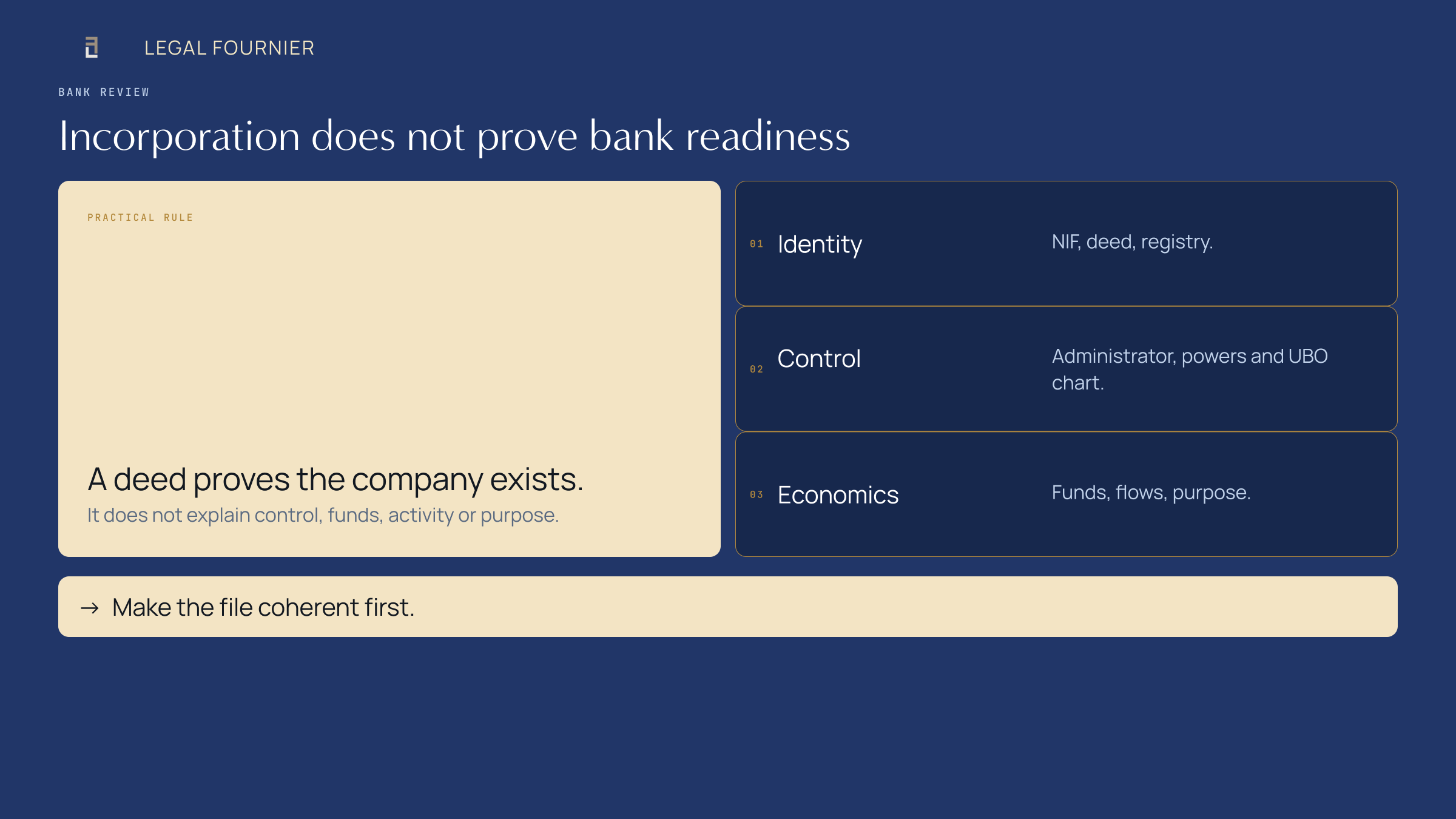
A bank cannot refuse for prohibited discriminatory reasons, and some refusals are handled poorly. But a branch officer cannot usually “override compliance” on the strength of the incorporation deed alone. The deed proves that the company exists. It does not show who ultimately controls it, where its first funds came from, why it needs a Spanish account or whether the expected transactions fit its business model.
The practical rule: after a denial, do not start with “which bank is easier?” Start with “what did the file fail to prove?”
The repair order: fix the file before the bank search
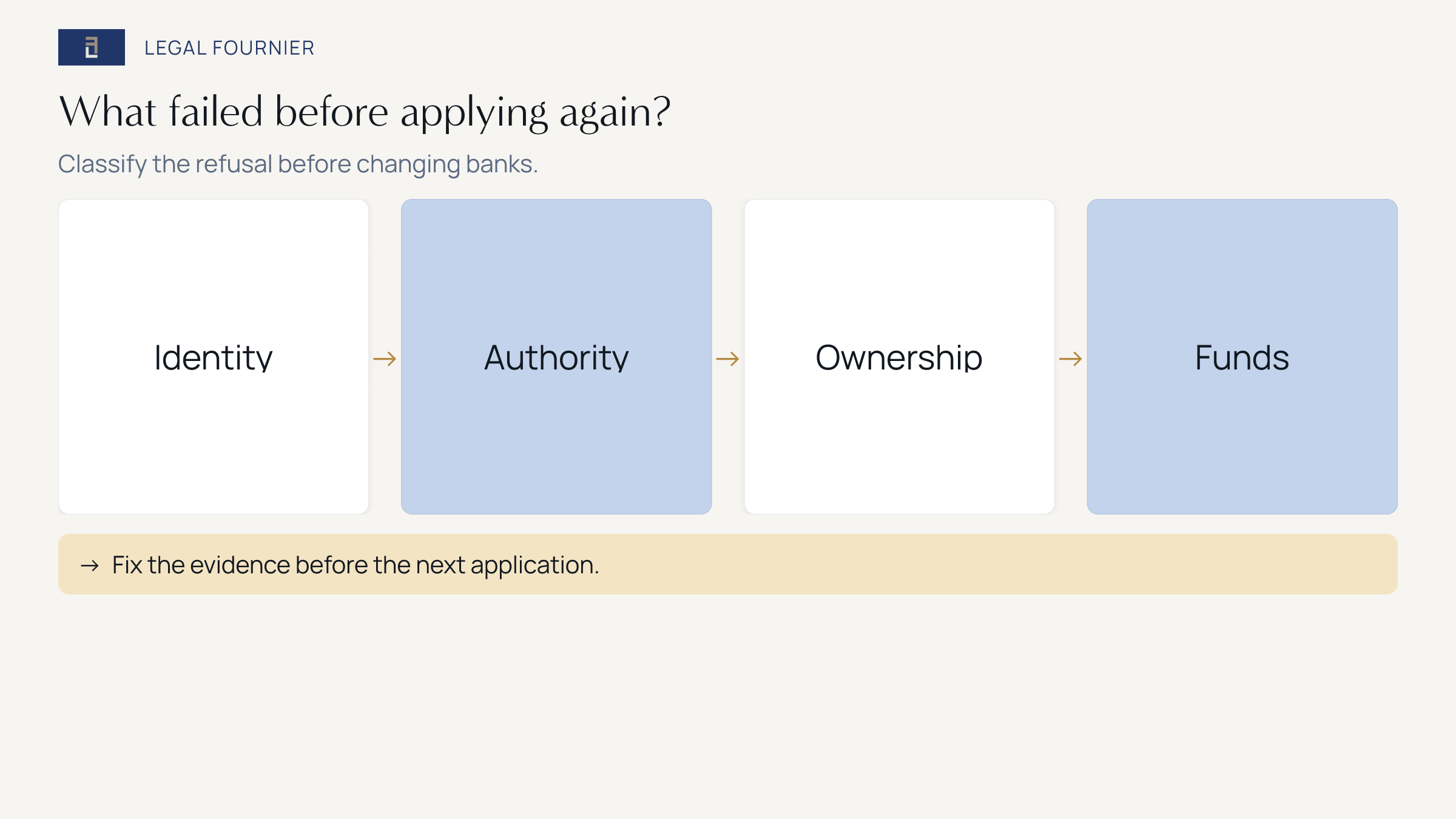
Review the refusal in six parts. Each one corresponds to a question the bank must answer before opening the account.
| Layer | Bank question | First repair |
|---|---|---|
| Company identity | Does this SL legally exist and have a usable tax identity? | Deed, NIF, registry evidence, tax address, current company data |
| Authority | Who can open and operate the account? | Administrator appointment, powers, representative identity, signing rules |
| Beneficial ownership | Which natural persons ultimately own or control the SL? | UBO chart, percentages, control criteria, supporting documents |
| Funds | Where does the first and future money come from? | Source-of-funds and source-of-wealth evidence, investor or loan documents |
| Activity | What will the company actually do through this account? | Business model, contracts, website, expected turnover, customer countries |
| Tax footprint | Is the Spanish company aligned with the real operations? | Accounting start, VAT position, director pay, permanent establishment review |
The order matters. Source-of-funds evidence will not cure uncertainty about registry status, the NIF or signing authority. Equally, complete company documents will not explain a large incoming transfer from abroad.
First fix: company identity and NIF status
The bank must first identify the company. That sounds basic, but newly formed Spanish SLs often arrive with a mixture of draft tax forms, notarial copies, provisional documentation, pending registry steps and translations. For a bank compliance team, a partial file can look like an unresolved entity.
The AEAT guidance on NIF for legal persons and organisations states that legal persons and entities without legal personality are generally required to have a NIF when carrying out operations with tax implications. AEAT also provides a procedure for requesting a company NIF through Modelo 036. Its Modelo 036 guidance explains that if not all documentation is provided, the assigned NIF may be provisional and the entity remains obliged to provide pending documentation for the definitive NIF after registration or after the public deed where registration is not required.
This can create a basic misunderstanding. The founder believes “the NIF is done”, while the bank sees a provisional tax identity or missing evidence. Resolve it with a single entity pack containing the deed, bylaws, registry evidence, NIF documentation, tax address, administrator details and any outstanding step for the definitive NIF.
The AML regulation also supports why banks ask for this. Royal Decree 304/2014, which develops the Spanish AML law, treats public documents proving a legal person’s existence, company name, legal form, address, administrators, bylaws and tax identification number as reliable documents for formal identification. For Spanish legal persons, a provincial Mercantile Registry certificate can be acceptable for formal identification. If the bank is missing those elements, the denial may be a predictable compliance outcome.
Second fix: authority to open and operate the account
A foreign founder may not be the person who legally binds the SL. The bank needs to know who the administrator is, whether the administrator acts alone or jointly, whether a power of attorney exists, whether the power is valid for banking operations, and whether the person in front of the bank is authorised to represent the company.
This becomes sensitive when the founder is abroad, when a Spanish professional has incorporated the company under a limited power, when a foreign parent company appoints a representative, or when two directors must sign together. If the deed, registry note, power of attorney and onboarding form do not match, the bank may decline the file even where the business itself is legitimate.
The repair is a representation matrix: company, administrator, attorneys, source document, scope of banking powers, signing rule and any limitation. Foreign powers may need apostille or legalisation, sworn translation and notarial review. The goal is making authority intelligible to the bank’s compliance team.
Third fix: beneficial ownership, not just shareholders
The shareholder list is not the end of the KYC analysis. Spanish AML law requires banks and other obliged entities to identify the titular real, or beneficial owner, and take appropriate measures to verify that identity before entering into a business relationship. Law 10/2010 also requires legal persons to obtain, keep and update beneficial-owner information and to have that information available when they establish business relationships or carry out occasional operations.
For an SL owned 100 percent by one individual, the ownership chart is usually simple. A foreign-owned structure may instead include a Delaware company, Latin American holding, UK LLP, family office, trust, investment vehicle or entities in several jurisdictions. The bank then needs more than a cap table. It needs a documented path to the natural persons who ultimately own or control the structure.
The Ministry of Justice page for the Registro Central de Titularidades Reales describes Spain’s central beneficial-ownership register and explains the general concept of beneficial ownership as the natural person or persons who ultimately own or control, directly or indirectly, more than 25 percent of the capital or voting rights of a legal person, or who otherwise exercise control. If no natural person meets that control test, administrators may be treated as assimilated beneficial owners under the relevant rules.
Prepare the UBO pack so that someone unfamiliar with the group can follow it. Include an ownership chart, entity extracts, shareholder registers, evidence of management, beneficial-owner IDs, tax residence information and an explanation of any nominee, trust, fund, family company or voting arrangement. A complex structure is not inherently suspicious, but an unexplained one will slow the review.
Fourth fix: source of funds and commercial purpose
A Spanish SL account is not opened only to hold a legal identity. It is opened to receive and move money. The bank therefore needs to understand the purpose and intended nature of the relationship. Law 10/2010 requires obliged entities to obtain information about the purpose and expected nature of the business relationship and, in particular, to understand the customer’s professional or business activity and reasonably verify the truth of that information.
This is where many foreign-founder files fail. The founder provides the deed, passport and tax form, but gives only a vague commercial explanation: “consulting”, “holding”, “investment”, “real estate”, “technology”, “international services”. A broad corporate object may be valid for company formation, but it does not necessarily explain the first transactions. The bank wants to know what money will enter, from where, in what amount, how often, from which countries, from which counterparties, and why those flows match the company’s declared activity.
A repair file should include a short business note covering the expected customers and supplier countries, first contracts, projected turnover, initial funding and source of the first transfer. Disclose any regulated activity, cash or crypto exposure, high-risk jurisdictions, politically exposed persons or large intercompany flows. The bank does not need a sales pitch; it needs an explanation its compliance team can verify.
For source of funds, the right evidence depends on the facts. Salary savings, dividends, sale proceeds, a property sale, a company distribution, investor subscription money, a shareholder loan, inherited funds or operating revenue all require different support. Bank statements alone may show where money sat before the transfer, but they may not explain how the wealth was generated. For larger sums, especially property, hospitality, import-export, financial, crypto-adjacent or family-office files, the difference between source of funds and source of wealth matters.
Fifth fix: risk profile and enhanced due diligence
Not every bank denial means the founder did something wrong. Sometimes the file sits outside the institution’s risk appetite. SEPBLAC’s due diligence guidance explains that obliged entities apply different levels of due diligence according to risk, including enhanced due diligence for higher-risk countries, business areas, activities, products, services, channels, relationships, clients and operations. Remote onboarding can also require secure identification procedures under the AML regulatory framework.
This is particularly relevant for non-resident founders. A bank may see a newly incorporated SL, no Spanish trading history, foreign UBOs, remote signing, a foreign parent company, expected transfers from outside the EU, and a business model involving international payments. None of those facts automatically prevents an account. Together, however, they can move the file from standard onboarding to enhanced review.
The repair is to reduce unexplained risk, not to hide it. Explain the foreign parent, Latin American transfers, property money, regulated activity or relocation facts before the bank discovers them from the website, contracts or transaction pattern. Align the company file with the residence, tax and social security plan where the founder is moving to Spain.
How permanent establishment risk enters the bank review
A bank refusal can expose a deeper inconsistency. The Spanish SL may be presented as a new operating company even though the founder or foreign group has already been doing business from Spain. That history can raise a permanent establishment Spain question.
AEAT’s definition of permanent establishment for Non-Resident Income Tax refers to a natural person or legal entity carrying out economic activities in Spain through facilities or workplaces on a continuous or habitual basis, or through an agent authorised to contract in the name and on behalf of the non-resident who habitually exercises those powers. AEAT also notes that a permanent establishment has no legal personality of its own.
That matters because a bank may ask for documents that reveal the operational history: prior invoices, contracts, customer countries, local staff, lease agreements, Spanish address, website claims, or payments already received by a foreign company for Spanish activity. If the story is “the SL is new”, but the evidence shows an active Spanish business before incorporation, the bank question becomes broader. Who was operating? Who owned the revenue? Was there a branch, fixed place of business, dependent-agent risk, VAT exposure or payroll issue before the SL account application?
Incorporating the SL may solve the structure going forward, but it does not erase earlier activity by a foreign company. Coordinate the KYC response with a tax review if the founder has already hired staff, sold goods or services, negotiated, stored goods, signed contracts or managed a foreign company from Spain. For the wider tax analysis, see our Spain permanent establishment risk checker.
What not to do after a bank denial
A refusal often arrives when payroll, a supplier deposit or an investor transfer is already due. Acting quickly is understandable, but some shortcuts make the next review harder.
- Do not submit the same weak pack to ten banks. Multiple inconsistent applications can create a trail of refusals without solving the evidence gap.
- Do not use a personal account as a permanent workaround. Temporary practical steps need legal and accounting review, especially where company revenue, VAT, investor funds or payroll are involved.
- Do not hide the foreign shareholder or UBO chain. The bank is required to understand beneficial ownership; incomplete disclosure usually increases risk.
- Do not change the business story to fit the bank. If the website, contracts, tax registrations and onboarding answers say different things, compliance will usually slow the file down.
- Do not ignore a provisional or incomplete NIF file. Resolve tax identity and registry evidence before treating the bank as the problem.
- Do not assume a fintech or online account removes Spanish compliance. It may be useful operationally, but it may not solve notarial, tax, payroll, property, investor or counterparty requirements.
When a complaint makes sense
Sometimes the issue is not only the founder’s file. The bank may have failed to explain what was missing, handled documentation poorly, applied a policy inconsistently, or refused for a reason that deserves review. Banco de España has a complaint route, but it is not the same thing as a bank account opening service.
The Banco de España complaint guidance requires a prior written complaint to the bank’s Customer Service Department or Ombudsman before escalating to Banco de España. It also lists the documents usually needed, including proof of identity or company name, address, Spanish ID/NIE/passport where relevant, evidence of legal representation, identification of the bank and branch, proof of the prior complaint, signature, and supporting documents.
For basic payment accounts, which are a specific regulated product and not the same as a normal corporate operating account, Banco de España’s good-practice criteria state that refusal can be in line with good practice where the customer fails to provide requested information, where the bank considers and shows an effective and real AML or terrorist-financing risk, or where the same bank previously ended the relationship for AML reasons. For an SL, the practical lesson is narrower: a complaint is stronger when the founder can show a complete, consistent, documented file and a specific conduct issue. It is weaker when the missing evidence is real.
How Legal Fournier handles a denied SL bank account
We do not treat this as a form-filling problem. The first step is to identify the bank’s concern, whether explicit or inferred from the file. Then we rebuild the sequence: company status, NIF status, registry evidence, representative authority, beneficial ownership, source of funds, business purpose, tax footprint and operational timeline. Where the SL is part of a relocation, property purchase, Latin American family group, startup investment, foreign holding structure or founder move to Spain, we also review the personal and international tax facts.
For ongoing compliance after the account is opened, our monthly accounting service can support tax filings, bookkeeping and company obligations. For formation files not yet incorporated, our Spanish SL formation guide explains the broader incorporation route. But when the bank has already refused, the priority is diagnostic: what part of the legal, tax or KYC story did the bank not accept?
Where the file is complex, a bank-facing evidence pack and legal risk note should be prepared before any second submission. Acceptance cannot be guaranteed because each bank applies its own policy and AML judgement. A properly organised file does, however, remove avoidable gaps and gives the next compliance team a clearer basis for its decision.
FAQ
Can a bank refuse to open an account for a Spanish SL?
Yes, an ordinary account is not automatic. A bank can decide whether to establish the relationship according to its policies and risk assessment, subject to applicable law and non-discrimination rules. For a foreign controlled SL, incomplete company documents, unclear beneficial ownership, weak source of funds evidence or high-risk activity can all block onboarding.
What should a foreign founder fix first after a denial?
Start with the legal identity pack: deed, NIF, registry evidence, tax address, administrator authority and powers. Then fix beneficial ownership, source of funds, business model, expected flows and tax footprint. Changing banks before repairing these layers often repeats the same rejection.
Is a provisional NIF enough for the bank?
It depends on the bank and the stage of the company. AEAT recognises provisional and definitive NIF procedures, but a bank may still require evidence of registry status, pending definitive documentation and current company data before it is comfortable opening an operating account.
Does a bank need to know the ultimate beneficial owner?
Yes. Spanish AML rules require identification and verification of the beneficial owner before the business relationship is established. If the SL is owned through a foreign company, trust, family vehicle or holding chain, the bank will usually need documents that trace control to natural persons.
Can permanent establishment risk affect bank onboarding?
It can. If the founder or foreign company has already operated from Spain through premises, staff, agents, contracts or management activity, the bank may see a mismatch between the new SL and the real history of the business. That should be reviewed before presenting the account file again.
Should I complain to Banco de España?
A complaint can make sense if the bank handled the file improperly or refused without a defensible basis. But the first step is usually to obtain or infer the reason, repair the evidence pack, and keep a written record. Banco de España generally requires prior complaint to the bank before escalation.