Company formation in Spain without NIE: timeline and bank risks
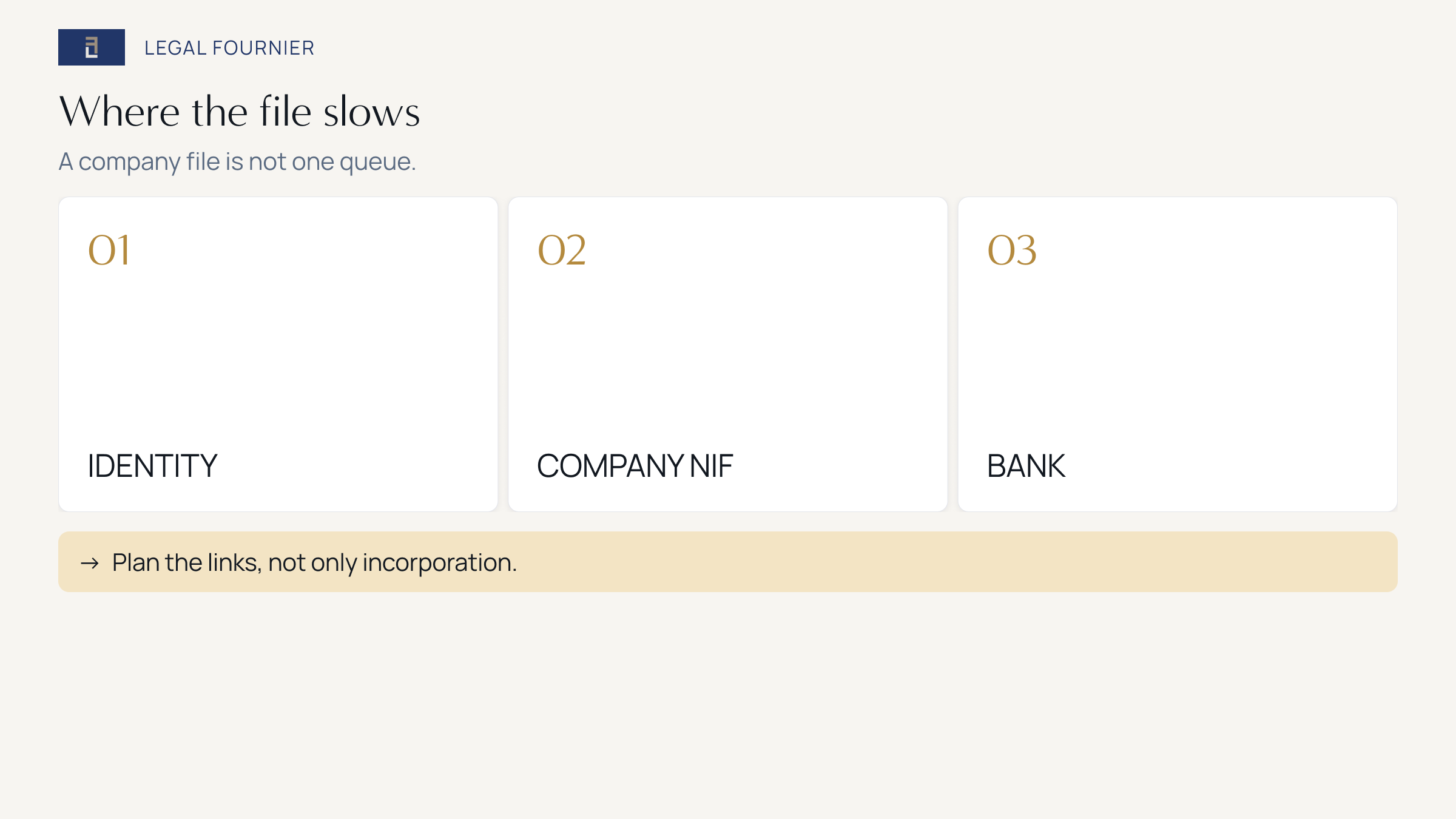
A foreign founder can usually move faster in Spain than the online folklore suggests. The problem is that a Spanish company formation file is not a single queue. It is a chain of identification, tax, notarial, registry, banking, anti-money-laundering, and operational decisions. If one link is missing, the company may exist on paper but still be unable to receive funds, sign cleanly, invoice safely, or explain its international activity to a bank.
This is especially true when the founder does not yet have a NIE. The working question is not simply “Can I incorporate without a NIE?” It is whether the founder has the right Spanish tax identifier, whether the company can obtain and prove its NIF, whether the bank will accept the ownership and source of funds file, and whether any pre-incorporation activity creates a permanent establishment in Spain or other tax exposure before the intended structure is ready.
For a fuller formation route, see our company formation in Spain service. If the bottleneck is personal identification rather than corporate design, our NIE number support can be coordinated with the incorporation strategy. This article focuses on the narrower, higher-risk edge case: a foreign founder, no NIE yet, a Spanish company to form, and a bank that may not follow the legal timetable.
Last updated: 27 June 2026
- A foreign founder without a NIE may need an AEAT-issued temporary NIF, often the “M” type for foreigners without NIE, before Spanish tax-significant acts can move cleanly.
- The company itself needs its own NIF. A 2024 registry resolution confirms that a mere application for company NIF is not enough for registration if the NIF itself has not been issued and evidenced.
- CIRCE can shorten standard company formation steps, but the official timing depends on the file and does not remove bank KYC, beneficial-owner, power-of-attorney, or source of funds review.
- An SL can often be incorporated without a prior bank certificate for cash contributions if the founders make the statutory responsibility statement, but that does not solve the operating bank account.
- Banks can decline ordinary account opening based on policy and risk. AML rules require identification, beneficial-owner checks, and purpose-of-relationship analysis.
- Starting sales, hiring, contracting, or using Spanish premises before the structure is ready can create permanent establishment Spain questions that are separate from the incorporation deed.
The mistake: treating the NIE as the only gate
Foreign founders often frame the issue as a single missing document: “I do not have a NIE, so I cannot open a company.” That is too simple. The NIE is a foreigner’s identification number issued through the immigration/police framework. The NIF is the tax identification number used in transactions with tax significance. For many foreign individuals, the NIE functions as their NIF once they have it. But Spanish tax rules also recognise that a foreigner may need to carry out a tax-significant act before the NIE has been issued.
The General Tax Management Regulation provides that foreign individuals without a NIE, either temporarily or because they are not obliged to have one, must request a tax identification number from the Spanish Tax Agency when they will carry out transactions with tax significance. AEAT’s own Form 030 guidance for natural persons without DNI or NIE describes the non-face-to-face procedure for requesting a NIF and identifies the “M” initial for foreigners who do not have NIE.
This matters because the notarial and registry process is not only an immigration process. It is a legal and tax file. The founder’s identity, the company’s tax identity, and the authority of any representative must be coherent across the notary, Mercantile Registry, AEAT, bank, accountant, and future counterparties. A rushed file may be technically curable later, but every correction costs time and can look worse to a bank than a well-prepared file from the start.
The key distinction is this: no NIE does not always mean no company. But no usable Spanish tax identification, no evidenced company NIF, or no credible bank KYC file can still stop the commercial launch.
A practical timeline for A founder without NIE
There is no universal deadline because the file changes with nationality, residence, shareholder chain, source of funds, notary availability, registry comments, bank policy, translations, apostilles, and whether the founder attends in Spain or acts through a power of attorney. Still, a realistic map helps founders see where the delays actually appear.
| Stage | Main risk | What should be prepared |
|---|---|---|
| Pre-file structuring | Wrong shareholder, director, or tax footprint | Founder role, residence plan, corporate chain, Spanish activity, accounting start date |
| Founder identification | No NIE and no temporary NIF route | Passport, tax residence, AEAT Form 030 position, representative authority if needed |
| Name and deed | Name certificate or powers do not match the file | RMC certificate, bylaws, capital plan, power of attorney, beneficial-owner data |
| Company NIF and registry | Application exists but NIF is not evidenced | AEAT documentation, notarial deed, registration follow-up, definitive NIF update |
| Bank onboarding | AML, source of funds, non-resident or ownership-chain rejection | KYC pack, business plan, invoices/contracts, UBO chart, tax residence and funds evidence |
The official CIRCE guidance says the DUE system can send data to the competent authorities and that the process can fall in a range depending on whether standardised statutes and deeds are used. That statement is useful, but it should not be read as a bank account guarantee. The Spanish administration may process a company file faster than a bank compliance team approves a foreign controlled operating account.
The name, deed, capital, and company NIF
The company formation file normally starts with a business decision, but procedurally it must also pass through the corporate name, deed, tax identification, and registry steps. The Registro Mercantil Central explains that incorporation of a company or registrable entity requires a prior favourable company-name certificate. The denomination in the deed must match the certificate. For a foreign founder, this is where seemingly minor naming, founder-beneficiary, or representative mismatches can create avoidable registry friction.
Capital is another point where outdated advice causes confusion. The consolidated Spanish Companies Act currently provides that the capital of a sociedad de responsabilidad limitada cannot be less than one euro. Where the capital is below EUR 3,000, special protective rules apply, including legal-reserve allocation and possible shareholder liability on liquidation for the difference up to EUR 3,000 if company assets are insufficient. The law also states that cash contributions must be expressed in euros. For many SL incorporations, the law allows founders not to prove the cash contribution with a bank deposit certificate if they state in the deed that they will be jointly and severally liable to the company and its creditors for the reality of those contributions.
That rule can reduce one classic bottleneck: opening a capital-deposit account before the deed. But it should not be oversold. A company may avoid needing a pre-deed bank certificate and still need a serious operating account immediately after incorporation. A founder may sign a deed and still be unable to receive customer funds because the bank is not satisfied with the KYC file, the beneficial-owner chart, the source of wealth, the business model, or the non-resident control structure.
The company NIF is separate from the founder’s NIF or NIE. A 2024 resolution of the Directorate-General for Legal Certainty and Public Faith confirmed the need for the company’s NIF to appear in the incorporation deed and registration context, and that merely showing the application for the NIF is not the same as evidencing the number issued by the Tax Agency. In practice, do not assume that “we requested it” is enough. The file should show what was issued, who holds it, and what remains to be updated once the registry entry is complete.
Why the bank Is often the slowest actor
Founders often expect the bank to be a service provider that follows the notarial file. In reality, the bank is also a regulated gatekeeper. Spanish anti-money-laundering rules apply to credit institutions and other obliged entities. Law 10/2010 requires formal identification before establishing business relationships, identification and verification of the beneficial owner, and measures to understand ownership and control structures. It also obliges legal persons to obtain, keep, and update beneficial-owner information.
The Banco de Espana’s client banking guidance is blunt about the commercial reality: financial institutions can generally decide whether to open an account, according to internal policies and risk criteria, provided they do not act on prohibited discriminatory grounds. The same guidance notes that even a basic payment account can be rejected in certain cases, including failure to provide documentation required for AML and counter-terrorist-financing compliance.
For a foreign controlled Spanish SL, the bank may therefore ask for more than the deed and passport. It may ask for the company NIF, registry extract, deed of incorporation, powers, proof of the director’s authority, tax residence, shareholder documents, source of funds evidence, expected turnover, customer and supplier countries, website or contracts, ownership chart, and information about any politically exposed person, sanctions exposure, high-risk jurisdiction, nominee, trust, or foreign holding company. SEPBLAC’s guidance on due diligence also recognises enhanced measures for higher-risk clients, products, channels, or countries.
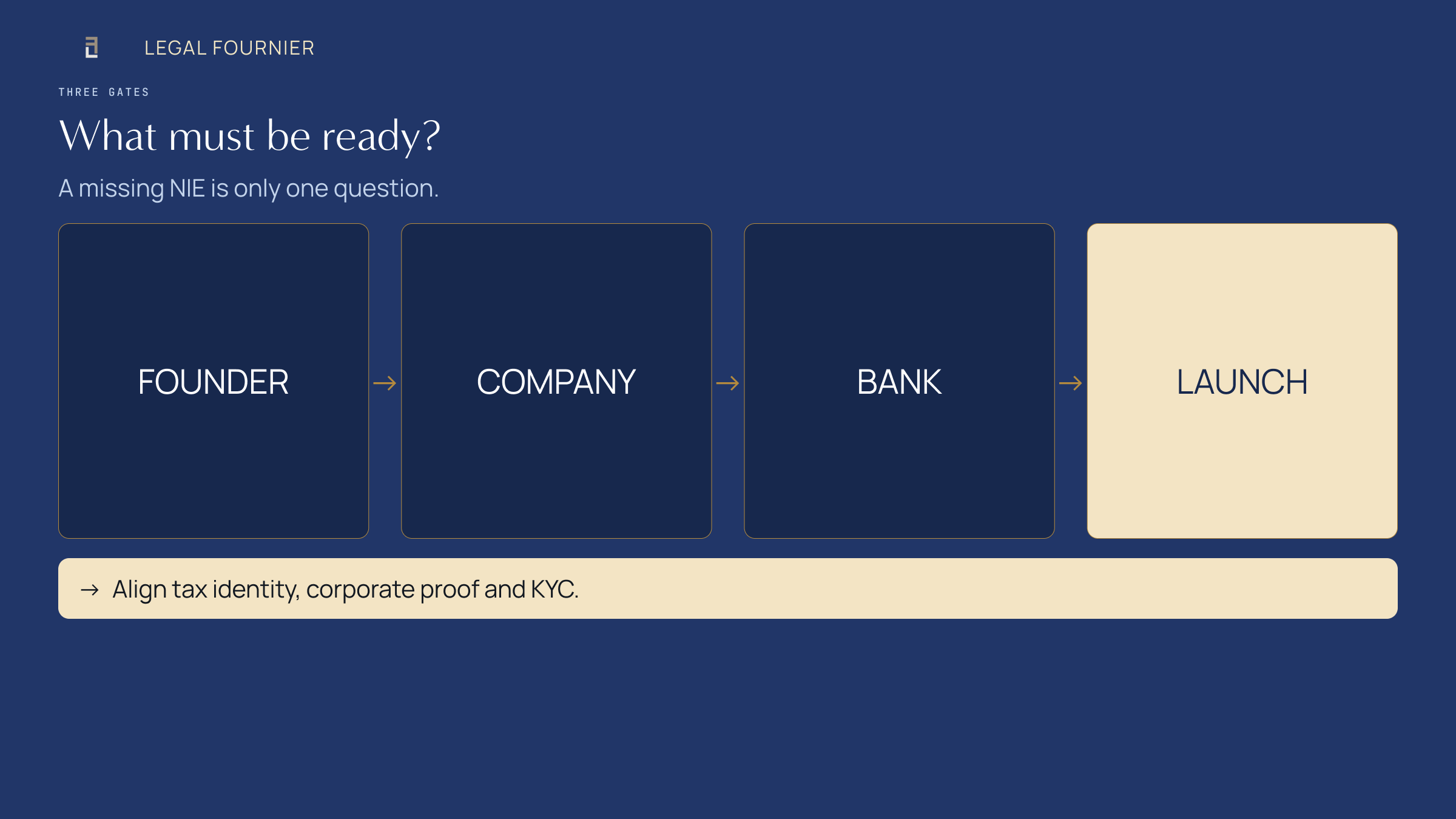
The result is a timing mismatch. The founder may have formed the company, signed a lease, promised an investor a Spanish account, or told customers that Spanish invoicing will start next week. The bank may still be waiting for group accounts, apostilled corporate documents, sworn translations, or an internal compliance approval. This is not unusual, and it is why bank strategy should be prepared before the deed, not improvised after incorporation.
A bank rejection is not only an inconvenience. It can delay payroll, VAT registration practice, supplier onboarding, investor drawdowns, and the credibility of the company’s first Spanish contracts.
The permanent establishment Spain problem
The SEO query may be about foreign founder without NIE company formation Spain bank, but the tax question underneath is often broader. What happens if the foreign company or founder starts operating in Spain while the Spanish SL is still being formed?
AEAT’s definition of permanent establishment for Non-Resident Income Tax explains that a non-resident may operate through a permanent establishment in Spain when it has, continuously or habitually, facilities or workplaces in Spain where it carries out all or part of its activity, or acts through an agent authorised to contract in the name and on behalf of the non-resident who habitually exercises those powers. AEAT also states that permanent establishments are taxed on income attributable to them and must keep separate accounting and meet filing obligations comparable in important respects to corporate taxpayers.
This does not mean every preparatory meeting, market visit, or negotiation automatically creates a permanent establishment. It means founders should not treat incorporation delay as a free period to run Spanish operations informally. The higher-risk facts include a person in Spain habitually signing or concluding contracts for the foreign company, using a Spanish office or coworking space as a real place of business, hiring local staff before the Spanish entity is ready, storing goods or delivering services from Spain, or telling customers that a Spanish branch already exists when no clear registration or tax structure has been implemented.
For founders relocating personally, the analysis can become even more sensitive. If the founder becomes Spanish tax resident, manages the foreign company from Spain, and starts using Spanish premises or employees, the issue is not only company formation. It may involve effective management, payroll, VAT, corporate tax, director remuneration, social security, and international tax treaty analysis. That is why a premium formation file should begin with the founder’s residence and management plan, not only with the company name.
Four founder profiles that need different handling
1. the non-resident individual founder
This can be the cleanest file if the business has a simple ownership structure, the founder has clear source of funds, and Spanish activity has not started. The immediate questions are whether to obtain NIE first, whether an AEAT temporary NIF route is appropriate, whether the founder will attend the notary or act through a power, and which bank is realistic for the business model. If the founder is from a country whose documents require apostille, legalisation, or sworn translation, that should be built into the calendar before promising an incorporation date.
2. the foreign company as shareholder
A foreign holding company can be legitimate, but it increases the banking and registry documentation burden. The Spanish notary and bank will want to understand authority, existence, good standing, representative capacity, and beneficial ownership. If the foreign shareholder is itself owned by another entity, fund, trust, or nominee arrangement, the bank review can become the long pole. In premium international files, the ownership chart should be prepared in bank language, not only in corporate-law language.
3. the founder moving to Spain
A founder who is also relocating to Spain needs the company timetable aligned with immigration, tax residency, social security, and director remuneration. For example, a digital nomad, highly qualified professional, entrepreneur, or family relocation plan can interact with who employs whom, where management decisions are made, and whether Spanish operations should begin before or after residence approval. The company is only one layer of the move.
4. the acquisition or property SPV founder
Some founders form a Spanish company to buy property, hold assets, contract with builders, or operate a hospitality or real estate project. These cases carry stronger source of funds, AML, tax, and local licensing considerations. The bank will often care not only who owns the company but what the company will do, where the purchase money comes from, and whether the business model makes sense. A property SPV should not be treated as a generic startup incorporation.
What A serious pre-bank file should include
The most efficient files are not the ones that push documents one by one. They are the files that anticipate the bank’s questions before the bank asks them. A foreign founder without NIE should normally prepare a coherent pack covering identity, tax, corporate, authority, funds, activity, and governance.
- Identity: passport, residence address, tax residence, NIE or temporary NIF route, contact details, and any prior Spanish tax identifiers.
- Authority: notarial power of attorney if the founder will not attend, with apostille/legalisation and translation planning where relevant. The Consejo General del Notariado explains that powers are public documents and that the Hague Apostille allows recognition between signatory countries.
- Corporate: proposed company name, RMC certificate, bylaws, director structure, registered office, activity description, capital and contribution plan.
- Beneficial ownership: UBO chart to natural persons, percentages, control by other means, and documentation for each entity in the chain.
- Funds: origin of capital, bank statements where appropriate, sale agreements, dividend records, salary or business-income evidence, investor documentation, or loan agreements.
- Commercial logic: business plan, expected turnover, customer and supplier countries, initial contracts, website, sector licences, and whether cash, crypto, high-risk jurisdictions, or regulated activity are involved.
- Tax and accounting start: VAT position, corporate tax obligations, payroll or director remuneration, invoices to be issued, and who will monitor filings and notices after incorporation.
For ongoing compliance after formation, see our monthly accounting service. For bank-specific planning, our guide to opening a bank account in Spain gives broader context, but company founders should treat bank onboarding as a legal and tax workstream, not a simple appointment.
Red flags that should slow the file down
Speed is valuable only when the structure is defensible. In our experience, these facts justify a more careful legal review before the deed or before presenting a bank file:
- The founder has already started selling, signing, hiring, or using Spanish premises through a foreign entity.
- The shareholder is a foreign company with several ownership layers or a nominee, trust, foundation, or fund structure.
- The founder is moving to Spain and may manage a foreign company from Spanish territory.
- The activity is regulated, financial, crypto-adjacent, real estate intensive, cash intensive, or linked to high-risk jurisdictions.
- The company is being formed to receive a large transfer, investor funds, property purchase money, or intercompany loan immediately after incorporation.
- The founder wants to use a very low capital amount but will enter into substantial obligations shortly after formation.
- The bank has already rejected the founder, the foreign company, or a related shareholder elsewhere.
In those cases, the better question is not “How fast can we incorporate?” It is “What sequence gives the notary, registry, bank, AEAT, accountant, and counterparties the same story?” That is where specialist counsel changes the outcome: by designing the order of acts, not just producing documents.
How Legal Fournier approaches this file
For premium foreign-founder matters, we usually separate the work into three decisions. First, the legal structure: who should own the SL, who should administer it, whether a foreign company belongs in the chain, and whether the founder’s residence plan changes the answer. Second, the formation mechanics: identification, NIF or NIE strategy, power of attorney, company name, deed, registry, and definitive tax updates. Third, the bank and tax launch: KYC file, source of funds pack, accounting start, permanent-establishment review, and first operational contracts.
This is not DIY formation. A simple Spanish founder with a local bank relationship may be able to use a standard workflow. A foreign founder without NIE, with investors, property money, foreign holding companies, or live Spanish operations needs a risk-controlled file. The cost of a poor sequence is often higher than the cost of structuring the file correctly before incorporation.
If the company will be part of a relocation, family office, property acquisition, Latin American expansion, or international founder move, a focused consultation with a Spanish lawyer is normally the right first step. We can review whether the file is a clean incorporation, a bank-risk matter, a permanent establishment Spain issue, or a combined corporate, tax, and residence matter.
FAQ
Can a foreigner form a Spanish company without a NIE?
It depends on the file. A foreigner without a NIE may need an AEAT-issued temporary NIF for tax-significant acts. The notary, registry, AEAT, and bank will each need coherent identification. In some cases obtaining the NIE first is cleaner; in others, the temporary NIF route can keep the file moving.
Is the bank account required before incorporating an SL?
Not always for the capital evidence point. Spanish company law allows SL founders, in the incorporation context, to avoid proving cash contributions with a bank certificate if they assume the statutory responsibility in the deed. But the operating bank account remains a separate commercial and AML issue.
Can the bank refuse a foreign controlled Spanish company?
A bank can generally decide whether to open an ordinary account according to its policies and risk appetite, subject to non-discrimination rules and specific basic-account rules. Foreign ownership, unclear source of funds, complex UBO chains, high-risk jurisdictions, and incomplete documents can all slow or block onboarding.
Does forming an SL remove permanent establishment risk?
Only prospectively and only if the operations are actually routed through the correct entity. If a foreign company has already been operating from Spain through premises, employees, or an agent with authority to contract, forming an SL later does not automatically erase earlier tax questions.
Should I choose one euro of share capital?
One euro may be legally possible for an SL, but it is not always commercially wise. Banks, suppliers, landlords, investors, and counterparties may view very low capital differently from a defensible operating capital amount. The answer should match the obligations the company will assume.