

Administrative silence in Spanish immigration: when to wait and when to act
An immigration file marked en trámite has not necessarily reached the point of administrative silence. The portal is reporting a processing status. It is not telling you which legal period applies, whether that period was suspended, or whether silence is positive or negative for your procedure.
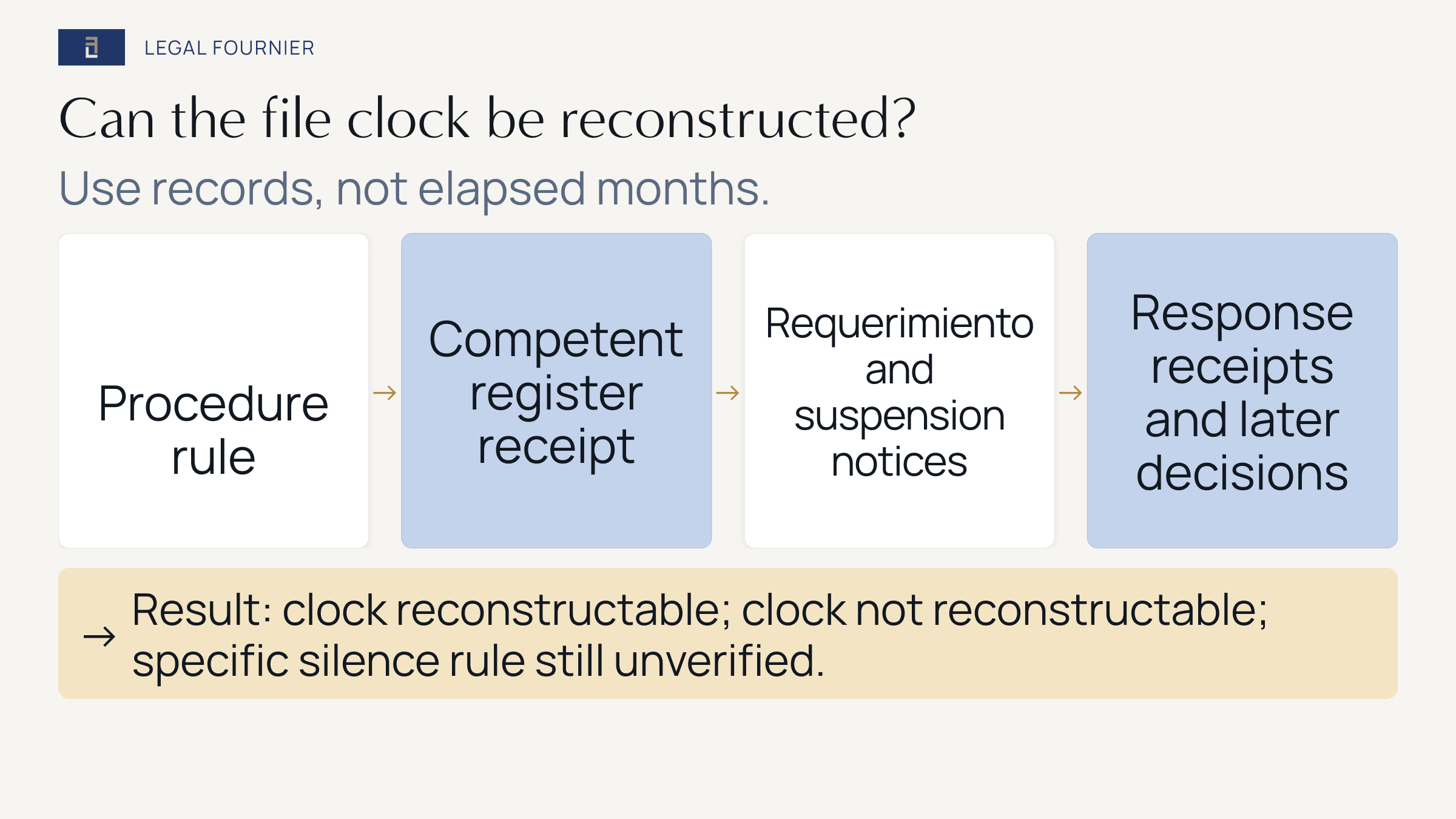
A reliable answer starts with records: the exact procedure, the receipt showing when it entered the competent register, and every formal notice since then. Without those records, a date calculated from the day you submitted a form may be confidently wrong.
Legal sources checked: 4 September 2026. This guide explains a method for reviewing an immigration-authorisation file. It does not decide the effect of silence for any particular application.
Start with the procedure, not the elapsed months
Spanish administrative law requires the Administration to issue and notify an express decision. The rule governing the particular procedure sets the maximum period. For an application started by the applicant, the general-law clock is tied to entry in the electronic register of the Administration competent to process it, under article 21 of Law 39/2015.
Immigration law gives a general maximum of three months for applications for authorisations, counted from the day after entry in the register of the body competent to process them. But a specific procedure can have a different period, and the general visa rule is different. The relevant starting points are additional provision 1 of Organic Law 4/2000 and additional provision 7 of Royal Decree 1155/2024.
Three months can be the right period and still be the wrong calculation. First confirm whether the matter is an immigration-office authorisation or a consular visa. Then record its current name and procedure code. The Ministry’s immigration information sheets are a useful operational starting point for the filing route, documents, fees and stated period. The sheets are orientative, so the law in force when the application was filed still controls.
What silence changes, and what it does not
Once the applicable notification period has actually expired, the law may assign an effect to the absence of an express decision. Immigration applications are generally deemed rejected, while Organic Law 4/2000 gives positive-silence treatment to named categories. Those categories must be matched to the current legal procedure, not to an old permit label or a shorthand description used online. Additional provision 8 of Royal Decree 1155/2024 refers back to the statutory rules and exceptions.
Negative silence is not an express finding that the application fails on its merits. It allows the appropriate administrative or judicial challenge while the Administration remains obliged to decide. A later decision is not bound by the presumed negative result. Positive silence works differently: a later express decision may only confirm the presumed act. These distinctions come from article 24 of Law 39/2015.
Neither label answers every practical question. A presumed act is not automatically a residence card, a travel document or proof of a right to work. Those consequences need their own procedure-specific legal analysis. Nor should a certificate be treated as though it creates silence. Article 24 allows silence to be proved by legally admissible means, including the statutory certificate, but whether to seek one and what it proves depend on the file.
Build a clock-and-notice ledger
Put the chronology on one page. Fill the ledger below from receipts and notices, not from memory, and leave a field blank when the evidence is missing.
| Field | Record to enter |
|---|---|
| 1 | Exact procedure name, current form or procedure code, and governing provision |
| 2 | Body competent to process the application |
| 3 | Electronic filing receipt and timestamp |
| 4 | Date the competent body recorded receipt, if different and evidenced |
| 5 | Maximum notification period for this procedure, with its source |
| 6 | Every requerimiento, report request, formal suspension or extension, including availability and access dates |
| 7 | Response filing receipt for each procedural event |
| 8 | Reconstructed reference date, or “not calculable” while an earlier field is missing |
| 9 | Statutory effect assigned to silence for this exact procedure |
| 10 | Any later notification or resolution and its legally effective date |
The ledger should produce one modest finding: clock reconstructable, clock not reconstructable, or specific silence rule still unverified. It should not manufacture a deadline to make the exercise feel complete.
A document request can change the chronology
A formal request to cure defects or supply necessary documents can suspend the Administration’s decision period. Under article 22.1(a) of Law 39/2015, the suspension runs from notification of the request until the applicant complies or the response period expires. The applicant’s response deadline and the Administration’s maximum decision period are two different clocks.
There is also a separate power to extend the maximum decision period in exceptional circumstances. An extension under article 23 of Law 39/2015 must be reasoned and notified, and it cannot exceed the original period. An unexplained portal message is not a substitute for that notice.
For each event, keep the full request, evidence of when it became available and was accessed, the response package, and the registered response receipt. If one of those pieces is missing, record the gap. Do not assume that uploading a file closed a suspension entry.
Email alerts are not the notification record
An email or device message is an alert. It is not the notification itself. Electronic service takes place when the recipient accesses the notice. Where electronic notification is mandatory or was chosen, a notice left unaccessed for ten calendar days after it became available is treated as rejected, subject to the statutory rules. See articles 41 and 43 of Law 39/2015.
Check all authorised representatives and service channels. A missing email alert does not by itself invalidate service. The practical records are the notice’s availability and access data, the identity of the recipient or representative, and the complete document served. For a broader explanation, read why an email alert is not the service record.
The government’s immigration-file status service describes its result as informational. It reports the current processing status and is unavailable to EU citizens. A screenshot from that service does not replace the application receipt, a suspension notice, a resolution or proof of silence. See what an en trámite status does and does not show.
Use an action boundary before choosing a remedy
Once the ledger is complete, write down answers to these four questions:
- Are you dealing with continued processing, a presumed act, or an unaccessed or later express notification?
- Does the exact procedure assign positive or negative silence?
- Is the proposed step about evidence of silence, an administrative remedy, judicial review, or obtaining a missing record?
- What consequence are you assuming for residence, work or travel, and which legal source supports that consequence?
If a record or rule is missing, the output is obtain the missing record or procedure-specific legal review. The card should never produce an automatic instruction to wait, appeal, travel, work or treat the application as approved.
Hypothetical example. An applicant has a submission confirmation and a portal screenshot, but the confirmation does not identify entry in the competent body’s register. A document request also appears in the file, without its access record or response receipt. The result is “clock not reconstructable.” Adding three months to the submission date would hide both missing facts.
What to gather for a file-clock review
Collect the competent-register filing receipt, the exact procedure identifier, the applicable information sheet, every formal notice and its access record, each response receipt, and any later resolution. Keep the original files rather than relying on cropped screenshots.
If the chronology is complete, the next review can identify the applicable silence provision and the legally available routes. If it is incomplete, finding the missing record comes first.
Request a file-clock review if you want Legal Fournier to assess whether the chronology is complete and which procedure-specific rule requires analysis. Have the filing receipt, procedure identifier, formal notice and access records, and response receipts ready. A review cannot promise a decision date or a particular effect on residence, work or travel.