
EU and Swiss Citizens Moving to Spain: Registration, NIE, Work and Tax
An NIE alone does not tell you which residence step comes next. Article 205 of Real Decreto 1155/2024 defines the NIE as the foreigner’s identification number. It can appear on several documents, but a standalone NIE does not, by itself, register an EU, EEA or Swiss citizen as resident in Spain.
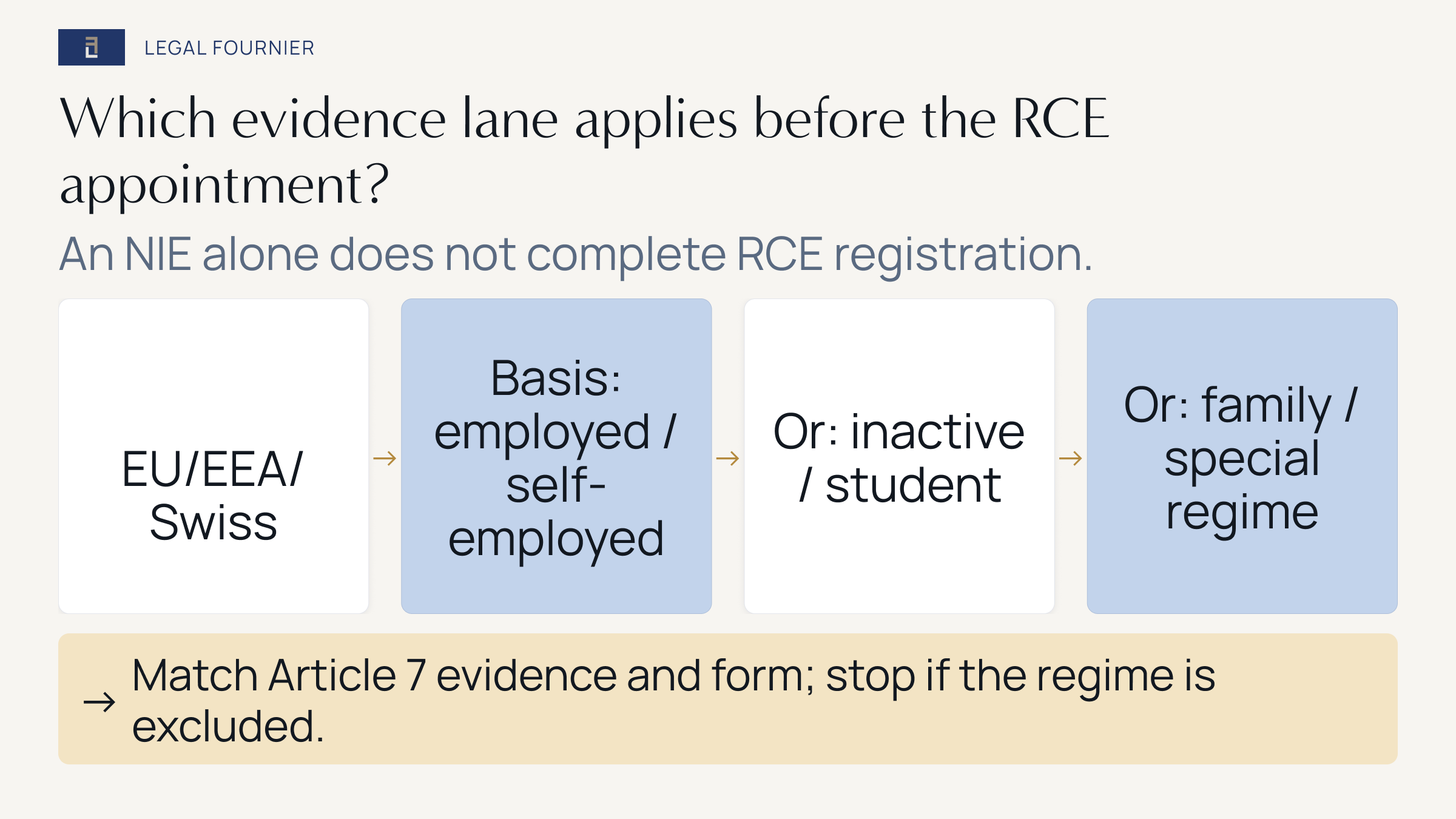
For an ordinary move lasting more than three months, start with the person’s legal and economic position: employee, self-employed, economically inactive, student or qualifying family member. That choice determines which documents are needed for the certificado de registro de ciudadano de la Unión, the certificate recording registration in the Registro Central de Extranjeros (RCE) under Article 7 of Real Decreto 240/2007 and Article 2 of Order PRE/1490/2012. Our separate guide explains in more detail what a Spanish NIE does.
Choose the evidence category before the appointment
| Position | Core evidence category | Important distinction |
|---|---|---|
| Employee in Spain | Valid identity document plus recognised employment evidence | The registration certificate neither replaces the employment contract nor determines the applicable Social Security position |
| Self-employed in Spain | Valid identity document plus recognised evidence of self-employment | Company ownership alone does not prove self-employed activity |
| Not working in Spain | Health coverage and sufficient resources under the rules for economically inactive people | No single minimum bank balance applies to every applicant, and an EHIC is not automatically sufficient |
| Student | Enrolment, coverage and the required resources declaration | The student-specific EHIC rule does not extend to an economically inactive applicant |
| Qualifying EU/EEA/Swiss family member | Identity, relationship and the principal person’s applicable Article 7 basis | The qualifying family categories, including the narrower definition for students, must be checked carefully |
| Qualifying non-EU family member | Separate residence-card analysis, normally involving EX-19 | This is not the citizen’s EX-18 file; a family member of a Spanish citizen may fall under a different procedure |
Official basis for the table: Article 7 of Real Decreto 240/2007 and Article 3 of Order PRE/1490/2012 for the evidence categories; Article 8 for the qualifying non-EU family member; and the Ministry’s current forms page for EX-18, EX-19 and EX-24.
The table helps identify the relevant evidence category; it is not an eligibility decision or a complete list of documents.
Who registers, and when
For an ordinary stay of under three months, Article 6 of Real Decreto 240/2007 says that a valid passport or national identity card is sufficient for an EU or EEA citizen. This short-stay rule does not resolve special cases involving jobseekers, family entry or public order.
When residence will exceed three months, the citizen must apply personally for RCE registration at the provincial Foreigners’ Office or corresponding police station within three months after entering Spain. Once the requirements are confirmed, the certificate is issued immediately and records the person’s name, nationality, address, NIE and registration date under Article 7 of Real Decreto 240/2007 and Article 2 of Order PRE/1490/2012. “Immediately” describes issue after the requirements have been confirmed; it is not a promise of an available appointment or acceptance of an incomplete file.
Swiss citizens are included through the EU–Switzerland free-movement agreement and the Spanish implementing rules, including the third additional provision of Real Decreto 240/2007. Switzerland is not an EU Member State. Our guide to moving from Switzerland to Spain covers the country-specific context; the agreement and Spanish rules remain the authority for the registration position explained here.
What Article 7 evidence looks like
For an employee, recognised evidence includes an employer’s hiring declaration or employment certificate containing the specified company details, a registered employment contract or the relevant Social Security registration. A self-employed applicant may show the activity through evidence such as the economic-activities census, Commercial Registry evidence or the relevant Social Security registration. Article 3 of Order PRE/1490/2012 sets out these forms of evidence. They do not cure an application whose documents are missing or inconsistent.
Under Article 3 of Order PRE/1490/2012, a person who is not working in Spain must show health coverage in Spain equivalent to the National Health System during residence and sufficient resources. The insurance may be public or private and may be based in Spain or another country if the legal coverage condition is met. Pensioners satisfy the healthcare condition where official certification shows that healthcare is chargeable to the state paying the pension. Neither a pension letter nor a private policy is automatically enough without checking the precise evidence and coverage.
No fixed sufficient-resources amount may be imposed for this route. Article 7 of Real Decreto 240/2007 requires the person’s circumstances to be considered and sets an upper limit for that assessment by reference to the social-assistance level for Spaniards or the minimum Social Security pension. Publishing one universal bank-balance figure would misstate an individual assessment.
For students, Article 3 of Order PRE/1490/2012 requires qualifying enrolment, health coverage and a responsible declaration of sufficient resources. In that category only, the Order accepts an EHIC whose validity covers the whole residence period and provides medically necessary benefits. It does not turn an EHIC into universal residence cover for an economically inactive applicant. EU guidance describes the EHIC as temporary-stay coverage and points habitual residents to S1 where that coordination route applies; S1 is not available to everyone.
EX-15, EX-18, EX-19 and EX-24 do different jobs
The Ministry’s general forms page, checked on 4 September 2026, lists EX-15 for NIE allocation and certificates, EX-18 for an EU citizen’s RCE registration, EX-19 for the residence card of a family member of an EU citizen, and EX-24 for temporary residence of family members of Spanish nationals.
A qualifying family member who is not an EU, EEA or Swiss citizen follows the separate residence-card route and applies within three months after entry. The family relationship and the EU, EEA or Swiss citizen’s qualifying position must be evidenced under Article 8 of Real Decreto 240/2007. EX-19 is not the EU, EEA or Swiss citizen’s own registration form.
A separate question arises for a foreign family member of a Spanish citizen. Current Ministry guidance for the EU-family residence card points to EX-19 only where the Spanish citizen exercised free-movement rights; otherwise, it directs the applicant to EX-24. That warning is not a full eligibility guide. UK nationals and family members covered by the Withdrawal Agreement should not use this ordinary EX-18/EX-19 outline without checking their specific regime.
Four records with different purposes
| Record | Its immediate job | What it does not establish by itself |
|---|---|---|
| NIE / EX-15 | Assigns or records the foreigner’s identifier | RCE registration, lawful residence, a TIE, work status or tax residence |
| EU registration certificate / EX-18 | Records RCE registration and includes the NIE and Article 7 details | Municipal registration, Social Security coverage or tax residence |
| Padrón / empadronamiento | Records habitual municipal address or residence | Immigration legality, RCE registration or tax residence |
| Applicable Social Security evidence | Records affiliation, coverage or cross-border coordination for its stated purpose | EU residence registration, an NIE, the padrón or tax residence |
Official basis for the table: the Ministry’s current forms page for EX-15 and EX-18; Article 205 of Real Decreto 1155/2024 for the NIE; Article 7 of Real Decreto 240/2007 and Article 2 of Order PRE/1490/2012 for the RCE certificate; the national padrón instructions; and EU Social Security coordination guidance.
A TIE (tarjeta de identidad de extranjero) belongs to a separate residence-card process used, among other cases, for qualifying non-EU family members under Article 8 of Real Decreto 240/2007 and the EX-19 route listed on the Ministry’s current forms page. The EU citizen’s registration certificate is not a TIE. Check the relevant municipality’s current evidence requirements and appointment procedure for the padrón.
Work, Social Security and tax remain separate
Article 3 of Real Decreto 240/2007 states that people within its scope may work as employees or self-employed persons, provide services or study on the same conditions as Spaniards, subject to the limits that apply to family categories and public-service employment. The green certificate does not itself create every underlying right to work, and it does not remove payroll, tax, professional registration or Social Security obligations.
Under EU Social Security coordination guidance, the applicable system depends on work and residence rather than nationality; a person cannot simply choose it. Someone moving to work in another member state will usually register in the host system, while posted, frontier and multi-country work have separate rules. An A1 may evidence continued home-state coverage in qualifying posting or multi-country situations. Those cross-border facts need their own analysis.
The RCE certificate, NIE, padrón and Social Security record do not determine tax residence either. AEAT’s domestic guidance looks, among other matters, at more than 183 days in Spain under its stated absence rules or at Spain being the principal centre or base of activities or economic interests. It also describes a rebuttable family presumption. Administrative residence and tax residence can differ. You may screen the separate Spanish tax-residence question, but a tool cannot decide it from the certificate alone.
Check which steps your circumstances require
- Check first whether the Withdrawal Agreement applies, whether the rules for family members of Spanish nationals apply, or whether another special regime governs the case.
- Identify whether the person is employed, self-employed, inactive, a student or a qualifying family member.
- Match the current official form and evidence to that category before seeking the RCE or residence-card appointment. Our guide to EU registration appointments explains the practical steps; it is not legal authority or a promise of availability.
- Complete municipal, employment, payroll and Social Security steps only when the person’s circumstances require them.
- Review tax residence on its own facts, rather than treating the certificate or padrón as the answer.
This article is general information based on sources checked on 4 September 2026. It does not decide eligibility, local appointment procedures, Social Security coverage or tax residence for an individual. A case-specific review can determine whether EX-18, EX-19 or the limited EX-24 procedure applies, then set out what must be resolved before documents are ordered or appointments booked. The consultation options explain how to request that review; leave confidential documents out of the public form.