

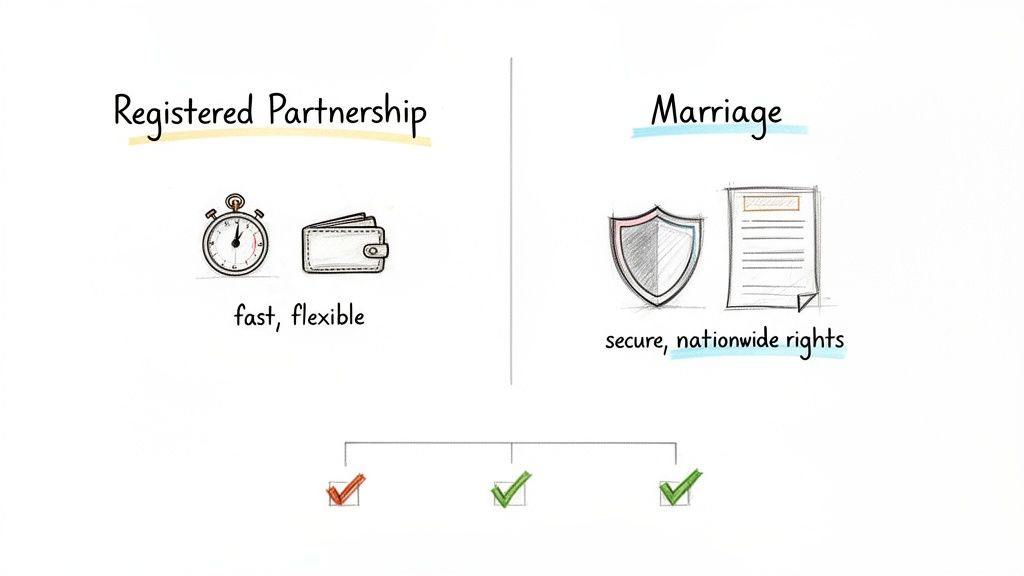
When formalising a relationship in Spain, foreigners face a classic dilemma: pareja de hecho or matrimonio? Let’s get straight to the point. The diferencia entre pareja de hecho y matrimonio really boils down to three things: legal security, speed, and money.
A ‘pareja de hecho’ (registered partnership) is often the faster route, especially for securing a residence card (‘Tarjeta de Familiar Comunitario’) for a non-EU partner. It’s flexible but comes with fewer automatic legal protections.
Marriage, on the other hand, provides a solid, nationwide legal framework with much stronger rights, particularly for inheritance and nationality. A spouse of a Spanish citizen can apply for Spanish nationality after just one year of residency—a major shortcut that a partnership doesn’t offer.
Pareja de Hecho vs Matrimonio: A Quick Comparison for Expats
We see countless clients weigh the speed of a pareja de hecho for residency against the long-term security of marriage. The right choice depends entirely on your personal goals in Spain.
This table breaks down the core differences to help you see which path aligns best with your situation.
Key Differences Pareja de Hecho vs Matrimonio in Spain
Here is a side-by-side comparison of the most critical legal and practical differences for expats moving to or living in Spain. It’s essential to understand these nuances before making a decision.
| Factor | Pareja de Hecho (Registered Partnership) | Matrimonio (Marriage) |
|---|---|---|
| Legal Framework | Regulated by Autonomous Communities; rules vary significantly by region (e.g., Catalonia vs. Madrid). | Regulated by the Spanish Civil Code; uniform rights and obligations across all of Spain. |
| Speed to Residency | Generally faster. Can secure a 'Tarjeta de Familiar Comunitario' for a non-EU partner quickly. | Slower due to the 'expediente matrimonial' process, which can take several months to complete. |
| Path to Nationality | No shortcut. The partner must meet standard residency requirements (typically 10 years). | Major advantage: The spouse of a Spanish citizen can apply for nationality after only 1 year of legal residency. |
| Tax Filing (IRPF) | Partners must always file income tax returns individually. There's no option for joint filing. | Couples can choose to file taxes jointly or separately, which can offer significant tax savings. |
| Inheritance Rights | No automatic inheritance rights. A Spanish will is absolutely essential to protect the surviving partner. | The surviving spouse is a "forced heir" ('heredero forzoso') and is automatically entitled to a portion of the estate. |
| Dissolution | Simple administrative process. It can be done unilaterally by just one partner at the registry. | Requires a formal divorce process, a more complex, time-consuming, and costly legal procedure. |
| Widow's Pension | Stricter requirements: typically requires at least 5 years of cohabitation and 2 years of registration. | More straightforward. The right is generally granted without the strict time requirements of a partnership. |
| International Recognition | Recognition varies widely by country. It may not be recognised at all outside of Spain. | Widely recognised internationally, which simplifies legal matters if you move to another country. |
Understanding these differences is key. A registered partnership is a tool for speed, while marriage is a foundation for long-term integration and security in Spain.
In our experience, the decision often hinges on one key factor: time vs. security. If your absolute priority is obtaining residency for your partner as quickly as possible, a pareja de hecho is a direct and effective solution. However, if long-term goals like Spanish citizenship, inheritance rights, and tax benefits are more important, marriage offers a much stronger and more predictable legal foundation.
Understanding the Legal Framework for Each Union
Need help with your case in Spain?
If this article applies to your situation, contact our team for tailored legal guidance and clear next steps.
To understand the real diferencia entre pareja de hecho y matrimonio, you have to look at how they’re built. Marriage is a national institution. It’s governed by the Spanish Civil Code, meaning your rights and duties are the same whether you get married in Galicia, Andalusia, or the Canary Islands. It’s consistent across the board.
A pareja de hecho (registered partnership) is a completely different animal. It’s regulated at the regional level by Spain’s 17 Autonomous Communities. This creates a confusing patchwork of rules. What gets you registered in one region might not even count in another.
The Impact of Regional Laws
This is where many expats get tripped up. Some communities, for instance, demand a minimum period of living together, which you usually prove with an empadronamiento certificate. Others, like Catalonia, are more flexible. There, having a child together can be enough to formalise your partnership, with no minimum cohabitation required.
This inconsistency causes real problems. We’ve seen it happen time and again. A partnership registered in one region’s specific registry might not be recognised for administrative processes in another. This can derail immigration applications that depend on proving a valid union nationwide.
The cleanest way to avoid this is to form your pareja de hecho before a public notary. A notarial deed is a public document with legal force across all of Spain. This is critical when you need to apply for residency cards like the Tarjeta de Familiar Comunitario.
A Shift Towards Financial Independence
Even within marriage, the trend is clear: couples want financial autonomy. The traditional default for marriage was a “community property” regime (sociedad de gananciales), where you share everything. That’s no longer the norm.
Data from 2023 shows that a staggering 92.3% of couples signing prenuptial agreements (capitulaciones matrimoniales) chose a “separation of assets” (separación de bienes) regime instead.
This mindset aligns perfectly with the pareja de hecho, where assets are separate by default. The demand for financial independence is a huge factor behind the explosion in registered partnerships. The number of parejas de hecho shot up by an incredible 2,172% between 2007 and 2023. You can dig into the numbers in the full report from the Consejo General del Notariado.
This societal shift means you need to be deliberate about your choice. While you can customise either union to fit your financial goals, they start from very different places. You can learn more about the process in our guide on how to register a pareja de hecho in Spain. The goal is to pick the structure that protects your interests from day one.
Residency and Nationality: The Deciding Factor
For most international couples, this is where the conversation gets serious. Securing residency is the immediate goal, and the good news is that both marriage and a pareja de hecho get the job done.
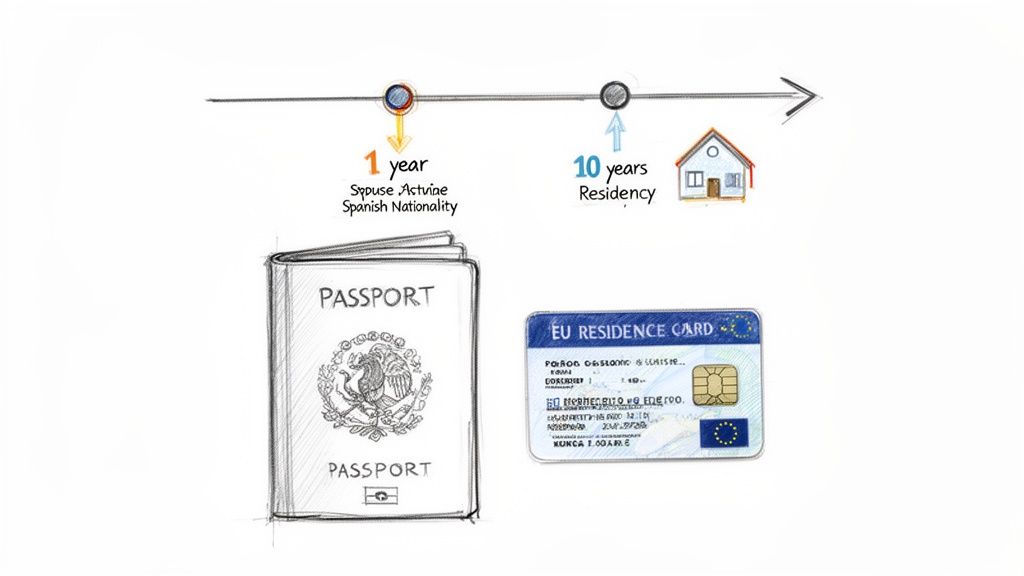
Once your union is officially registered, the non-EU partner can apply for the Tarjeta de Familiar Comunitario. This is the five-year residence and work permit for family members of EU citizens. It grants the right to live and work in Spain under the same conditions as your EU partner.
The Initial Residency Card
The application for the tarjeta comunitaria hinges on the EU citizen exercising their rights in Spain—either by working, being self-employed, or demonstrating sufficient financial resources and private health insurance. For instance, to prove sufficient means, the EU citizen needs to show they have €600 per month (100% of Spain’s IPREM), plus additional funds for the non-EU partner. We handle this process constantly, and with a marriage certificate or pareja de hecho deed in hand, it’s quite straightforward.
But here’s where the two paths diverge. The real diferencia entre pareja de hecho y matrimonio shows up when you start thinking about the long game: Spanish citizenship.
The One-Year Shortcut to a Spanish Passport
Marriage to a Spanish citizen unlocks a huge advantage. You can apply for Spanish nationality after just one year of legal and continuous residency in Spain. This is an incredible shortcut, considering the standard route is ten years.
For many couples, this is the deal-breaker. It fast-tracks you to a Spanish passport and full EU citizenship, opening up the freedom to live and work across all 27 member states.
A pareja de hecho, even with a Spanish citizen, doesn’t offer this benefit. The non-EU partner is on the standard 10-year path to citizenship. You get the five-year residency card, but the journey to a passport is much, much longer.
We see this scenario play out frequently. An American client, partnered with a Spaniard, went the pareja de hecho route for its speed. A year later, he realised a Spanish passport would unlock major career opportunities across the EU. They decided to marry specifically to access the one-year citizenship path. It’s a strategic choice.
This doesn’t make a pareja de hecho a bad option. It’s an excellent tool for securing residency quickly. But if an EU passport is your ultimate goal, marriage is the only direct and accelerated route.
Not sure which path fits? Book a consultation and we’ll map out the best option.
For a deeper dive into the residency application itself, our family reunification visa for Spain guide covers the specifics.
Renewals and Permanent Residency
After five years, both married spouses and registered partners holding the tarjeta comunitaria can apply for a permanent residence card. This ten-year card solidifies your long-term status in Spain.
The main requirement is that the relationship must remain intact during that initial five-year residency period. If the couple separates or divorces before the non-EU partner obtains permanent residency, their right to remain in Spain can be jeopardised, though some exceptions apply. Generally, marriage offers slightly more robust legal protections in the event of a separation.
Your choice should align with your goals. Are you focused on getting residency now, or is the Spanish passport your priority? Your answer will determine the right path for you.
Analysing the Financial and Tax Implications
The financial and tax differences between a pareja de hecho and marriage aren’t just details; they can fundamentally change your household income and long-term security in Spain. In our experience, too many couples focus only on the residency paperwork and don’t realise the financial impact until it’s too late.
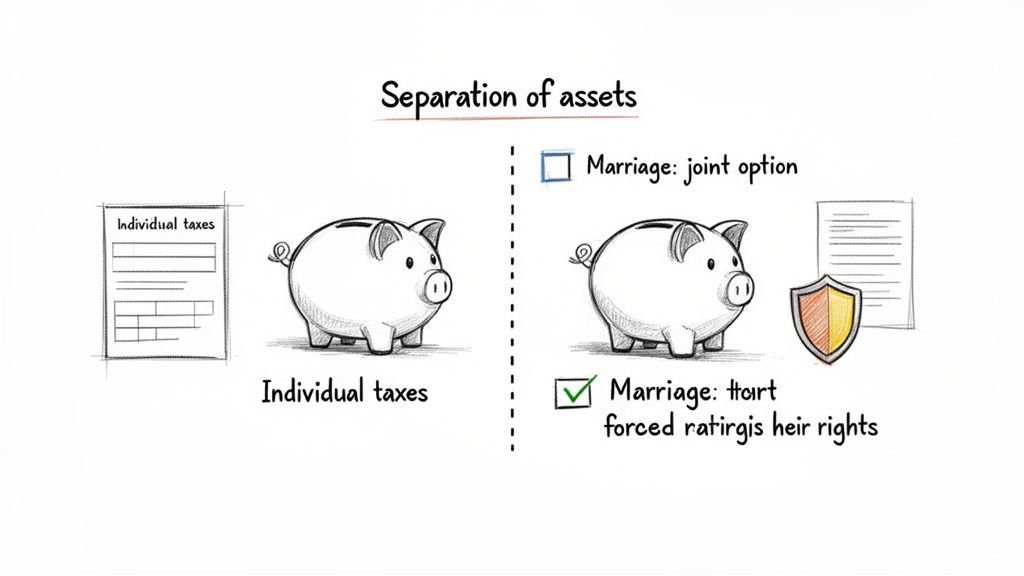
The biggest financial perk of marriage is the ability to file your annual income tax (Impuesto sobre la Renta de las Personas Físicas or IRPF) jointly. This option does not exist for registered partners.
Income Tax Filing: The Joint Declaration
Married couples in Spain get to choose each year whether to file their taxes individually or as a single unit. Joint filing almost always makes sense when there’s a big income difference between the two.
If one spouse earns a high salary and the other has little or no income, filing together pools their earnings. This allows the couple to apply deductions and allowances across the combined total, often leading to a much lower tax bill.
Couples in a pareja de hecho have no such choice. They must always file their tax returns individually. This lack of flexibility can mean paying thousands more in tax every single year—a major diferencia that adds up. For a high-earning professional with a non-working partner, this factor alone can make marriage the obvious financial choice.
In Spain, filing taxes jointly can save a couple thousands of euros annually, especially if one partner earns less than €8,000 per year. A pareja de hecho completely misses out on this tax-saving strategy, making marriage a more attractive option from a purely fiscal standpoint for many couples.
Inheritance Rights: A Tale of Two Systems
When it comes to inheritance law, the gap between these two unions is massive. In Spain, a married spouse is legally recognised as a ‘heredero forzoso’ (forced heir). This gives them automatic, nationwide protection.
This status means that if one spouse dies, the survivor is legally guaranteed a portion of the estate—specifically the usufruct (the right to use and enjoy) of one-third of the inheritance. This right holds true across all of Spain, no matter what the will says.
A partner in a pareja de hecho has no automatic, nationwide rights at all. While some Autonomous Communities like Catalonia, the Basque Country, or Navarre have passed regional laws granting similar inheritance rights, this protection is patchy. In most of Spain, a surviving partner could be left with absolutely nothing.
This makes having a professionally drafted Spanish will absolutely essential if you are in a registered partnership. Without one, your partner has no automatic claim to your assets, a situation that can quickly turn into a financial and legal nightmare for them.
Social Security and Pensions
The differences carry over to social security benefits, particularly the widower’s pension (pensión de viudedad). While both married spouses and registered partners can potentially receive this pension, the rules are significantly tougher for a pareja de hecho.
To qualify for a widower’s pension, a surviving registered partner must typically prove all of the following:
- The partnership was registered at least two years before the death.
- They lived together continuously for at least five years right before the death.
- The surviving partner’s income in the previous year was below a specific government threshold.
For a married spouse, the process is far simpler. The right to the pension is generally granted without these strict cohabitation timelines and income tests, providing a much more reliable safety net.
Ultimately, while a pareja de hecho is a useful tool for residency, marriage offers a far more robust framework for financial protection, tax optimisation, and long-term security. If you need clarity on how these financial implications apply to your specific situation, contact us for personalised advice.
Navigating the Registration Process and Timelines
So, you’re ready to make it official in Spain. The path you choose here—partnership or marriage—massively affects your timeline and the amount of paperwork you’ll face. The diferencia entre pareja de hecho y matrimonio is never clearer than when you’re staring down a pile of administrative forms.
A ‘pareja de hecho’ is all about speed and simplicity. You can register at a regional government office, but we always advise clients to use a public notary. Why? It creates a public deed, a document recognised across all of Spain, which is critical for any immigration process.
The process itself is incredibly fast. Once your documents are in order, you can often land a notary appointment and have your registration finalised in just a few days.
Required Documents for a Pareja de Hecho
The document list is surprisingly straightforward. You’ll generally need to get these items together:
- NIE Number: Your Spanish tax ID for foreigners. We can obtain this for you online across Spain.
- Valid Passport: For both of you.
- Empadronamiento Certificate: This proves you live together. Some regions demand a minimum period of cohabitation, and this certificate is how you prove it.
- Certificate of Civil Status: A document from your home country confirming you are single, divorced, or widowed. It will likely need an Apostille of The Hague and a sworn translation.
Once you have this stack of papers, things move quickly. From our experience, this is the single fastest way to get the legal proof of relationship needed for a residency application.
This flowchart shows the two very different paths to registering your union.
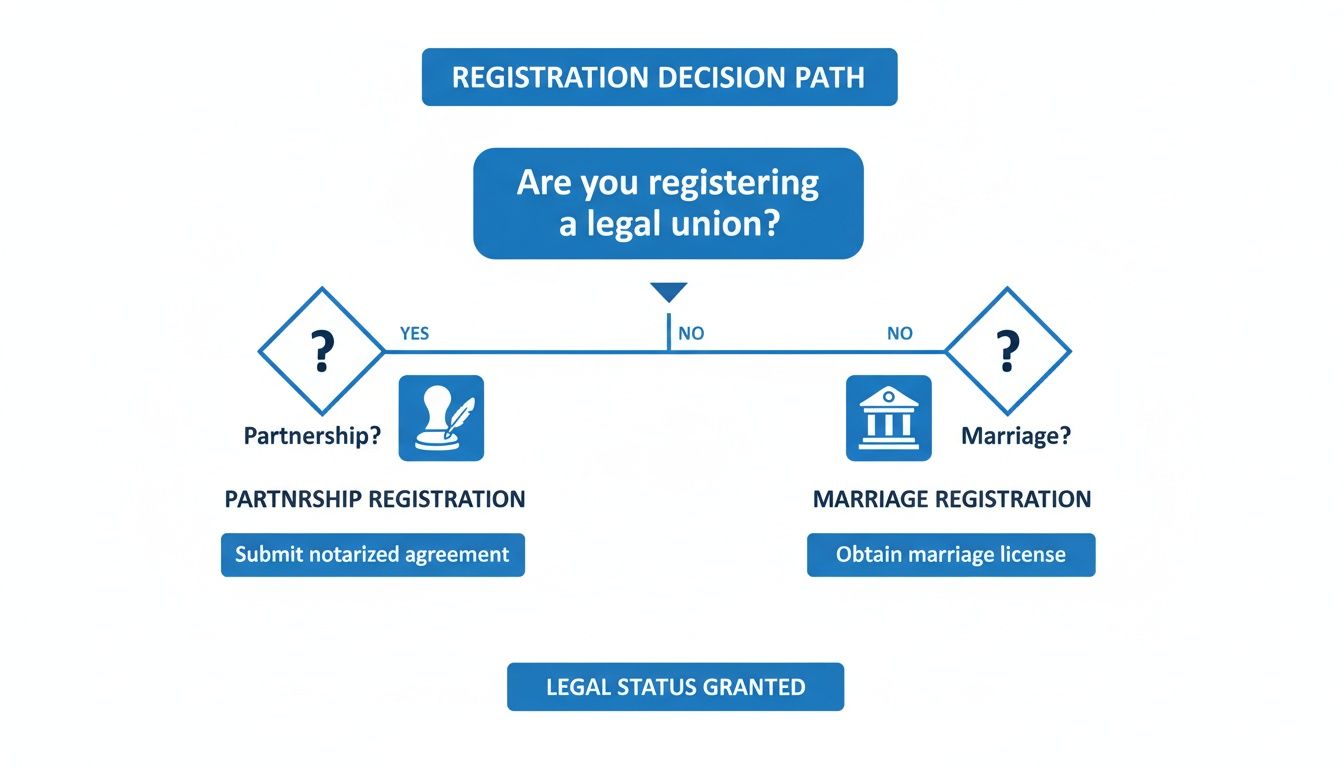
As you can see, the partnership-via-notary route is a straight shot. Marriage, on the other hand, requires navigating a more complex administrative file.
The Marriage Process: The Expediente Matrimonial
Getting married in Spain is a far more formal and drawn-out affair. It involves a procedure called the ‘expediente matrimonial’, which the Civil Registry manages. Think of it as an official investigation to confirm that both you and your partner are legally free to marry.
The administrative weight is much heavier. The paperwork is extensive, and every single document must be perfect to avoid grinding the process to a halt.
We see so many couples get bogged down in the expediente matrimonial for months. The usual culprits are missing documents, shoddy translations, or expired certificates. We work with clients to build a flawless file from day one, ensuring the process flows as smoothly as possible.
The document checklist for marriage is longer and more demanding:
- Apostilled Birth Certificates: They must be recent and come with an official translation.
- Certificates of No Impediment to Marry: This proves you are legally single.
- Proof of Residence: Your empadronamiento certificate.
- NIE and Passports: For both partners.
From submitting the initial file to finally getting approval to marry, the whole ordeal can take anywhere from three to six months. Sometimes, it’s even longer, depending on how backed up the local Civil Registry is. This delay is a deal-breaker for couples who need to sort out residency for a non-EU partner quickly.
For those who need the faster option, you can find all the details in our dedicated guide on how to register a pareja de hecho.
Figuring out whether to get married or become a pareja de hecho comes down to one thing: what you need to accomplish in Spain, both now and in the future.
If your main goal is getting a non-EU partner residency as quickly as possible, the pareja de hecho is often the fastest way. It’s a powerful tool for securing the Tarjeta de Familiar Comunitario, which allows them to live and work in Spain without the months-long wait that can come with marriage.
This path is perfect for couples who want to start their life together in Spain immediately and aren’t yet focused on things like citizenship or complex financial planning.
When a Pareja de Hecho Makes Sense
A registered partnership is usually the better option if:
- Residency is your top priority. You need to get that residency card for your partner, and you need it now. Registering with a notary can take just a few days, not months.
- You want flexibility. The registration process is simpler, and ending the union is an administrative task, not a court battle.
- You prefer financial independence. Your assets remain separate by default. This suits many modern couples who want to maintain financial autonomy without a formal prenuptial agreement.
When Marriage is the Stronger Choice
Marriage, on the other hand, provides a level of legal and long-term security that a partnership simply can’t match. It’s the right move when your goals are more comprehensive.
In our work with hundreds of expat couples, the one-year path to Spanish nationality is the single biggest reason for choosing marriage. If getting a Spanish passport is the end goal, marriage is the only way to get this shortcut.
You should choose marriage if:
- Spanish citizenship is your ultimate goal. A spouse of a Spanish citizen can apply for nationality after just one year of legal residency. This is a massive advantage over the standard ten-year wait.
- You need maximum legal protection. Marriage grants automatic inheritance rights nationwide, makes it easier to claim a widower’s pension, and allows for joint tax filing, which can lead to significant savings.
- You need international recognition. A Spanish marriage certificate is accepted and understood everywhere. This avoids a lot of headaches if you ever decide to move to another country.
What happens if the relationship ends is also a critical factor. Dissolving a pareja de hecho is a straightforward administrative process. Ending a marriage means divorce, a formal and more expensive process handled through the Spanish courts.
The best path depends entirely on your situation. Not sure which one aligns with your plans for Spain? Book a consultation, and we’ll help you map out the right choice.
Common Questions on Spanish Unions
Can I Convert My Pareja de Hecho to a Marriage?
Yes. You can get married without dissolving your pareja de hecho first. The marriage legally overrides the partnership. No extra paperwork is needed to cancel the old union.
We see many clients take this step specifically to qualify for the one-year path to Spanish citizenship, an option only available through marriage.
Do We Need a Prenuptial Agreement in Spain?
A prenuptial agreement, or ‘capitulaciones matrimoniales’, is not required for marriage, but we strongly advise it. It allows you to define your financial regime.
Over 92% of couples now use it to establish a ‘separación de bienes’ (separation of assets). This keeps finances independent. A pareja de hecho already defaults to separate assets, so this is mainly a consideration for marriage.
In our experience, signing capitulaciones matrimoniales before the wedding is a standard, practical step. It provides both partners with legal and financial clarity from day one, preventing future problems.
Is My Pareja de Hecho Valid Across All of Spain?
This is a critical detail, especially for residency. A partnership registered in a regional office, like Madrid’s, might not be recognised for official business in another, like Catalonia.
To guarantee nationwide validity, register your pareja de hecho with a public notary. The notarial deed is a public document recognised everywhere in Spain. This is essential for immigration applications.
How Is My Foreign Same-Sex Marriage Recognised?
Spain gives full recognition to foreign same-sex marriages, granting them the same rights as any other marriage. Your foreign marriage certificate, once apostilled and with a sworn translation, is all you need to apply for residency as the family member of an EU citizen.
A foreign civil partnership is another matter. It likely won’t grant automatic residency rights. You will probably need to register as a pareja de hecho in Spain to secure the tarjeta comunitaria for your non-EU partner.
The decision between partnership and marriage is a trade-off between speed and long-term security. The right choice hinges on your specific goals for life in Spain. If you need personalised advice on the best route for your situation, contact Legal Fournier for a consultation. Book your consultation with us today.
