

Immigration fine in Spain: when multa de extranjería replaces expulsion
A multa de extranjería is an administrative fine under Spain’s immigration rules. Paying it as though it were a routine bill can be a mistake. The notice may concern a proposed fine, a final fine, a requirement to leave Spain or an expulsion order. Each has different effects and may call for a different response.
Start by identifying exactly what was notified and when. A police report, initiation notice, proposed resolution, final resolution and proof of notification may each start a different procedural stage. The person’s immigration history, identity documents, ties to Spain and any pending residence application can also affect the analysis.
Position at 19 August 2026
- Irregular stay is generally classified as a serious infringement under Article 53.1.a of Organic Law 4/2000.
- Article 55 sets a fine of EUR 501 to EUR 10,000 for serious infringements. Article 57 permits expulsion instead of the fine in specified cases, subject to proportionality and a reasoned decision.
- Supreme Court authority requires an individual assessment of aggravating circumstances before expulsion is chosen for irregular stay. Those circumstances must be identified and assessed in the administrative decision.
- A fine is not a residence permit. The financial sanction must also be distinguished from any departure or return requirement in the operative part of the decision.
- Payment consequences depend on the procedural stage and the wording of the notice. A pre-resolution reduction may require recognition of responsibility and withdrawal or waiver of an administrative challenge.
- An appeal does not normally suspend execution automatically. The appropriate suspension or interim-measures request depends on the act and procedure.
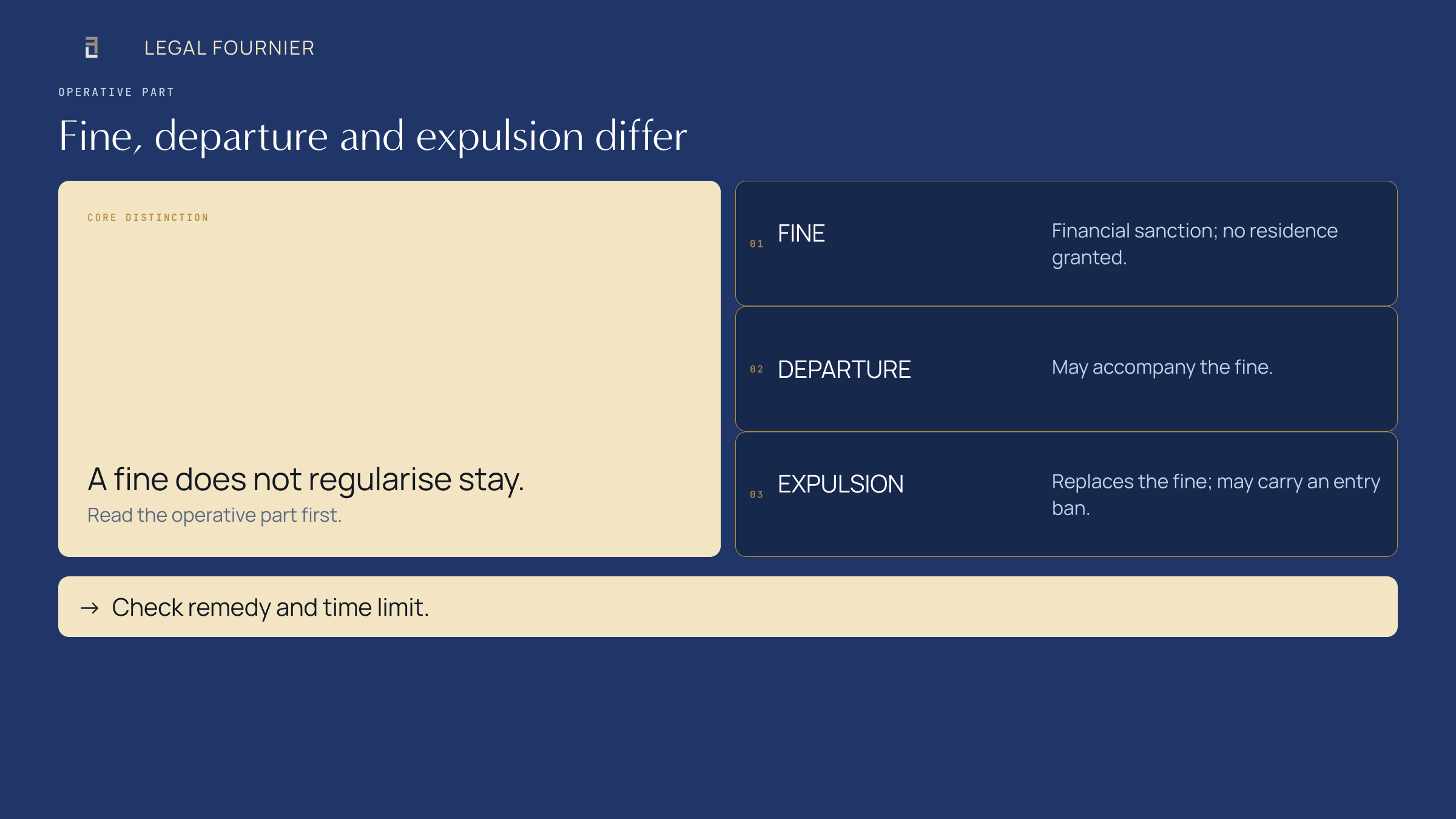
Read the operative part before paying
Although a fine may be less severe than expulsion, it does not make an irregular stay lawful. It may sit alongside a requirement to leave voluntarily, and failure to comply may affect later enforcement. An expulsion order is different: it is imposed instead of the fine and may carry an entry ban.
Before paying or appealing, read the operative part of the decision. This is where you should find whether the document imposes money only, includes a departure requirement, orders expulsion, states an entry ban or records another consequence. It should also identify the available remedy, the authority or court before which it may be brought, and the time limit.
What Spanish law says about fines and expulsion
Article 53.1.a of Organic Law 4/2000 classifies irregular stay as a serious infringement where the statutory conditions are met. For serious infringements, Article 55 sets a fine of EUR 501 to EUR 10,000. It also requires proportionality in grading the sanction and makes the person’s financial capacity relevant to the amount.
Under Article 57.1, expulsion may be imposed instead of a fine for specified serious or very serious conduct. The administration must use the appropriate procedure and issue a reasoned resolution that applies proportionality to the facts. Article 57.3 prevents a fine and expulsion from being imposed together as sanctions for the same infringement.
Not every case of irregular stay therefore ends in a fine. The administration must justify, in law and on the facts, why it has chosen expulsion. The person affected should check whether the alleged aggravating facts are established, relevant and assessed in the resolution, and should present any material favourable circumstances in time.
Fine, departure and expulsion are different
The three concepts are connected, but they are not interchangeable:
- Fine: a financial sanction under Article 55. It does not grant or extend permission to stay.
- Compulsory departure requirement: Article 28.3 of Organic Law 4/2000 identifies situations in which departure is obligatory, including lack of authorisation to remain. A person may be given a period in which to comply voluntarily.
- Expulsion: a separate sanction or return measure adopted through the relevant procedure. It may be executed voluntarily within a stated period in an ordinary procedure or enforced if the legal conditions are met. It can carry an entry ban under Articles 57 and 58.
The Supreme Court has explained that when irregular stay is sanctioned by a fine, the resolution should also include an order to leave that can be complied with voluntarily. This departure component is not the same as an expulsion sanction. The precise wording and procedural stage remain important because the Immigration Regulation approved by Royal Decree 1155/2024 lays down distinct rules for compulsory departure, ordinary expulsion and immediately enforceable preferential expulsion.
Article 24 of the Regulation provides that a compulsory departure following certain refusal or lack-of-authorisation decisions must be completed within the period stated in the decision, or generally within a maximum of fifteen days from notification where that provision applies. For an ordinary expulsion resolution, Article 245 generally provides a voluntary-compliance period of seven to thirty days. A preferential expulsion procedure is different and may lead to immediate execution. A period that applies to one type of act should not be transferred to another.
Supreme Court authority on proportionality
The analysis should begin with the cited Supreme Court judgments, not a general case-law search. In Supreme Court judgment 1312/2023 of 24 October 2023, appeal 865/2022, ECLI:ES:TS:2023:4327, the Court applied the principle that a fine is preferred for irregular stay when no aggravating circumstances justify expulsion under proportionality. The judgment also addresses the need for relevant aggravating circumstances to appear in the administrative reasoning, instead of being added later as a new justification.
The Constitutional Court’s judgment 47/2023 of 10 May 2023, ECLI:ES:TC:2023:47, explains how Spanish law relates to the EU Return Directive. It rejected the direct use of the directive against an individual to produce a harsher sanction not justified by Spanish law and the case file.
A fine is not guaranteed. Expulsion for irregular stay still requires an individual, reasoned proportionality assessment. A case without any properly established aggravating circumstance differs from one involving non-identification, evasion, non-compliance with a previous departure requirement or a properly evidenced risk to public order. Favourable circumstances also need to be considered in context; they should not be assumed to determine the outcome automatically.
Evidence that may be relevant
The notice and the proposed legal consequence determine which evidence is useful. No single checklist fits every case. The following categories are common.
1. Identity and travel history
A valid passport, previous NIE or TIE, consular records, entry stamps, visas and travel records may help establish identity, nationality and route of entry. The absence of one particular document is not automatically decisive. What matters is whether the administration can reliably identify the person and why any gap is relevant to proportionality or enforcement.
2. Address, family life and ties to Spain
Relevant evidence may include municipal registration, a tenancy, marriage or partnership documents, children’s records, dependent relatives, school enrolment, medical treatment and a documented history of residence. None of these facts automatically prevents expulsion. They may, however, be relevant to proportionality, family life and whether the person is likely to remain available to the authorities.
3. Pending residence applications
Document a pending application with its filing date, receipt, legal basis and current status. Article 240 of Royal Decree 1155/2024 contains specific coordination rules when an exceptional-circumstances residence application was filed before an expulsion procedure began. The effect is not automatic; it depends on the type, timing and merits of the application.
4. Work, study, health and vulnerability
Employment, self-employment, study, medical evidence, disability, pregnancy, care responsibilities and other documented vulnerabilities may all be relevant. Each document should be connected to a specific factual or legal point. Volume alone does not make an evidence pack persuasive.
Facts that may increase expulsion risk
The Regulation identifies circumstances relevant to using the preferential procedure for irregular stay. Article 233 refers to a risk of non-appearance, with factors including the absence of an address or identifying documents, lack of evidence of lawful Schengen entry or non-compliance with a compulsory departure requirement. It also covers conduct that avoids or obstructs expulsion, as well as risks to public order, public security or national security.
A decision cannot rely on labels alone. The administration must identify the supporting facts and explain their relevance. Police references likewise require care: a bare reference is not equivalent to a conviction or a reasoned assessment of specific conduct. The file should show what happened, the procedural status of any criminal matter and why the material is said to be relevant.
| Issue in the file | Possible relevance | Documents to consider |
|---|---|---|
| Identity and entry | Identification, travel history and availability to the authorities | Passport, stamps, visas, tickets, consular records and previous files |
| Address and family life | Proportionality, family life and risk of non-appearance | Municipal registration, tenancy, civil-status records, school and care evidence |
| Pending application | May affect procedure or a separate residence route, depending on timing and legal basis | Filing receipt, case number, status and supporting documents |
| Police or criminal material | May be alleged as aggravating if specific, relevant and properly assessed | Court status, dismissal or acquittal records, conviction and cancellation records, and context |
Procedure affects timing and execution
Royal Decree 1155/2024 provides ordinary, preferential and simplified sanction procedures. The ordinary procedure generally moves through an initiation notice, a period for allegations and documents, evidence where appropriate, a proposed resolution, and a hearing before the final decision. The shorter preferential procedure may be used in certain expulsion cases, including irregular-stay cases involving circumstances listed in Article 233.
An expulsion file also carries rights to legal assistance and, where required, an interpreter. The final resolution must give reasons and state the available remedies, the competent body and the time limit. In a preferential procedure, Article 235 provides for the expulsion order to be executed immediately after notification, without removing the right to appeal. Prompt assessment of judicial interim measures is therefore particularly important.
Payment, reductions and waiver of an administrative challenge
The effect of payment depends on whether the document is an initiation notice, a proposed sanction or a final fine, and whether a statutory reduction is on offer.
Article 85 of Law 39/2015 states that once a sanction procedure has begun, recognition of responsibility may allow it to be resolved. If the sanction is only financial, or a non-financial sanction has been found inappropriate, voluntary payment before the final resolution may terminate the procedure. For an exclusively financial sanction, the initiation notice must specify the applicable reductions. These are at least 20 per cent for the statutory mechanisms and may be cumulative. Their effectiveness is conditional on withdrawal or waiver of an administrative action or appeal against the sanction.
Paying a final fine once it is final in the administrative route is a different matter. Article 252 of Royal Decree 1155/2024 states that immigration fines are enforceable once final in that route and generally must be paid within fifteen days of finality, unless suspended. Failure to pay may lead to enforcement proceedings.
Paying the financial amount neither grants residence nor, by itself, cancels a departure requirement. Before using a reduction or paying a final fine, check the exact act, the terms of the reduction, what must be recognised or waived, any remaining departure language and the person’s separate residence strategy.
Appeal periods depend on the act and notice
There is no single appeal period that can safely be applied to every immigration sanction. First establish whether the act is final or procedural, whether it ends the administrative route, whether it is express or presumed, which body issued it and when valid notification took place.
Under Articles 121 and 122 of Law 39/2015, an express act that does not end the administrative route may generally be challenged by an administrative appeal to the superior body within one month. Under Articles 123 and 124, an express act that does end the administrative route may generally be challenged by an optional reconsideration appeal within one month, or taken directly to court where permitted. Article 46 of Law 29/1998 generally provides two months for judicial review of an express act ending the administrative route.
These are general statutory periods, not a deadline calculation for a particular notice. Presumed acts, defective or unsuccessful notification, prior reconsideration, special procedures and non-final documents can change the route or calculation. Begin with the remedies section and notification record, then check them against the applicable law.
An appeal does not automatically suspend execution
Article 117 of Law 39/2015 sets the general rule that filing an administrative appeal does not suspend the challenged act unless another rule provides otherwise. Suspension can be requested when the statutory conditions are met, but it should not be assumed merely because an appeal has been filed.
In court, suspension or another interim measure also has to be requested and justified. Articles 129 and 130 of Law 29/1998 allow interim measures after the court weighs the interests involved and the risk that execution would defeat the legitimate purpose of the claim. Urgent measures are subject to their own procedural requirements.
Urgency depends on execution risk. A fine, an ordinary expulsion order with a voluntary-compliance period and an immediately enforceable preferential expulsion order do not carry the same urgency.
Submit evidence early, but assess later evidence carefully
Articles 227, 228 and 231 of Royal Decree 1155/2024 provide stages in the ordinary procedure for allegations, documents and evidence. Relevant material should be organised and submitted as early as reasonably possible, together with an explanation of what each item proves.
Do not assume that any document produced after the final decision will automatically be considered. Article 118.1 of Law 39/2015 restricts reliance in an administrative appeal on facts, documents or arguments that could have been presented during the earlier allegations stage. In court, admissibility is governed by the rules and issues of the proceeding. A later document may still be relevant in some circumstances, but its admissibility and weight, as well as the explanation for producing it late, require a case-specific assessment.
File checklist before choosing a response
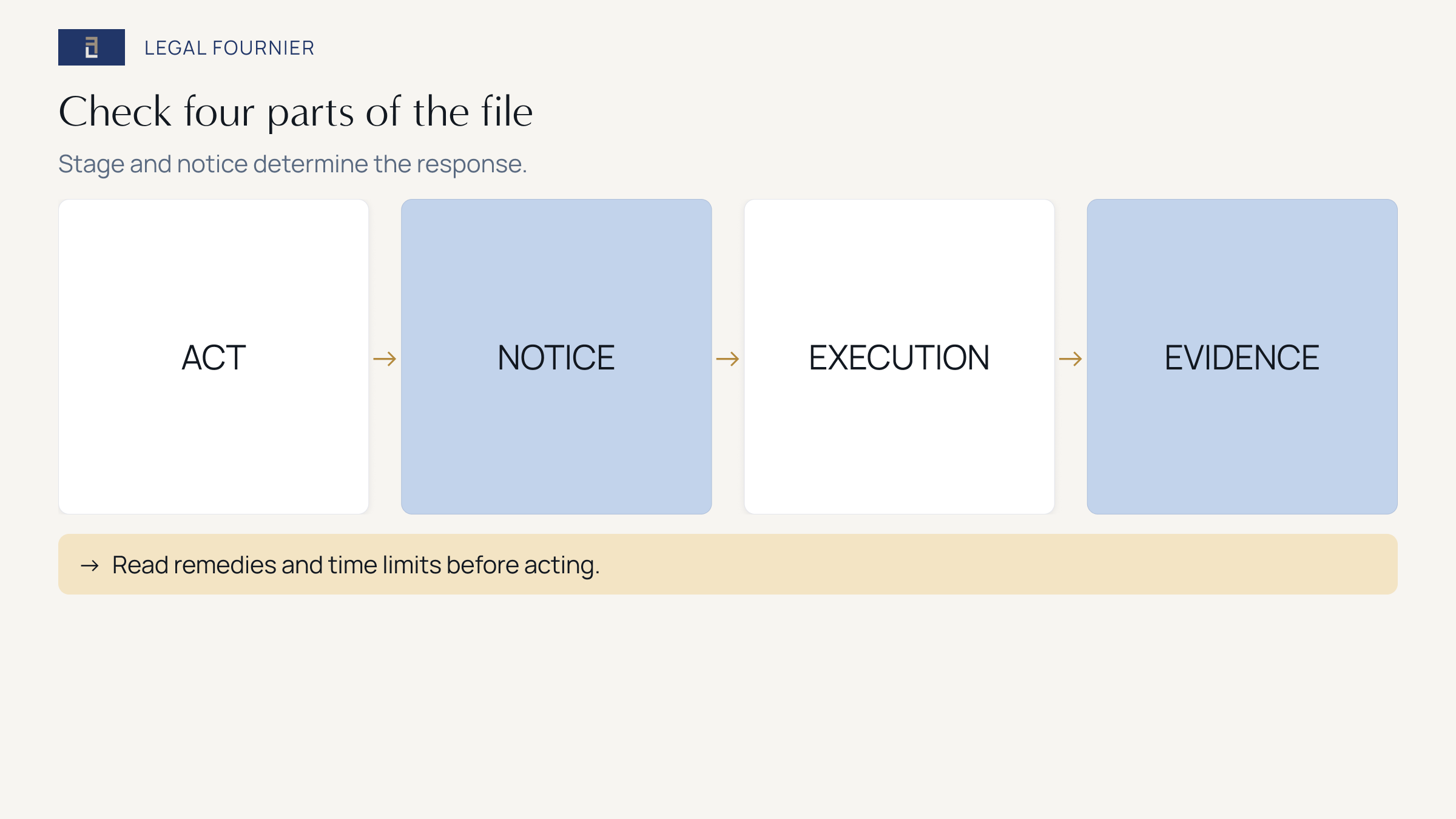
Before deciding whether to recognise responsibility, pay, appeal or seek suspension, collect:
- the complete document received, including its remedies section;
- proof of the date and method of notification;
- the initiation notice, police report, proposed resolution and final resolution, if available;
- passport, identity and travel records;
- address, family, work, study, health and vulnerability evidence relevant to the alleged facts;
- receipts and current status for any residence or protection application;
- documents clarifying any police, criminal or previous immigration reference; and
- a dated chronology of entry, expiry, applications, police contact, notifications and deadlines.
Record what is missing instead of filling the gaps with assumptions. A clear chronology and focused index are usually more useful than a large, unstructured bundle.
FAQ
Does an immigration fine legalise my stay in Spain?
No. A fine is a sanction, not a residence authorisation. Any residence route must be assessed separately. The decision may also contain a departure requirement.
Can Spain order expulsion for irregular stay?
Article 57 allows expulsion instead of a fine in specified cases, but requires proportionality and a reasoned, individual assessment. If no properly established aggravating circumstances appear, the Supreme Court’s case law supports the preference for a fine. The outcome depends on the actual decision and record.
Does paying the fine end the whole immigration issue?
Not necessarily. The effect depends on what is being paid, when, and whether a statutory reduction and waiver are involved. Payment does not grant residence and may not remove a separate departure requirement.
Does an appeal stop removal?
Not automatically. Administrative appeals generally do not suspend execution, and court proceedings also require an appropriate interim-measures request. The procedure and urgency must be checked immediately.
Can I submit new evidence after the decision?
Sometimes, but not always. Administrative and judicial rules can limit late evidence, especially when it could have been submitted earlier. Relevance, admissibility, timing and the reason for late production all need to be assessed.
Can I travel while an appeal is pending?
Do not assume that travel is safe. A departure requirement, expulsion order, entry ban, notification issue or residence status can affect re-entry and execution. Obtain advice on the exact file before leaving Spain.