Pareja de Hecho in Madrid: Requirements, Proof and Residence
In Madrid, a couple can reach the appointment and discover that the Registry counts documented cohabitation, not the length of the relationship itself. A change of address, a late entry on the municipal register or an incomplete foreign civil certificate can alter the entire sequence.
Keep two decisions separate. Registering a pareja de hecho and obtaining a residence permit are related, but they are not the same procedure. If one of the members is a foreigner, the nationality of the other and the applicable immigration route determine what should be done next. For the wider immigration context, see our immigration lawyer in Spain guide.
Published: 6 August 2026.
- The Madrid Registry requires proof of twelve uninterrupted months of joint empadronamiento at the same address immediately before requesting registration.
- The two members must reside in the Community of Madrid and meet the conditions of marital status, relationship and capacity.
- The validity and form of the certificates must be reviewed before making an appointment, especially when they come from abroad.
- Registration alone does not grant a residence card.
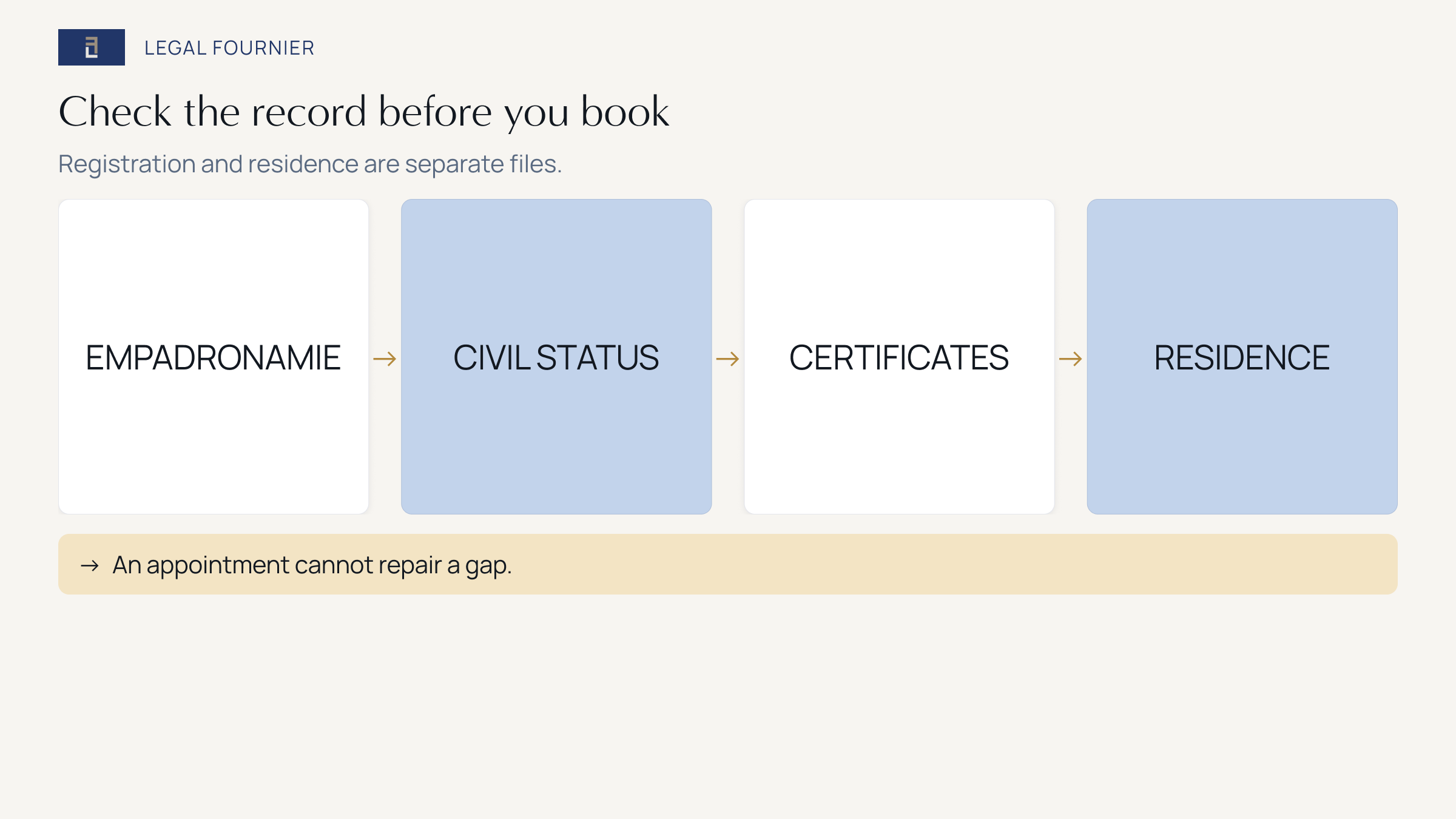
- Review empadronamiento first, then the civil documents, partnership registration and immigration route.
Madrid requires twelve months of joint empadronamiento
The Community of Madrid requires that both members have been listed on the municipal register at the same address during the twelve months immediately prior to the application. Photos, travel records, a joint account or messages cannot replace the empadronamiento requirement. That evidence may help elsewhere, but the Registry starts with the joint empadronamiento certificate.
Read the full empadronamiento history, not just the current certificate. If one of the members registered later, one person was removed from the register or the couple changed municipalities and the record does not show a continuous sequence, clarify the record before booking the appointment. Filing with an obvious interruption only postpones the problem until it is harder to correct.
Personal requirements and civil documents
Alongside the empadronamiento evidence, the Registry verifies that the applicants can give consent, that there is no current incompatible marital bond and that they are not linked to each other by the excluded degree of kinship. Nor can they maintain another de facto union registered in another autonomous community.
For birth, single-status, divorce or other civil-status certificates issued outside Spain, check the required legalization or apostille, sworn translation and acceptable issue date. The names, surnames and document numbers must match between passport, NIE, empadronamiento record and certificates.
What to check before making an appointment
Prepare a chronology of addresses, check the marital status of both and request certificates in good time. If there is a recent divorce, legal separation, prior registration, or name differences between documents, resolve them before filing. An appointment does not correct an inconsistent record.
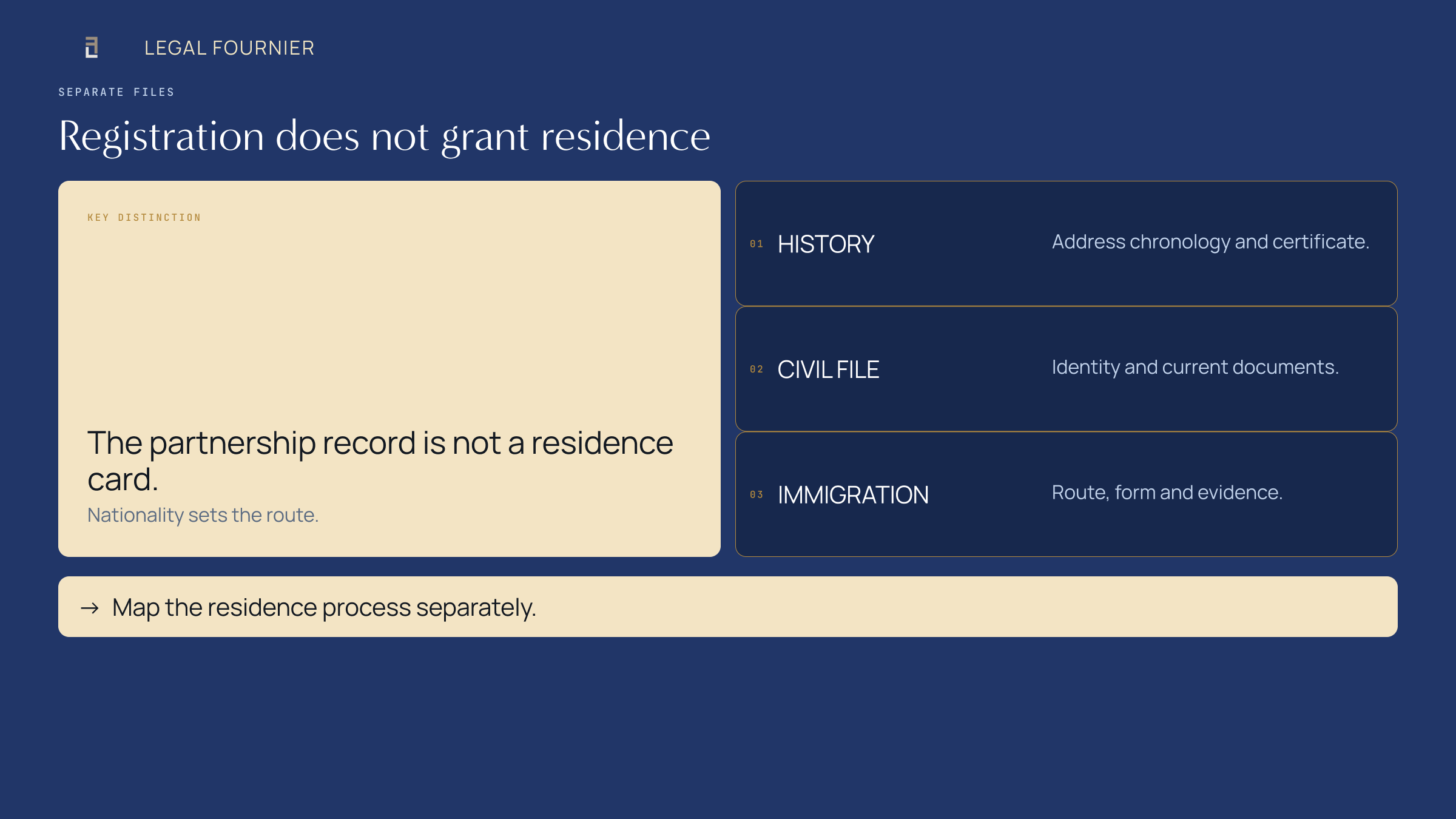
Registration and residence are different files
Registration can prove the relationship, but the residence authorization still depends on the applicable regime. It is not the same to be a partner of a Spanish person, a citizen of another State of the Union or a foreign person subject to the general regime. Each case changes the form, the authority, the financial documentation and the time of presentation.
Do not assume that registration produces a particular immigration result. First identify each partner’s nationality and the relationship. Then check which authorization fits, whether it can be filed from Spain and what further evidence it requires. Family reunification is a separate route and does not fit every couple.
Errors that delay the file
A common error is to count twelve months of relationship instead of twelve months of joint empadronamiento. Other delays come from expired foreign certificates, missing formalities, treating any cohabitation as registration or choosing an immigration form too early.
A move near the filing date can create an apparent break in the historical record. Moving does not necessarily invalidate cohabitation, but the certificate must reflect an understandable sequence. If the couple needs to travel or one of their permits is close to expiring, that time pressure should be built into the plan from the beginning.
An orderly file begins with a chronology
A four-column chronology usually reveals the gaps: date, address, document that proves it and legal effect. Add the dates of issuance of civil certificates, the validity of passports or TIE and any appointments already booked. This shows whether the application is ready to file or whether evidence still needs to be consolidated.
Early legal review can prevent unnecessary document requests or the wrong residence filing. Each document should prove a relevant fact and support the next step.
Example: an interruption that changes the calendar
A couple has been living together for two years, but one partner joined the municipal register at their shared address nine months before the consultation. They have a joint lease, bank transfers and travel records, although the historical certificate does not cover the twelve months required by Madrid. Presenting immediately does not solve this lack: the registration requirement is measured through joint empadronamiento.
Set the first date on which the historical record shows the full period. Time the civil documents so they remain valid, and check which authorization the foreign partner retains meanwhile. If one partner’s immigration status expires earlier, another legal avenue should be considered instead of assuming that future registration will cover the gap.
Checklist before you act
- Joint historical certificate covering exactly the previous twelve months.
- Valid passports, NIE or identity documents with matching data.
- Current proof of marital status of both members.
- Apostille or legalization and translation of foreign documents when applicable.
- Confirmation that there is no other registered union or kinship impediment.
- Separate map of the residency process that will follow registration.
Frequently asked questions
Is it enough to be in a relationship for one year?
Not for Madrid registration. Madrid requires joint and uninterrupted registration at the same address during the immediately preceding twelve months, in addition to the other personal conditions.
Can we change address during those twelve months?
It may be possible if the history certifies joint continuity, but how each registration and removal appears must be reviewed. A discontinuity or a poorly recorded date may prevent the required period from being demonstrated.
Does registration automatically grant residency?
No. It is evidence of the relationship, but the corresponding authorization must be identified and processed according to the nationalities and circumstances of the couple.
What happens with foreign documents?
They may require an apostille or legalization and sworn translation. They must also be current and match the identity used in Spain.
Legal review before you decide. We can review the empadronamiento history, civil documentation and residence route before the couple books an appointment or files an application that does not fit. Contact Legal Fournier to review the file and its immigration sequence.
This guide provides general information and is not a substitute for legal, tax, accounting or financial advice tailored to the facts.