Pareja de Hecho in Barcelona and Catalonia: Registration and Residence
Article 234-1 of the Catalan Civil Code recognises three ways for a couple living in a marriage-like relationship to qualify as a stable couple: more than two years of uninterrupted cohabitation, a child together during the relationship, or formalisation in a public deed. A couple therefore does not always need to wait two years.
Registration and legal status are separate. The Catalan stable-couple register can make the relationship easier to prove, but registration is voluntary and does not create the stable couple. If one partner will apply for residence, prepare the civil evidence for that specific immigration route.
Legal sources checked: 17 August 2026.
- A stable couple can arise through more than two years of uninterrupted cohabitation, a child together during cohabitation or a public deed.
- Registration is voluntary and is not constitutive, although it can simplify proof.
- Barcelona follows the Catalan civil-law framework.
- A historical empadronamiento certificate can evidence cohabitation when the couple relies on that route.
- Civil recognition of the couple and immigration authorisation require separate legal tests.
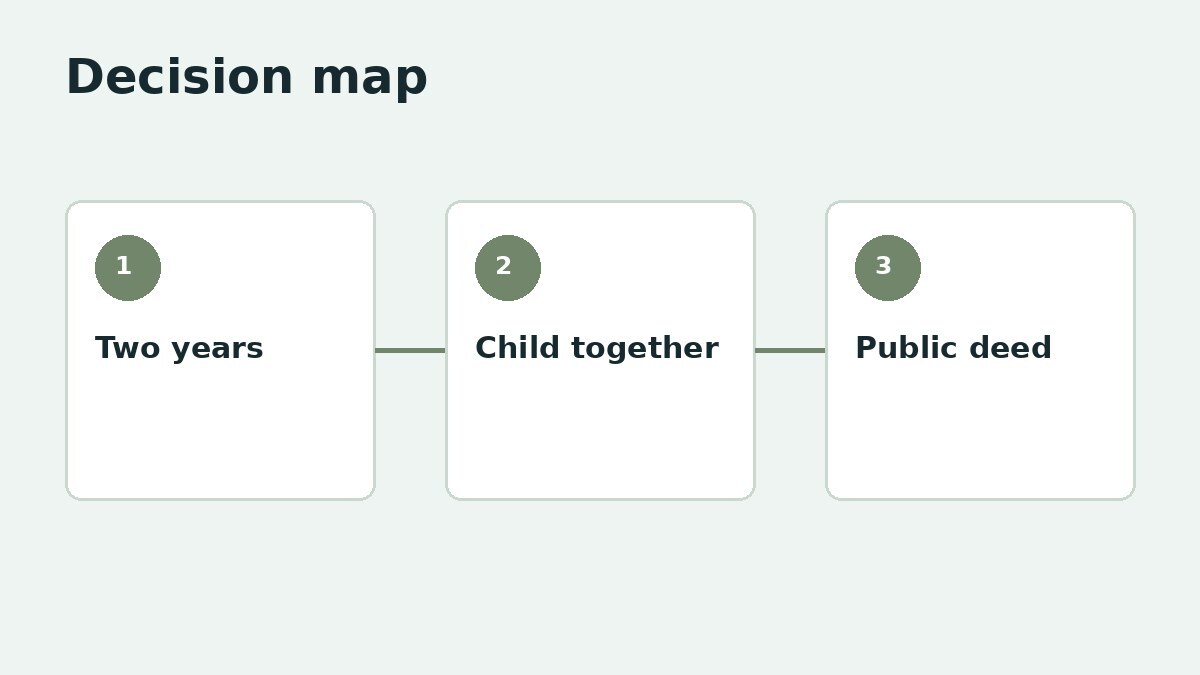
Three ways to qualify as a stable couple
The first route is more than two years of uninterrupted cohabitation. A joint historical empadronamiento certificate is usually central evidence. Changes of address, time outside Catalonia or inconsistent records may require additional proof.
The other routes are having a child together during cohabitation or formalising the relationship in a public deed. Both can be used before the two-year point, provided the couple meets the personal requirements and can document its identity and civil status.
What registration proves
Registration is voluntary and not constitutive. Its practical value is a clear administrative record that can simplify later procedures. Catalan civil law still recognises the other routes described above.
To register, both members give consent and provide the required documentation. The procedure can be carried out through the means enabled by the Generalitat. When the couple has already executed a public deed, the notary can send the data if they have the corresponding authorization.
Barcelona is not a separate regime
Barcelona does not have a separate pareja de hecho regime. Catalan civil law and the Catalan register apply, while the municipal empadronamiento record may help prove cohabitation. Couples comparing another region should use the separate Madrid pareja de hecho guide rather than assume the Catalan rules apply there.
Documents and consistency of evidence
The Generalitat’s current registration checklist includes identity documents, recent full birth certificates and, for the cohabitation route, a historical joint empadronamiento certificate. The administration may verify some records electronically when the applicants do not object. Foreign documents and complex family histories may require additional steps.
A divorce that is not correctly registered, a separation that is only alleged, different names between passport and certificate or an address that appears incomplete can raise doubts. The priority is to construct coherent evidence, not to present as many documents as possible.
From stable couple to residence
Civil recognition does not by itself grant residence. The immigration route depends on each partner’s nationality and status. For example, the Ministry’s current guidance has a specific authorisation for family members of Spanish citizens; family members of other EU citizens and applicants under the general immigration regime follow different rules.
A registration certificate or public deed may support the application, but the immigration authority will also apply the requirements of the chosen authorisation. Confirm the form, who may apply, where to file, any financial or employment evidence and the effect of earlier applications before submitting.
When should a couple sign a deed, register or wait?
The answer depends on the route that is already available and the objective. A couple with two years of joint empadronamiento can prepare the registration on that basis. A recent couple may consider a public deed, but must understand its civil and immigration effects before signing. The existence of a common child offers another avenue that must be well documented.
When an immigration deadline is close, check which evidence that procedure accepts and when the deed or registration certificate will be available. Compare the viable routes against the actual filing date rather than choosing one because it appears faster.
Example: recent couple with public deed
Suppose two people have lived together in Barcelona for eight months and need to prove their relationship. They have not reached two years, so they consider a public deed. Before signing, they should check for any legal impediment, correct discrepancies in their civil documents and understand the deed’s effects.
The deed can be relevant immigration evidence, but it does not replace the requirements of the residence authorisation. Nationality, the applicant’s current status and the chosen procedure determine what else must be filed.
Checklist before you act
- Identify which of the three stable partner routes is used.
- Obtain the historical empadronamiento certificate when cohabitation is part of the evidence.
- Review both partners’ birth records and any marriage, separation or divorce documents.
- Decide whether a public deed and registration add useful evidence for the specific objective.
- Prepare translation and legalization of foreign certificates.
- Separate the civil-status evidence from the immigration form and residence requirements.
Frequently asked questions
Do you always have to live together for two years?
No. Catalonia also contemplates the existence of a common child during cohabitation or formalization in a public deed, provided that the other conditions are met.
Is registration mandatory?
It is voluntary. It can facilitate proof of the relationship, but it is not the only way to prove a stable partnership.
Does Barcelona have its own requirements?
Barcelona does not set a separate civil regime. Catalan law and the Catalan register apply, while municipal empadronamiento records may help prove cohabitation.
Does being a stable couple grant residency?
Not automatically. The relationship must be connected with the residence authorization that corresponds to nationality, regime and circumstances.
This guide provides general information and is not a substitute for legal, tax, accounting or financial advice tailored to the facts.