
Expulsion order in Spain: fines, appeals and proportionality defence
A Spanish orden de expulsion is a removal decision, not another name for an immigration fine. It can remove a person from Spain, create an entry ban affecting Schengen travel, extinguish an existing authorization and close pending residence or work files. Start with the procedure: identify what was notified, which deadline is running and whether the administration justified expulsion instead of a fine.
Advice on irregular stay often collapses into two claims: that it should only lead to a multa, or that expulsion is automatic. Neither is accurate. Spanish law allows expulsion for certain serious immigration infringements, including irregular stay under Article 53.1.a of Organic Law 4/2000, but the decision must be reasoned and proportionate. The Supreme Court’s current line treats a fine as the preferred response where no aggravating circumstances justify expulsion.
Legal Fournier reviews expulsion orders in the context of the whole file: entry history, notices, family ties, pending applications, employment, criminal or police records, previous immigration procedures and realistic regularisation routes. If you already have a resolution, the matter should be treated as an immigration appeal, not as a general status question. If the issue started with a renewal or pending residence application, also review our residency renewal support in Spain.
Published: 21 July 2026 · Based on Organic Law 4/2000, Royal Decree 1155/2024, Law 39/2015, Law 29/1998, CJEU case C-409/20 and Supreme Court/CENDOJ summaries from 2023.
Before responding
- Do not assume expulsion is automatic. For simple irregular stay, the current Supreme Court line treats the fine as preferred where no aggravating facts justify expulsion.
- Fine and expulsion cannot be imposed together. Article 57.3 LOEX prohibits imposing both sanctions jointly for the same infringement.
- The proportionality defence is evidence-led. Identity, entry route, family ties, pending applications, conduct and prior files matter more than generic hardship.
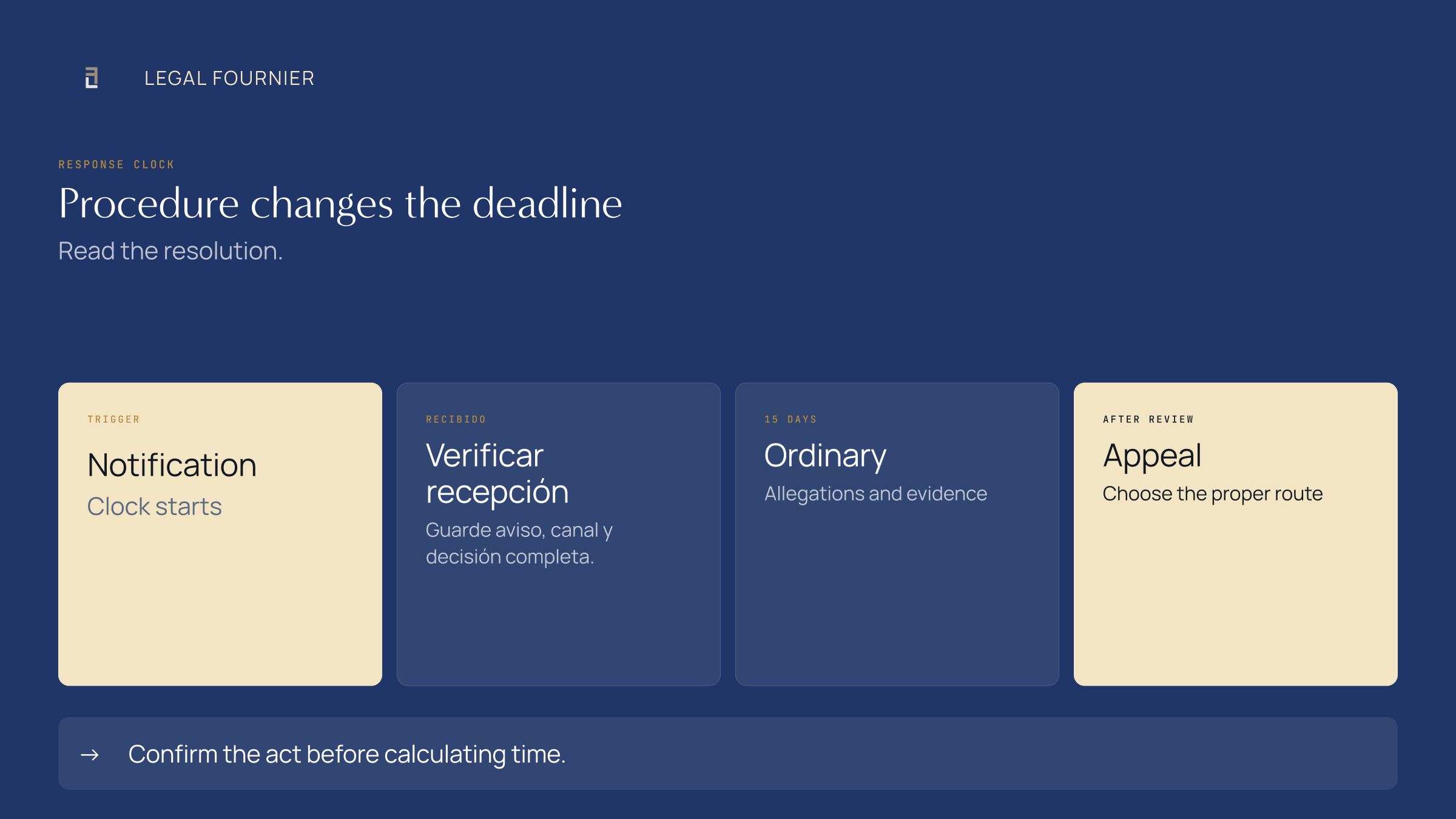
- The procedure changes the clock. Ordinary expulsion procedures normally allow 15 days for allegations; preferential procedures can compress the first response to 48 hours.
- Appeal deadlines run from notification. Reposicion and court routes have short periods. The exact resolution needs to be read before choosing payment, appeal or urgent suspension.
What an orden de expulsión does
An orden de expulsion is an administrative sanction that orders the foreign national to leave Spanish territory. In many cases it also carries a prohibition on entry. Under Organic Law 4/2000, expulsion can be used instead of a fine for certain very serious infringements and for specific serious infringements, including irregular stay, working without the required authorization in certain circumstances, concealment or serious falsehood, breach of security-related measures and participation in activities listed by the statute.
The order reaches beyond physical departure. Article 57 LOEX states that expulsion entails the extinction of any authorization to remain legally in Spain and the archive of any procedure intended to authorize residence or work for the expelled person. Article 58 adds that expulsion normally carries an entry ban, generally up to five years, with a possible longer period in exceptional public-order, public-security, national-security or public-health cases.
This is why a foreigner who receives an expulsion decision should not treat it as a standard administrative letter. A pending work authorization, family application, arraigo route, renewal, study modification or business plan can be affected by the order. The decision also matters for banks, employers, family logistics, travel and future Schengen entries.
Two questions matter: can the person avoid removal, and has the administration justified expulsion as the proportionate sanction for this file?
Fine or expulsion for irregular stay?
Irregular stay is a serious infringement under Article 53.1.a LOEX when a person is in Spain without having obtained an extension of stay, without residence authorization, or with an authorization expired for more than three months, provided they have not applied for renewal within the regulatory period. Article 55.1.b sets the ordinary fine range for serious infringements at 501 to 10,000 euros.
Article 57.1 then allows expulsion to be applied, in attention to the principle of proportionality, instead of the fine, after the relevant administrative file and through a reasoned resolution that assesses the facts configuring the infringement. Article 57.3 is equally important: fine and expulsion cannot be imposed jointly.
The controversy is whether a person in Spain irregularly should normally receive a fine or an expulsion order. After several CJEU and Spanish Supreme Court turns, the current working position is more balanced than the slogans suggest. The CJEU’s C-409/20 judgment accepted that, in the absence of aggravating circumstances, national law may initially impose a fine together with an obligation to leave, followed later by compulsory removal if the person neither regularises nor leaves within the prescribed period, provided the voluntary-departure framework respects the Return Directive.
The Spanish Supreme Court, as summarised in the official CENDOJ record for STS 4337/2023, systematised the doctrine in 2023: irregular stay can lead to a fine or expulsion, with the fine preferred when no circumstances justify expulsion under proportionality. Where the administration chooses a fine, the resolution should also contain a voluntary departure order. Where it chooses expulsion, it needs an individualised assessment of aggravating circumstances that justify the more severe response.
The proportionality defence
A proportionality defence uses law and evidence to show that the file does not justify expulsion, or that the administration failed to explain why expulsion is proportionate instead of a fine. The defence should be built from the facts that existed and were documented in the administrative procedure, because a court may focus heavily on what the resolution itself used to justify the sanction.
Start with the aggravating circumstances relied on by the administration and test whether they are absent, weak or unsupported. A resolution that simply says “irregular stay” and then orders expulsion may be vulnerable if it does not identify facts that make expulsion proportionate. If the file alleges risk of absconding, lack of documentation, previous sanctions, a prior unexecuted expulsion, public-order concerns or obstruction of the procedure, those points must be tested one by one against the evidence.
Positive personal circumstances also matter, but they must be presented carefully. Family ties in Spain, minor children, school attendance, a Spanish or EU partner, a pending residence route, a clean criminal record, stable address, passport, medical or pregnancy circumstances, social roots, employment evidence and prior lawful entry can all be relevant. Their weight depends on the procedure and on whether they counter the specific reasons used by the administration.
For founders, professionals and internationally mobile families, the file may involve more than an overstay. A founder may have been waiting for corporate documentation, a spouse may have a pending EU family route, a family office may have submitted residence planning late, or a professional may have relied on a previous advisor’s renewal filing. These facts do not automatically defeat an expulsion order, but they can change the proportionality and remedy analysis.
Which procedure are you in?
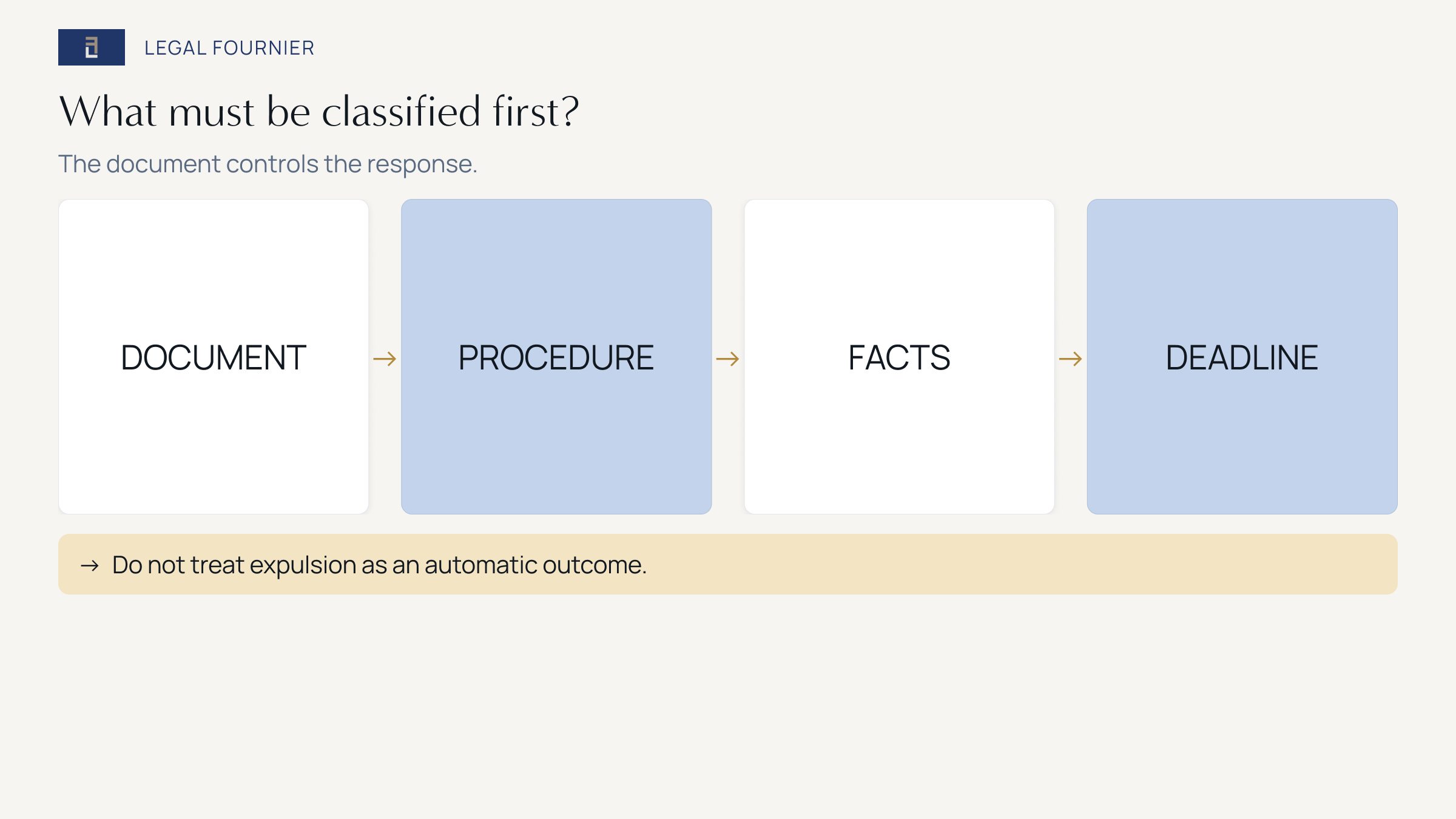
The first document must be classified. An initiation agreement is different from a proposed resolution. A final expulsion resolution is different from a fine with an obligation to leave. A court judgment is different from an administrative act. Acting on the wrong assumption can waste the only useful deadline.
| Document or stage | What it usually means | Immediate legal task |
|---|---|---|
| Acuerdo de iniciacion | The sanction file has started. | Identify whether ordinary or preferential procedure applies and calculate allegations. |
| Tramite ordinario | The ordinary sanction procedure is being used. | Prepare allegations and evidence. Royal Decree 1155/2024 gives a 15-day period in the ordinary procedure. |
| Procedimiento preferente | Used for certain higher-risk situations, including specified public-order, absconding or obstruction scenarios. | Act immediately. LOEX gives 48 hours for initial allegations and no voluntary departure period in those cases. |
| Fine with obligation to leave | A monetary sanction may be paired with a voluntary departure requirement. | Review regularisation options and the exit deadline. A fine does not legalise the person. |
| Final expulsion resolution | The administration has ordered expulsion and usually an entry ban. | Calculate administrative and court deadlines, assess suspension and build the appeal record. |
Under Royal Decree 1155/2024, sanction resolutions must be reasoned and, for sanction choice, the authority must value personal and family circumstances where Article 57 is engaged. The same regulation provides that ordinary expulsion resolutions include a voluntary compliance period, normally between seven and thirty days, while preferential expulsion resolutions are executed immediately according to their specific rules.
When a fine may be the correct outcome
A fine may be the correct or strategically preferable outcome where the file is essentially simple irregular stay and the administration has not proved aggravating circumstances of sufficient weight. This does not mean the person obtains a right to remain in Spain. It means the sanction is monetary, normally paired with an obligation to leave voluntarily unless the stay is regularised within the relevant period.
The fine route may be relevant where the person has a passport and stable address, entered lawfully, has no adverse record, did not obstruct the procedure, has Spanish family or social ties, has a pending or realistic regularisation route, and the administration has relied only on the fact of irregular stay. It may also be relevant where the alleged aggravating facts are not in the resolution, are unsupported by the file, or are too weak to justify expulsion.
However, the fine route is not a permanent shield. If the person does not regularise and does not leave, later proceedings may follow. A defence focused only on “give me a multa” can miss the rest of the file. Counsel must also assess any lawful route to status, the consequences of voluntary departure and whether an appeal provides useful protection or merely delays a weak case.
When expulsion risk is higher
Expulsion risk rises when the administration can point to facts beyond simple irregular stay. The law and case law do not reduce this to a closed checklist, but the risk analysis often focuses on identity, documentation, previous conduct, prior immigration files, public-order concerns, attempts to evade enforcement, employment infringements and whether the person can realistically be located during the procedure.
Article 63 LOEX allows preferential procedure for irregular stay where there is risk of non-appearance, where the foreigner avoids or hinders expulsion, or where the person represents a risk to public order, public security or national security. Article 62 also shows the kinds of factors a judge considers when authorising detention in an expulsion file, including risk of non-appearance due to lack of address or identity documentation, conduct aimed at hindering removal, prior convictions or sanctions and other pending criminal or sanction proceedings.
Those factors do not mean that every negative fact automatically validates expulsion. The administration must still motivate the decision and connect the facts to proportionality. A proportionality defence may accept that the stay was irregular while disputing that the additional facts are proven, serious, current or legally sufficient to justify expulsion.
Appeal routes and deadlines
A final expulsion resolution must state the available remedies, the competent body and the deadline. That text controls the immediate calendar. As a general framework, Law 39/2015 provides a one-month period for an optional recurso de reposicion against express acts that put an end to the administrative route. Law 29/1998 provides a general two-month period for contentious-administrative court appeals against express acts that put an end to the administrative route.
Those deadlines are short in practice. The lawyer needs the full notification, the administrative file if obtainable, the police report or initiation act, the proposed resolution, evidence submitted earlier, notification history, pending immigration files and proof of personal circumstances. If suspension is needed, it should be assessed immediately, especially where the procedure is preferential or the person is detained.
For a person outside Spain, the regulation provides that the relevant resources may be filed through diplomatic or consular representations, which will forward them to the competent body. That does not make the appeal simple; it makes documentation and timing even more important.
An expulsion appeal is usually won or lost on the administrative record: what the authority alleged, what evidence was before it, and whether the resolution explains why expulsion was proportionate.
Evidence to prepare before challenging the order
We normally start with a document map rather than a generic appeal template. The useful evidence depends on the ground for expulsion, but the core review often includes:
- Identity and entry evidence. Passport, stamps, visa, tickets and documents showing lawful entry or explainable movement.
- Status and filing history. Previous TIE, renewal receipts, pending Mercurio filings, family-card applications, arraigo files or rejection notices.
- Notification record. How and when each act was notified, whether a representative was involved, and whether any deadline was missed.
- Family and social ties. Marriage or partnership, children, school records, dependency, Spanish or EU relatives, registration and stable address.
- Conduct evidence. Criminal-record certificates where appropriate, absence of prior sanctions, compliance with appointments and cooperation with the procedure.
- Regularisation route. Whether a real legal path exists and whether it was already filed before the sanction file started.
The evidence should make the proportionality issue concrete: why the facts do not justify expulsion, why a fine or other handling would be legally more proportionate, or why execution should be suspended while a pending residence route is decided.
How Legal Fournier reviews the file
- Classify the act. We identify whether the client has an initiation notice, proposal, fine, final expulsion resolution, court deadline or enforcement problem.
- Calculate the live deadline. We work from the notification date and channel, not from when the client opened the email or understood the letter.
- Read the stated reasons. We separate proven facts, legal classification, aggravating circumstances and generic wording.
- Build the proportionality record. We gather evidence that weakens expulsion or supports suspension, regularisation or a fine outcome.
- Choose the remedy. Depending on timing and risk, the next step may be allegations, reposicion, court appeal, urgent suspension, regularisation filing or a controlled voluntary-departure strategy.
This file leaves little room for trial and error: a missed 48-hour window, a weak appeal without suspension, or a document bundle that ignores the actual aggravating facts can turn a defensible case into an enforcement problem.
FAQ
Does an orden de expulsion mean I am banned from Spain?
Usually, yes, an expulsion resolution carries an entry ban. Under LOEX, the general maximum is five years, with an exceptional period of up to ten years for serious public-order, public-security, national-security or public-health threats. The exact period needs to be checked in the resolution.
Can I ask for a fine instead of expulsion?
In some irregular-stay cases, yes, the argument may be that the fine is the proportionate sanction because no aggravating circumstances justify expulsion. This is not automatic. The defence must address the facts used by the administration and the current Supreme Court line.
Can Spain impose both a fine and expulsion?
Article 57.3 LOEX states that fine and expulsion cannot be imposed jointly. A fine may still be paired with an obligation to leave, and later removal can follow if the person does not leave or regularise in the relevant period.
How long do I have to appeal an expulsion order?
The resolution must state the remedies and deadlines. Commonly, an express act ending the administrative route can be challenged by optional reposicion within one month or by contentious-administrative appeal within two months. Preferential and detention cases need urgent review because execution risk may be immediate.
Does a pending residence application stop expulsion?
It depends on the type of application, timing and procedure. LOEX contains specific rules for some exceptional-circumstances applications filed before the expulsion file. The CJEU also recognises that regularisation efforts can matter within the voluntary-departure framework. Do not assume every pending application suspends removal.
Can I appeal if I have already left Spain?
Yes, the current regulation contemplates filing administrative and judicial remedies from abroad through diplomatic or consular representations. In practice, evidence, powers of attorney, translations and timing must be organised carefully.