
Immigration appeal in Spain after an unfavorable residence decision
Before writing a single ground of an immigration appeal in Spain, settle the route. You need the signed decision, reliable evidence of service and the material that was actually in the original file. Without those records, even a persuasive draft may be addressed to the wrong body, use the wrong procedure or fail to address the point on which the Administration based its decision.
If all you have is an en trámite, no favorable or archived portal label, first obtain the formal decision before choosing a remedy. The discussion below assumes that the adverse act has been identified. It covers general residence and authorisation decisions; expulsion, refusal of entry, asylum, nationality and EU free-movement cases need their own analysis.
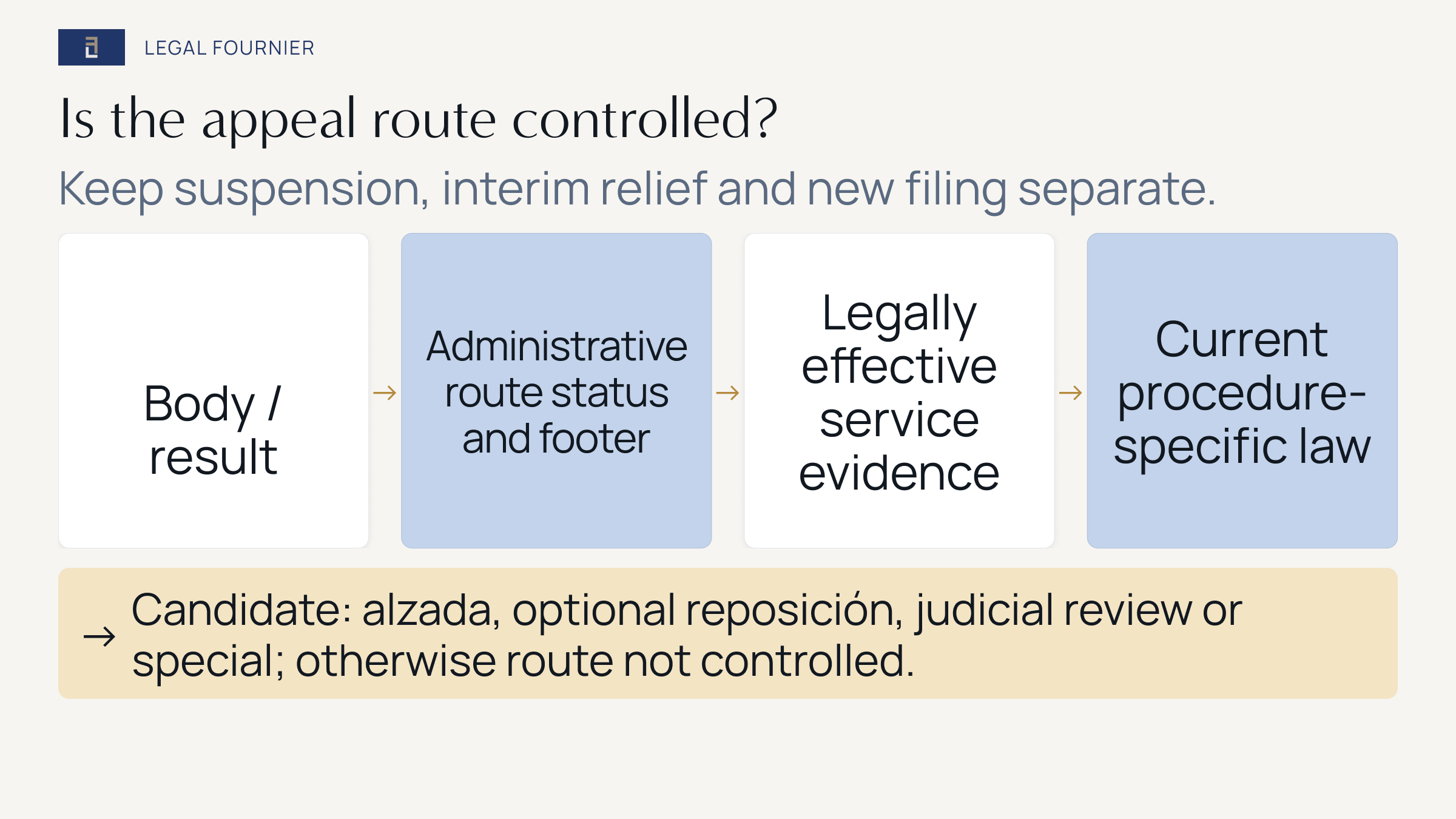
Control the route on one page
Complete the following record before drafting any ground of challenge. If a field has no documentary source, write “not confirmed”. Do not fill it from memory or from a general web article.
| Field | What the record must show |
|---|---|
| Act | Issuing body, decision date, procedure and exact operative result |
| Administrative route | Whether the act ends it, with the footer and current legal provision recorded separately |
| Service | Availability, access or delivery event, recipient or representative, channel and supporting evidence |
| Candidate remedy | Alzada, optional reposición, direct judicial review, a special route, or “unclear” |
| Filing control | Competent body, current channel, calculated date, official calendar used and reviewer |
| Separate decisions | Whether suspension or judicial interim relief needs analysis, and whether a new application is being compared |
Until every field has a documentary source and a lawyer has confirmed the candidate remedy and date for the specific act, the working result should remain route not controlled.
Notification evidence controls more than the screen
A notification should contain the full decision, state whether it ends the administrative route and identify the remedies, filing body and period. The notification record also needs to preserve the relevant availability or dispatch, access or receipt, time, content and identities. These requirements are set out in articles 40 and 41 of Law 39/2015.
An email alert is not a substitute for that record. Where an electronic notification is involved, preserve the platform evidence and check whether a representative accessed it or whether service first occurred through another channel. This guide to DEHú notifications in Spain explains the difference between an alert and the electronic record. It does not identify the immigration remedy or calculate the date.
Alzada and reposición are not interchangeable
Recurso de alzada is available against appealable acts that do not end the administrative route. It is decided by the hierarchical superior and may be filed with either the issuing body or the body competent to decide it. Under the general rule, the period for challenging an express act is one month. These rules appear in articles 121 and 122 of Law 39/2015. They do not make alzada the default immigration appeal.
Where an act ends the administrative route, optional recurso potestativo de reposición may be filed before the same body, or the interested person may go directly to judicial review when that route is available. Filing reposición means judicial review must wait until the appeal has been expressly decided or is deemed rejected. The general period for reposición against an express act is one month. See articles 123 and 124 of Law 39/2015.
The immigration regulation matters at this first fork. Additional provision 9 says that decisions by the listed ministries, Government Delegates and Subdelegates in specified visa, stay, residence and work matters end the administrative route, and it also sets out exceptions. Match the authority and subject of the decision to additional provision 9 of Royal Decree 1155/2024. A generic explanation of alzada must not override that exercise or the reviewed footer.
For an express act that ends the administrative route, article 46 of the judicial-review law provides a two-month period starting the day after notification or publication. It has separate rules for non-express acts and for a prior reposición. Do not calculate a court deadline for silence or defective notice from this summary. The governing text is article 46 of Law 29/1998.
Map every refusal ground to the original record
Once the route is controlled, read the decision once for structure. Give every independent ground its own row. An appeal that answers one reason well and ignores another may leave the operative result untouched.
| Ground | Decision finding | Rule cited | Original evidence and receipt | Alleged error | Additional evidence and its timing | Requested legal outcome | Unresolved risk |
|---|---|---|---|---|---|---|---|
| 1 | Use neutral wording from the resolution | Provision named by the authority | List document and submission proof | Factual or legal issue alleged | Explain why and when it arose or was absent | State precisely; do not predict it | Write “not yet answered” if unresolved |
Treat the grid as an issue map, rather than a filing-ready appeal. Article 115 of Law 39/2015 requires an administrative appeal to identify the appellant, the challenged act and reason, the date, signature, notification method and body addressed. A wrong or missing label does not prevent processing if the appeal’s true character is clear. That rule does not settle the competent body, filing code, representation or current submission channel. Verify those details on the filing day under article 115.
New evidence needs an explanation
The evidence column is not an unrestricted second chance. Article 118 provides a hearing framework when new facts or documents enter an administrative appeal. It also says that the decision will not take account of facts, documents or allegations that could have been supplied in the earlier allegations stage but were not, and it limits evidence omitted through the interested person’s fault. Record whether each document was in the original file. If it was not, record when it arose and why it was unavailable. A lawyer must then assess whether and how it can be used under article 118 of Law 39/2015.
An administrative-appeal decision may allow or reject the appeal, or declare it inadmissible. A formal defect may lead to the matter being sent back to the stage where it occurred, and the decision cannot worsen the appellant’s original position. None of those possible results predicts what will happen in a particular file or turns a procedural defect into an automatic grant. See article 119.
Suspension is a separate request
Filing an administrative appeal generally does not suspend execution of the challenged act. The deciding body may grant suspension after a reasoned assessment under the statutory conditions. The one-month deemed-suspension rule in article 117 concerns an unanswered suspension request filed in the competent register; it does not mean the appeal itself suspends the decision. See article 117 of Law 39/2015.
Judicial interim measures are governed separately. A court may grant measures to protect the effectiveness of a future judgment, applying a case-specific balance and considering serious harm to general or third-party interests. Articles 129 and 130 do not create automatic protection. They also do not support a self-filing strategy from a general article. Consult articles 129 and 130 of Law 29/1998.
For both routes, do not assume that a filing preserves residence, work, travel or renewal rights. Those effects require analysis of the exact decision and the person’s current status.
Compare a new application without treating it as a reset
A new application belongs in a separate comparison. Identify the reason for the earlier decision, what has genuinely changed, the current eligibility rule and any status consequences. Organic Law 4/2000 permits inadmissibility of a repeated authorisation application where an earlier request was denied and the circumstances behind that denial have not changed. The relevant provision is additional provision 4.1(c).
Current Ministry immigration information sheets can help identify the procedure’s operational requirements. They are orientative, so save the exact sheet and update date and verify the governing law. Filing a new application does not, by itself, suspend or replace an existing challenge period.
The route remains uncontrolled until the records agree
If the signed decision, remedy footer or service record is missing, leave the working status as route not controlled. Do not calculate a filing date or draft grounds yet. First match the issuing body, operative result and service event to the current law.
After a lawyer confirms the route and date, move through the evidence grid one ground at a time. Record whether each document was in the original file; if it came later, record when it arose and why it was unavailable. Keep administrative suspension and judicial interim relief outside the ground row. Residence, work or travel effects and a new application also need separate analysis.
Request a route-and-record review with the signed decision, legally effective service evidence, remedy footer and indexed original submission. The review can confirm the available route and deadline from those records, then compare each refusal ground with the evidence file. It cannot promise that an appeal is available, that any filing preserves status, or that suspension, interim protection, a new application or a particular result will follow.