
Unfavorable archived or inadmissible immigration file in Spain: what to do next
If an immigration portal shows unfavorable, archived or inadmissible, download the signed resolution before choosing what to do. Each label may sit over a different legal event. The screen also leaves out information that may control the response: the formal decision, its reasons, the effective notification record and the paragraph explaining possible remedies.
The government’s immigration-file status service says that its results are for information only. Use the status as a prompt to retrieve the file, not as the basis for calculating a deadline or deciding between an appeal and a new application. If the file still appears pending, this separate guide explains why a portal status is not the formal decision.
Before analysing the result, preserve five things:
- the full signed decision and its verification data;
- evidence of when and how it was legally notified;
- the exact operative paragraph, preserving any resuelvo label used in the decision;
- each separate reason and the legal provision cited; and
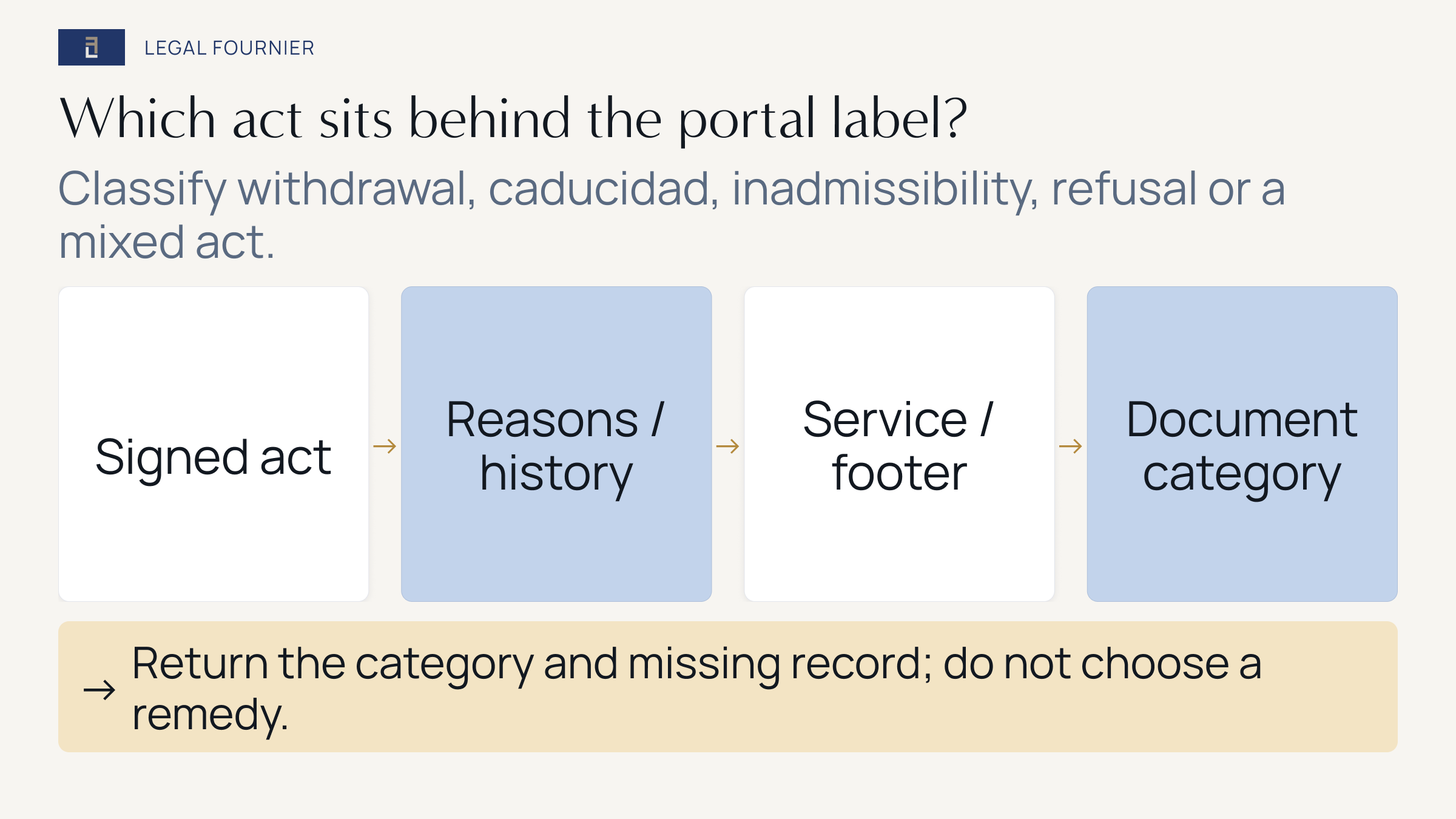
- the footer stating whether the act ends the administrative route, the available remedy, the filing body and the period.
If one of these is absent, mark it as missing. A portal screenshot cannot fill the gap.
What the portal cannot classify
The general administrative-procedure law distinguishes a resolution, withdrawal by the applicant, waiver where the law permits it, and a declaration of caducidad as different ways a procedure may end. They should not be translated into a single idea of “denied” or “closed”. Read the operative paragraph alongside the procedural history. The categories come from article 84 of Law 39/2015.
An unfavorable portal label may correspond to a decision on the substance of the application, but the screen alone does not establish that. A signed resolution should set out the decision and, where required, its reasons. It should also identify the available remedies. Those requirements appear in articles 40.2 and 88.3 of Law 39/2015. Missing or confusing remedy information calls for legal review; it is not permission to invent a route or date.
An archived file needs closer reading. Where an initiating application was incomplete, article 68 provides a procedure for requesting correction. If the applicant does not cure the stated defect, the Administration may treat the applicant as having withdrawn, but article 68 links that result to a resolution under article 21. The file does not simply vanish when the response period ends. The notice, the material submitted, its receipt and the later resolution all matter. The relevant text is in articles 68.1 and 21.1 of Law 39/2015.
Caducidad under article 95 is another category. Where the applicant has caused the procedure to stall, the provision requires a warning and a three-month period tied to an action needed to resume processing, followed by an archive decision and notice. A declaration of caducidad does not by itself cause prescription, but that does not mean a fresh application is always open. The claim must not have prescribed, and the rules for the particular procedure must still allow it. See article 95 of Law 39/2015.
A card for classifying the result
Use the card to organise the record. Its output is a document category and a list of missing records, rather than an appeal, correction or refiling instruction.
| Working classification | Signal in the documents | Record still needed | Boundary |
|---|---|---|---|
| Withdrawal after non-cure | Correction notice, requested material and later resolution | Service evidence and filing receipt | That this is caducidad or a merits refusal |
| Caducidad under article 95 | Prior warning, three-month history and archive resolution | A complete chronology of the stalled step | That refiling is available |
| Application inadmissibility | The exact statutory threshold ground | Procedure, standing and filing history | That the merits were decided |
| Merits refusal | A substantive requirement and factual finding | The original evidence and current procedure rule | That new evidence will be admitted |
| Appeal inadmissibility | A ground attached to a later appeal | The challenged act, service record and appeal receipt | That it describes the original application |
| Unclear or mixed act | Missing or inconsistent decision, reasons or footer | The complete signed document or file access | Any route until the inconsistency is reviewed |
Two kinds of inadmissibility are easy to confuse
Immigration law lists threshold grounds for inadmitting an authorisation application. They include, among other defined grounds, lack of standing or representation, late filing, and repeating a previously denied request when the reasons for that denial have not changed. The exact letter cited in the resolution controls the analysis. Visa applications for transit or stay have a separate subsection. The source is additional provision 4 of Organic Law 4/2000.
An administrative appeal has its own inadmissibility grounds. Article 116 refers to matters such as filing before the wrong Administration, lack of standing, an act that cannot be appealed, expiry of the appeal period or manifest lack of foundation. An inadmitted appeal therefore needs a different record from an inadmitted immigration application. See article 116 of Law 39/2015.
The remedy comes from the exact act
The current immigration regulation says that decisions by specified ministries, Government Delegates and Subdelegates in listed visa, stay, residence and work matters end the administrative route. It also contains exceptions. This means a common residence refusal should not be sent automatically to recurso de alzada. The issuing authority, subject of the decision, statutory provision and actual remedy footer need to agree. Consult additional provision 9 of Royal Decree 1155/2024.
The Ministry’s immigration information sheets can help identify the current documents, route, fee and processing period for a particular procedure. The sheets are orientative. Record the exact procedure and the sheet’s update date, then check the law in force and the provision cited in the resolution.
A fresh filing is not a neutral reset button. The previous ground may remain relevant, and Organic Law 4/2000 expressly addresses repeated applications where the reasons for an earlier denial have not changed. Nor should anyone assume that a new filing pauses a challenge deadline or preserves residence, work or travel rights. Those questions need their own legal analysis.
Put the file in an order someone else can audit
Start with the application receipt and a copy of everything originally filed. Add each notification in sequence, including any request to cure defects, the response and its receipt. Finish with the signed resolution and service evidence. Do not replace the documents with a summary spreadsheet; use the spreadsheet as an index to the documents.
For every reason in the resolution, note the rule cited, the material already in the file and what remains unclear. If the result still cannot be placed in one row of the classification card, stop there. The honest output at that stage is “classification unresolved”, not a guessed appeal or refiling instruction.
Finish the first review with a document category
Use the chronology to test the operative paragraph and reasons. A substantive requirement plus a factual finding supports the merits-refusal row. The withdrawal-after-non-cure row instead needs the cure notice, its filing history and a later withdrawal resolution. An archive label alone establishes neither category nor caducidad.
A new application is a later question. Record the earlier ground, what has changed, whether the current procedure is open and whether a separate challenge period is running. If the signed act still does not fit one row, finish the card with classification unresolved and name the missing or inconsistent record.
Request a resolution-classification review with the signed resolution, complete notification evidence, indexed original filing and any prior correction notice and response receipt. The first review identifies the act, operative result, grounds and remedy footer. It does not promise that any option is available or will succeed, or that taking it would preserve status.