Immigration document request in Spain: requerimiento de extranjería explained
A response to a Spanish immigration requerimiento must be mapped to the notice itself. A folder full of documents is not a response if no one can tell which file answers which numbered request. Before collecting new evidence, preserve the complete notice and establish when it was legally served.
Open the notice itself, not just the email alert. Identify the type of procedural act, calculate the response period from the correct service event, and map every request line to evidence. Keep the registered filing receipt. If the notice questions eligibility or exposes contradictory evidence, adding another attachment may not solve the problem.
Legal sources checked: 4 September 2026. This guide covers general Spanish administrative procedure and current immigration filing resources. The notice and the law governing the exact immigration procedure control in an individual file.
Secure the service record before counting days
A valid notification record must show dispatch or availability, receipt or access, the relevant dates and times, the complete content, and reliable identification of sender and recipient. That evidence becomes part of the administrative file under article 41.1 of Law 39/2015. A forwarded email or a screenshot of the first page does not establish all of those facts.
Email and device messages are alerts rather than notifications. Failure to receive an alert does not, by itself, invalidate service. Electronic service occurs when the notice is accessed; where electronic service is mandatory or was chosen, ten calendar days without access after availability is treated as rejection under articles 41 and 43 of Law 39/2015.
Check whether the applicant or an authorised representative accessed the notice and whether another channel operated first. The DEHú notifications guide explains why an email alert is not the service record. If all you have is a portal status, first retrieve the notice behind the pending status.
Identify the act before applying a deadline
The word requerimiento is used broadly. The document might be a request to cure an incomplete application under article 68, a general procedural step under article 73, a hearing notice, or a procedure-specific evidence request. Those acts do not necessarily share the same rule or consequence.
Where an application does not meet a general or procedure-specific requirement, article 68 of Law 39/2015 provides a ten-day cure period. The notice warns that failure to cure may lead to the applicant being treated as having withdrawn, but that consequence requires the corresponding resolution. The Administration may extend the cure period by up to five days when obtaining the documents presents special difficulty, outside competitive or selective procedures. The extension is discretionary. It should never be assumed.
For procedural steps generally, article 73 uses a default ten-day period from the day after notification unless another rule sets a different one. The article also addresses a procedural step completed late but before, or on the day of, notification of a decision treating the response period as elapsed. That is not a safe invitation to file late. If the period may already have expired, obtain urgent review rather than assuming the Administration must accept the material.
Day periods are generally working days and exclude Saturdays, Sundays and declared holidays unless a law or applicable European Union rule says otherwise. A natural-day period must say so. Day periods begin on the day after notification, and the official electronic-register timestamp governs electronic filing. Articles 30 and 31 of Law 39/2015 contain the counting and electronic-register rules. Use the official calendar and the body named in the notice; do not copy a date from a generic calculator.
Make a one-page notice-control sheet
Complete this sheet from the notice and service evidence before deciding what to upload:
| Control field | Entry from the record |
|---|---|
| File | Issuing body and procedure or file identifier |
| Legal basis | Complete notice and every provision cited in it |
| Service | Availability time, access time, recipient or representative, and channel |
| Type of act | Application cure, general procedural step, hearing, evidence request, or unclear |
| Response period | Period as stated, working or calendar-day unit, and calculated last day |
| Consequence | Exact consequence stated for no response |
| Filing route | Permitted channel and any named technical condition |
| Extension | Whether legally available, plus request and decision status |
| Escalation | Urgent unresolved issue and the person responsible for review |
Give the sheet one of four outcomes: controlled, service record missing, act type unclear, or deadline needs urgent review. If the underlying document is missing, “controlled” is not available.
Separate the problem before choosing evidence
A missing document is only one possibility. The office may have identified a defect in form, evidence that is no longer current, an inconsistency between documents, a foreign-document formality, or a substantive eligibility question. Each problem needs a different response.
For example, sending a second copy of an existing certificate does not resolve a challenge to its validity period. A translation does not cure a conflict between the translated document and the application form. And a new bank statement does not by itself answer a legal question about whose funds count under the particular permit. The governing provision and the notice tell you what the evidence must prove.
The Ministry’s immigration information sheets provide current operational guidance on procedure-specific requirements, filing routes, fees and periods. Record the precise sheet and its update date. The Ministry describes the sheets as orientative, so verify the governing law as well. Do not carry a translation, legalisation, validity or income rule from one permit to another.
Map every request line to its answer
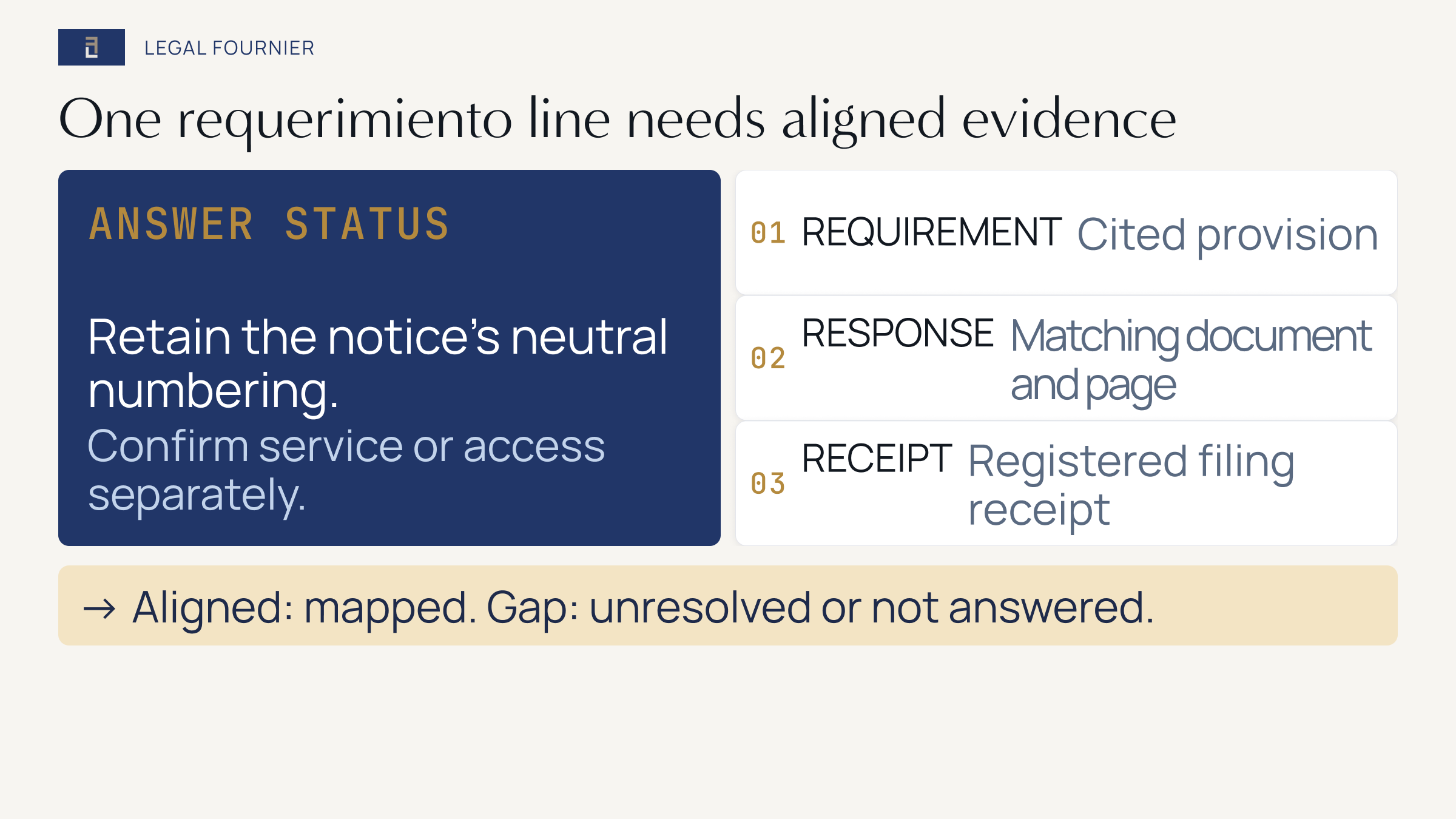
Fictional neutral example. Keep the numbering used in the notice. The concordance below maps each proposed document to an identified request and makes gaps visible before filing. Its labels and entries are illustrative and do not reproduce a real notice.
| Notice item | Neutral request label | Applicable requirement/source | Response document | Page/section | Identity/date/validity check | Translation/legalisation check | Prior-filing reference | Explanation needed | Filed receipt reference | Status |
|---|---|---|---|---|---|---|---|---|---|---|
| 1 | Identity evidence | Provision copied from notice | Document 1 | p. 1 | Checked | Check if applicable | Original receipt, item A | No | Add after filing | mapped |
| 2 | Current supporting evidence | Provision copied from notice | None yet | Not available | Pending | Pending | Check original filing | Yes | Not available | not answered |
The other permitted statuses are response explanation required and legal issue. Do not mark a row “mapped” because a likely-looking file sits in the upload folder. Check the person, date, validity, required formality, relevant page and connection to the legal requirement.
If the Administration already received the document
As a general rule, the Administration should not request information or documents that the applicable rules do not require or that were already supplied to an Administration. The applicant must identify when and where the earlier document was filed, and article 28.3 of Law 39/2015 contains exceptions where the Administration cannot retrieve it.
So “you already have it” is not a complete answer to a numbered request. Add the prior filing reference, verify that the document is the same evidence now requested, consider whether an exception applies, and respond through the channel named in the notice.
File through the route that applies, then preserve the receipt
The official Mercurio service supports electronic filing of new and renewal immigration authorisations and attachment of documents to pending immigration authorisation or card proceedings. After registration, it provides an electronic PDF receipt.
Mercurio is not automatically the right route for every notice. Its page also contains legacy procedure references. Follow the current procedure sheet and the instructions in the notice, then verify file, signature and technical requirements on the day of filing. An upload without the final registered receipt should not be treated as filed.
A cure or document request can also suspend the Administration’s separate maximum decision period from notification until compliance or expiry of the response period, under article 22.1(a) of Law 39/2015. The response deadline and the Administration’s decision clock are different calculations. Keep the response receipt so the chronology shows when the suspension entry closed.
Read the notice again before filing
Read the notice once more beside the concordance, line by line. Confirm that every item has an allowed status, that no explanation contradicts the underlying evidence, and that the filing package uses the permitted channel. Keep the complete submitted package and final receipt together.
If a line remains not answered, the service event is uncertain, or the notice raises a legal eligibility issue, resolve that point before treating the pack as complete. If the stated response period may have expired, do not rely on a generic statement about late filing.
Request a requerimiento response review if you want Legal Fournier to map the notice, identify unanswered or inconsistent evidence, and confirm the applicable filing route. Have the complete notice, service or access record, original filing, numbered proposed evidence and earlier submission receipts available. A review cannot promise an extension, acceptance of late material or a particular outcome.