
AEAT notice for a Spanish SL: documents and deadlines for foreign shareholders
A Spanish Sociedad Limitada (SL) with foreign shareholders is not unusual. The risk begins when the company receives a requerimiento AEAT asking it to prove who the shareholders are, who controls the company, whether the census data is correct, or why a transaction with a foreign shareholder has been declared in a certain way. At that point the issue is no longer generic company formation. It is evidence, deadlines and representation.
For foreign founders and family-owned groups, the practical problem is that the documents often sit in different jurisdictions: Spanish deed and tax registration in one file, passports and foreign company certificates elsewhere, powers of attorney with a notary abroad, and a shareholder chain that the Spanish accountant has never had to reconstruct. If the SL was opened quickly, the AEAT file may not match the real structure. That is why corporate setup should be linked from the beginning to company formation advice in Spain and ongoing tax control, not treated as a one time notarial act.
This article is narrower than our general guide to a notificacion AEAT. It focuses on the edge case that matters for foreign controlled companies: what the Tax Agency usually wants to see when a Spanish SL has non-resident individual or corporate shareholders, and how the response calendar should be managed before a procedural notice becomes a sanction issue.
Last updated: 28 May 2026 · Based on AEAT census guidance, Law 39/2015, the Ley General Tributaria, the Ley de Sociedades de Capital and official beneficial ownership rules.
Key takeaways for a foreign controlled SL
- Electronic notice is the default. Legal persons must receive AEAT notices electronically. If nobody opens the notice, it can still be treated as notified after 10 calendar days from being made available.
- The notice controls the deadline. Many administrative steps default to 10 days, but the exact AEAT document, model or procedure can set a different period. Read the PDF, not the email alert.
- Foreign shareholders need tax visibility. At the NIF and census stage, founder shareholders must be identified with NIF, fiscal residence and participation percentage; non-resident shareholders add proof and translation work.
- Ownership evidence is layered. AEAT may need the deed, Modelo 036 record, shareholder register, public transfer deeds, beneficial ownership evidence and foreign corporate extracts.
- Late or incomplete responses can escalate. Not attending a duly notified requirement can fall under the Ley General Tributaria rules on resistance or obstruction, with sanctions that become more serious when accounting or business documents are involved.
What kind of AEAT requirement Is this?
The first decision is procedural. Before collecting documents, identify what the AEAT is asking for and under which file. A requirement about the Modelo 036 is not the same as a corporate tax check, a request for transfer-pricing documentation, a notification about the company’s NIF, or a proposed sanction for not answering a previous notice.
The AEAT’s own help page for answering requirements tells taxpayers to check the content of the requirement first because the notice may specify a particular route for answering, filing allegations or attaching supporting documents. It may refer to the general CSV route, a specific model, or a procedure-specific option inside the electronic office.
For a foreign controlled SL, we usually separate AEAT requirements into five practical categories:
- Census and NIF requirements. These usually ask for proof of the company’s formation, definitive NIF, representative, fiscal address, shareholders, or corrections to the original Modelo 036 record.
- Shareholder identity requirements. These focus on foreign individuals or foreign companies that appear as shareholders, beneficial owners or related parties.
- Corporate tax or VAT review. These are less about who incorporated the SL and more about whether the activity, invoices, deductions or returns match the tax file.
- Linked-party or transfer-pricing requests. These arise where the SL has loans, services, royalties, asset transfers or other transactions with shareholders, administrators or foreign group companies.
- Sanction or appeal-stage notices. These often follow a missed filing, incomplete answer, incorrect census statement or failure to attend a prior requirement.
The question is not only “what documents do we have?”. The better question is “which fact does the AEAT need each document to prove?”.
Why foreign shareholders create a heavier evidence burden
A Spanish SL does not stop being Spanish because its shareholders are foreign. Under the Corporate Income Tax Law, entities incorporated under Spanish law, domiciled in Spain or effectively managed from Spain can be tax resident in Spain. The shareholder’s nationality is a separate question.
What changes is the evidence. The AEAT census guidance for legal entities states that the NIF request through Modelo 036 includes identifying data, fiscal and social address, date of incorporation, representatives and the list of founding shareholders. It also states that founding shareholders of an entity incorporated in Spain must have their own NIF, whether Spanish, EU or non-EU, and that non-resident shareholders must have their tax residence and any Spanish fiscal representative identified where applicable.
This is where many foreign controlled SLs become fragile. The notarial deed may have been accepted, but the tax file may still lack a clean NIF trail for a non-resident founder, a foreign corporate shareholder, or a later transfer of participations. If the company still has a provisional NIF, the risk is higher: AEAT guidance gives the provisional NIF a six-month validity period and requires the definitive NIF to be requested within one month from registration or execution of the relevant public deed and statutes. Failure to regularize can lead to revocation of the assigned NIF.
The documents AEAT usually expects
There is no universal document pack because the requirement may relate to incorporation, census data, a later share transfer, beneficial ownership, or a specific tax return. The practical pack below is the one we build when a foreign controlled SL receives a requirement and the exact scope still needs to be narrowed.
| AEAT question | Documents to prepare | Risk point |
|---|---|---|
| Does the company legally exist? | Deed of incorporation, bylaws, Registro Mercantil registration certificate, provisional or definitive NIF card, Modelo 036 filings. | A valid deed is not enough if the census file was never updated after registration. |
| Who represents the SL? | Administrator appointment, powers of attorney, representative certificate, NIF/NIE of the signatory, digital certificate or AEAT apoderamiento. | A response can fail procedurally if filed by someone who cannot prove authority. |
| Who are the foreign shareholders? | Passports or IDs, Spanish NIF/NIE or NIF M where applicable, tax residence evidence, participation percentages, contact and notification data. | Foreign identity documents do not automatically solve the Spanish tax identification requirement. |
| Is a shareholder a foreign company? | Foreign registry extract, certificate of incumbency or good standing, bylaws, directors, tax ID abroad, Spanish NIF for the foreign entity if required, apostille/legalization and translation. | The AEAT needs to understand the foreign entity’s legal existence and representative authority, not just its commercial name. |
| Who owns or controls the SL? | Libro registro de socios, public deeds for transfers of participations, group chart, beneficial ownership declaration or acta de titularidad real. | The founding deed may be outdated if participations were transferred later. |
| Are there transactions with shareholders? | Loan agreements, service contracts, invoices, dividend minutes, withholding records, transfer-pricing support and valuation evidence. | Under Article 18 LIS, shareholder, administrator and group transactions can require market-value support where the statutory linked-party threshold or rule applies; administrator remuneration for the exercise of office has its own exclusion. |
Corporate records: deed, registry and shareholder book
The Ley de Sociedades de Capital requires capital companies to be incorporated by public deed and registered in the Mercantile Registry. For an SL, it also requires a Libro registro de socios showing original ownership, later transfers, rights and encumbrances over participations. The company only treats as shareholder the person recorded in that book. Transfers of SL participations must also be documented in a public document.
That matters because AEAT may be looking at the founding deed while the real ownership has changed. A foreign investor may have entered later, a parent company may have acquired participations, or a founder may have transferred shares to a holding company abroad. If the requirement asks about current shareholders, the answer should not stop at incorporation documents.
Foreign documents: translation and legalization
AEAT guidance on NIF documentation for foreign legal entities is clear on formality. Documents issued outside Spain should be translated into Spanish, or another official language in Spain, and their authenticity should be evidenced through diplomatic legalization or Hague apostille where applicable. For a foreign corporate shareholder, this can include registry certificates, powers, board resolutions and evidence that the person signing is empowered to bind the foreign entity.
This is the point foreign founders often underestimate. The AEAT requirement may give a short response window, but a foreign registry extract, apostille and sworn translation can easily take longer than the notice period. If the documents cannot be ready on time, the response strategy should usually include a partial filing, proof of the requested document trail and a reasoned request for time, rather than silence.
Beneficial ownership: beyond the registered shareholder
Foreign shareholder structures can hide the real control point of an SL. Spanish anti-money-laundering law defines the titular real as the natural person who ultimately owns or controls, directly or indirectly, more than 25% of the capital or voting rights, or who otherwise exercises control. Spanish legal entities are required to obtain, keep and update beneficial ownership information, including the chain where ownership is indirect.
The AEAT is one of the public authorities that can access beneficial ownership information under the current framework. In practice, a foreign controlled SL should be able to produce a clear chart from the Spanish company up to the natural persons, with percentages, countries, IDs and supporting documents. A chart without evidence is a drawing; evidence without a chart is often unreadable.
Deadline rules: do not count one clock for everything
Most procedural damage in these files comes from counting the wrong clock. A foreign director reads an email alert, assumes it is merely informative, waits for the accountant, and discovers later that the legal clock ran from the electronic notice in DEHu or the AEAT electronic office.
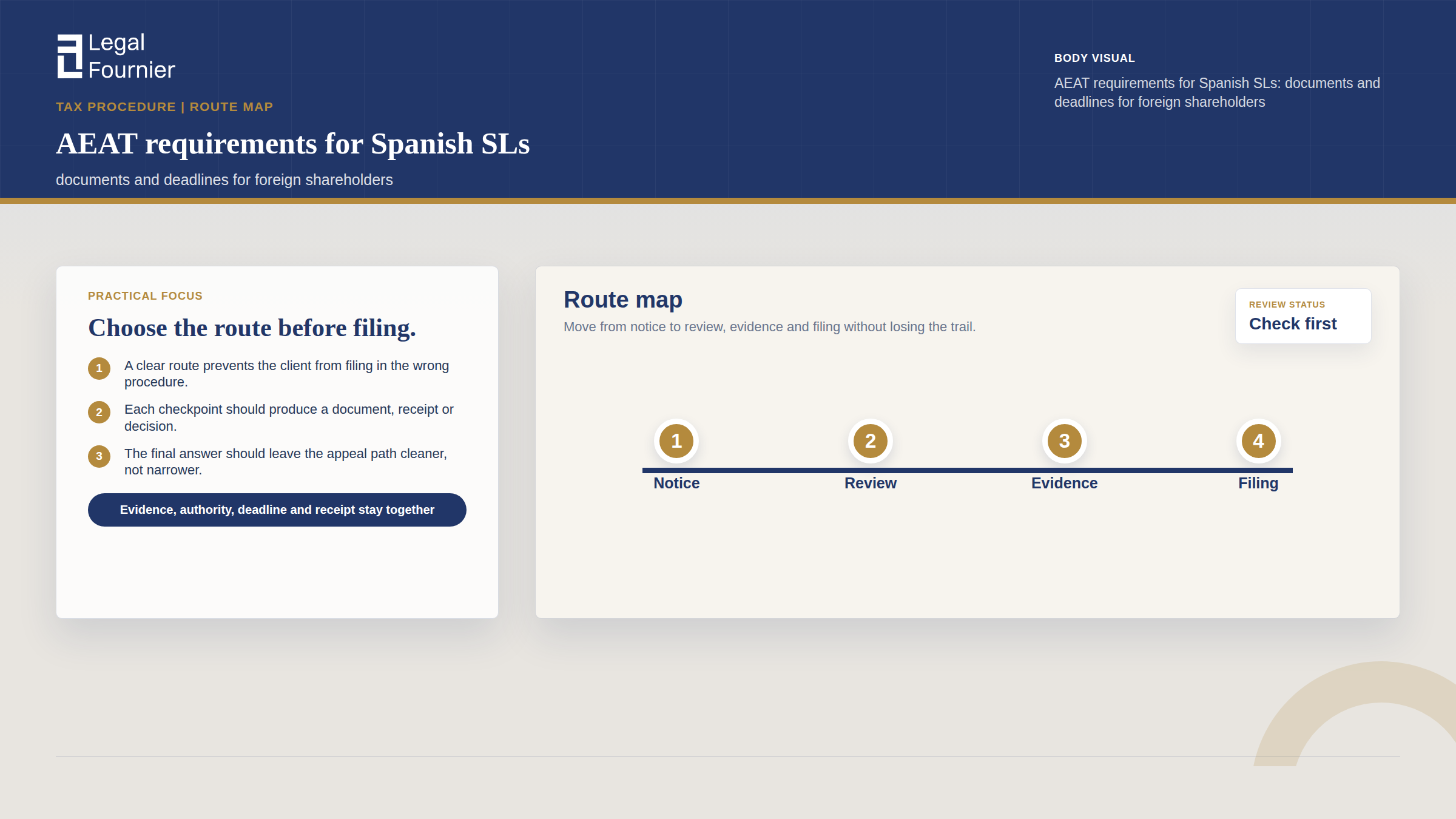
1. the electronic notification clock
AEAT confirms that legal persons are obliged to receive communications and notifications electronically. Its FAQ explains that electronic notifications are produced when the content is accessed, or, if there is no access, after 10 calendar days from being made available. Law 39/2015 follows the same rule for mandatory electronic notifications. The email alert is useful, but the legal event is the electronic notification system.
The DEHu help page also shows why remote directors should not rely on a single inbox: notices can be checked through the AEAT electronic office or DEHu, a representative certificate can be used, and up to five contact emails can be configured for alerts. Alerts help operations; they do not replace formal monitoring.
2. the response deadline in the requirement itself
Once the notice is considered received, read the PDF and count from the date stated in the act. Article 73 of Law 39/2015 sets a general 10-day period for interested parties to complete procedural steps, unless the applicable rule sets a different deadline. In a tax file, the requirement may specify a concrete number of business days or calendar days, or point to a model-specific rule.
For Modelo 036 with additional documentation, AEAT guidance states that the documents must be supplied within 10 business days from the filing of the model, excluding Sundays and public holidays. That is a different clock from the 10 calendar days for electronic notification access.
3. the NIF regularization clock
Where the issue concerns a provisional company NIF, AEAT guidance gives two practical deadlines. The provisional NIF is valid for six months from assignment. Once the company has been registered or the public deed and statutes have been executed, the definitive NIF should be requested within one month. If this was missed, the response to AEAT should not simply attach old documents; it should explain the sequence and correct the census position.
4. sanction and appeal clocks
If the document is no longer a simple requirement but a proposed sanction, settlement or final administrative act, the clock changes again. Law 39/2015 gives one month for a recurso de reposicion against an express act that ends the administrative route. Some tax appeals follow their own economic-administrative route. The safest first step is to classify the document before deciding whether the answer is evidence, allegations, appeal, payment, or a combination.
A 10-day electronic-notification rule, a 10-business-day Modelo 036 document rule and a one-month appeal rule are not interchangeable. Treating them as the same deadline is how strong cases become urgent cases.
How we structure the response
A polished response to AEAT is not a folder dump. It is a controlled filing that ties each requested fact to a document, explains any foreign-law evidence and preserves proof of submission. This is especially important for substantial families, holding structures and foreign companies where the shareholder chain is not self-explanatory.
- Secure the notice and receipt. Download the notification, annexes, acknowledgement and CSV. Record the date of availability, access and deadline.
- Classify the file. Identify whether the requirement concerns NIF, Modelo 036, shareholder identity, beneficial ownership, corporate tax, VAT, related-party transactions or a sanction stage.
- Build the evidence map. Create a table matching each AEAT request to a document and to the legal fact it proves.
- Normalize foreign documents. Check whether each foreign extract, certificate, power or ID needs apostille/legalization and sworn translation before submission.
- Explain the structure. Where ownership is indirect, include a chart and a short legal narrative. Do not expect the officer to reconstruct a foreign holding chain from annexes.
- File through the correct route. Use the route stated in the AEAT notice: CSV response, model-specific document upload, allegations or appeal procedure. Keep the electronic receipt.
This work often overlaps with the company’s first-year compliance architecture. If the SL is still operating with informal accounting, missing Modelo 036 updates or weak shareholder documentation, the response should be coordinated with the legal structure of the Spanish limited company, banking due diligence and accounting records. The point is not just to answer one notice; it is to prevent the same defect from reappearing in the next tax period.
Common mistakes in foreign-shareholder files
- Answering from the email alert. The alert is not the notice. The PDF and electronic receipt control the procedural position.
- Uploading foreign documents without formalization. A clean foreign registry extract can still be weak if it is not apostilled/legalized and translated where required.
- Confusing legal shareholder with beneficial owner. The registered shareholder may be a holding company; AEAT may need the natural person who ultimately controls the structure.
- Relying only on the incorporation deed. Later transfers of participations, capital increases or shareholder exits need their own evidence.
- Ignoring related-party transactions. Loans, management fees and service contracts with shareholders or foreign group companies can trigger Article 18 LIS analysis.
- Letting the accountant answer alone. Accounting records matter, but foreign powers, shareholder chains and beneficial ownership often need legal reconstruction.
When specialist counsel changes the outcome
Specialist review is most valuable where the AEAT requirement touches more than one jurisdiction. A Spanish accountant can usually provide tax returns and ledgers. They may not be positioned to validate a Delaware certificate, a Mexican corporate power, a UK holding chart, a Colombian family shareholder structure, or whether the Spanish deed and beneficial ownership declaration tell the same story.
Legal review is strongly advisable where the SL has a foreign corporate shareholder, a family holding company, non-resident administrators, shareholder loans, undocumented services between group companies, late NIF regularization, or an AEAT notice that already references sanctions. In those situations, the goal is not only to answer quickly. The goal is to make the answer defensible if the file later moves into review, appeal or inspection.
The premium work is forensic and preventive: classify the act, protect the deadline, reconstruct the company record, normalize foreign documents and draft a response that an AEAT officer can audit without guessing. For founders and private clients using Spain as an operating base, that work is usually cheaper than repairing a tax file after the company has already been marked as unresponsive or inconsistent.
Frequently asked questions
Does every foreign shareholder of a Spanish SL need a Spanish NIF?
At the incorporation and NIF request stage, AEAT guidance states that founding shareholders of an entity incorporated in Spain must have their own NIF, whether Spanish or foreign, and that the Modelo 036 record includes shareholder identity and participation percentage. In later cases, the requirement depends on the transaction and on what AEAT is checking. If a foreign shareholder appears in a tax-relevant operation, ownership chain or census correction, expect Spanish tax identification to become part of the evidence review.
How long do we have to answer an AEAT requirement?
Do not assume. Electronic notices to legal persons can be considered notified after 10 calendar days if not opened. After notification, the actual response period is the one stated in the document or applicable procedure. Law 39/2015 uses a general 10-day rule for many procedural steps unless another rule applies, while AEAT’s Modelo 036 documentation route uses 10 business days from filing the model. The PDF needs to be read before counting.
Can AEAT require apostilled and translated documents from foreign shareholders?
Yes, where foreign documents are being used to prove legal existence, identity, representation or ownership. AEAT guidance on NIF documentation for foreign entities states that documents issued outside Spain should be translated into Spanish or another official language in Spain and authenticated by diplomatic legalization or Hague apostille where applicable. In practice, this is often the longest part of the response.
What happens if the company misses the AEAT requirement?
The immediate effect depends on the procedure, but it is never neutral. The administration may continue with the file using the information available, treat the procedural step as lost, or initiate a sanction route. Article 203 of the Ley General Tributaria treats not attending a duly notified requirement as one possible form of resistance, obstruction or refusal to the Tax Administration, with escalating sanctions when business documents, books, invoices or tax-relevant data are involved.
Is this the same as a general notificacion AEAT?
No. A general notificacion AEAT can concern many personal or business tax matters. A requirement involving an SL with foreign shareholders usually adds corporate evidence, representation, foreign document formalities and ownership-chain questions. The response should be handled as a company file, not as a simple upload of missing tax forms.