
Modelo 303 VAT error in Spain: how a company should answer AEAT
A Modelo 303 VAT error becomes materially more serious once it is no longer just an accounting issue and has become a requerimiento or electronic notice from AEAT. For a Spanish company, especially a Sociedad Limitada (SL), the question is not simply “which box was wrong?”. The question is how to correct the VAT position without creating a second procedural problem: late response, inconsistent explanation, weak evidence, or an unnecessary admission that later supports a sanction.
This piece is narrower than our general guide to a notificacion AEAT. It focuses on the company VAT situation: a filed Modelo 303 contains an error, AEAT has asked questions or may do so, and the administrators need a controlled answer. The same issue often appears after incorporation, when the tax census, invoicing process and quarterly VAT filings have not been aligned with the real business model. That is why the response should be read together with the company’s wider Spanish company formation and compliance structure, not treated as an isolated form correction.
The correct strategy depends on timing, the period affected, the type of VAT error, whether AEAT has already notified the company, and whether the correction harms the Treasury or the taxpayer. A fast amendment can be useful. A fast but uncoordinated amendment can also make the file harder to defend.
Last updated: 30 May 2026 – Based on AEAT and BOE sources checked during preparation.
Key takeaways for company directors
- Classify before correcting. The response is different for underpaid VAT, overpaid VAT, wrong period, informative-box errors, and VAT wrongly charged to a client.
- The correction channel changed. For monthly periods from September 2024 and quarterly periods from Q3 2024, AEAT generally directs Modelo 303 corrections through the autoliquidacion rectificativa, with specific exclusions.
- A requerimiento changes the risk map. A voluntary correction before AEAT action is not the same as a correction after formal notice. Article 27 LGT is expressly built around late filing without prior administrative requirement.
- The notice controls the procedural deadline. Do not rely on generic internet deadlines. Read the exact AEAT document, the notification date, and the response channel it identifies.
- Evidence matters more than tone. The answer should include a coherent reconciliation of invoices, VAT books, Modelo 303 boxes, payments and the corrective filing, if one is made.
First: treat the notice as a procedure, not as an email
When an SL receives a VAT notice, the first error is often emotional: someone wants to “fix the form” immediately. That instinct is understandable, but it is incomplete. Once AEAT has issued a requerimiento, the company is inside a procedure. The company has to answer that procedure in the route indicated by the notice, not merely file something elsewhere and hope the file closes.
AEAT’s own technical guidance on answering notices tells taxpayers to review the content of the requerimiento, confirm that the selected route is the correct one, use the CSV shown in the notice, attach supporting files, and obtain the electronic registration receipt. That receipt is not decoration. It is the company’s proof that the response was made, when it was made, and through which channel.
The aim is not to look cooperative in the abstract. The aim is to make the company’s version easy for the AEAT officer to verify and difficult to misread.
What should be locked down immediately
- Notification date. Identify when the electronic notice was accessed or, if it was not accessed, when it was deemed notified.
- Procedure and file number. Do not answer a VAT management request as if it were a generic communication. Use the reference in the document.
- Period affected. Confirm the month or quarter. A Q3 2024 issue is not handled the same way as a Q2 2024 issue.
- Original filing evidence. Preserve the submitted Modelo 303, receipt number, NRC or payment evidence, and any direct debit record.
- VAT evidence. Export the issued and received invoice books, ledger accounts, bank support and any SII records if the company is in that system.
For a company, there is also a representation layer. AEAT’s Modelo 303 instructions state that the model is filed electronically and that entities such as sociedades anonimas and sociedades de responsabilidad limitada are obliged to use electronic certificate filing. In practice, the answer should be signed by the company through its certificate or by a properly authorised representative. A manager using the wrong credential can create a traceability problem even where the substantive VAT position is defensible.
The correction channel depends on the period
Spanish VAT is a self-assessment system. Article 120 of the Ley General Tributaria defines an autoliquidacion as a return in which the taxpayer reports the data and performs the calculations needed to determine the tax debt, refund or amount to compensate. That is why the taxpayer’s own correction mechanism matters so much: the administration is not correcting a formality; it is checking the company’s self-assessed tax position.
AEAT’s current Modelo 303 guidance divides errors by period. For monthly returns from September 2024 onward, and quarterly returns from the third quarter of 2024 onward, the ordinary correction route is the autoliquidacion rectificativa in Modelo 303, identifying the receipt number of the prior return. AEAT states that this route can be used whether the corrected result is higher, lower or equal to the earlier self-assessment.
That does not mean every VAT problem can be solved by ticking the rectifying box. AEAT identifies specific exclusions, including corrections of VAT amounts wrongly charged to other taxpayers where invoice rectification is involved. AEAT also notes that an autoliquidacion rectificativa does not allow supporting documentation to be attached and does not include a free-text allegation box. That distinction is central where the company needs to explain facts, invoices, contract timing or a legal criterion.
Periods before september or Q3 2024
For periods before September 2024 for monthly filers, or before the third quarter of 2024 for quarterly filers, AEAT’s FAQ on the rectifying Modelo 303 keeps the previous logic: errors that harmed the Treasury were normally corrected through a traditional complementary self-assessment, while errors that harmed the taxpayer required a request for rectification of the self-assessment. That older distinction still appears in live disputes because many AEAT checks in 2026 concern earlier periods.
A practical classification table
| Error profile | Typical risk | Response posture |
|---|---|---|
| Output VAT understated | Potential unpaid VAT and sanction exposure under Article 191 LGT if not regularised correctly. | Quantify, decide whether corrective filing is appropriate, and answer AEAT with the reconciliation and payment position. |
| Input VAT over-deducted | Usually a higher payable result or lower compensation. Invoice validity and business-use evidence matter. | Produce supplier invoices, payment proof, deductibility analysis and corrected boxes where needed. |
| VAT overpaid | Refund or compensation issue. The company may need explanation, not only a numerical amendment. | Use the current rectifying route where available, or rectification request where required, especially if documents must be attached. |
| Wrong period filed | AEAT can read the wrong period as a missing or incoherent return if not neutralised clearly. | AEAT’s FAQ indicates a rectifying return for the wrong period, generally zeroing it out as appropriate, followed by a new return for the correct period. |
| Informative box error only | No tax debt, but possible incorrect-return issue if the data has tax relevance. | Correct the data where the model allows it and explain why the result is unchanged. |
| VAT wrongly charged to a client | Invoice rectification and third-party effects. AEAT excludes this from the simple rectifying self-assessment route. | Coordinate invoice rectification, client position, and a formal rectification request rather than treating it as a box edit. |
What changes once AEAT has already contacted the company
The most important strategic distinction is whether the company is acting before or after formal AEAT action. Article 27 LGT governs late self-assessments filed without prior administrative requirement. It defines the surcharge regime around that absence of prior requirement. Once the company has received a formal notice directed to recognition, regularisation, checking, inspection, securing or liquidation of the tax debt, the analysis changes.
That does not mean the company should stop correcting. It means correction has to be coordinated with the answer. A rectifying Modelo 303 may still be necessary. But if AEAT has already asked for invoices, VAT books or an explanation, the company should usually file the correction and the response as a single legal narrative: what happened, which return was affected, how the corrected calculation was made, what has been paid or requested, and why any sanction should be limited or should not apply.
The relevant LGT provisions illustrate the risk map. Article 191 addresses unpaid tax that should have resulted from a correct self-assessment. Article 199 covers incomplete, inaccurate or false self-assessments where there is no economic loss, and also incorrect answers to individual information requests. Article 203 treats failure to attend a duly notified requirement as resistance, obstruction, excuse or refusal. In other words, an SL can worsen its position not only by filing the wrong VAT amount, but also by answering badly or not answering at all.
After a requerimiento, the response is not “we fixed it”. The response is a documented explanation that connects the original filing, the error, the correction mechanism and the legal position on penalties.
Build the evidence pack before you write the answer
A strong AEAT response usually looks plain. It is not a long essay. It is a controlled submission with annexes that allow the officer to verify the figures quickly. The company should avoid vague explanations such as “accounting mistake” unless the mistake is identified precisely. The better formulation is factual: which invoice, which book entry, which box, which period, which corrected amount.
Core documents for a Modelo 303 answer
- Original Modelo 303. Include the filing receipt, period, amount due or to compensate, and proof of payment or direct debit where relevant.
- Corrected calculation. Show the exact movement from original boxes to corrected boxes. Avoid presenting only final totals.
- Invoice matrix. List invoice number, date, supplier or customer, base, VAT rate, VAT amount, payment status and accounting entry.
- VAT books. Provide issued and received invoice books for the affected period, not a partial export that forces AEAT to reconstruct the file.
- Business-use support. For input VAT, include contracts, delivery evidence, bank payments or internal approvals if deductibility could be questioned.
- Corrective filing evidence. If a rectifying or complementary filing has been made, include its receipt number and payment or refund position.
Where the company is disputing AEAT’s premise, the evidence pack should be even tighter. A disagreement with AEAT is not won by tone. It is won by proving that the company’s VAT treatment follows the invoice facts, the taxable event, the applicable rate, and the deductibility rules for the business activity.
Deadlines: read the notice, then check the electronic date
For companies, electronic notification discipline is not optional. Article 14 of Law 39/2015 makes legal persons, including Spanish companies, subject to electronic interaction with public administrations. Article 43 states that electronic notifications are deemed made when the content is accessed, and that where electronic notification is mandatory, the notification is deemed rejected once ten calendar days have passed from availability without access.
AEAT’s own notifications FAQ confirms the same operational point: electronic notifications take effect on access, or after the ten-calendar-day period if the company does not access them. The practical result is uncomfortable but important. A company can be inside a deadline even if no one in the finance team has read the notice. Email alerts help, but they are not the legal notification system.
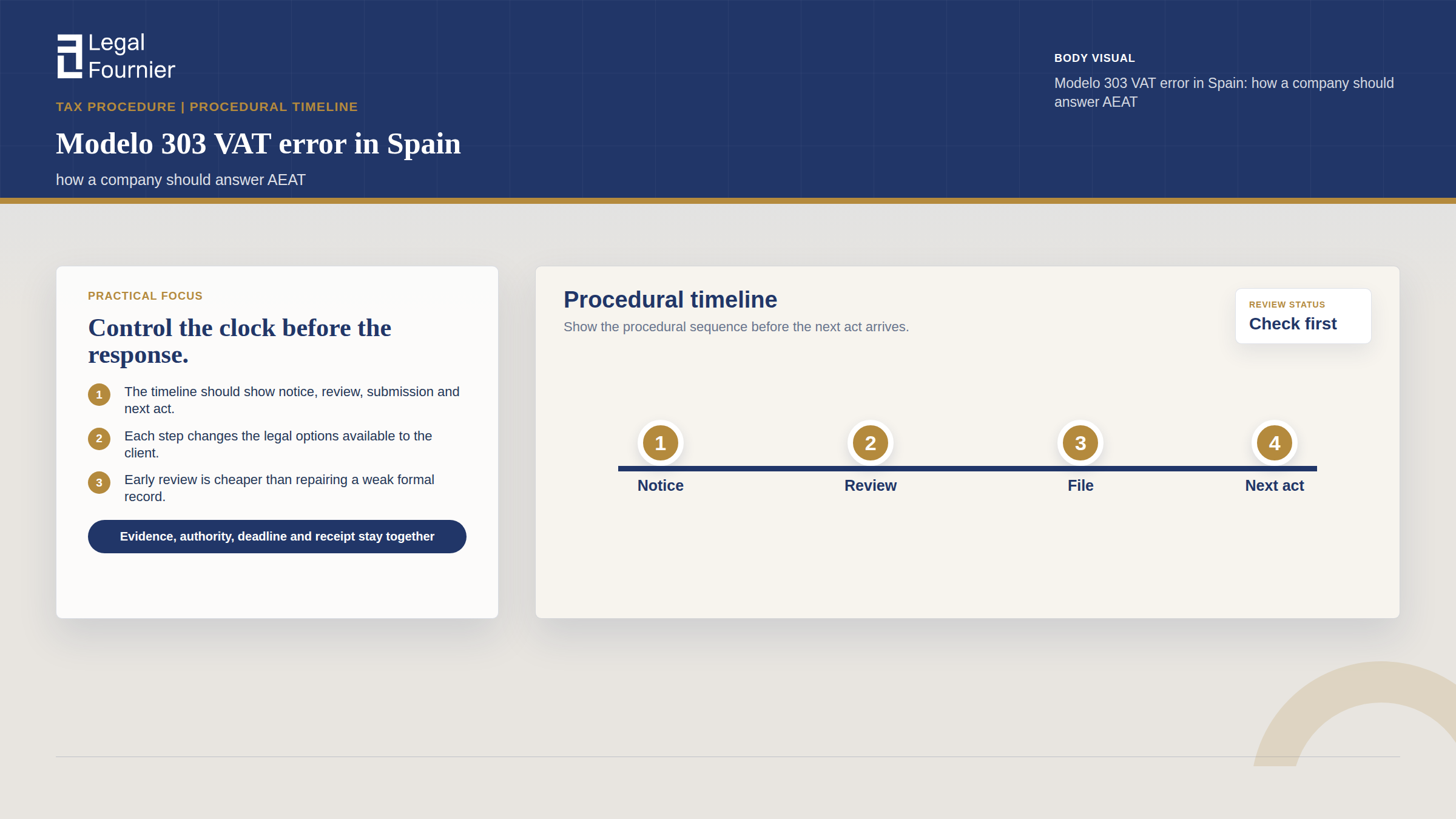
Many information requests give a response period that is at least ten days from the day after notification, but the actual document controls. If the company needs more time, Article 91 of Royal Decree 1065/2007 allows the tax authority to grant an extension for procedural deadlines, normally not exceeding half of the original period, with only one extension for the deadline and with a justified request made before the final three days of the period. This is a tool to use early, not a last-day rescue.
A controlled deadline checklist
- Confirm the notification moment. Do not calculate from the date someone forwarded the PDF internally.
- Record the last day. Use the deadline stated in the notice and verify whether the day is business or calendar under the relevant procedure.
- Decide on extension immediately. If invoice reconstruction is needed, request the extension before the final three-day boundary.
- Submit with proof. Use the response channel identified by AEAT and preserve the electronic registration receipt.
Four response strategies we use in practice
The right answer is not always the longest answer. It is the answer that matches the procedural position. In a company file, the decision usually falls into one of four patterns.
1. the company found the error before AEAT did
This is usually the cleanest scenario. The company can correct through the available route, pay or request the corrected amount, and keep a board-level memo explaining the origin of the error. If the correction produces a late amount to pay and there has been no prior AEAT requirement, Article 27 LGT becomes relevant. Even here, the company should document why the correction was voluntary and when the error was detected.
2. AEAT has asked for information, and the company agrees there is an error
This is the most common risk scenario. The company should normally prepare the corrective filing, but also answer the requerimiento with a reconciliation. The answer should not read as a casual confession. It should identify the error, explain the corrected tax treatment, attach the supporting documents, and reserve the company’s position on sanctions where there are reasonable grounds to do so.
3. aeat’s premise is wrong or incomplete
Sometimes there is no Modelo 303 error. AEAT may be comparing mismatched periods, data from third parties, a supplier invoice that was not deductible yet, a cash-accounting issue, or a return that appears inconsistent because the company’s activity changed. In that case, the company should not file a corrective return merely to close the file. It should answer with the legal and factual basis for the original filing.
4. the VAT error reveals a wider compliance defect
A single box error may be isolated. A pattern of inconsistent Modelo 303 filings is usually a system problem: weak invoice controls, late supplier documentation, poor classification of intra-Community operations, unmonitored direct debits, or an accounting process that does not match the company’s actual activity. In that situation, the AEAT answer should be accompanied by an internal correction of the company’s recurring VAT workflow. Our monthly accounting and tax compliance service is often relevant where the company needs filings to align with management decisions, contracts and immigration or shareholder planning.
Where directors should be especially careful
For a Spanish company, Modelo 303 errors are rarely just operational. They can sit at the intersection of administrator duties, tax sanctions, cash flow and company credibility. The most dangerous files are not always the largest ones; they are the ones where the company sends inconsistent signals.
- Do not ignore small notices. A small VAT difference can become a larger procedural issue if the requerimiento is not answered.
- Do not rely only on the gestor’s explanation. The company should understand the legal character of the correction, especially if AEAT has already opened a file.
- Do not create a second inconsistency. A rectifying 303, VAT books and written answer must all tell the same story.
- Do not delay extension requests. If the evidence needs reconstruction, use the procedural extension route early and justify it properly.
- Do not over-admit. Cooperating with AEAT does not require conceding every legal conclusion, especially where penalty exposure is possible.
The strongest company answers are calm, narrow and evidenced. They correct what must be corrected and defend what can properly be defended.
Frequently asked questions
Can a Spanish company correct Modelo 303 after an AEAT requerimiento?
Often yes, but the correction should be coordinated with the response to the requirement. Once AEAT has already contacted the company, filing a corrected Modelo 303 does not replace the need to answer the notified procedure unless AEAT’s document expressly says otherwise. The company should submit the corrected filing evidence, payment or refund position, and supporting reconciliation through the indicated response channel.
Should the company always file an autoliquidacion rectificativa?
No. For monthly periods from September 2024 and quarterly periods from Q3 2024, AEAT generally uses the rectifying Modelo 303 route, but there are exclusions. VAT wrongly charged to another taxpayer, for example, can require invoice rectification and a rectification request rather than a simple rectifying self-assessment. For earlier periods, the older split between complementary filing and rectification request may still matter.
How much time does the company have to answer AEAT?
The answer is in the notice. Do not rely on a generic rule without reading the document. Many tax information requests provide at least ten days from the day after notification, and extensions may be available if requested early and justified, but the specific AEAT document and procedure control the filing calendar.
What if nobody opened the electronic notification?
That can still count against the company. Under Law 39/2015 and AEAT’s notification guidance, mandatory electronic notifications are deemed notified when accessed, or after ten calendar days from availability if not accessed. For an SL, internal email failure or staff absence is usually not a reliable defence to a missed electronic notice.
Does paying the extra VAT end the sanction risk?
Not necessarily. Payment is important, but sanction analysis depends on timing, prior AEAT action, the nature of the error, culpability, evidence and the legal provision invoked. The response should address the tax difference and the penalty position separately.
Can a representative answer the requerimiento for the company?
Yes, provided representation is valid and the route allows it. AEAT’s response guidance distinguishes access by the interested party and by a representative, and company filings commonly require electronic identification. Before filing, confirm the representative’s authority and preserve the registration receipt.
Conclusion: correct the VAT, control the file
A Modelo 303 error is manageable when the company controls the sequence. The right order is to identify the notification date, classify the error, select the correct correction route, build the evidence pack, decide whether an extension is needed, and answer AEAT through the exact procedure named in the notice.
For foreign founders and internationally managed SLs, the practical risk is often governance rather than tax arithmetic. The people who sign contracts, issue invoices, manage payments and file VAT may not be looking at the same facts. AEAT will read the company as one taxpayer. The response should be prepared with that standard in mind.