Non-lucrative visa denied in Spain: appeal timing and evidence
A non-lucrative visa refusal in Spain starts a deadline and exposes an evidence problem. The applicant must choose between reconsideration, judicial review and a better-prepared new filing. Read the refusal as a procedural document. Sending more documents without answering its legal reasoning is unlikely to resolve the problem.
This guide addresses a non lucrative visa Spain denied scenario: insufficient financial means, doubtful passive income, health insurance concerns, criminal-record or medical-certificate defects, unclear residence plans, missing apostilles or translations, or a consular conclusion that the file does not prove genuine non-working residence in Spain. Legal Fournier handles contested immigration files through our appeals service, and can also review the evidence route through a focused consultation with a Spanish lawyer via our consultation route.
A denial is a written administrative act. The appeal must answer the actual legal reason for refusal, preserve the deadline, and rebuild the evidence file around the current rules. Since May 2025, the core regulatory framework for this authorization is Royal Decree 1155/2024, so older online explanations based only on the previous regulation may miss the structure now being applied.
If the refusal concerns a non-lucrative route, compare the decision with the core Spain non-lucrative visa guide before deciding whether an appeal or a corrected filing is stronger.
Published: 3 August 2026
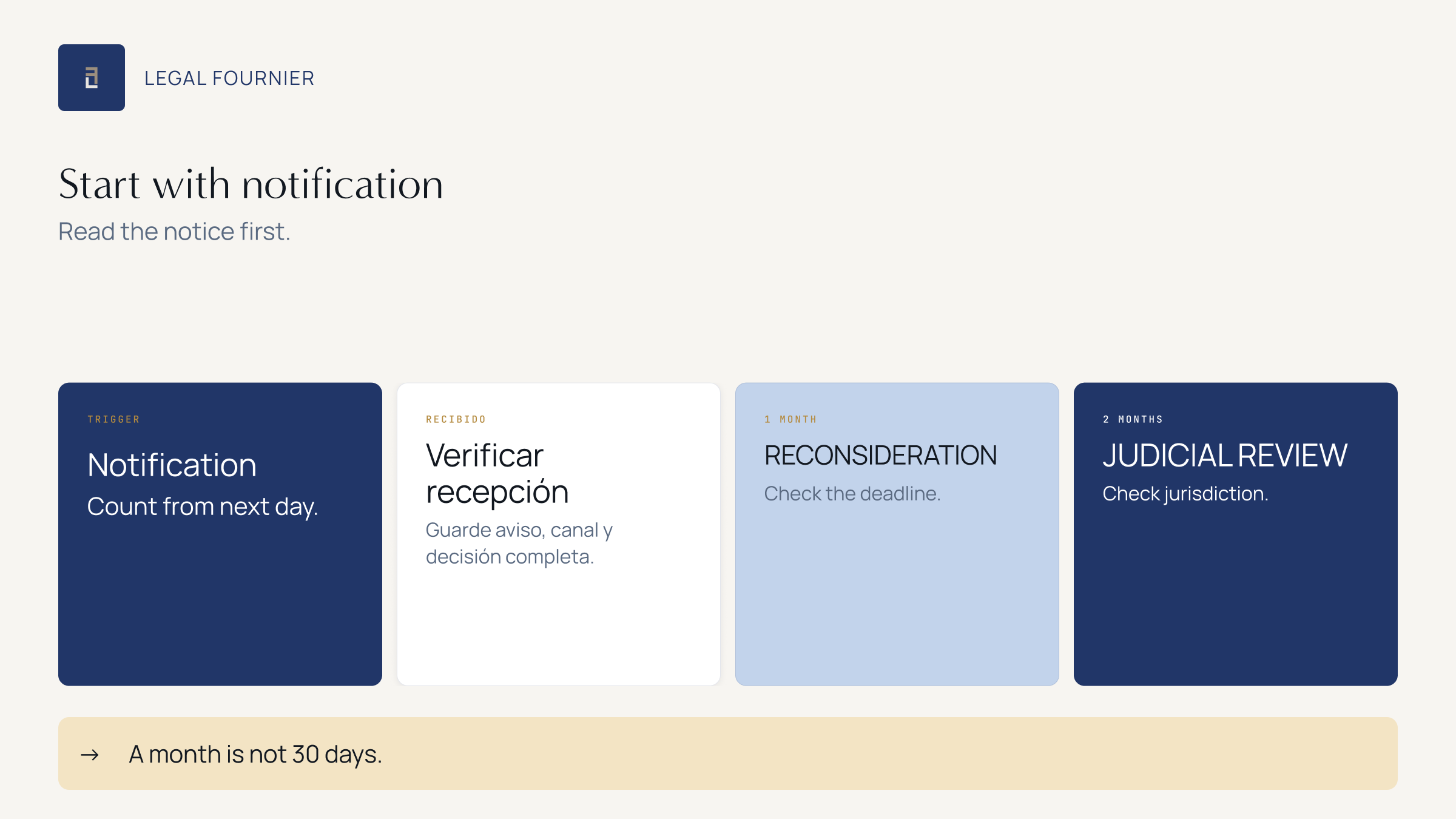
- The appeal clock normally starts from the day after notification of the refusal, not from the day the applicant first feels ready to respond.
- Official Spanish consular pages commonly describe two routes: a reconsideration appeal within one month, and judicial review before the High Court of Justice of Madrid within two months.
- Always read the denial notice first. The notice should identify the authority, the decision, the route of appeal, and the deadline applicable to that file.
- An indexed legal and evidence pack usually works better than a long personal letter or the same documents uploaded again.
- Under RD 1155/2024, non-lucrative residence turns on sufficient means, health insurance, no work or professional activity, and the general visa requirements.
- In weak files, a new application may sometimes be more practical than an appeal, but only after checking deadline, jurisdiction, consular practice, and the risk of repeating the same defect.
Start with the refusal letter, not with the checklist
Most applicants first reopen the checklist and look for a document to replace. The instinct is understandable, but it starts in the wrong place. The appeal starts with the refusal letter: who issued it, when it was notified, whether it denies the visa, the residence authorization, or both, what legal basis it cites, and what factual conclusion it reaches.
For non-lucrative residence, the file has two connected layers. Article 39 of Royal Decree 1155/2024 provides that the non-lucrative residence visa application carries with it the application for the corresponding temporary residence authorization. The consular office assesses the general visa requirements and, for this visa, the specific requirements in Article 61.2(a) and (b). The immigration office assesses certain other specific requirements. The final refusal may therefore reflect a consular concern, an immigration-office concern, or both.
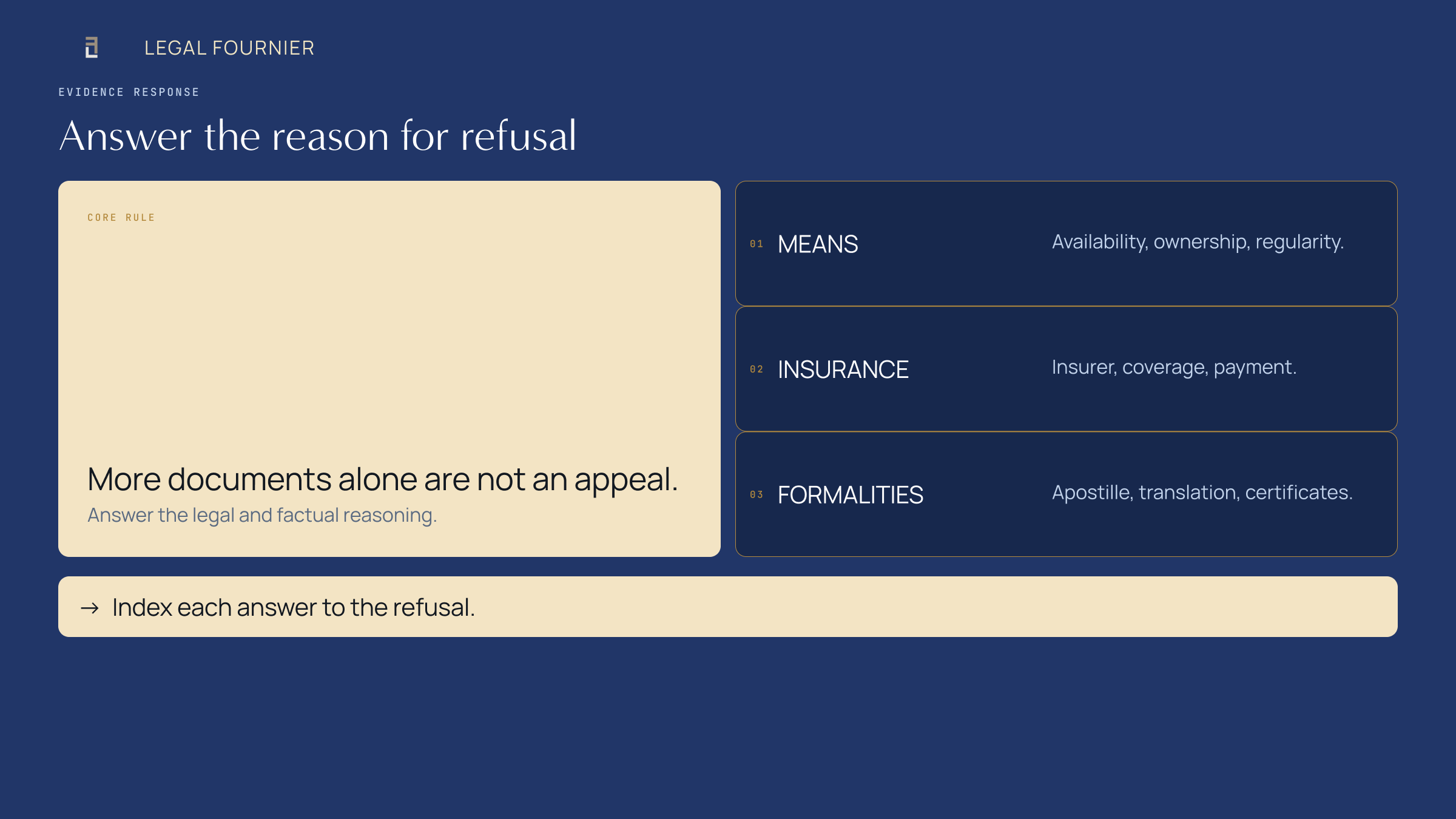
An appeal that only says “I meet the requirements” is too vague. If the refusal says the financial means are not proven, the appeal must prove availability, ownership, regularity, amount, and credibility of those means. If the refusal says the health insurance is not adequate, the appeal must prove the insurer, the policy, territorial coverage, effective dates, payment, and any exclusions that matter. If the refusal cites missing legalization or translation, the answer is documentary, not rhetorical.
A denial is not a request to tell your life story again. It is a request to identify the legal defect found by the administration and answer it with admissible, organized evidence.
The current legal framework for non-lucrative residence
For applications in 2026, the current regulation is Real Decreto 1155/2024. Its transitional rules state that applications filed before the regulation entered into force are resolved under the rules in force when they were filed, unless the applicant requests application of the new regulation and meets the relevant requirements. The regulation also repealed the previous RD 557/2011 framework, so appeal work must check the filing date and the applicable legal regime before citing old article numbers.
Article 38 of RD 1155/2024 sets out general visa requirements. For example, the applicant must submit the visa form, not be irregularly in Spain, not be listed as rejectable in relevant territories, hold a passport or travel document valid for Spain with at least one year of validity, lack criminal records in countries of residence during the previous five years for conduct criminalized under Spanish law, pay the visa fee, and provide a medical certificate showing they do not suffer from diseases with serious public-health implications under the International Health Regulations.
Article 61 defines temporary non-lucrative residence as residence in Spain without carrying out work or professional activities. It also identifies specific requirements including sufficient economic means for maintenance and residence, health insurance, not being within an applicable commitment not to return, not representing a public order, public security or public-health threat, and payment of the procedure fee. The medical-certificate requirement sits in Article 38. Article 62 then explains the economic means test: 400% of IPREM for the applicant and an additional 100% of IPREM for each dependent family member, referred to the moment of the visa application or renewal. Because IPREM can change, appeals should calculate the threshold by reference to the amount in force on the relevant filing date.
Meeting the legal threshold is only the start. A consulate may examine whether funds are genuinely available, whether periodic income is reliable, whether the money belongs to the applicant, whether the evidence is recent, whether family members are correctly counted, and whether the applicant’s profile contradicts the promise not to work in Spain. A high bank balance can still fail if it is unexplained, temporary, borrowed, inaccessible, or inconsistent with the rest of the file.
Appeal timing: one month, two months, and the notice
Spanish consular pages for non-working residence visas usually state that, if a residence permit or visa is refused, the applicant may submit an appeal for reconsideration to the office that denied the request within one month from the day after notification. They also state that judicial review may be filed with the High Court of Justice of Madrid within two months from the day after notification of the refusal, or from dismissal of the reconsideration appeal.
Those consular statements sit against the general administrative and judicial rules. Law 39/2015 regulates administrative appeals. Article 124 provides that a recurso potestativo de reposicion must be filed within one month when the act is express, and that the maximum period to decide and notify that appeal is one month. Article 30 explains how administrative time limits are counted: when a period is set in months, it is counted from the day after notification or publication, and if the final day is non-working, the deadline extends to the next working day.
Law 29/1998, which governs contentious-administrative judicial review, sets the general two-month period for judicial review of an express administrative act. It also states that, where a reconsideration appeal has been filed first, the judicial-review period is counted from the day after express notification of that appeal’s resolution or from the day it should be deemed dismissed.
For the applicant, this produces three practical rules. First, keep proof of the notification date: email, electronic notice, consular letter, courier receipt, appointment record, or any other delivery evidence. Second, do not assume that “one month” means 30 calendar days. Month-based deadlines have their own counting rules. Third, do not file a superficial reconsideration appeal just to buy time if the case is really headed to court; a weak administrative appeal may damage the narrative and still leave the same evidence gaps.
Why non-lucrative visa applications are denied
Every file is individual, but most denials fall into a limited set of evidence categories. The legal requirements are not abstract. They have to be proven with documents that are current, properly legalized or apostilled where required, translated where required, and consistent with the applicant’s real life.
1. financial means are not credible enough
The non-lucrative visa is built for residence without work or professional activity in Spain. The appeal must therefore prove both amount and character of the funds. The applicant may need to show savings, pensions, dividends, rental income, investment income, company distributions, annuities, or other passive resources. If the file relies on employment income, remote work, active business services, or a promise to continue working while living in Spain, the evidence may contradict the nature of the authorization.
A strong appeal does more than attach a bank statement. It explains the source of the funds, the account holder, currency conversion, average balance, regularity of income, liquidity, restrictions on withdrawal, and whether family members are covered. For high-net-worth applicants, a wealth summary may help, but it should not replace transaction-specific proof. If money moved into the account shortly before filing, the appeal should explain where it came from and why it is genuinely available for residence in Spain.
2. health insurance does not match the requirement
Article 61 requires health insurance. Article 38 also includes the medical-certificate requirement. In practice, refusals can arise where the policy is not clearly valid in Spain, the insurer is not adequately identified, the coverage period does not match the intended residence period, proof of payment is missing, exclusions are unclear, or the policy document is not translated or formalized as requested by the consulate.
The appeal should include the policy certificate, general and special conditions where needed, insurer details, coverage dates, proof of payment, and a concise explanation of why the coverage satisfies the Spanish requirement. If the denial specifically refers to co-payments, waiting periods, territorial scope, repatriation language, or public/private coverage, the appeal must answer that exact point.
3. the criminal-record or medical evidence is defective
Article 38 requires lack of criminal records in the countries where the adult applicant has resided during the previous five years, for offences that exist under Spanish law. Official consular pages also regularly require legalization or apostille for foreign documents and official translation into Spanish where applicable. A denial may therefore come from the wrong country, wrong date range, missing apostille, non-accepted background-check format, uncertified translation, or mismatch between residence history and police certificates.
These defects are often fixable, but timing matters. If the appeal deadline is short and a new police certificate or apostille will take weeks, counsel may need to decide whether to file with evidence of the request, seek to supplement later where possible, or prepare a new application. The answer depends on the refusal wording and the consulate’s practice.
4. the residence plan looks inconsistent
A non-lucrative residence file should show a coherent plan to live in Spain without working. Problems arise when the applicant appears to be moving for remote work, continuing to manage a foreign company day to day, relying on active consultancy income, lacking a real Spanish address, applying with a family unit that is not well documented, or giving inconsistent answers at interview.
Drafting matters here. The appeal should not exaggerate or invent a lifestyle. It should describe the applicant’s real economic position in a way that fits the authorization: passive resources, retirement, investment income, family relocation, children’s schooling, private health coverage, Spanish housing plan, and any separation between ownership of assets and active work. For founders, executives, and investors, the file may need careful wording to distinguish shareholder income or governance from work or professional activity performed from Spain.
What counsel tests before recommending appeal or reapplication
The first question is whether the refusal rests on a correctable evidential gap, a legal disagreement, a credibility finding or facts that have changed since filing. That distinction affects both the available remedy and the evidence that can properly be used.
Counsel should compare the refusal notice with the original file, notification date and current circumstances. Financial means, insurance, foreign documents, residence plans and family calculations are reviewed for consistency. The resulting advice may favour an administrative appeal, judicial review or a new application, but the article cannot choose between them without the full record.
Appeal or reapply?
Not every denial deserves the same response. Reconsideration can work where the refusal is based on a misunderstanding, an overlooked document, a correctable formality, or a legal conclusion that can be challenged with a tighter explanation. A new application may be more efficient where the original file was incomplete, the applicant’s financial profile has materially changed, or the missing document could not realistically be obtained within the appeal window.
| Situation | Appeal may fit when… | New filing may fit when… |
|---|---|---|
| Financial means | The funds existed but were poorly explained or overlooked. | The applicant did not meet the threshold or relied on active work income. |
| Insurance | The policy was valid but the document was incomplete or unclear. | The policy genuinely did not cover the required Spanish residence period. |
| Formal documents | Apostille, translation, or certificate corrections can be produced quickly. | Several core documents are missing and the file needs to be rebuilt. |
| Work-activity concern | The conclusion is wrong and passive-income evidence can prove it. | The applicant’s real plan is remote work or active business from Spain. |
Speed alone should not decide the route. An appeal creates a record. A poorly drafted appeal may confirm the administration’s concern. A new filing without understanding the denial may repeat the same defect and waste months. In complex family, wealth, or founder cases, the file may justify both: preserving the appeal deadline while preparing the next evidentiary route if the appeal is dismissed.
Special risk cases for wealthy families, founders, and cross-border applicants
A retiree with a pension and clean documents may have a mainly technical appeal. Founders, shareholders, wealthy families and internationally mobile applicants often present a different risk. The applicant may have enough money, but the file may not prove the right kind of money for a non-lucrative route.
Common examples include a founder who still owns and manages a company abroad, a family whose assets are held through trusts or holding companies, a spouse whose income supports the whole family but is not clearly available to the applicant, a recent property sale with funds moving through several jurisdictions, crypto-derived wealth converted into bank deposits, or a rental-income portfolio without clean tax and title evidence. These are not automatically fatal. They require a better evidence map.
The non-lucrative route also interacts with tax and residence planning. A successful visa is not the same as a complete tax strategy. Spending substantial time in Spain may trigger Spanish tax residence questions, foreign-asset reporting, wealth-tax exposure, inheritance planning, and banking evidence questions. The appeal should not casually describe facts that create unplanned tax consequences. For clients with property, family wealth, company ownership, or international income, immigration evidence and tax evidence should be aligned before the file is sent.
When the deadline makes review urgent
Urgency starts with the date and method of notification, not the date the applicant happens to read the decision. Preserve the refusal notice, notification record and complete application file, then obtain advice before a live appeal period is allowed to expire.
If there is no immediate deadline, review still matters where the refusal affects family travel, a property or relocation commitment, or a future residence application. See the underlying Non-Lucrative Visa requirements. Legal Fournier handles disputes through its appeals service; a paid consultation is the starting point for a case-specific recommendation.
FAQ: non-lucrative visa denied in Spain
Can I appeal a denied non-lucrative visa in Spain?
Usually yes. Official Spanish consular pages commonly refer to a reconsideration appeal to the office that denied the request and a judicial-review route before the High Court of Justice of Madrid. The exact route and deadline should be confirmed from the denial notice and the facts of the file.
How long do I have to appeal?
Consular guidance commonly states one month for reconsideration and two months for judicial review, counted from the day after notification. Month-based Spanish deadlines must be calculated carefully under Law 39/2015 and the applicable judicial-review rules.
Can I add new evidence in the appeal?
Often the appeal includes corrected, clarified, or additional evidence, but it should be tied directly to the refusal reason. The safest approach is to explain whether the evidence proves a fact that already existed at filing, corrects a formal defect, or responds to a misunderstanding in the denial.
Is it better to appeal or apply again?
It depends on the defect. If the denial is based on a misread file or a fixable document issue, appeal may be appropriate. If the original application genuinely failed the economic, insurance, or non-work requirements, rebuilding and refiling may be more practical. The decision should be made before the appeal deadline expires.
Does a high bank balance guarantee approval?
No. The file must usually prove sufficient amount, availability, ownership, source, continuity, and compatibility with non-lucrative residence. A sudden or unexplained balance can create questions instead of solving them.
Legal Fournier support for visa appeals
Legal Fournier helps foreign applicants, families, investors, founders, and high-net-worth clients review refused Spanish immigration files and prepare appeal strategies. In a non-lucrative visa denial, our work usually starts with the refusal notice, the full original submission, the evidence trail, and a deadline calculation. From there, we assess whether the stronger route is reconsideration, judicial review, a new filing, or a combined preservation strategy.
If your non-lucrative visa has been denied in Spain, do not wait until the last week of the deadline to assemble documents from banks, insurers, foreign registries, translators, and apostille offices. Use our appeals service for contested immigration matters, or speak with a Spanish lawyer through our consultation route if you need a focused assessment before deciding whether to appeal or reapply.